Within Internet Prophecies
Can a Prophecy Website Preserve Its Own Failure?
Predictor-controlled websites can preserve claims, revise them or hide earlier deadlines, making the record of failure difficult to reconstruct.
On this page
- Why websites seem like permanent records
- How edits and removals obscure old promises
- The role of independent web archives
Page outline Jump by section
Introduction
Websites appear to offer a permanent record of UFO prophecies. A prediction is published with a date, remains online, and can seemingly be checked once the deadline passes. In practice, the record is much less stable. The same website that publishes a prophecy usually remains under the control of the person or group that made it, allowing pages to be edited, deleted, relocated or reframed after the prediction fails. As a result, reconstructing what was originally promised often depends less on the prophecy website itself than on independent copies preserved elsewhere. This distinction is especially important when studying failed UFO predictions: the evidence is strongest when dated claims can be verified against archived snapshots rather than relying on later recollections or revised webpages.[Internet Archive Help Center]archivesupport.zendesk.comInternet Archive Help CenterUsing The Wayback Machine – Internet Archive Help CenterJanuary 13, 2021…
Why websites seem like permanent records
The web gives an impression of permanence because search engines continue to index pages, domain names can remain active for years and old posts often stay accessible long after publication. For followers of internet-based UFO prophecies, this can create the impression that every prediction remains available for public scrutiny.
In reality, a live website is not a historical archive. Most content management systems allow authors to replace text without leaving visible revision histories. Deadlines can disappear, wording can soften, or explanatory material can be inserted after an event has passed. Unless the site explicitly publishes version histories, readers usually cannot tell whether they are viewing the original prediction or a later revision. Digital preservation researchers describe this as a fundamental property of the web: online resources are continually changing, while older representations often vanish unless they have been archived independently.[arXiv]arxiv.orgarXiv Memento: Time Travel for the WebarXiv Memento: Time Travel for the Web
For researchers examining failed UFO prophecies, the practical consequence is straightforward. A prophecy page that still exists today cannot automatically be treated as evidence of what readers actually saw before the predicted date.
How edits and removals obscure old promises
When a public prediction fails, website owners have several options that alter the historical record without necessarily drawing attention to the changes.
Common patterns include:
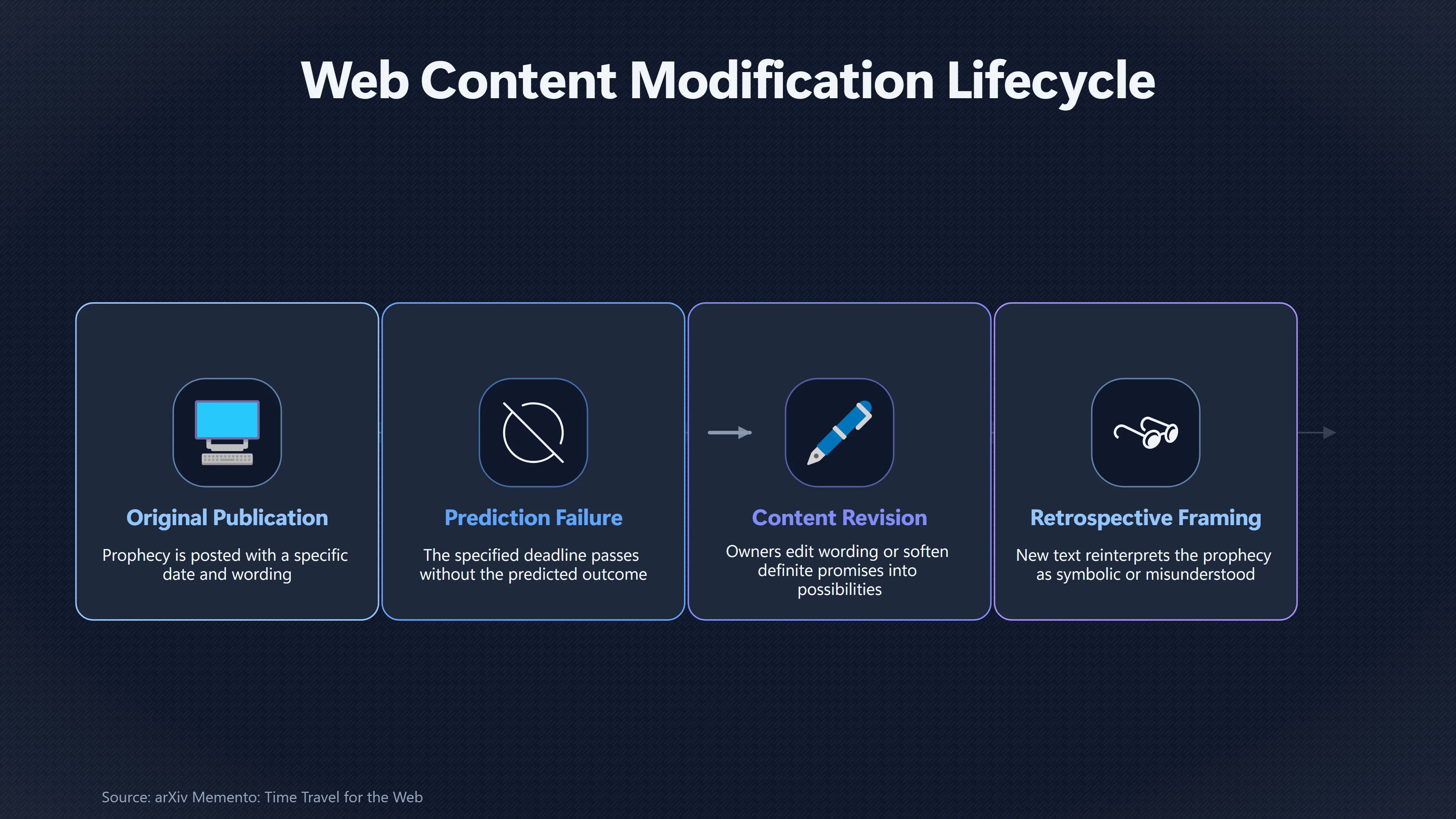
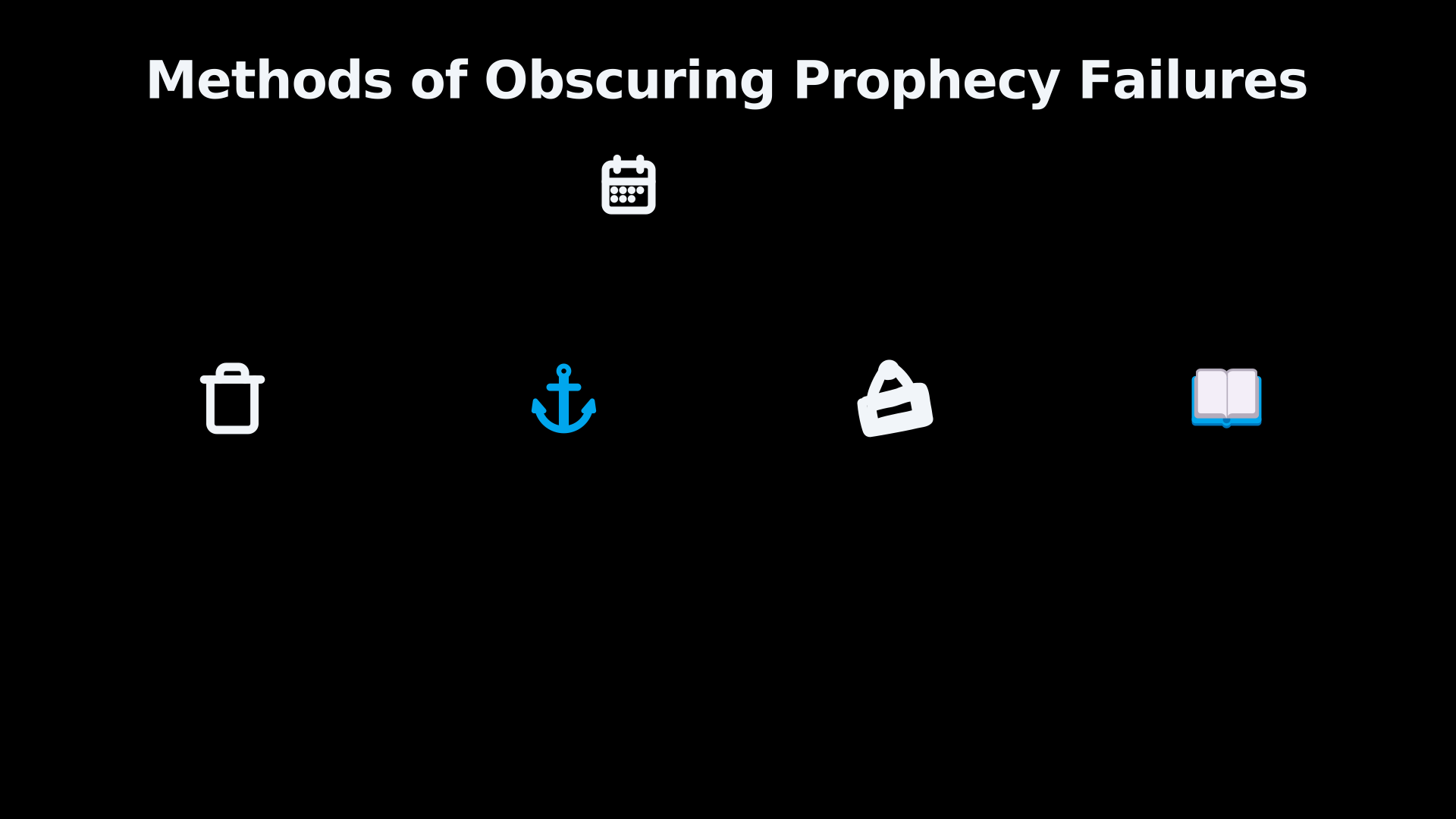
- Editing the original wording. Specific dates may become broader timeframes, or definite promises may be rewritten as possibilities.
- Deleting failed predictions. Entire pages may disappear, leaving only later summaries that omit unsuccessful forecasts.
- Moving material to new URLs. Site redesigns or reorganisations can break links that critics previously cited.
- Adding retrospective explanations. New text may reinterpret the original prophecy as symbolic, misunderstood or only partially fulfilled without clearly separating the new interpretation from the original publication.
- Allowing domain expiry. When websites disappear entirely, only external copies may preserve what was originally claimed.
These practices do not necessarily imply deliberate deception. Websites are frequently redesigned, hosting providers change, software is upgraded and domains lapse for routine reasons. However, regardless of motive, the effect is the same: later readers may struggle to establish exactly what prediction existed before the deadline expired.
This instability has particular significance for UFO prophecy movements because failed predictions often become turning points. If the original wording is difficult to recover, discussions about whether the prophecy “really” failed can become arguments over competing memories instead of documentary evidence.
The role of independent web archives
Independent web archives provide a partial solution because they capture snapshots outside the control of the original publisher. Services such as the Internet Archive’s Wayback Machine preserve dated versions of publicly accessible webpages, allowing readers to compare what appeared before and after a prediction failed. The archive records when a snapshot was captured rather than relying on the website owner’s later presentation of events.[Internet Archive Help Center]archivesupport.zendesk.comInternet Archive Help CenterUsing The Wayback Machine – Internet Archive Help CenterJanuary 13, 2021…
This independence makes archived copies valuable for several reasons:
- They establish whether a prediction actually appeared before the claimed event.
- They allow comparisons between earlier and later versions of the same page.
- They preserve pages that have since been deleted.
- They reduce reliance on screenshots or quotations that can be selectively presented.
For studies of internet UFO prophecies, archived snapshots frequently become the primary evidence used to verify exactly what was promised and when.
Why independent archives are still imperfect
Web archives improve transparency but are not flawless historical records.
Most archives capture websites intermittently rather than continuously. A page may change several times between snapshots, leaving important edits undocumented. Dynamic websites that rely heavily on JavaScript, databases or embedded content may archive incompletely, with missing images, broken navigation or absent interactive elements. Some websites also prevent or limit automated crawling, reducing archival coverage.[Internet Archive Help Center]archivesupport.zendesk.comInternet Archive Help CenterUsing The Wayback Machine – Internet Archive Help CenterJanuary 13, 2021…
Researchers have also shown that the archived web is itself subject to technical limitations. Archived resources may become difficult to locate after infrastructure changes, and replayed pages do not always reproduce every element exactly as originally displayed. These issues do not eliminate the value of web archives, but they mean archived pages should be interpreted as preserved snapshots rather than perfect replicas of the live web.[arXiv]arxiv.orgarXiv Where Did the Web Archive Go?Where Did the Web Archive Go?August 12, 2021…
For this reason, the strongest historical reconstructions usually combine multiple forms of evidence, including archived webpages, dated forum discussions, contemporary news coverage and preserved mailing-list posts.
Can a prophecy website preserve its own failure?
A prophecy website can preserve its own failed prediction only if its operators choose not to alter or remove it. In practice, that makes the website both the source of the original claim and the party with the greatest ability to reshape how that claim is remembered.
For historians of internet UFO movements, the most reliable record therefore comes from comparing the live site with independent archival evidence. When multiple archived captures confirm that a dated prediction existed before the deadline and later versions differ, researchers can reconstruct how expectations changed after the prophecy failed. When no independent copies exist, certainty declines because the surviving record remains dependent on the publisher’s own presentation of events.
This is why unstable archives have become a recurring issue in documenting failed UFO predictions. The internet leaves many traces, but only independently preserved, date-stamped copies consistently allow readers to distinguish between what was originally promised and what was later remembered.
Amazon book picks
Further Reading
Books and field guides related to Can a Prophecy Website Preserve Its Own Failure?. Use these as the next step if you want deeper reading beyond the article.
When Prophecy Fails
The study reported in this volume grew out of some theoretical work, one phase of which bore specifically on the behavior of individuals...
The Demon-Haunted World
Rating: 4.5/5 from 43 Google Books ratings
NEW YORK TIMES BESTSELLER • From the renowned astronomer and author of Cosmos comes a “powerful [and] stirring defense of informed ration...
The Demon-Haunted World: Science as a Candle in the Dark
Rating: 4.5/5 from 43 Google Books ratings
NEW YORK TIMES BESTSELLER • From the renowned astronomer and author of Cosmos comes a “powerful [and] stirring defense of informed ration...
The Web as History
The World Wide Web has now been in use for more than 20 years. From early browsers to today's principal source of information, entertainm...
eBay marketplace picks
Marketplace Samples
Live-tested eBay searches with available results related to this page.
Selected fromUFO poster oneBay.co.uk.

Current eBay listing
I Want To Believe UFO Poster Giclée Fine Art Heavyweight Print

Current eBay listing
VINTAGE UFO FLYING SAUCERS COMIC ADVERTISING A2 POSTER PRINT


Endnotes
1.
Source: arxiv.org
Title: arXiv Memento: Time Travel for the Web
Link:https://arxiv.org/abs/0911.1112
2.
Source: arxiv.org
Title: arXiv The Ephemeral Web and the Case for Proactive Archiving
Link:https://arxiv.org/abs/2605.21517
3.
Source: arxiv.org
Title: arXiv Where Did the Web Archive Go?
Link:https://arxiv.org/abs/2108.05939
Source snippet
Where Did the Web Archive Go?August 12, 2021...
Published: August 12, 2021
4.
Source: wayback-machine.live
Link:https://www.wayback-machine.live/
5.
Source: archivesupport.zendesk.com
Link:https://archivesupport.zendesk.com/hc/en-us/articles/360004651732-Using-The-Wayback-Machine
Source snippet
Internet Archive Help CenterUsing The Wayback Machine – Internet Archive Help CenterJanuary 13, 2021...
Published: January 13, 2021
6.
Source: archivesupport.zendesk.com
Title: 360018359991 Search A Basic Guide
Link:https://archivesupport.zendesk.com/hc/en-us/articles/360018359991-Search-A-Basic-Guide
Additional References
7.
Source: pmc.ncbi.nlm.nih.gov
Link:https://pmc.ncbi.nlm.nih.gov/articles/PMC10256179/
Source snippet
PubMed Central (PMC)Hashes are not suitable to verify fixity of the public archived web - PMC...
8.
Source: support.archive-it.org
Title: 208333963 About Wayback URLs and messages
Link:https://support.archive-it.org/hc/en-us/articles/208333963-About-Wayback-URLs-and-messages
Source snippet
Wayback URLs and messages – Archive-It Help CenterJuly 17, 2026 — ABOUT WAYBACK URLS AND MESSAGES Image: Avatar Tanya Ulmer Updated July...
Published: July 17, 2026
9.
Source: youtube.com
Link:https://www.youtube.com/watch?v=H6fLsJHGt0Y
Source snippet
Saving the Web: Ethics & Challenges of Preserving the Internet...
10.
Source: waybackmachine.bar
Title: It lets you view, search
Link:https://waybackmachine.bar/
Source snippet
Wayback Machine: How to View, Search, and Save Archived Web PagesJuly 1, 2026 — WAYBACK MACHINE: HOW TO VIEW, SEARCH, AND SAVE ARCHIVED W...
Published: July 1, 2026
11.
Source: link.springer.com
Link:https://link.springer.com/article/10.1007/s00799-023-00391-0
Source snippet
the untapped functional potential of Memento aggregators beyond aggregation | International Journal on Digital Libraries | Springer Natur...
12.
Source: olavarria.work
Link:https://olavarria.work/tools/wayback-lookup/
13.
Source: waybackmachine.org.im
Link:https://www.waybackmachine.org.im/
14.
Source: doc-tools.readthedocs.io
Link:https://doc-tools.readthedocs.io/en/ia-test-gsod/wayback_machine.html
15.
Source: waybackm.created.app
Link:https://waybackm.created.app/
16.
Source: mementoweb.org
Link:https://mementoweb.org/guide/howto/