Within False Corroboration
When Debunking Gives a UFO Claim More Reach
Replies, quote-posts and skeptical coverage can introduce a false UFO forecast to new audiences even while attempting to challenge it.
On this page
- How corrective attention expands exposure
- When repetition inside a rebuttal backfires
- Safer ways to report unsupported predictions
Page outline Jump by section
Introduction
Failed UFO predictions rarely disappear the moment they are disproved. Instead, the act of debunking can unintentionally introduce the original claim to people who would never otherwise have encountered it. Replies, quote-posts, sceptical articles and reaction videos may all increase the visibility of an unsupported forecast, even while explaining why it lacks evidence.
This creates an important distinction. A debunk may expand awareness of a UFO prediction without increasing belief in it. Modern research on misinformation generally finds that well-designed corrections reduce false beliefs rather than strengthening them, but those corrections still expose new audiences to the underlying claim. Within the broader pattern of online repetition that can make UFO predictions appear independently corroborated, this means corrective attention can become another stage in the circulation of the story rather than the end of it.[nih.gov]pmc.ncbi.nlm.nih.govPubMed Central (PMC)Can corrections spread misinformation to new audiences? Testing for the elusive familiarity backfire effect - PMCAugu…
How corrective attention expands exposure
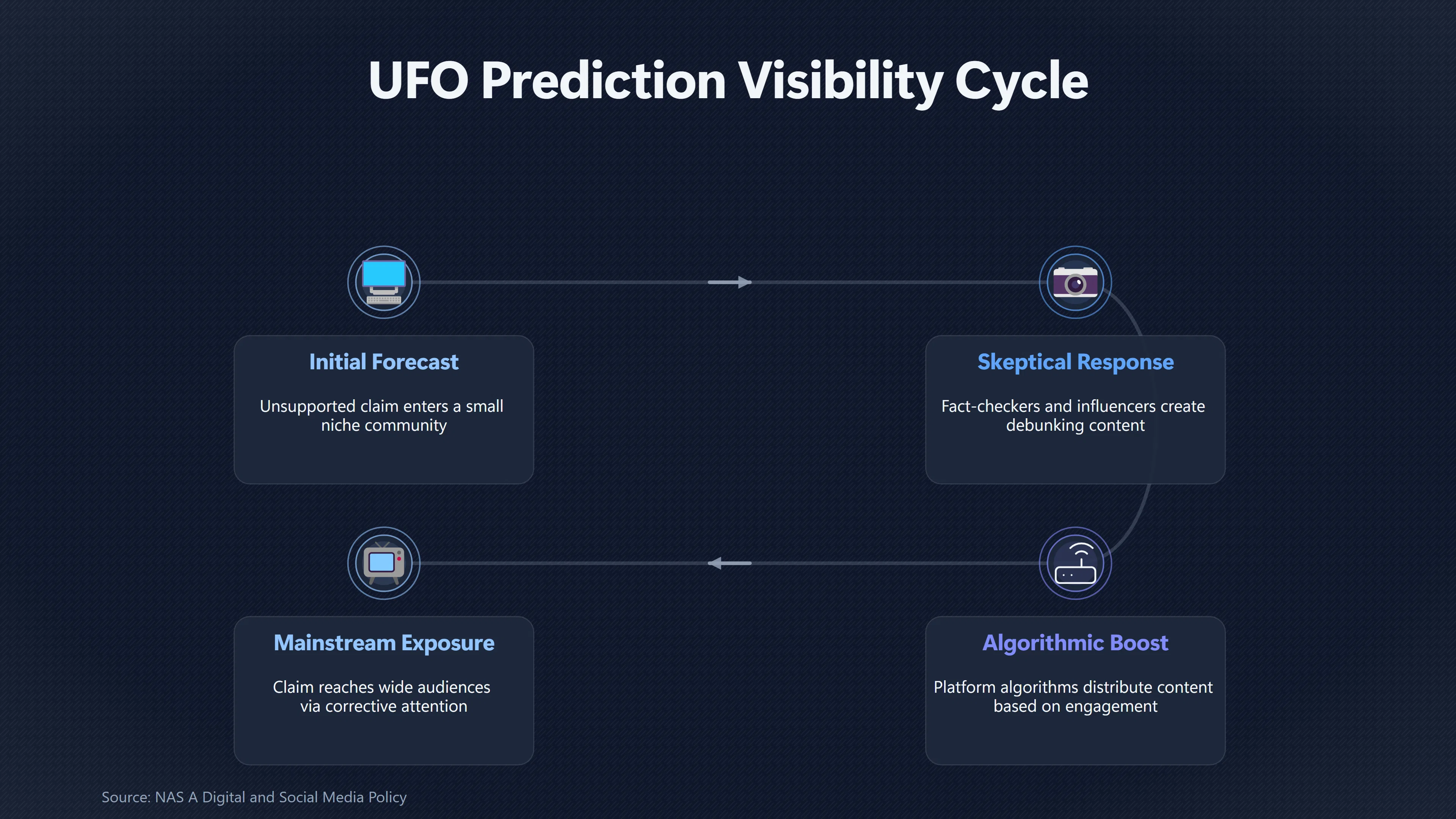
When an unsupported UFO prediction begins attracting attention, sceptical responses often follow a predictable path. A fact-checking article links to the original claim. Readers share the fact-check with comments expressing disbelief. Influencers create reaction videos discussing why the prediction is unlikely to occur. News organisations report that “a viral UFO prediction has been debunked.”
Each step reaches audiences beyond the original community.
From the perspective of platform algorithms, engagement matters more than whether that engagement is supportive or critical. Comments, quote-posts and discussions all indicate that a topic is attracting attention. As a result, a failed prediction may receive far greater distribution after sceptics respond than it achieved within its original niche.
This is particularly relevant for UFO predictions because many begin in relatively small communities before receiving wider coverage precisely because they appear unusual or controversial. The corrective discussion therefore becomes part of the mechanism through which the claim enters mainstream awareness, even though the accompanying message is sceptical.
Importantly, increased exposure should not be confused with increased acceptance. Experimental research has found little evidence that exposing new audiences to a correction causes a systematic “familiarity backfire” in which the correction itself makes people more likely to believe the false claim. Instead, clear corrections generally reduce misconceptions compared with leaving the claim unanswered.[nih.gov]pmc.ncbi.nlm.nih.govPubMed Central (PMC)Can corrections spread misinformation to new audiences? Testing for the elusive familiarity backfire effect - PMCAugu…
When repetition inside a rebuttal backfires in practice
The practical communication problem is subtler than the classic “backfire effect” hypothesis.
Research consistently supports the illusory truth effect: repeated statements become easier to process and may therefore feel more familiar or plausible over time, regardless of their truth. Repetition alone is not proof that people will ultimately believe a UFO prediction, but repeated exposure increases the risk that readers remember the claim while forgetting where or how they encountered it.[Nature]nature.comSystematic review and meta-analysis of the evidence for an illusory truth effect and its determinants | Nature CommunicationsFebrua…
Several patterns contribute to this problem:
- Headline-first reading. Many users only read a headline mentioning a dramatic UFO prediction before scrolling on.
- Quote-post fragmentation. A rebuttal may circulate independently from the detailed explanation attached to it.
- Memory for claims over context. People often remember the prediction itself more easily than the reasoning showing why it failed.
- Cross-platform copying. A debunk on one platform becomes another discussion topic elsewhere, multiplying references to the original prediction.
Over time, someone searching for the prediction may encounter dozens of webpages discussing it. Without examining those pages carefully, the sheer number of references can resemble widespread corroboration when many are actually discussing the same unsupported forecast.
This differs from claiming that debunks themselves create belief. Rather, they may contribute to an environment where the prediction becomes highly familiar, highly searchable and repeatedly encountered long after the predicted event has failed to occur.[PubMed]pubmed.ncbi.nlm.nih.govThe illusory truth effect: A review of how repetition increases belief in misinformation - PubMed…

Failed UFO predictions illustrate the visibility paradox
Within UFO culture, unsuccessful predictions often remain easier to find than quieter corrections.
A forecast announcing a dramatic mass sighting or imminent extraterrestrial contact is inherently newsworthy. Once it attracts online discussion, numerous creators produce commentary before the prediction date. After the event fails to occur, another wave of commentary analyses the failure, questions the claimant or debates possible excuses.
The result is an archive dominated by discussion rather than evidence.
Someone discovering the topic months or years later may interpret hundreds of webpages, videos and forum discussions as indicating that the prediction was historically significant or widely supported. In reality, much of that apparent consensus may simply consist of repeated reactions to a single failed forecast.
This dynamic reinforces the broader phenomenon of false corroboration discussed elsewhere: multiple publications can emerge from one unsupported source without adding independent evidence.
Safer ways to report unsupported predictions
Research on misinformation increasingly recommends improving the structure of corrections rather than avoiding corrections altogether. The current evidence does not support abandoning debunking because of fears that it inevitably strengthens misinformation. Instead, communicators can reduce unnecessary amplification by changing how they present corrections.[nih.gov]pmc.ncbi.nlm.nih.govPubMed Central (PMC)Can corrections spread misinformation to new audiences? Testing for the elusive familiarity backfire effect - PMCAugu…
Useful practices include:
- Lead with the verified conclusion before describing the unsupported prediction.
- Avoid sensational headlines that repeat dramatic claims more prominently than the correction.
- Emphasise the absence of independent evidence rather than repeatedly restating the prediction.
- Explain how multiple online references often trace back to a single original source.
- Highlight the outcome after the prediction date passes, making the failed prediction itself part of the factual record.
These approaches preserve the corrective function of reporting while reducing the chance that audiences remember only the striking claim.
Why this matters for evaluating UFO forecasts
Readers evaluating future UFO predictions should distinguish between visibility, discussion and verification.
A prediction that generates thousands of replies, sceptical articles and reaction videos has clearly attracted attention. That does not demonstrate independent confirmation. The most important questions remain unchanged:
- Did new evidence emerge beyond the original claimant?
- Did independent observers verify the prediction before the forecast date?
- After the predicted event failed to occur, were explanations supported by evidence or simply introduced to preserve the original claim?
Keeping those questions separate helps prevent corrective attention from being mistaken for corroboration. A prediction can become widely discussed—even because people are explaining why it failed—without becoming any better supported by evidence.
Amazon book picks
Further Reading
Books and field guides related to When Debunking Gives a UFO Claim More Reach. Use these as the next step if you want deeper reading beyond the article.
Foolproof: Why Misinformation Infects Our Minds and How to Bu...
One of the world’s top experts on fighting misinformation reveals the psychology behind its power—and how we can protect ourselves. From...
The Misinformation Age: How False Beliefs Spread
"Empowering and thoroughly researched, this book offers useful contemporary analysis and possible solutions to one of the greatest threat...
Calling Bullshit: The Art of Skepticism in a Data-Driven World
Bullshit isn’t what it used to be. Now, two science professors give us the tools to dismantle misinformation and think clearly in a world...
eBay marketplace picks
Marketplace Samples
Live-tested eBay searches with available results related to this page.
Selected fromUFO poster oneBay.co.uk.
Current eBay listing
VINTAGE UFO FLYING SAUCERS COMIC ADVERTISING A2 POSTER PRINT


Current eBay listing
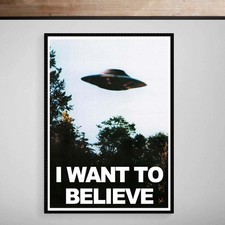
I Want To Believe UFO Poster Giclée Fine Art Heavyweight Print
Endnotes
1.
Source: nature.com
Link:https://www.nature.com/articles/s41467-026-70041-x
Source snippet
Systematic review and meta-analysis of the evidence for an illusory truth effect and its determinants | Nature CommunicationsFebrua...
2.
Source: nature.com
Link:https://www.nature.com/articles/s41467-025-62462-x
3.
Source: nature.com
Link:https://www.nature.com/articles/s41591-022-01713-6
4.
Source: pmc.ncbi.nlm.nih.gov
Link:https://pmc.ncbi.nlm.nih.gov/articles/PMC7447737/
Source snippet
PubMed Central (PMC)Can corrections spread misinformation to new audiences? Testing for the elusive familiarity backfire effect - PMCAugu...
5.
Source: skepticalscience.com
Link:https://skepticalscience.com/print.php?n=4890
Source snippet
Skeptical ScienceThe Debunking Handbook 2020: The elusive backfire effects...
6.
Source: pubmed.ncbi.nlm.nih.gov
Link:https://pubmed.ncbi.nlm.nih.gov/38113667/
Source snippet
The illusory truth effect: A review of how repetition increases belief in misinformation - PubMed...
7.
Source: pmc.ncbi.nlm.nih.gov
Link:https://pmc.ncbi.nlm.nih.gov/articles/PMC10096191/
Source snippet
PubMed Central (PMC)Correcting vaccine misinformation: A failure to replicate familiarity or fear-driven backfire effects - PMC...
8.
Source: psychologytoday.com
Title: Illusory Truth Effect | Psychology Today
Link:https://www.psychologytoday.com/us/basics/illusory-truth-effect
9.
Source: pubmed.ncbi.nlm.nih.gov
Link:https://pubmed.ncbi.nlm.nih.gov/39974768/
10.
Source: pmc.ncbi.nlm.nih.gov
Link:https://pmc.ncbi.nlm.nih.gov/articles/PMC6279465/
Additional References
11.
Source: sciencedirect.com
Link:https://www.sciencedirect.com/science/article/pii/S0167811626000261
Source snippet
Familiarity backfire effects? Disentangling the competing effects of repetition and fact-checking corrections of brand misin...
12.
Source: uap-archive.org
Title: NAS A UAP Independent Study — Public Meeting & Briefings | UAP Records Archive
Link:https://uap-archive.org/uap/records/nasa-uap-independent-study-public-events/
Source snippet
NASA UAP Independent Study — Public Meeting & Briefings | UAP Records ArchiveJune 6, 2026 — NASA UAP INDEPENDENT STUDY — PUBLIC MEETING &...
Published: June 6, 2026
13.
Source: nasa.gov
Title: NAS A Digital and Social Media Policy
Link:https://www.nasa.gov/reference/nasa-digital-and-social-media-policy/
Source snippet
NASA Digital and Social Media Policy - NASAJune 8, 2026 — CONTENTS * Social Media Commenting Policy * Privacy on NASA Social Media Channe...
Published: June 8, 2026
14.
Source: nasa.gov
Title: Official NASA Social Media Accounts
Link:https://www.nasa.gov/social-media/
Source snippet
Follow us on our mission of exploration and discovery in the feed of your favorite platforms. Missions Science Mission Directorates NASA...
15.
Source: youtube.com
Title: 8 Tips for Debunking Fake News
Link:https://www.youtube.com/watch?v=CwR18pY_brM
Source snippet
Debunking backfire effect misinformation spreading Correcting Misinformation Eric Luttrell...
16.
Source: medium.com
Link:https://medium.com/1st-draft/10-questions-to-ask-before-covering-mis-and-dis-information-ead4497189e0
17.
Source: firstdraftnews.org
Link:https://firstdraftnews.org/training/responsible-reporting/
18.
Source: research-information.bris.ac.uk
Link:https://research-information.bris.ac.uk/en/publications/can-corrections-spread-misinformation-to-new-audiences-testing-fo/
19.
Source: sciencedirect.com
Link:https://www.sciencedirect.com/science/article/abs/pii/S2352250X23001811
20.
Source: nasa.gov
Title: NAS A Provides Coverage of Unidentified Anomalous Phenomena Meeting
Link:https://www.nasa.gov/news-release/nasa-provides-coverage-of-unidentified-anomalous-phenomena-meeting/