Within UFO Deadlines
Do Public Bets Make UFO Claims More Credible?
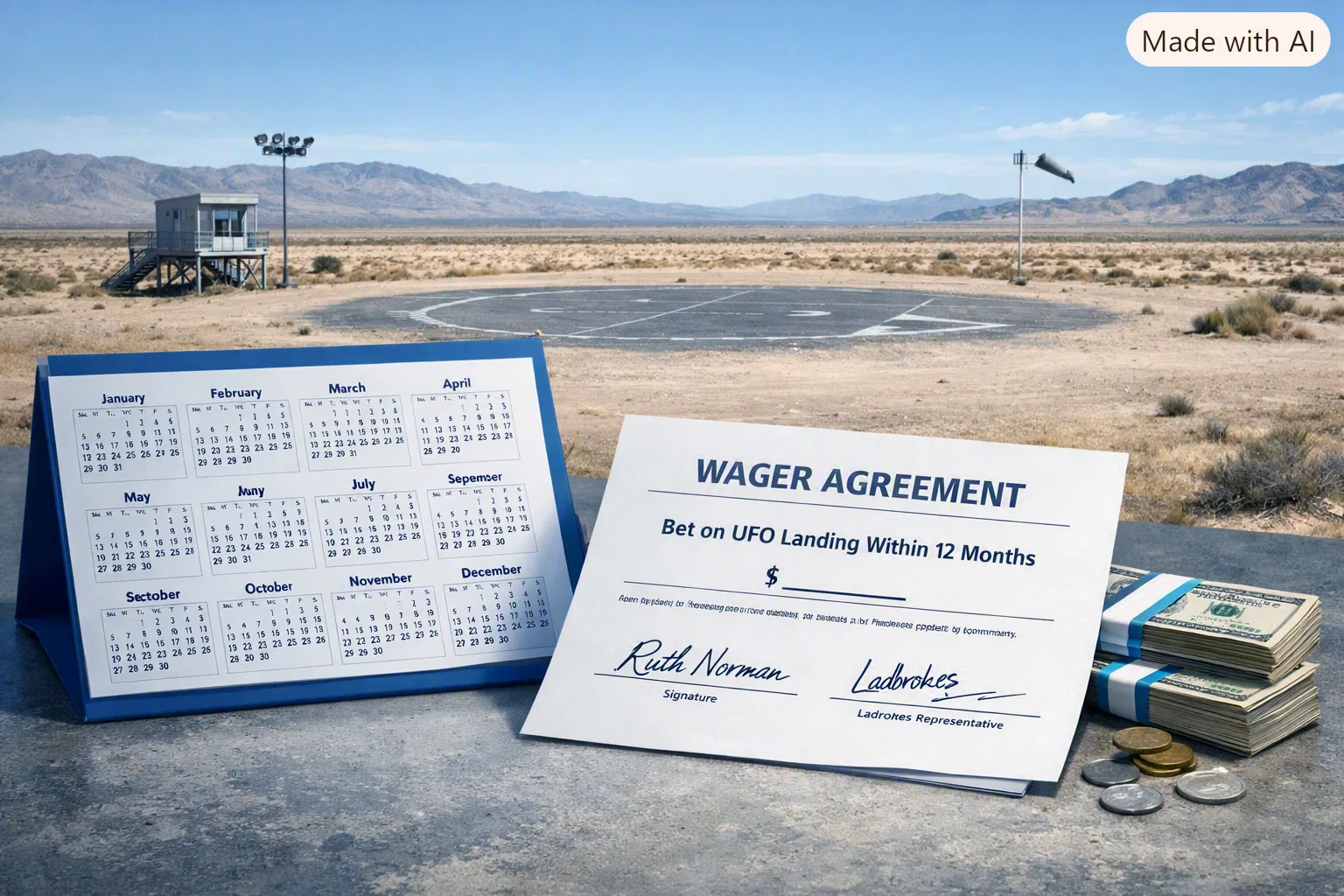
Ruth Norman's public wager made the landing claim unusually concrete by tying credibility to a twelve-month deadline.
On this page
- Norman's twelve month wager
- Why public stakes increase testability
- What happens when the deadline passes
Page outline Jump by section
Introduction
A public bet can make a UFO prediction easier to judge, but not necessarily more credible. Ruth Norman, leader of the California-based Unarius movement, demonstrated the difference in 1976 when she and several followers reportedly wagered that extraterrestrial spacecraft would land on Earth within twelve months. The bet attached money, publicity and a clear deadline to a claim that might otherwise have remained indefinitely vague. When no landing occurred, the wager was lost in the ordinary sense.
Yet the failed bet did not settle the larger belief. The expected arrival was moved into a broader future timetable, while later explanations suggested that humanity was unprepared or that outsiders had misunderstood the original claim. Norman’s wager is therefore important not because gambling verified anything, but because it created an unusually sharp test: either publicly observable visitors arrived during the agreed period or they did not. The episode also shows how a precise prediction can later be absorbed into a less precise story.
Norman’s twelve-month wager
Ruth Norman, also known within Unarius as Uriel, had already promoted several expectations of an extraterrestrial arrival before approaching the betting market. A 1974 Unarius publication anticipated a space-fleet landing, and the organisation acquired land near Jamul, California, intended as a reception site. The planned visitors were described as benevolent “Space Brothers” from an interplanetary confederation who would bring scientific knowledge and inaugurate a peaceful new age.[Encyclopedia.com]encyclopedia.comUnarius Academy of Science | Encyclopedia.comUnarius Academy of Science | Encyclopedia.com
An expected landing in 1975 did not occur. Norman then explained that she had been reliving a traumatic past-life episode rather than accurately perceiving the timing of the arrival. Some students accepted this interpretation, while others reportedly left. The important point for the later wager is that the failed date did not end the prediction; it became part of an evolving sequence of anticipated arrivals.[Wikipedia]WikipediaRuth NormanRuth Norman
In March 1976, Norman and some of her students made the claim more public by placing a wager with the British bookmaker Ladbrokes that spacecraft would land on Earth within one year. Sociologist Diana Tumminia’s study of Unarius gives the collective stake as $4,000. A contemporary British newspaper-search record, however, describes Norman as betting Ron Pollard of Ladbrokes “£500 worth of dollars” that visitors would arrive that year. The surviving summaries may be referring to different portions or descriptions of the same arrangement, so the exact financial structure is less certain than the central fact: a bookmaker accepted a time-limited bet on a publicly observable alien arrival.[jstor.org]jstor.orgs would come to explain away multipleHow Prophecy Never Fails: Interpretive Reason in a Flying-…by D Tumminia · 1998 · Cited by 67 — A careful reading reveals not one…
The twelve-month period expired without the promised landing. No publicly verified spacecraft, extraterrestrial delegation or corresponding global event appeared. In conventional betting terms, that outcome was decisive: the stipulated event had not happened by the deadline.
The wager nevertheless succeeded as publicity. It transformed a small religious movement’s teaching into a compact newspaper story containing an eccentric claimant, a famous bookmaker, a substantial stake and a result that could be checked within a year. Norman had already cultivated media attention, and Unarius subsequently became a recurring subject for local and national reporters.[Wikipedia]WikipediaRuth NormanRuth Norman
Why public stakes increase testability
Putting money behind a prediction is often treated as evidence of sincerity. A person willing to lose a meaningful sum may genuinely believe what they are saying. Norman’s wager therefore supplied information about commitment: she and participating followers were prepared to incur a public cost if the forecast failed.
Sincerity, however, is not the same as reliability. A wager does not demonstrate that the claimant has accurate information, a valid method or privileged access to future events. It only demonstrates willingness to accept the stated risk—or, in publicity-oriented cases, willingness to pay for the attention generated by the bet.
The stronger value of Norman’s wager was testability. It improved the claim in three ways:
- It fixed a deadline. “The Space Brothers will arrive someday” cannot readily fail. “They will land within twelve months” can.
- It implied an observable event. A landing on Earth should be detectable independently of Norman’s private visions or channelled messages.
- It established the prediction before the outcome. The bookmaker and press coverage reduced the possibility of inventing the forecast retrospectively.
Those features distinguish the wager from ordinary UFO reports. A report of an unidentified light may remain inconclusive because evidence is incomplete. Norman’s claim was different: it predicted a major future event whose absence during the specified window could be established without first explaining every object seen in the sky.
The bet also limited one common escape route. A claimant cannot simply say that the date was never definite when an outside institution has accepted money on a one-year proposition. The wager created a record whose ordinary meaning was difficult to dispute.
It did not, however, define every possible term with scientific precision. What would count as “landing on Earth”? Would one craft suffice, or did the wager require the predicted fleet? Did the visitors have to appear publicly? Could an alleged secret landing qualify? Contemporary summaries do not preserve a full betting contract answering all these questions. That ambiguity matters because loosely specified conditions leave room for reinterpretation even when the deadline itself is clear.
A bet is not an independent investigation
Bookmakers sometimes accept wagers on unusual political, cultural or speculative events because novelty attracts customers and press attention. Acceptance of a bet does not mean that the bookmaker has verified the premise. The firm prices a proposition, defines its settlement conditions and manages its financial exposure; it does not certify the claimant’s evidence.
Norman’s wager therefore should not be understood as Ladbrokes endorsing extraterrestrial contact. The bookmaker was acting as a counterparty, not as a scientific institution. The existence of odds or a monetary stake cannot replace physical evidence such as independently recorded observations, recoverable materials, identifiable visitors or measurements open to examination.
This distinction is particularly important in UFO culture, where publicity is sometimes mistaken for corroboration. A story may appear more substantial because a newspaper reports it, a television programme discusses it or a bookmaker accepts money on it. Those actions demonstrate that a claim has become newsworthy. They do not demonstrate that it is true.
In Norman’s case, the bet made the prediction clearer while leaving its evidential basis unchanged. The alleged information still came from Unarius teachings and channelled communications rather than independently testable observations.

What happened when the deadline passed?
The most revealing part of the episode was not simply that no spacecraft landed, but that the missed deadline did not permanently close the claim. According to accounts of Unarius, Norman showed little public distress over losing the wager. The arrival expectation was subsequently attached to the year 2001, associated with the end of one historical cycle and the beginning of another.[Wikipedia]WikipediaRuth NormanRuth Norman
By September 1977, Norman was again describing a landing as potentially imminent but avoiding a firm date. She told The Washington Post that the visitors might arrive within months, by the end of the century or perhaps that year, while adding that “they don’t give us a date”. When local UFO reports attracted journalists, she also said the aliens had chosen not to land because an Earth resident might shoot at them.[The Washington Post]washingtonpost.comThe Washington Post Unarius Group Prepares Landing Site for Space BrothersThe Washington PostUnarius Group Prepares Landing Site for Space Brothers - The Washington Post…
This was a significant retreat in testability. The wager had created a one-year window. The later formulation offered several possible periods and an external reason why the visitors could postpone their appearance. The prediction had moved from a proposition that a bookmaker could settle to one that depended on unknowable alien decisions and human readiness.
The revised 2001 expectation also passed without the advertised fleet. Later Unarius explanations held that the landing would occur when people on Earth were ready, while some members argued that earlier statements had been misunderstood or should not have been treated as ordinary prophecy. The organisation continued its annual celebrations and maintained the expected arrival as part of a longer spiritual narrative.[encyclopedia.com]encyclopedia.comUnarius Academy of Science | Encyclopedia.comUnarius Academy of Science | Encyclopedia.com
Tumminia’s research treats this not as one isolated failed forecast but as a series of prophecies sustained through interpretive revision. Within the movement, contradictory outcomes could be incorporated into continuing accounts involving past-life experiences, altered cosmic schedules and conditions on Earth.[JSTOR]jstor.orgs would come to explain away multipleHow Prophecy Never Fails: Interpretive Reason in a Flying-…by D Tumminia · 1998 · Cited by 67 — A careful reading reveals not one…
How the wager changed the claim
Before the bet, Norman’s landing predictions were already associated with dates, preparations and a designated site. The wager nevertheless changed the public status of the claim. It converted belief into a compact proposition with three visible components: money at risk, a twelve-month period and an event expected to occur in the shared physical world.
After the deadline, the public and internal meanings diverged. From the bookmaker’s perspective, the matter was simple: the event had not occurred in time. Within the movement’s wider belief system, the missed date could be treated as a problem of interpretation, readiness or scheduling rather than a refutation of extraterrestrial contact itself.
That divergence explains why bets can sharpen a prediction without resolving a belief dispute. Outside observers generally apply the literal terms that made the wager possible. Committed believers may regard those terms as only one imperfect expression of a much larger revelation.
A public wager therefore raises credibility only in a limited sense. It can show that a claimant is willing to make a concrete commitment. It cannot show that the prediction rests on dependable evidence, and it cannot force participants to abandon the underlying story after losing.
The lesson of landing wagers
Norman’s wager is one of the clearest historical examples of why deadlines matter when assessing UFO predictions. It provided a prospective test rather than an ambiguous recollection. The claim was recorded, the interval was finite and the expected event was extraordinary enough that its occurrence should have been unmistakable.
The result was equally clear at the narrow level: the twelve-month deadline passed without an alien landing. The later survival of the prediction does not change that outcome. Instead, it shows how the meaning of a claim can shift after its most testable version fails.
Public bets are therefore useful accountability devices, but only when readers preserve the original terms. The essential questions are not how confident the claimant appeared or how much money was risked. They are:
- What exactly was predicted?
- What counted as success?
- When did the deadline expire?
- Was the event independently observed?
- Were the conditions changed only after the result was known?
Applied to Ruth Norman’s wager, those questions produce a straightforward judgement. The bet made the promised landing unusually concrete. No qualifying public arrival occurred within the allotted year. Subsequent postponements and reinterpretations belonged to a new, less testable version of the claim rather than a fulfilment of the wager that had already been lost.
Amazon book picks
Further Reading
Books and field guides related to Do Public Bets Make UFO Claims More Credible?. Use these as the next step if you want deeper reading beyond the article.
Heaven's Gate: America's UFO Religion
In March 1997, thirty-nine people in Rancho Santa Fe, California, ritually terminated their lives. To outsiders, it was a mass suicide. T...
Why People Believe Weird Things
Rating: 4.0/5 from 7 Google Books ratings
Revised and Expanded Edition. In this age of supposed scientific enlightenment, many people still believe in mind reading, past-life regr...
When Prophecy Fails
The study reported in this volume grew out of some theoretical work, one phase of which bore specifically on the behavior of individuals...
The Demon-Haunted World
NEW YORK TIMES BESTSELLER • From the renowned astronomer and author of Cosmos comes a “powerful [and] stirring defense of informed ration...
eBay marketplace picks
Marketplace Samples
Live-tested eBay searches with available results related to this page.
Selected fromUFO poster oneBay.co.uk.

Current eBay listing
VINTAGE UFO FLYING SAUCERS COMIC ADVERTISING A2 POSTER PRINT
Current eBay listing
I Want To Believe UFO Poster Giclée Fine Art Heavyweight Print


Endnotes
1.
Source: encyclopedia.com
Title: Unarius Academy of Science | Encyclopedia.com
Link:https://www.encyclopedia.com/environment/encyclopedias-almanacs-transcripts-and-maps/unarius-academy-science
2.
Source: Wikipedia
Title: Ruth Norman
Link:https://en.wikipedia.org/wiki/Ruth_Norman
3.
Source: jstor.org
Title: s would come to explain away multiple
Link:https://www.jstor.org/stable/3712078
Source snippet
How Prophecy Never Fails: Interpretive Reason in a Flying-...by D Tumminia · 1998 · Cited by 67 — A careful reading reveals not one...
4.
Source: gwern.net
Title: 1999 dawson
Link:https://gwern.net/doc/sociology/1999-dawson.pdf
Source snippet
When Prophecy Fails and Faith Persists5 May 2004 — The media called the event prophecy, not Unarius. Prophecy implies a prediction that c...
Published: May 2004
5.
Source: Wikipedia
Title: Unarius Academy of Science
Link:https://en.wikipedia.org/wiki/Unarius_Academy_of_Science
6.
Source: unarius.org
Link:https://unarius.org/extraterrestrial-intelligence/
7.
Source: britishnewspaperarchive.co.uk
Link:https://www.britishnewspaperarchive.co.uk/search/results/1970-01-01/1979-12-31?basicsearch=%22mona+lisa%22+&newspapertitle=daily%2Bmirror&phrasesearch=mona+lisa&retrievecountrycounts=false&sortorder=score
Source snippet
British Newspaper ArchiveResults for '"mona lisa" ' | Between 1st Jan 1970 and 31st Dec 1979 | Daily Mirror | Publication | British Newsp...
8.
Source: washingtonpost.com
Title: The Washington Post Unarius Group Prepares Landing Site for Space Brothers
Link:https://www.washingtonpost.com/archive/politics/1977/09/23/unarius-group-prepares-landing-site-for-space-brothers/fc42c27a-1a35-4def-a4c2-e9c3d4e81248/
Source snippet
The Washington PostUnarius Group Prepares Landing Site for Space Brothers - The Washington Post...
9.
Source: britishnewspaperarchive.co.uk
Link:https://www.britishnewspaperarchive.co.uk/search/results/1970-01-01/1979-12-31?basicsearch=%22mona+lisa%22+&phrasesearch=mona+lisa®ion=london%2C+england&retrievecountrycounts=false&sortorder=score
10.
Source: britishnewspaperarchive.co.uk
Link:https://www.britishnewspaperarchive.co.uk/search/results/1976-02-01/1976-02-29?basicsearch=horse+racing&mostspecificlocation=south+east%2C+england®ion=south+east%2C+england&retrievecountrycounts=false&somesearch=horse+racing
Additional References
11.
Source: brewminate.com
Title: uriel ruth e norman and the cult of unarius from the mid 20th century
Link:https://brewminate.com/uriel-ruth-e-norman-and-the-cult-of-unarius-from-the-mid-20th-century/
Source snippet
Uriel: Ruth E. Norman and the Cult of Unarius from the Mid-...14 Oct 2022 — Tumminia writes that they used “adaptive storytell...
12.
Source: anthrobase.com
Title: Anthro Base Stefan Isaksson
Link:https://www.anthrobase.com/Txt/I/Isaksson_S_01.htm
Source snippet
Stefan Isaksson - New Religious UFO Movements: Extraterrestrial Salvation in Contemporary America - AnthroBaseIn March 1976, Ru...
Published: March 1976
13.
Source: youtube.com
Title: The UFO Church: Unarius Academy of Science
Link:https://www.youtube.com/watch?v=biDKfr3lfVg
Source snippet
Unarius Academy of Science Ruth Norman alien landing What is Unarius? UFOs, wild costumes and out of this world videos | Bartell's Backro...
14.
Source: nasa.gov
Link:https://www.nasa.gov/wp-content/uploads/2023/03/sp-4203.pdf
15.
Source: dbpedia.org
Link:https://dbpedia.org/page/Ruth_Norman
16.
Source: facebook.com
Link:https://www.facebook.com/NASAArtemis/videos/all-four-astronauts-on-the-ship/2130495704467285/
17.
Source: facebook.com
Link:https://www.facebook.com/groups/spacehipsters/posts/24339994792285408/
18.
Source: researchgate.net
Link:https://www.researchgate.net/publication/344122776_How_Prophecy_Endures
19.
Source: scribd.com
Link:https://www.scribd.com/document/240321757/How-Prophecy-Never-Fails-Interpretive-Reason-in-a-Flying-Saucer-Group
20.
Source: facebook.com
Link:https://www.facebook.com/NASA/posts/liftoff-the-artemis-ii-mission-launches-from-nasas-kennedy-space-center-at-635-p/1491956392299732/