Within Specificity
Why Detailed UFO Predictions Are Easier to Disprove
Every added date, duration, location and visibility claim makes a UFO forecast easier to test but gives it more ways to fail.
On this page
- How added details increase testability
- The accuracy cost of narrow forecasting
- What a genuinely falsifiable claim requires
Page outline Jump by section
Introduction
Detailed UFO predictions attract attention because they appear more concrete and therefore more credible. A claim that a spacecraft will appear on a specific date, remain visible for three days and hover above a named location sounds more authoritative than a vague statement that contact is imminent. However, every extra detail also creates another point that can be checked against reality. This is why highly specific UFO predictions often fail more decisively than broad ones. Their precision increases testability, but it also narrows the range of outcomes that would count as success.
Research on forecasting consistently shows that precision is valuable when it accurately expresses uncertainty, but unwarranted specificity can become a liability. Within the history of failed UFO predictions, this trade-off is especially visible because many forecasts include exact dates, locations, durations or observable behaviours that either occur as described or do not.
How added details increase testability
Each additional claim attached to a prediction introduces another condition that must be satisfied simultaneously. A simple forecast that “alien contact is approaching” is difficult to evaluate because almost any later event can be interpreted as partial fulfilment. By contrast, a prediction such as:
- a spacecraft will appear on 14 October;
- above a particular city;
- remain visible for 72 hours;
- and be witnessed by millions of people
contains four separate factual claims rather than one. Failure of any single element weakens the prediction, while failure of all of them leaves little room for ambiguity.
From an evidence perspective, specificity therefore improves falsifiability. A prediction tied to observable details allows supporters, sceptics and neutral observers to examine exactly the same claim. Rather than debating intentions or symbolism, they can ask straightforward questions:
- Did the event happen on the stated date?
- Was it observed in the specified location?
- Did it last for the predicted duration?
- Was it visible in the way described?
The more measurable the forecast, the easier it becomes to distinguish between confirmation and failure.
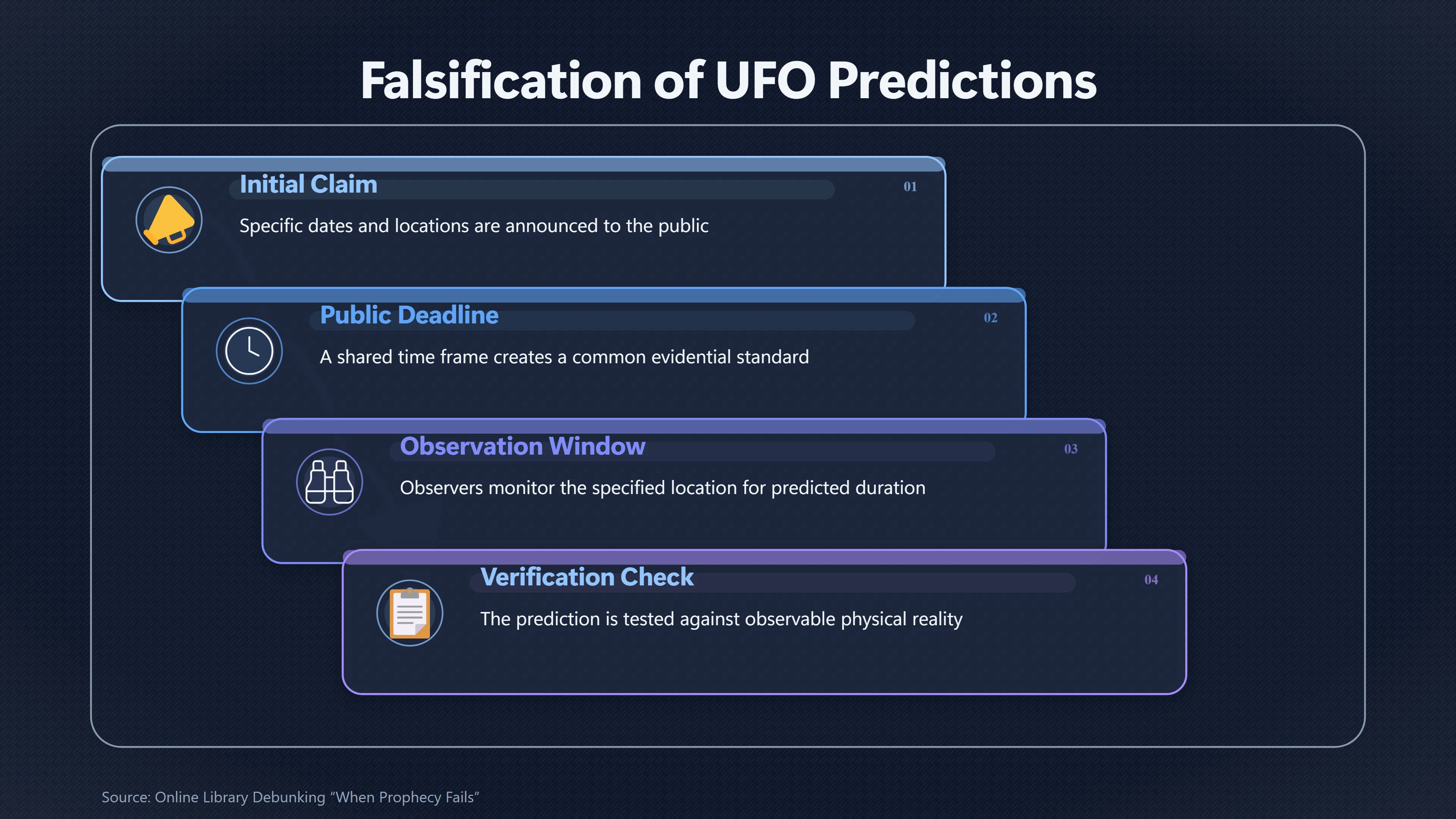
This explains why precise UFO predictions generate so much public attention. They create a shared deadline and a common evidential standard. Once that deadline passes, however, the prediction cannot easily retreat into vagueness.
The accuracy cost of narrow forecasting
Forecasting research distinguishes between being informative and being correct. More informative forecasts often contain greater detail, but each additional constraint reduces the number of outcomes that qualify as success.
Large forecasting tournaments led by Philip Tetlock and colleagues demonstrate that good forecasters benefit from expressing uncertainty explicitly rather than relying on vague language. Quantitative probability estimates improve evaluation because they can be calibrated against later outcomes. However, these studies also emphasise that useful precision must reflect genuine evidence rather than unjustified confidence.[Harvard Kennedy School]hks.harvard.eduHarvard Kennedy SchoolThe Value of Precision in Probability Assessment: Evidence from a Large-Scale Geopolitical Forecasting Tournament |…
This distinction matters in UFO prediction claims. A forecast offering exact dates and locations without verifiable supporting evidence is not made stronger simply because it is more detailed. Instead, it becomes easier to falsify because reality has more opportunities to contradict it.
Research on overprecision illustrates a related problem. Analyses of professional forecasting have found that people frequently express greater certainty than their actual predictive accuracy warrants. In one long-running survey of economic forecasters, participants’ reported confidence substantially exceeded their observed success rate, demonstrating that confidence and correctness are not the same thing.[University of California Press]online.ucpress.eduUniversity of California PressOverprecision in the Survey of Professional Forecasters | Collabra: Psychology | University of California P…
Although these studies concern economics and geopolitics rather than UFO claims, they identify a general feature of human prediction: increasing confidence or specificity does not automatically increase accuracy.

Why detailed UFO predictions often fail so visibly
The history of UFO prediction provides numerous examples in which highly detailed forecasts produced highly visible failures.
Dorothy Martin’s 1954 prophecy illustrates the point. The prediction involved a precise timetable for catastrophic flooding together with rescue by flying saucers before dawn on a specified date. Because the claim included an exact deadline, observers knew precisely when it would either succeed or fail. When neither the flood nor the rescue occurred, the prediction was immediately testable against observable reality.[Wiley Online Library]onlinelibrary.wiley.comOnline Library Debunking “When Prophecy Fails”Wiley Online LibraryDebunking “When Prophecy Fails” - Kelly - 2026 - Journal of the History of the Behavioral Sciences - Wiley Online Lib…
The historical interpretation of Martin’s group has itself become more complex. Recent archival research challenges influential claims made in When Prophecy Fails, arguing that the group’s post-failure behaviour differed substantially from the classic account. Nevertheless, the newer scholarship leaves unchanged the central point relevant here: the prediction failed in a way that could be clearly identified because it contained precise, observable commitments.[Wiley Online Library]onlinelibrary.wiley.comOnline Library Debunking “When Prophecy Fails”Wiley Online LibraryDebunking “When Prophecy Fails” - Kelly - 2026 - Journal of the History of the Behavioral Sciences - Wiley Online Lib…
This pattern recurs across many failed UFO forecasts. Predictions commonly accumulate details intended to demonstrate insider knowledge:
- exact calendar dates;
- named landing sites;
- identifiable spacecraft;
- expected media coverage;
- promises of worldwide visibility.
Each addition increases apparent authority before the event, but afterwards each becomes another independent criterion that can be checked.
What a genuinely falsifiable claim requires
Not every detailed statement is genuinely testable. A claim becomes meaningfully falsifiable only when it defines observable conditions that could clearly prove it wrong.
A strong testable prediction generally specifies:
- Time – when the event should occur.
- Place – where it should be observable.
- Observable outcome – what independent witnesses should see.
- Failure condition – what would count as the prediction not occurring.
Many failed UFO predictions satisfy the first three conditions but weaken the fourth through later reinterpretation. After an expected date passes, explanations sometimes shift towards invisible events, altered timelines, spiritual fulfilment or secret government concealment. These reinterpretations reduce falsifiability because they replace observable evidence with claims that cannot easily be tested.
From an evidence standpoint, the original prediction remains the appropriate object of evaluation. If the announced observable event did not occur under the stated conditions, the forecast has failed regardless of subsequent reinterpretations.
Why failure becomes more convincing as detail increases
Detailed predictions create a paradox. Their specificity attracts attention because audiences interpret precise information as evidence that the speaker possesses unusual knowledge. Yet exactly the same specificity produces stronger disconfirmation when events fail to unfold as described.
This is why failed UFO predictions with exact dates often remain influential examples in discussions of credibility. The issue is not simply that they were wrong. It is that their own precision supplied the standards by which they could be judged.
For researchers, journalists and readers evaluating extraordinary claims, this creates an important distinction. Specificity is valuable because it makes predictions testable, but it should not be mistaken for evidence in itself. A forecast becomes scientifically useful only when its precise details are supported by reliable information before the event—not because those details sound convincing after they are announced.
Amazon book picks
Further Reading
Books and field guides related to Why Detailed UFO Predictions Are Easier to Disprove. Use these as the next step if you want deeper reading beyond the article.
Superforecasting: The Art and Science of Prediction
NEW YORK TIMES BESTSELLER WINNER OF THE CMI MANAGEMENT FUTURES BOOK OF THE YEAR AWARD What if we could improve our ability to predict the...
The Signal and the Noise: Why So Many Predictions Fail—but So...
This work explores the history, art and science of prediction.
The Logic of Scientific Discovery
2014 Reprint of Original 1959 Edition. Exact facsimile of the original edition, not reproduced with Optical Recognition Software. This bo...
Why People Believe Weird Things
Rating: 4.5/5 from 5 Google Books ratings
"This sparkling book romps over the range of science and anti-science." --Jared Diamond, author of Guns, Germs, and Steel Revised and Exp...
eBay marketplace picks
Marketplace Samples
Live-tested eBay searches with available results related to this page.
Selected fromUFO poster oneBay.co.uk.
Related eBay result
I Want To Believe UFO Poster Giclée Fine Art Heavyweight Print



Related eBay result
VINTAGE UFO FLYING SAUCERS COMIC ADVERTISING A2 POSTER PRINT
Endnotes
1.
Source: hks.harvard.edu
Link:https://www.hks.harvard.edu/publications/value-precision-probability-assessment-evidence-large-scale-geopolitical-forecasting
Source snippet
Harvard Kennedy SchoolThe Value of Precision in Probability Assessment: Evidence from a Large-Scale Geopolitical Forecasting Tournament |...
2.
Source: onlinelibrary.wiley.com
Title: Online Library Debunking “When Prophecy Fails”
Link:https://onlinelibrary.wiley.com/doi/10.1002/jhbs.70043
Source snippet
Wiley Online LibraryDebunking “When Prophecy Fails” - Kelly - 2026 - Journal of the History of the Behavioral Sciences - Wiley Online Lib...
3.
Source: onlinelibrary.wiley.com
Title: Online Library Debunking “When Prophecy Fails”
Link:https://onlinelibrary.wiley.com/doi/full/10.1002/jhbs.70043
Source snippet
“When Prophecy Fails” - Kelly - 2026 - Journal of the History of the Behavioral Sciences - Wiley Online LibraryNovember 4, 2025 — Volume...
Published: November 4, 2025
4.
Source: onlinelibrary.wiley.com
Link:https://onlinelibrary.wiley.com/doi/abs/10.1002/jhbs.70043
5.
Source: onlinelibrary.wiley.com
Link:https://onlinelibrary.wiley.com/doi/abs/10.1002/jhbs.70043?campaign=woletoc
6.
Source: onlinelibrary.wiley.com
Link:https://onlinelibrary.wiley.com/doi/abs/10.1002/ffo2.157
7.
Source: online.ucpress.edu
Link:https://online.ucpress.edu/collabra/article/10/1/92953/200113/Overprecision-in-the-Survey-of-Professional
Source snippet
University of California PressOverprecision in the Survey of Professional Forecasters | Collabra: Psychology | University of California P...
Additional References
8.
Source: pubmed.ncbi.nlm.nih.gov
Link:https://pubmed.ncbi.nlm.nih.gov/28154049/
Source snippet
Bringing probability judgments into policy debates via forecasting tournaments - PubMed...
9.
Source: skeptic.org.uk
Title: The Skeptic When predictions fail: UFO cults, QAnon and cognitive [dissonance]({{ ‘dissonance/’ | relative_url }})
Link:https://www.skeptic.org.uk/2021/02/when-predictions-fail-ufo-cults-qanon-and-cognitive-dissonance/
Source snippet
The SkepticWhen predictions fail: UFO cults, QAnon and cognitive dissonance - The Skeptic...
10.
Source: pubmed.ncbi.nlm.nih.gov
Link:https://pubmed.ncbi.nlm.nih.gov/41881200/
Source snippet
2026 Jun:194:112247. doi: 10.1016/j.jclinepi.2026.112247. Epub 2026 Mar 23. HOW TO EVALUATE PROBABILISTIC PREDICTION MODELS: KEY METRICS...
11.
Source: psychologicalscience.org
Link:https://www.psychologicalscience.org/journals/perspectives/17456916231185339/
12.
Source: youtube.com
Title: End of Days Cults, the Day After | Cognitive Dissonance (Video Essay)
Link:https://www.youtube.com/watch?v=5yVuauQjkDc
Source snippet
Superforescasting: How to be good at predicting the future?...
13.
Source: youtube.com
Title: Precision and Probability: The Science of Superforecasting
Link:https://www.youtube.com/watch?v=K4L6Zm4MObo
Source snippet
End of Days Cults, the Day After | Cognitive Dissonance (Video Essay)...
14.
Source: journals.sagepub.com
Link:https://journals.sagepub.com/doi/abs/10.1177/24518492261436231
Source snippet
Comprehensive Review of Classifier Probability Calibration Metrics - Richard Oliver Lane, 2026April 17, 2026 — First published online Apr...
Published: April 17, 2026
15.
Source: forecastingresearch.org
Link:https://forecastingresearch.org/research/near-term-xpt-accuracy
16.
Source: cambridge.org
Link:https://www.cambridge.org/core/journals/judgment-and-decision-making/article/comparative-evaluation-of-the-forecast-accuracy-of-analysis-reports-and-a-prediction-market/3360FC0D8835FC8B2C241F835C9288EB
17.
Source: sciencedirect.com
Link:https://www.sciencedirect.com/science/article/pii/S0169207022000371