Within Spiritual Recasting
Why Failed UFO Predictions Multiply Online
Decentralized online groups can preserve a failed landing prediction through several competing explanations without needing one official account.
On this page
- How websites preserve conflicting explanations
- Why no central authority is required
- How explanation variety weakens disconfirmation
Page outline Jump by section
Introduction
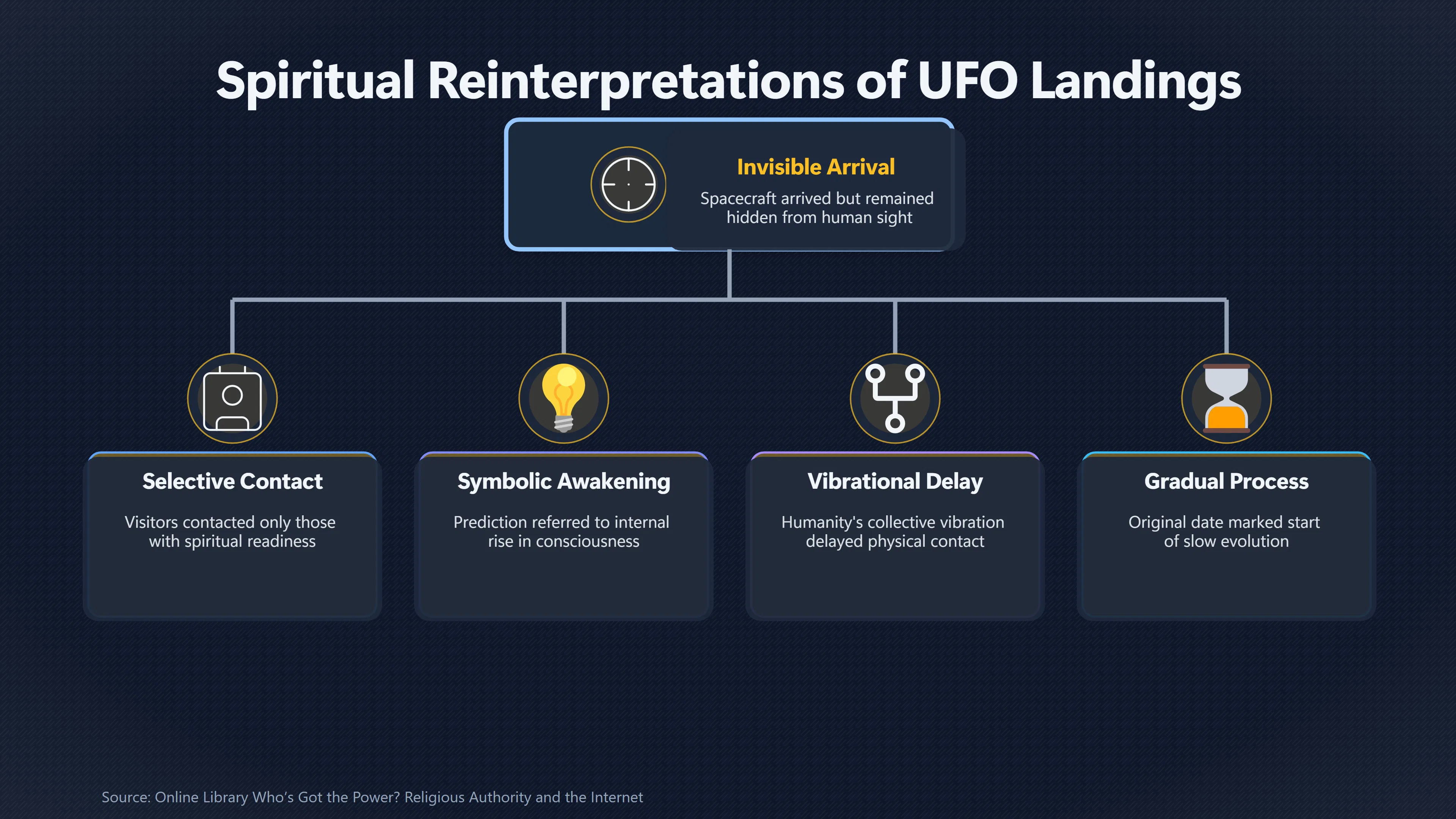
When a publicly predicted UFO landing fails to occur, online communities rarely settle on a single replacement explanation. Instead, internet-based networks often generate numerous spiritual reinterpretations at the same time. One group may argue that extraterrestrials arrived on a higher plane of consciousness, another that humanity was not spiritually ready, another that the event occurred invisibly, and still others that the prediction referred to an internal awakening rather than a physical spacecraft. This multiplication of explanations is not simply a feature of UFO belief itself. It reflects how decentralised online communities function. Without a central authority to declare one official interpretation, competing narratives can coexist indefinitely, allowing belief systems to adapt without requiring broad agreement. Research on digital religion, online authority and failed prophecy helps explain why this pattern has become especially visible in internet-era UFO movements.[wiley.com]onlinelibrary.wiley.comOnline Library Who’s Got the Power? Religious Authority and the InternetWiley Online LibraryWho’s Got the Power? Religious Authority and the Internet - Campbell - 2007 - Journal of Computer-Mediated Communicat…
How websites preserve conflicting explanations
Before widespread internet communication, reinterpretations of failed predictions often depended on a movement’s recognised leadership, newsletters or local meetings. Online communities operate differently. Blogs, discussion forums, video platforms, podcasts, archived livestreams and social media posts remain searchable long after an expected event has passed. Rather than replacing one explanation with another, new interpretations accumulate alongside older ones.
This creates an unusually durable record of competing ideas. A failed landing prediction may continue to generate explanations such as:
- the spacecraft arrived but remained invisible;
- the visitors contacted only spiritually prepared individuals;
- the prediction referred symbolically to a rise in consciousness;
- humanity’s collective vibration delayed physical contact;
- the original date marked the beginning of a gradual process rather than a single event.
Unlike a centrally managed organisation, there is rarely any mechanism requiring these explanations to be reconciled. Contradictions often remain visible because different participants simply continue promoting the interpretation they find most convincing. Campbell’s research on religious authority online argues that internet environments redistribute authority away from formal hierarchies towards networks in which multiple voices compete for credibility rather than one institution exercising final control.[Wiley Online Library]onlinelibrary.wiley.comOnline Library Who’s Got the Power? Religious Authority and the InternetWiley Online LibraryWho’s Got the Power? Religious Authority and the Internet - Campbell - 2007 - Journal of Computer-Mediated Communicat…
Why no central authority is required
The internet lowers the cost of producing interpretations. Anyone with a blog, podcast, livestream or discussion thread can offer an explanation without receiving approval from recognised leaders.
Several features encourage this process:
- Distributed expertise. Participants often claim authority through personal experiences, meditation, channelling or perceived spiritual insight rather than formal positions.
- Network amplification. Individual explanations can spread through reposts, recommendations and cross-linking without becoming officially endorsed.
- Persistent archives. Older explanations rarely disappear, allowing several generations of reinterpretation to coexist.
- Audience selection. Readers naturally gather around explanations matching their existing worldview rather than seeking consensus.
Researchers studying digital religion describe this as a shift from institutional authority towards networked authority, where credibility emerges from interaction, visibility and perceived authenticity instead of formal leadership. In practice, this means that after a failed UFO prediction, dozens of partially overlapping explanations can survive simultaneously because no recognised authority is expected to eliminate alternatives.[wiley.com]onlinelibrary.wiley.comOnline Library Who’s Got the Power? Religious Authority and the InternetWiley Online LibraryWho’s Got the Power? Religious Authority and the Internet - Campbell - 2007 - Journal of Computer-Mediated Communicat…
Why spiritual explanations spread particularly easily
Spiritual reinterpretations possess characteristics that make them especially adaptable within decentralised online discussions.
First, they usually depend on subjective experience rather than publicly observable events. A physical landing can be confirmed or disproved by external evidence. Claims about collective consciousness, higher-dimensional contact or energetic transformation rely far more heavily on individual interpretation.
Second, these explanations are highly compatible with personal storytelling. Community members can report dreams, intuitions, meditation experiences or perceived synchronicities as supporting evidence, allowing multiple narratives to reinforce one another even when they differ substantially.
Third, spiritual explanations can absorb contradictory outcomes. If no spacecraft appears, that absence may itself be interpreted as evidence that humanity required further preparation or that contact intentionally remained unseen. This reduces pressure to select one definitive account after an unsuccessful prediction.
Studies of contemporary digital religion note that online religious participation increasingly values experiential authenticity—personal experience as a source of authority—which naturally favours these kinds of interpretations.[Routledge]routledge.comDigital Religion: The BasicsDigital Religion: The Basics - 1st Edition - Heidi A. Campbell - Wendi…
How explanation variety weakens disconfirmation
Within decentralised online communities, failed predictions do not necessarily produce one decisive moment of collective disappointment. Instead, disconfirmation becomes fragmented.
Different participants may respond by:
- abandoning the prediction entirely;
- postponing the expected event;
- redefining the prediction as symbolic;
- claiming partial fulfilment;
- treating the prediction as a successful spiritual exercise despite physical failure.
Because these responses occur simultaneously across loosely connected communities, criticism aimed at one explanation does not automatically affect the others. A visible landing may have failed, yet alternative interpretations remain available for those wishing to preserve broader beliefs about extraterrestrial guidance or spiritual evolution.
This differs from movements with highly centralised leadership, where a single official explanation may become the focus of scrutiny. Online environments instead distribute interpretive risk across many independent voices.
Online reframing within failed UFO predictions
The broader pattern of recasting failed physical UFO landings as spiritual contact fits especially well with internet governance structures. Rather than replacing one failed prediction with one revised doctrine, decentralised online communities generate an expanding ecosystem of interpretations.
Research on failed prophecy has long observed that believers often preserve broader systems of meaning even when specific predictions prove incorrect, although scholars continue to debate the relative importance of cognitive dissonance, organisational dynamics and interpretive flexibility. More recent work on digital religion adds an important layer by showing how internet communication changes the social organisation of belief itself. Instead of relying on a recognised prophet or institution to redefine events, networked communities can collectively produce many parallel explanations that remain permanently accessible online. This diversity makes it easier for failed landing predictions to evolve into narratives of invisible contact, spiritual preparation or ongoing consciousness change without requiring a single agreed account.[oup.com]academic.oup.comOUP AcademicHow Prophecy Never Fails | When Prophecy Never Fails: Myth and Reality in a Flying-Saucer Group | Oxford Academic…
Amazon book picks
Further Reading
Books and field guides related to Why Failed UFO Predictions Multiply Online. Use these as the next step if you want deeper reading beyond the article.
UFO Religions
The spectre of the UFO, as popularized by shows such as The X-Files, has brought an astonishing slant to the face of modern religious pra...
The Chaos Machine
'The Chaos Machine is an essential book for our times' - Ezra Klein The Chaos Machine is the story of how the world was driven mad by soc...
Suspicious Minds
Suspicious Minds decodes the psychology of why we all believe in conspiracy theories--some of us just hide it better than others.
Networks of Outrage and Hope
This book is an exploration of the new forms of social movements and protests that are erupting in the world today, from the Arab uprisin...
eBay marketplace picks
Marketplace Samples
Live-tested eBay searches with available results related to this page.
Selected fromUFO t shirt oneBay.co.uk.




Endnotes
1.
Source: onlinelibrary.wiley.com
Title: Online Library Who’s Got the Power? Religious Authority and the Internet
Link:https://onlinelibrary.wiley.com/doi/abs/10.1111/j.1083-6101.2007.00362.x
Source snippet
Wiley Online LibraryWho’s Got the Power? Religious Authority and the Internet - Campbell - 2007 - Journal of Computer-Mediated Communicat...
2.
Source: routledge.com
Title: Digital Religion: The Basics
Link:https://www.routledge.com/Digital-Religion-The-Basics/Campbell-Bellar/p/book/9780367528102
Source snippet
Digital Religion: The Basics - 1st Edition - Heidi A. Campbell - Wendi...
3.
Source: academic.oup.com
Link:https://academic.oup.com/book/7811/chapter/152989636
Source snippet
OUP AcademicHow Prophecy Never Fails | When Prophecy Never Fails: Myth and Reality in a Flying-Saucer Group | Oxford Academic...
4.
Source: newyorker.com
Link:https://www.newyorker.com/culture/the-lede/is-cognitive-dissonance-actually-a-thing
Source snippet
Political scientist Thomas Kelly argues that the researchers' deep involvement skewed results, challenging the validity of key conclusion...
5.
Source: onlinelibrary.wiley.com
Link:https://onlinelibrary.wiley.com/doi/abs/10.1002/jhbs.70043
Source snippet
“When Prophecy Fails” - Kelly - 2026 - Journal of the History of the Behavioral Sciences - Wiley Online LibraryNovember 4, 2025 — ORIGINA...
Published: November 4, 2025
6.
Source: onlinelibrary.wiley.com
Link:https://onlinelibrary.wiley.com/doi/10.1002/jhbs.70043
Source snippet
“When Prophecy Fails” - Kelly - 2026 - Journal of the History of the Behavioral Sciences - Wiley Online LibraryNovember 4, 2025 — Volume...
Published: November 4, 2025
7.
Source: onlinelibrary.wiley.com
Link:https://onlinelibrary.wiley.com/doi/abs/10.1002/jhbs.70043?campaign=woletoc
8.
Source: onlinelibrary.wiley.com
Link:https://onlinelibrary.wiley.com/doi/full/10.1002/jhbs.70043
9.
Source: academic.oup.com
Link:https://academic.oup.com/jcmc/article/15/2/251/4064813
10.
Source: onlinelibrary.wiley.com
Title: j.1083 6101.2007.00362.x
Link:https://onlinelibrary.wiley.com/doi/10.1111/j.1083-6101.2007.00362.x
11.
Source: academic.oup.com
Link:https://academic.oup.com/book/7811/chapter-abstract/152994882
12.
Source: academic.oup.com
Link:https://academic.oup.com/book/7811/chapter/152994882
13.
Source: doi.org
Title: Debunking “When Prophecy Fails”
Link:https://doi.org/10.1002%2Fjhbs.70043
Source snippet
Kelly - 2026 - Journal of the History of the Behavioral Sciences - Wiley Online LibraryNovember 4, 2025 — DEBUNKING “WHEN PROPHECY FAILS”...
Published: November 4, 2025
14.
Source: doi.org
Link:https://doi.org/10.1558%2Fijsnr.33085
15.
Source: doi.org
Title: The Oxford Handbook of Digital Religion | Oxford Academic
Link:https://doi.org/10.1093/oxfordhb/9780197549803.001.0001
Additional References
16.
Source: youtube.com
Title: Children of the Stars | Unarius UFO Cult Documentary | Full Movie
Link:https://www.youtube.com/watch?v=4Y3hUMuaTvk
Source snippet
This video features expert research on digital religion and digital culture, exploring how decentralized online platforms change authorit...
17.
Source: youtube.com
Link:https://www.youtube.com/watch?v=_573dNJ0R2E
Source snippet
They Claimed to Speak With Aliens, and America Watched | Welcome Space Brothers Official Trailer...
18.
Source: youtube.com
Link:https://www.youtube.com/watch?v=C0gileo_Y2k
Source snippet
Children of the Stars | Unarius UFO Cult Documentary | Full Movie...
19.
Source: journals.ub.uni-heidelberg.de
Title: de The Truth of Messages from Beyond | Syllogos
Link:https://journals.ub.uni-heidelberg.de/index.php/syllogos/article/view/110987
Source snippet
"Crosby (Author) [https://orcid.org/0000-0002-1440-3578](https://orcid.org/0000-0002-1440-3578) * PDF IDENTIFIERS (ARTICLE) DOI: [https://..."](https://...")...
20.
Source: youtube.com
Title: Digital Religion: Technology Reshaping Religious Practices and Communities
Link:https://www.youtube.com/watch?v=Mu2zBeeLIEA
Source snippet
Theology and Technology with Heidi Campbell...
21.
Source: youtube.com
Title: Theology and Technology with Heidi Campbell
Link:https://www.youtube.com/watch?v=Q20Y5fVb5Jw
Source snippet
Hyper-Real Religion, Digital Capitalism, and the Pygmalion Effect with Adam Possamai...
22.
Source: researchgate.net
Link:https://www.researchgate.net/publication/261967407_Understanding_the_Relationship_between_Religion_Online_and_Offline_in_a_Networked_Society
23.
Source: heiup.uni-heidelberg.de
Link:https://heiup.uni-heidelberg.de/journals/religions/article/view/381
24.
Source: taylorfrancis.com
Link:https://www.taylorfrancis.com/chapters/mono/10.4324/9781003058465-2/networked-community-heidi-campbell-wendi-bellar
25.
Source: taylorfrancis.com
Title: Who’s got the Power? | 6 | Religious authority and the Internet | Heid
Link:https://www.taylorfrancis.com/chapters/edit/10.4324/9781003763680-6/got-power-heidi-campbell