Within Falsifiability
What Should Count as a Predicted UFO Sighting?
A UFO forecast can only be judged fairly when terms such as visible, public, massive and unexplained are defined before the deadline.
On this page
- Why ordinary UFO language creates loopholes
- How to define visibility, duration and location
- Examples of clear and ambiguous sighting criteria
Page outline Jump by section
Introduction
A prediction about unidentified flying objects can only be judged as successful or failed if everyone agrees in advance on what counts as a qualifying sighting. Without that agreement, almost any unusual light, disputed photograph or anecdotal report can be claimed as fulfilment after the fact, making the prediction effectively immune to failure.

For the purpose of testing predictions, the question is not whether an object is extraterrestrial. It is whether a pre-defined event occurred according to agreed rules. Modern scientific and forecasting practice therefore relies on operational definitions: precise criteria that specify what observers must see, where it must happen, how long it must last, what evidence is acceptable, and which ordinary explanations must be excluded before a sighting is counted. NASA’s recent work on unidentified anomalous phenomena (UAP) likewise stresses that meaningful investigation depends on high-quality, well-defined observations rather than vague descriptions.[NASA Science]science.nasa.govScience UAPNASA ScienceUAP - NASA ScienceFebruary 23, 2026…
Why ordinary UFO language creates loopholes
Many UFO predictions use words that sound precise but are actually highly flexible. Terms such as visible, massive, public, worldwide or unexplained invite disagreement because different readers interpret them differently.
Consider the prediction:
“A massive UFO will appear publicly over Europe before the end of the year.”
Without additional definitions, several questions immediately arise:
- Does “Europe” mean one city or any location on the continent?
- Must the object be visible to the naked eye?
- Does one eyewitness qualify, or are thousands required?
- Is a brief appearance enough?
- Does a later explanation invalidate the prediction?
- Can a disputed online video count?
Because these questions remain unanswered, believers and sceptics can reach opposite conclusions while both claiming to follow the original wording. That makes the prediction difficult—or impossible—to falsify.
A scientifically useful prediction instead removes these interpretive gaps before the deadline arrives.
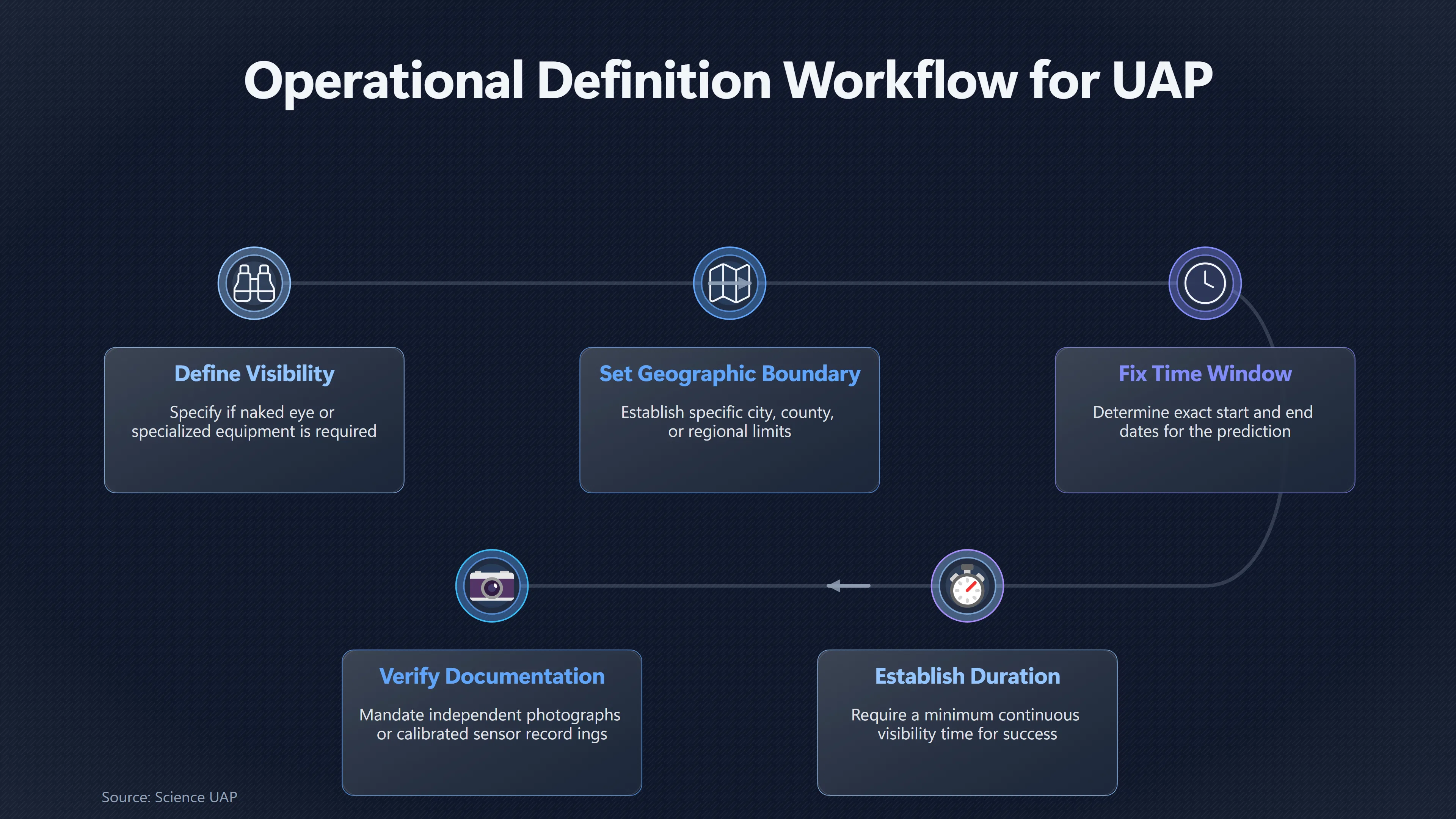
How to define visibility, duration and location
A prediction becomes much easier to evaluate when each important element receives an operational definition.
A practical framework might specify:
CriterionExample of a clear definitionVisibilityObservable without specialised equipment by ordinary members of the public.LocationWithin a named city, county or geographic boundary.TimeBetween specific dates and times.DurationRemaining continuously visible for at least 20 minutes.ScaleObservable simultaneously by multiple independent observers across the defined area.DocumentationRecorded by multiple independent photographs, videos or calibrated sensors.VerificationReports from unrelated observers whose accounts substantially agree.
None of these definitions proves that an object is extraordinary. Their purpose is simply to establish whether the predicted event occurred.
Forecasting platforms that evaluate real-world predictions routinely use similar resolution criteria. Questions are written so that the closing date, evidence requirements and later resolution are fixed before events unfold, reducing the opportunity to redefine success retrospectively.[Metaculus]metaculus.comMetaculus FAQ…
Should an unexplained object be required?
One of the largest sources of disagreement concerns the word unexplained.
There are at least three different possibilities:
- Initially unidentified. Observers cannot immediately identify the object.
- Unexplained after investigation. Experts examine available evidence and no conventional explanation is established.
- Permanently unexplained. No explanation is ever accepted.
These are very different standards.
Many reported UFO sightings are initially mysterious but later attributed to aircraft, balloons, astronomical objects, drones or optical effects. NASA notes that the limited quality of many observations makes firm conclusions difficult, and that there is currently no evidence linking UAP reports to extraterrestrial technology.[nasa.gov]science.nasa.govScience UAP FAQsNASA ScienceUAP FAQs - NASA Science…
If a prediction merely requires an object to be unidentified at first glance, it will succeed far more often than one requiring the object to remain unexplained after careful investigation.
Therefore, any falsifiable prediction should specify which definition is intended before the event.
Public visibility needs measurable thresholds
Predictions often promise a “public” appearance without defining what public means.
Possible measurable standards include:
- observed by at least a specified number of unrelated witnesses;
- reported from multiple independent locations;
- visible over a populated area rather than a remote location;
- documented by independent media organisations or public authorities;
- recorded simultaneously by more than one imaging system.
These thresholds are imperfect, but they are preferable to subjective claims that “many people saw it.”
Importantly, media coverage alone should not determine success. News organisations may ignore genuine events or heavily report mistaken ones. The prediction should define the observational event itself rather than relying on publicity afterwards.
Examples of clear and ambiguous sighting criteria
The contrast between vague and operational wording illustrates why definitions matter.
Ambiguous prediction
“A huge UFO will appear over America.”
Problems include:
- undefined geographic area;
- no deadline beyond the broader prediction period;
- no minimum size;
- no duration;
- no evidence standard;
- no definition of “huge”;
- no requirement that ordinary explanations be excluded.
Operational prediction
“Between 18:00 and 22:00 UTC on 14 October, an unidentified aerial object at least the apparent size of the full Moon will remain visible to the unaided eye for at least 30 consecutive minutes above central London, be independently photographed by at least 100 unrelated observers, and remain without an accepted conventional explanation after investigation.”
The second prediction may still prove false, but everyone can judge the outcome using the same criteria.
Why consistent rules prevent moving the goalposts
Failed UFO predictions are often rescued by changing the definition of success after the deadline.
Common examples include:
- reducing “worldwide” to a single local report;
- accepting blurry photographs after originally implying an obvious public spectacle;
- changing “landing” into a distant light in the sky;
- redefining “public appearance” as a private spiritual experience;
- arguing that governments concealed the event despite the original prediction implying open observation.
Predetermined sighting rules reduce these opportunities. Once the criteria have been published, later reinterpretation should not change whether the prediction succeeded.
This mirrors broader principles used in empirical science and structured forecasting: hypotheses are evaluated against criteria established before observations are collected, not rewritten afterwards to accommodate unexpected results.[NASA Science]science.nasa.govScience UAPNASA ScienceUAP - NASA ScienceFebruary 23, 2026…
The essential rule for testing UFO predictions
A UFO prediction should not be judged by whether people remain convinced that “something happened.” It should be judged against pre-agreed observational criteria.
At a minimum, a testable prediction should define:
- what object or event qualifies as the sighting;
- where it must occur;
- when it must occur;
- how long it must remain observable;
- who must be able to observe it;
- what evidence counts;
- whether later conventional explanations invalidate the claim.
Only when these definitions are fixed before the deadline can a prediction be fairly classified as either fulfilled or failed. Such operational rules do not settle whether UFOs exist; they simply ensure that extraordinary claims are evaluated by consistent, transparent standards rather than changing interpretations after the event.
Amazon book picks
Further Reading
Books and field guides related to What Should Count as a Predicted UFO Sighting?. Use these as the next step if you want deeper reading beyond the article.
The UFO Experience
Cited by the New York Review of Books as “the best brief for visitation,” this classic study presents an analysis of UFO reports and conc...
The Logic of Scientific Discovery
When first published in 1959, this book revolutionized contemporary thinking about science and knowledge. It remains one of the most wide...
The Demon-Haunted World
NEW YORK TIMES BESTSELLER • From the renowned astronomer and author of Cosmos comes a “powerful [and] stirring defense of informed ration...
Calling Bullshit
Bullshit isn’t what it used to be. Now, two science professors give us the tools to dismantle misinformation and think clearly in a world...
eBay marketplace picks
Marketplace Samples
Live-tested eBay searches with available results related to this page.
Selected fromUFO camera accessory oneBay.co.uk.


Endnotes
1.
Source: science.nasa.gov
Title: Science UAP
Link:https://science.nasa.gov/uap/
Source snippet
NASA ScienceUAP - NASA ScienceFebruary 23, 2026...
Published: February 23, 2026
2.
Source: science.nasa.gov
Title: Science UAP FAQs
Link:https://science.nasa.gov/uap/faqs/
Source snippet
NASA ScienceUAP FAQs - NASA Science...
3.
Source: nasa.gov
Title: to Release, Discuss Unidentified Anomalous Phenomena Report
Link:https://www.nasa.gov/news-release/nasa-to-release-discuss-unidentified-anomalous-phenomena-report/
Source snippet
NASA to Release, Discuss Unidentified Anomalous Phenomena Report - NASA...
4.
Source: metaculus.com
Link:https://www.metaculus.com/faq/
Source snippet
Metaculus FAQ...
5.
Source: wired.com
Link:https://www.wired.com/story/nasa-ufos-aliens-report-2023
Source snippet
The agency stressed the need to shift the conversation from sensationalism to science and eliminate the stigma associated with reporting...
6.
Source: nasa.gov
Title: NAS A Provides Coverage of Unidentified Anomalous Phenomena Meeting
Link:https://www.nasa.gov/news-release/nasa-provides-coverage-of-unidentified-anomalous-phenomena-meeting/
7.
Source: nasa.gov
Title: NAS A Announces Unidentified Aerial Phenomena Study Team Members
Link:https://www.nasa.gov/general/nasa-announces-unidentified-aerial-phenomena-study-team-members/
8.
Source: science.nasa.gov
Title: identifying ufos and uaps
Link:https://science.nasa.gov/solar-system/skywatching/night-sky-network/identifying-ufos-and-uaps/
Additional References
9.
Source: apnews.com
Link:https://apnews.com/article/8b477a5ed6a42f99bb13a4518368ce9a
Source snippet
The findings from a yearlong study suggest overcoming the stigma attached to UFO research is essential for data collection. While the stu...
10.
Source: mdpi.com
Link:https://www.mdpi.com/2218-1997/11/10/326
Source snippet
Reliability Scale for UAP reports. Table 1. Reliability Scale for UAP reports. X | Long-duration sighting by multiple individuals/groups...
11.
Source: youtube.com
Title: 70 Years of UFO-UAP Data: A Scientific Review with Robert Powell (SCU Founder)
Link:https://www.youtube.com/watch?v=0hS4OYk_rOU
Source snippet
NASA Unidentified Anomalous Phenomena report press conference David Grusch Opening Statement at Unidentified Anomalous Phenomena (UAP) He...
12.
Source: ufouap.net
Title: It is a structured record of time, p
Link:https://www.ufouap.net/en/explainers/how-to-report-a-ufo-sighting
Source snippet
How to Report a UFO or UAP Sighting | Global UFO ArchiveJuly 23, 2026 — Reporting / Updated 2026-07-23 / 10 min read HOW TO REPORT A UFO...
Published: July 23, 2026
13.
Source: simplypsychology.org
Title: Karl Popper: Falsification Theory
Link:https://www.simplypsychology.org/karl-popper.html
Source snippet
July 27, 2026 — KARL POPPER: THEORY OF FALSIFICATION By Saul McLeod, PhD | Updated on July 27, 2026 Reviewed by Olivia Guy-Evans, MSc & >...
Published: July 27, 2026
14.
Source: youtube.com
Link:https://www.youtube.com/watch?v=KFSWeJe
Source snippet
70 Years of UFO-UAP Data: A Scientific Review with Robert Powell (SCU Founder)...
15.
Source: youtube.com
Title: Karl Popper, Science, & Pseudoscience: Crash Course Philosophy #8
Link:https://www.youtube.com/watch?v=-X8Xfl0JdTQ
Source snippet
The Scientific Approach to UAPs: An Insider Look with Dr. Michael Lembeck | Merged EP0113...
16.
Source: youtube.com
Title: Public Meeting on Unidentified Anomalous Phenomena (Official NASA Broadcast)
Link:https://www.youtube.com/watch?v=bQo08JRY0iM
Source snippet
Replay! NASA's Release of the Unidentified Anomalous Phenomena Report...
17.
Source: youtube.com
Title: Replay! NASA’s Release of the Unidentified Anomalous Phenomena Report
Link:https://www.youtube.com/watch?v=nuBMnluJfs0
Source snippet
Karl Popper, Science, & Pseudoscience: Crash Course Philosophy #8...
18.
Source: defense.gov
Link:https://www.defense.gov/News/News-Stories/Article/Article/3701297/dod-report-discounts-sightings-of-extraterrestrial-technology/