Within UFO Deadlines
How Publicity Raises the Cost of a Failed Landing
Publicity can raise the stakes of a landing prediction by attracting reporters, spectators, and pressure to explain failure afterward.
On this page
- Why groups alert the media
- Public expectation and performance
- How press coverage shapes the aftermath
Page outline Jump by section
Introduction
Press attention changes a predicted UFO landing from an internal belief into a public test. Once newspapers, broadcasters, online audiences and spectators know the date and place, the promised event acquires a visible deadline: reporters can wait, cameras can record an empty sky, and outsiders can ask why nothing happened. Publicity therefore raises both the attraction of the prophecy before the deadline and the reputational cost after it.
This pattern appears across very different eras. Dorothy Martin’s small 1954 circle was drawn into a cycle of newspaper stories, telephone calls, practical jokes and crowds outside her home. Decades later, the Unarius Academy deliberately cultivated publicity around predicted extraterrestrial arrivals. By 2008, Blossom Goodchild’s forecast spread largely through websites, videos and online discussion rather than a single local press corps. In each case, the audience beyond the core believers helped turn waiting for aliens into a performance whose failure required explanation.[theatlantic.com]theatlantic.comThe Atlantic The Christmas the Aliens Didn't ComeThe AtlanticThe Christmas the Aliens Didn't ComeDecember 18, 2015 — 18 Dec 2015 — At 6 o'clock on Christmas Eve, 1954, a small group of p…
Why groups alert the media
A landing prophecy needs witnesses if it is to deliver its full promised meaning. A private sighting might reassure insiders, but a publicly observed arrival could validate the group, establish its leader as a genuine contactee and force outsiders to reconsider humanity’s place in the universe. Media attention offers a shortcut to that larger audience.
The motives are not always purely promotional. Some believers regard publicity as a duty: if an extraterrestrial intervention is imminent, warning others can be framed as a moral obligation. Publicity may also create social proof. A prediction covered by a newspaper or discussed on television can appear more consequential simply because professional media have deemed it newsworthy, even when the coverage is sceptical or openly amused.
Yet press interest usually follows journalistic rather than prophetic priorities. A precise date, a promised spacecraft and a colourful group offer conflict, suspense and an easily understood deadline. Reporters do not need to endorse the claim to find it publishable. The story contains its own follow-up: either something extraordinary happens or the prediction fails in public.
Dorothy Martin’s prophecy became news before it became a classic case
In 1954, Dorothy Martin said messages received through automatic writing warned that a catastrophic flood would strike on 21 December and that flying saucers would rescue the faithful. The case attracted researchers after a newspaper report publicised the forecast. The press was therefore not merely documenting a settled group from a distance; publicity helped expand the circle of people watching, questioning and interfering with events.[WIRED]wired.comDon't Despair: Big Ideas Can Still Change The WorldIt revisits Leon Festinger's infiltration of a Chicago sect in 1954 to study cognitive dissonance, where believers faced the disconfirmat…
The resulting attention had immediate consequences. Journalists telephoned Martin’s home as the deadline approached. Public knowledge of the prediction also encouraged prank calls, including a supposed message from “Captain Video” announcing an earlier spacecraft collection. Members prepared for that arrival before eventually treating its failure as a rehearsal. The episode shows how publicity can alter the very event being reported: once a prophecy enters public circulation, hoaxers, reporters and curious outsiders become active participants rather than neutral observers.[Internet Archive]ia802802.us.archive.orgFestinger Riecken Schachter When Prophecy Fails 1956Keech. There were occasional calls from reporters, but the press had begun to lose interest in what might be happening at the…
The familiar account says Martin’s group initially resisted publicity but sought wider coverage after the flood and rescue failed, announcing that their spiritual light had saved the world. That sharp before-and-after contrast became central to When Prophecy Fails, the 1956 study associated with the theory of cognitive dissonance. Recent archival work by Thomas Kelly, however, disputes the claim that the group suddenly began proselytising only after failure. Kelly argues that publicity activity existed earlier and that the original researchers produced a misleading account of the group’s response.[Wiley Online Library]onlinelibrary.wiley.comOnline Library Debunking “When Prophecy Fails”Dorothy Martin continued to believe in aliens and extraterrestrial contact. All three would continue to study alien psychic messages in…
That dispute matters for understanding press attention. The safest conclusion is not that publicity automatically makes disappointed believers recruit more followers. It is that Martin’s group was already operating inside an unusually crowded environment of believers, undercover researchers, journalists, pranksters and neighbours. The public setting made a clean psychological interpretation difficult because the observers were helping shape the behaviour they claimed merely to record.
Public expectation turns waiting into performance
A prediction becomes more costly when it specifies not only a date but an observable scene. Reporters and spectators expect something to happen at a particular location. Believers may then have to decide where to stand, what to wear, how to behave and what to tell onlookers as the deadline passes. Waiting itself becomes news.
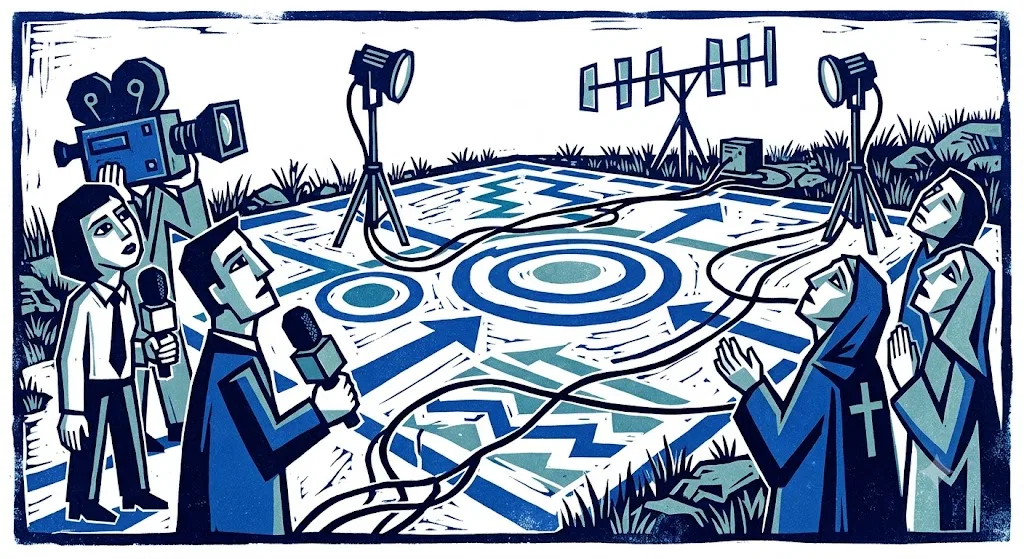
On Christmas Eve 1954, Martin’s followers gathered outside her Oak Park home for another expected spacecraft arrival. About 200 spectators reportedly came to watch. The crowd became disorderly enough for police involvement, while local officials considered action against Martin after complaints about the disruption and her influence on neighbourhood children. The spectacle had moved far beyond a private devotional gathering: it had become a community event involving crowd control, public ridicule and possible legal consequences.[The Atlantic]theatlantic.comThe Atlantic The Christmas the Aliens Didn't ComeThe AtlanticThe Christmas the Aliens Didn't ComeDecember 18, 2015 — 18 Dec 2015 — At 6 o'clock on Christmas Eve, 1954, a small group of p…
This kind of scene places asymmetric pressure on the predicting group. If a craft appears, the claimants expect vindication on a historic scale. If nothing appears, journalists still have a complete story: the crowd waited, the hour passed and the sky remained empty. The prophecy’s promoters cannot control which outcome receives attention.
Publicity also encourages observers to treat the deadline as entertainment. Some spectators attend in hope, others to mock, and others simply because a strange event is happening nearby. Their presence can harden the boundary between insiders and outsiders. Believers see jeering crowds as hostile or spiritually unprepared; sceptics interpret continued belief as proof of irrationality. That polarisation makes a nuanced admission—“we were mistaken”—socially difficult, because it can feel like capitulation to an audience that came expecting humiliation.
Unarius made media visibility part of the prediction
The Unarius Academy of Science offers a contrasting case because publicity was not merely an unwanted intrusion. Ruth Norman, one of its founders, developed an elaborate narrative in which advanced extraterrestrials would arrive on Earth. In 1976 she publicly wagered $4,000 with the bookmaker Ladbrokes that extraterrestrials would land within a year. The bet converted a religious expectation into a simple public proposition with a deadline, a financial stake and an obvious news angle.[Brewminate]brewminate.comUriel: Ruth E. Norman and the Cult of Unarius from the MidUriel: Ruth E. Norman and the Cult of Unarius from the Mid
After that prediction failed, Norman moved the expected arrival to 2001. The later forecast became a recurring feature of press coverage. A 1997 Los Angeles Times profile described the group’s expectation that extraterrestrials would come to Earth in 2001, giving the prediction renewed exposure several years before its deadline.[Los Angeles Times]latimes.comLos Angeles Times Age of Unarius: El Cajon Group Believes UFOs areLos Angeles Times Age of Unarius: El Cajon Group Believes UFOs are
Unarius also prepared for the landing through pageantry, art, costumes, films and rehearsed narratives. Scholarly work on the group stresses that members did not all understand the prediction in the same literal way. Some expected physical spacecraft; others treated the anticipated arrival as part of a larger spiritual process. After the September 11 attacks, some members suggested that world conditions might prevent the extraterrestrials from landing.[OUP Academic]academic.oup.comAcademic9 Preparation for the LandingAcademic9 Preparation for the Landing
That interpretive flexibility reduced the cost of public failure. The absence of spacecraft in 2001 could be explained through humanity’s unreadiness, changing conditions or misunderstanding by outsiders. At the same time, the publicity was not necessarily damaging to the organisation. Sociologist Diana Tumminia found that adverse coverage following failed predictions could still attract new interest. For a group whose identity already included colourful public performances, being treated as an eccentric curiosity could sustain visibility even when literal confirmation did not arrive.[Brewminate]brewminate.comUriel: Ruth E. Norman and the Cult of Unarius from the MidUriel: Ruth E. Norman and the Cult of Unarius from the Mid

Digital publicity creates a dispersed landing site
The internet altered the geography of UFO prophecy. A predicted landing no longer needed a single field or suburban house to attract an audience. Websites, message boards and video platforms could turn people in many countries into simultaneous sky-watchers.
Blossom Goodchild’s prediction for 14 October 2008 illustrates this shift. Goodchild said that a large craft associated with the “Federation of Light” would appear for three days in a way that proved the existence of extraterrestrial life. Her own promotional material presented the forecast in advance, while online supporters circulated videos, commentary and requests for people to watch the sky with cameras ready.[Blossom Goodchild]blossomgoodchild.comOpen source on blossomgoodchild.com.
By the deadline, the prediction had moved well beyond Goodchild’s immediate following. Religion Dispatches reported tens of thousands of search results for her name and dozens of related videos. Newspapers also ran deadline-day pieces, transforming a channelled message into an international media event.[Religion Dispatches]religiondispatches.orgReligion DispatchesAliens To Arrive in Alabama Today!Certainly, the October 14 prophecy seems to have resonated with the broader UFO comm…
The modern media environment intensified several older dynamics:
- The audience assembled without sharing one location. People could wait in different countries while still feeling part of a collective event.
- Supporters produced their own publicity. Videos, reposts and discussion threads reduced reliance on professional journalists.
- The prediction remained searchable after failure. Earlier claims, interviews and promotional statements could be compared directly with later explanations.
- Failure generated more content. Debunking, defence and reinterpretation extended attention beyond the missed date.
No widely verified craft appeared. Goodchild later described herself as shocked and distressed and continued to interpret messages attributed to the same source. The episode demonstrates that digital publicity makes failure harder to erase but does not necessarily end the underlying belief system. The failed deadline becomes part of an expanding archive that supporters can revisit, reinterpret or separate from the broader teachings.
How press coverage shapes the aftermath
Publicity does more than increase embarrassment. It influences which explanations are available and which are likely to be repeated.
A failed landing can be reframed as a postponement. The claim survives by moving the event into the future, as occurred repeatedly in the Unarius narrative.
The absence can be presented as purposeful. Believers may say that humanity was unready, that sceptical energy prevented contact or that public awareness itself fulfilled part of the mission.
The prophecy can shift from physical to spiritual language. A visible landing becomes an inner transformation, an unseen intervention or the beginning of a gradual process.
Hostile coverage can strengthen group boundaries. Mockery may be interpreted as evidence that outsiders are closed-minded, fearful or incapable of recognising the truth.
Publicity can outlive the failure. A group may gain books, interviews, documentary attention or new recruits precisely because the prediction became famous.
These responses should not be treated as automatic. Research on failed prophecy shows considerable variation: some adherents leave, some reinterpret, some remain attached to the community while quietly abandoning the literal prediction, and some leaders reduce their public claims. The response depends on prior commitment, group cohesion, leadership and the availability of an explanation that followers find credible. The Martin case is especially unsuitable as a universal template because researchers and journalists were deeply entangled in the events, and the standard account is now subject to substantial archival criticism.[Wiley Online Library]onlinelibrary.wiley.comOnline Library Debunking “When Prophecy Fails”Dorothy Martin continued to believe in aliens and extraterrestrial contact. All three would continue to study alien psychic messages in…

Publicity raises the cost, but also supplies an escape route
Press attention creates a paradox. It raises the cost of failure by preserving the promise, assembling witnesses and demanding an answer when the predicted craft does not arrive. Yet it also supplies the attention through which a group can reinterpret the event, reach new audiences and transform embarrassment into a new chapter of its story.
The most important distinction is between evidential failure and organisational survival. A public landing prediction fails when the promised observable event does not occur by its stated deadline. Whether the predicting group survives is a separate question. Publicity may expose the failed claim more clearly, but it can also give leaders the platform needed to explain, postpone or spiritualise it.
In failed UFO prophecies, therefore, the press is neither a passive mirror nor a simple corrective. Reporters, spectators and online participants help construct the social occasion surrounding the deadline. They turn private expectation into public theatre, increase the pressure for a visible result and shape the narratives through which the empty sky is remembered afterwards.
Amazon book picks
Further Reading
Books and field guides related to How Publicity Raises the Cost of a Failed Landing. Use these as the next step if you want deeper reading beyond the article.
When Prophecy Fails
The study reported in this volume grew out of some theoretical work, one phase of which bore specifically on the behavior of individuals...
The Demon-Haunted World
NEW YORK TIMES BESTSELLER • From the renowned astronomer and author of Cosmos comes a “powerful [and] stirring defense of informed ration...
The UFO Experience: A Scientific Inquiry
Cited by the New York Review of Books as "the best brief for visitation," this classic study presents an analysis of UFO reports and conc...
American Cosmic
More than half of American adults and more than seventy-five percent of young Americans believe in intelligent extraterrestrial life. Thi...
eBay marketplace picks
Marketplace Samples
Live-tested eBay searches with available results related to this page.
Selected fromalien memorabilia oneBay.co.uk.


Endnotes
1.
Source: jstor.org
Link:https://www.jstor.org/stable/3712078
Source snippet
Unarius simply pushed back the date to the year 2001. public record of distress over the...
2.
Source: wired.com
Title: Don’t Despair: Big Ideas Can Still Change The World
Link:https://www.wired.com/2017/04/dont-despair-big-ideas-can-still-change-world
Source snippet
It revisits Leon Festinger's infiltration of a Chicago sect in 1954 to study cognitive dissonance, where believers faced the disconfirmat...
3.
Source: ia802802.us.archive.org
Title: Festinger Riecken Schachter When Prophecy Fails 1956
Link:https://ia802802.us.archive.org/4/items/pdfy-eDNpDzTy_dR1b0iB/Festinger-Riecken-Schachter-When-Prophecy-Fails-1956.pdf
Source snippet
Keech. There were occasional calls from reporters, but the press had begun to lose interest in what might be happening at the...
4.
Source: onlinelibrary.wiley.com
Title: Online Library Debunking “When Prophecy Fails”
Link:https://onlinelibrary.wiley.com/doi/10.1002/jhbs.70043
Source snippet
Dorothy Martin continued to believe in aliens and extraterrestrial contact. All three would continue to study alien psychic messages in...
5.
Source: onlinelibrary.wiley.com
Title: Online Library Debunking “When Prophecy Fails”
Link:https://onlinelibrary.wiley.com/doi/abs/10.1002/jhbs.70043
6.
Source: brewminate.com
Title: Uriel: Ruth E. Norman and the Cult of Unarius from the Mid
Link:https://brewminate.com/uriel-ruth-e-norman-and-the-cult-of-unarius-from-the-mid-20th-century/
7.
Source: academic.oup.com
Title: Academic9 Preparation for the Landing
Link:https://academic.oup.com/book/7811/chapter/152993807
8.
Source: jstor.org
Link:https://www.jstor.org/stable/10.1525/nr.1999.3.1.60
9.
Source: jstor.org
Link:https://www.jstor.org/stable/48767983
10.
Source: compass.onlinelibrary.wiley.com
Title: j.1749 8171.2011.00313.x
Link:https://compass.onlinelibrary.wiley.com/doi/10.1111/j.1749-8171.2011.00313.x
11.
Source: archive.org
Title: whenprophecyfail00fest 0
Link:https://archive.org/details/whenprophecyfail00fest_0
12.
Source: time.com
Title: ufo cultists political paranoia essay
Link:https://time.com/6960441/ufo-cultists-political-paranoia-essay/
13.
Source: youtube.com
Link:https://www.youtube.com/watch?v=7ISouYtSsrE
Source snippet
Blossom Goodchild UFO 2008 Thank You Blossom Goodchild...
14.
Source: theatlantic.com
Title: The Atlantic The Christmas the Aliens Didn’t Come
Link:https://www.theatlantic.com/health/archive/2015/12/the-christmas-the-aliens-didnt-come/421122/
Source snippet
The AtlanticThe Christmas the Aliens Didn't ComeDecember 18, 2015 — 18 Dec 2015 — At 6 o'clock on Christmas Eve, 1954, a small group of p...
Published: December 18, 2015
15.
Source: religiondispatches.org
Link:https://religiondispatches.org/2008/10/14/aliens-arrive-alabama-today
Source snippet
Religion DispatchesAliens To Arrive in Alabama Today!Certainly, the October 14 prophecy seems to have resonated with the broader UFO comm...
16.
Source: Wikipedia
Title: When Prophecy Fails
Link:https://en.wikipedia.org/wiki/When_Prophecy_Fails
17.
Source: latimes.com
Title: Los Angeles Times Age of Unarius: El Cajon Group Believes UFOs are
Link:https://www.latimes.com/archives/la-xpm-1997-04-07-mn-46356-story.html
18.
Source: blossomgoodchild.com
Link:https://www.blossomgoodchild.com/eyes-to-the-skies/
19.
Source: blossomgoodchild.com
Link:https://www.blossomgoodchild.com/wp-content/uploads/2020/04/SNAPSHOT-with-Index.pdf
20.
Source: Wikipedia
Title: Unarius Academy of Science
Link:https://en.wikipedia.org/wiki/Unarius_Academy_of_Science
21.
Source: Wikipedia
Title: Ruth Norman
Link:https://en.wikipedia.org/wiki/Ruth_Norman
22.
Source: books.google.com
Title: When Prophecy Fails
Link:https://books.google.com/books/about/When_Prophecy_Fails.html?id=FTAxYAAACAAJ
23.
Source: youtube.com
Link:https://www.youtube.com/watch?v=f7VNRX879Ns
24.
Source: youtube.com
Link:https://www.youtube.com/watch?v=h5MA03Dac4Y
25.
Source: unexplained-mysteries.com
Link:https://www.unexplained-mysteries.com/forum/?app=core&content_class=forums_Topic&content_commentid=2551587&content_id=136655&controller=content&do=find&module=system
26.
Source: markfoster.net
Link:https://www.markfoster.net/dcf/Unarius.pdf
Additional References
27.
Source: youtube.com
Title: End of Days Cults, the Day After | Cognitive Dissonance (Video Essay)
Link:https://www.youtube.com/watch?v=5yVuauQjkDc
Source snippet
What is Unarius? UFOs, wild costumes and out of this world videos | Bartell's Backroads...
28.
Source: youtube.com
Title: The Seekers: When UFO Prophecy Failed and the Cult Stayed
Link:https://www.youtube.com/watch?v=Xlp4qETDQL8
Source snippet
End of Days Cults, the Day After | Cognitive Dissonance (Video Essay)...
29.
Source: brookguitars.com
Link:https://www.brookguitars.com/author/stve/
30.
Source: rcfp.org
Link:https://www.rcfp.org/resources/first-amendment-handbook/
31.
Source: apa.org
Link:https://www.apa.org/topics/social-media-internet/health-advisory-adolescent-social-media-use
32.
Source: facebook.com
Link:https://www.facebook.com/keith.dindi/posts/it-was-in-the-middle-of-a-ward-round-right-there-in-front-of-more-than-twenty-cl/33954205427499831/
33.
Source: oprfmuseum.org
Link:https://oprfmuseum.org/this-month-in-history/seekers-cuyler-avenue
34.
Source: instagram.com
Link:https://www.instagram.com/reel/DYQn5qvI6GU/?hl=en
35.
Source: happierabroad.com
Link:https://www.happierabroad.com/forum/viewtopic.php?t=4348
36.
Source: reddit.com
Link:https://www.reddit.com/r/Soulnexus/comments/c5zwn4/recent_channeling_from_blossom_goodchild_saying/