Within Disaster Averted
How Real Prevention Leaves Evidence Behind
Evacuations, screenings and inspections leave measurable traces that spiritual catastrophe claims usually lack.
On this page
- Observable threats and measurable interventions
- Comparisons with untreated or unprotected cases
- Why belief only claims lack the same evidence chain
Page outline Jump by section
Introduction
Within discussions of failed UFO prophecies, one recurring claim is that a predicted catastrophe did not occur because believers spiritually prevented it. This explanation differs fundamentally from genuine risk reduction. When a real hazard is reduced through evacuation, engineering, disease screening or other practical interventions, the process leaves observable evidence: the threat can be measured, the intervention can be documented, and outcomes can be compared with situations where the intervention was absent or delayed. By contrast, claims that prayer, meditation or collective belief prevented a foretold UFO-related disaster generally offer no independent evidence that either the original danger or the alleged preventive mechanism existed. The distinction is not about whether prevention is possible in principle—it clearly is—but about whether the claimed prevention can be independently verified.
How practical prevention creates an evidence trail
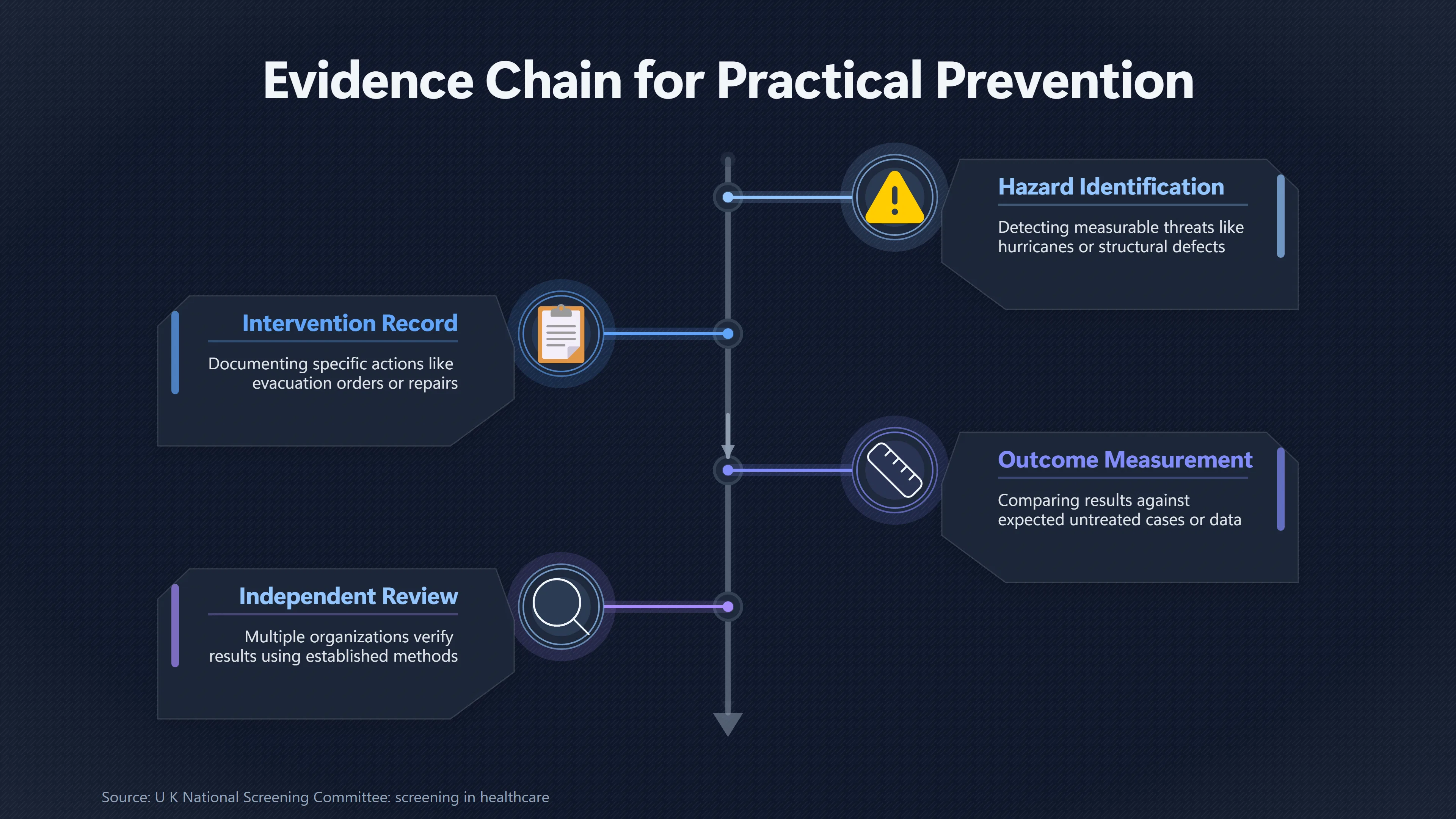
Successful prevention often appears paradoxical because the feared disaster never fully unfolds. However, the absence of disaster is not the only evidence available. Researchers and public authorities evaluate prevention through a chain of observable facts rather than through the outcome alone.
For practical interventions, investigators can typically identify:
- A documented hazard, such as an approaching hurricane, a structural defect or a detectable disease.
- An identifiable intervention, including evacuation orders, repairs, vaccination or screening.
- Records showing who received the intervention and when.
- Measurable outcomes that can be compared with expected or untreated cases.
- Independent review by multiple organisations using established methods.
The key point is that prevention is supported by evidence before, during and after the intervention, rather than by retrospective interpretation.
Population screening illustrates this approach well. Health authorities recommend screening programmes only after evidence shows that the complete pathway—from testing through treatment—improves outcomes more than it causes harm. Programmes are continually monitored and reassessed using measurable indicators such as disease incidence, mortality and false-positive rates rather than relying on assertions that unseen dangers have been removed.[GOV.UK]GOV.UKU K National Screening Committee: screening in healthcareUK National Screening Committee: screening in healthcare - Principles of screening - Guidance - GOV.UKOctober 10, 2022…
Similarly, the World Health Organization emphasises that screening programmes require evidence demonstrating effectiveness and ongoing quality assurance because screening itself can create harms if unsupported by good evidence.[World Health Organization]who.intWorld Health OrganizationScreening programmes: a short guide. Increase effectiveness, maximize benefits and minimize harmFebruary 6, 2020…
Why comparisons matter
A defining feature of evidence-based prevention is the ability to compare outcomes.
Although it is impossible to observe the exact alternative history in which no intervention occurred, researchers can often estimate effects through controlled comparisons, historical data, natural experiments or statistical modelling.
Examples include:
- Disease screening: Researchers compare screened and unscreened populations, adjusting for relevant differences, to estimate reductions in mortality or severe illness.
- Engineering inspections: Structures inspected and repaired can be compared with known failure mechanisms and historical failure rates.
- Emergency evacuations: Authorities examine casualty rates, property losses, evacuation compliance and storm intensity to evaluate whether protective actions reduced harm.
For example, modelling of increased uptake of evidence-based cancer screening estimates substantial reductions in preventable deaths because researchers can measure screening participation, disease detection and mortality over time. These estimates remain open to revision as new evidence emerges, illustrating that scientific prevention is continually tested rather than insulated from criticism.[CDC]cdc.govPreventing Breast, Cervical, and Colorectal Cancer Deaths: Assessing the Impact of Increased ScreeningOctober 8, 2020…
Importantly, not every proposed preventive measure proves effective. Some broad health-check programmes have shown little or no reduction in mortality despite good intentions. Rather than treating this as a success, systematic reviews report the disappointing results and recommend reconsideration of such programmes. This willingness to reject ineffective interventions is itself part of evidence-based practice.[Cochrane]cochrane.orgGeneral health checks for reducing illness and mortality | CochraneGeneral health checks for reducing illness and mortality | Cochrane…

Why belief-based catastrophe prevention lacks the same evidence chain
Belief-based rescue claims surrounding failed UFO prophecies usually lack each stage of this evidential sequence.
Typically, there is:
- No independently verified impending catastrophe.
- No demonstrated physical mechanism by which collective belief alters the predicted event.
- No measurable record linking the claimed intervention to a change in risk.
- No comparison allowing investigators to distinguish prevention from an incorrect prediction.
Instead, the reasoning depends on a counterfactual assertion: the disaster would have happened had believers not acted. Because the alternative history cannot be independently examined, the claim becomes effectively unfalsifiable. Every outcome can be interpreted as supporting the original prophecy.
This differs from ordinary scientific uncertainty. Scientific estimates may be incomplete, but they remain tied to observable measurements that can confirm, weaken or overturn previous conclusions.
The Dorothy Martin case as a comparison
The 1954 Dorothy Martin episode remains one of the best-known examples involving UFO-related failed prophecy.
Martin predicted catastrophic flooding and taught that extraterrestrial beings would rescue selected followers. After neither the flood nor the rescue occurred, an alternative explanation emerged that the group’s spiritual activity had saved the world. In its classic interpretation, this became an influential illustration of belief adjustment following prophetic failure.[Wikipedia]WikipediaWhen Prophecy FailsWhen Prophecy Fails
Regardless of debates over later historical interpretations of the episode—including recent archival arguments challenging aspects of the original social-psychological account—the central evidential issue remains unchanged. Neither the original catastrophe nor its alleged spiritual prevention produced independent physical evidence that could distinguish “the disaster was prevented” from “the prediction was incorrect.”[DOI]doi.orgDebunking “When Prophecy Fails”Debunking “When Prophecy Fails” - Kelly - 2026 - Journal of the History of the Behavioral Sciences - Wiley Online LibraryNovember 4, 2025…
This contrasts sharply with genuine emergency management. If authorities order a coastal evacuation before a hurricane, investigators can later examine meteorological measurements, evacuation records, infrastructure damage and casualty statistics. Those records permit independent evaluation of whether the intervention reduced harm.
Why observable evidence matters
The distinction between practical prevention and belief-based prevention is not whether the outcome is desirable—both seek to avoid catastrophe—but whether the claimed causal chain can be independently examined.
Evidence-based prevention remains accountable because it generates observable traces:
- Hazards are measured before intervention.
- Actions are documented.
- Outcomes are monitored.
- Independent investigators can challenge or replicate the findings.
- Programmes can be revised or abandoned when evidence fails to support them.[Wikipedia]WikipediaWhen Prophecy FailsWhen Prophecy Fails
Belief-only prevention claims lack these safeguards. Because they rely on an invisible change to an unseen alternative future, there is no independent method for determining whether a disaster was genuinely averted or whether no disaster was ever imminent.
Within the broader pattern of failed UFO predictions, this evidential difference explains why practical prevention can be evaluated scientifically, whereas post hoc claims that believers spiritually prevented an expected catastrophe remain matters of belief rather than independently testable historical evidence.
Amazon book picks
Further Reading
Books and field guides related to How Real Prevention Leaves Evidence Behind. Use these as the next step if you want deeper reading beyond the article.
The Art of Statistics
'A statistical national treasure' Jeremy Vine, BBC Radio 2 'Required reading for all politicians, journalists, medics and anyone who trie...
The Book of Why
The hugely influential book on how the understanding of causality revolutionized science and the world, by the pioneer of artificial inte...
The Demon-Haunted World
NEW YORK TIMES BESTSELLER • From the renowned astronomer and author of Cosmos comes a “powerful [and] stirring defense of informed ration...
Why People Believe Weird Things
Rating: 4.0/5 from 7 Google Books ratings
Revised and Expanded Edition. In this age of supposed scientific enlightenment, many people still believe in mind reading, past-life regr...
eBay marketplace picks
Marketplace Samples
Live-tested eBay searches with available results related to this page.
Selected fromUFO poster oneBay.co.uk.

Current eBay listing
I Want To Believe UFO Poster Giclée Fine Art Heavyweight Print

Current eBay listing
VINTAGE UFO FLYING SAUCERS COMIC ADVERTISING A2 POSTER PRINT
Endnotes
1.
Source: GOV.UK
Title: U K National Screening Committee: screening in healthcare
Link:https://www.gov.uk/guidance/principles-of-population-screening/principles-of-screening
Source snippet
UK National Screening Committee: screening in healthcare - Principles of screening - Guidance - GOV.UKOctober 10, 2022...
Published: October 10, 2022
2.
Source: GOV.UK
Title: U K National Screening Committee: screening in healthcare
Link:https://www.gov.uk/guidance/principles-of-population-screening/effectiveness
Source snippet
UK National Screening Committee: screening in healthcare - Effectiveness - Guidance - GOV.UK...
3.
Source: GOV.UK
Title: Criteria for a population screening programme
Link:https://www.gov.uk/government/publications/evidence-review-criteria-national-screening-programmes/criteria-for-appraising-the-viability-effectiveness-and-appropriateness-of-a-screening-programme
4.
Source: who.int
Link:https://www.who.int/publications/i/item/9789289054782
Source snippet
World Health OrganizationScreening programmes: a short guide. Increase effectiveness, maximize benefits and minimize harmFebruary 6, 2020...
Published: February 6, 2020
5.
Source: who.int
Link:https://www.who.int/europe/publications/i/item/978
Source snippet
World Health OrganizationWhat is the effectiveness of systematic population-level screening programmes for reducing the burden of cardiov...
6.
Source: cdc.gov
Link:https://www.cdc.gov/pcd/issues/2020/20_0039.htm
Source snippet
Preventing Breast, Cervical, and Colorectal Cancer Deaths: Assessing the Impact of Increased ScreeningOctober 8, 2020...
Published: October 8, 2020
7.
Source: cochrane.org
Title: General health checks for reducing illness and mortality | Cochrane
Link:https://www.cochrane.org/evidence/CD009009_general-health-checks-reducing-illness-and-mortality
Source snippet
General health checks for reducing illness and mortality | Cochrane...
8.
Source: Wikipedia
Title: When Prophecy Fails
Link:https://en.wikipedia.org/wiki/When_Prophecy_Fails
9.
Source: doi.org
Title: Debunking “When Prophecy Fails”
Link:https://doi.org/10.1002%2Fjhbs.70043
Source snippet
Debunking “When Prophecy Fails” - Kelly - 2026 - Journal of the History of the Behavioral Sciences - Wiley Online LibraryNovember 4, 2025...
Published: November 4, 2025
10.
Source: cdc.gov
Link:https://www.cdc.gov/field-epi-manual/php/chapters/interventions.html
11.
Source: who.int
Link:https://www.who.int/europe/publications/i/item/9789289055376
12.
Source: stacks.cdc.gov
Link:https://stacks.cdc.gov/view/cdc/88994/
Additional References
13.
Source: youtube.com
Title: The Seekers: When UFO Prophecy Failed and the Cult Stayed
Link:https://www.youtube.com/watch?v=Xlp4qETDQL8
Source snippet
When Prophecy Fails Leon Festinger cognitive [dissonance]({{ 'dissonance/' | relative_url }}) 1954 Festinger & Carlsmith's Cognitive Dissonance Study...
14.
Source: youtube.com
Title: Strange UFO Cult Changed Psychology Forever | Origin of Cognitive Dissonance
Link:https://www.youtube.com/watch?v=VclR4H0PzmI
Source snippet
End of Days Cults, the Day After | Cognitive Dissonance (Video Essay)...
15.
Source: youtube.com
Title: Festinger’s When Prophecy Fails: What Happens After the World Doesn’t End
Link:https://www.youtube.com/watch?v=bkRjQ5juZXk
Source snippet
When Prophecy Fails: Why We Believe Harder After Being Proven Wrong...
16.
Source: youtube.com
Title: End of Days Cults, the Day After | Cognitive Dissonance (Video Essay)
Link:https://www.youtube.com/watch?v=5yVuauQjkDc
Source snippet
Festinger's When Prophecy Fails: What Happens After the World Doesn't End...
17.
Source: youtube.com
Title: When Prophecy Fails: Why We Believe Harder After Being Proven Wrong
Link:https://www.youtube.com/watch?v=5ClPsT9jZng
Source snippet
The Seekers: When UFO Prophecy Failed and the Cult Stayed...
18.
Source: labs.sciety.org
Link:https://labs.sciety.org/articles/by?article_doi=10.31235%2Fosf.io%2F9j7qc_v2
Source snippet
Thomas Kelly 0 evaluations Published on Oct 5, 2025 Read the full article Related papers This article on Sciety ABSTRACT In 1954, Dorothy...
19.
Source: eurekamag.com
Link:https://eurekamag.com/research/099/774/099774291.php
20.
Source: persee.fr
Link:https://www.persee.fr/doc/assr_0003-9659_1958_num_5_1_1979_t1
21.
Source: bmj.com
Link:https://www.bmj.com/content/345/bmj.e7191
22.
Source: skepticalinquirer.org
Link:https://skepticalinquirer.org/2021/04/when-qanon-prophecy-fails/