Within Prediction Records
Why a Screenshot Is Not Enough Proof
Screenshots preserve appearance but may omit URLs, edits, account details and timestamps needed to authenticate a prediction.
On this page
- What screenshots preserve and what they lose
- How attribution errors happen
- Building corroboration around a screenshot
Page outline Jump by section
Introduction
When assessing failed UFO predictions, a screenshot is useful as a visual record, but it is rarely enough to establish that a prediction genuinely existed in a particular form before its stated deadline. A screenshot shows what appeared on one screen at one moment, yet it often omits the information needed to verify who published the claim, when it was published, whether it was later edited, and whether the image itself has been altered. Because many UFO predictions circulate through social media, messaging apps and reposted images, relying on screenshots alone creates opportunities for both honest mistakes and deliberate misrepresentation.

For documenting predictions before they fail or succeed, screenshots should therefore be treated as one piece of evidence within a broader record rather than as definitive proof. The strongest documentation combines screenshots with archived webpages, original URLs, independent timestamps and other records that can be checked by others.
What screenshots preserve and what they lose
A screenshot captures the visible appearance of a page or post. It can preserve:
- The wording visible at the time of capture.
- The layout and formatting.
- Images or graphics accompanying the prediction.
- Comments or reactions that happened to be visible.
However, important information is frequently absent or cropped away. A screenshot often fails to preserve:
- The complete URL.
- The platform or website where the claim originated.
- The account profile or author information.
- The publication date and precise timestamp.
- Whether the content was edited after publication.
- Links to related posts or corrections.
- Technical metadata proving where or when the image itself was created.
These omissions matter because a UFO prediction is normally evaluated on specific details such as who made it, exactly what was predicted, and whether the statement was publicly available before the promised event. Without those details, an image cannot by itself establish the history of the claim. Research on verifying social-media screenshots has shown that screenshots commonly require additional information—such as account names, timestamps and archived versions—to confirm that they accurately represent an authentic original post.[arXiv]arxiv.orgarXiv Extracting Information from Twitter ScreenshotsExtracting Information from Twitter ScreenshotsJune 14, 2023…
Why timing cannot be established from the image alone
The central question for failed predictions is whether the prediction genuinely existed before the deadline.
A screenshot may appear to show a date, but several uncertainties remain:
- The visible date might refer to when the post was displayed rather than when it was originally published.
- The platform may allow posts to be edited after publication.
- The image itself can be captured days, months or years later.
- Local device clocks can be incorrect or deliberately altered.
- Cropped screenshots may remove the surrounding context that identifies the relevant timeline.
Consequently, a screenshot saying “14 October” does not necessarily prove that readers could see that prediction before 14 October. Independent evidence—such as an archived webpage captured before the deadline or a contemporaneous news report—is needed to demonstrate that the prediction was publicly available at the relevant time.
How attribution errors happen
Attribution problems are common when screenshots circulate independently of their original source.
A prediction may be incorrectly assigned because:
- the username or website name has been cropped out;
- reposts substitute a different caption;
- several similar-looking accounts exist;
- the screenshot combines multiple images into one composite;
- text has been edited before redistribution.
In UFO discussions, predictions often spread across forums, image-sharing sites and social-media reposts. As the image moves further from the original publication, it becomes increasingly difficult to identify the actual author or determine whether the wording has changed.
Academic work on screenshot verification has highlighted author misattribution as a recurring problem. Researchers have developed methods that extract usernames, timestamps and post text from screenshots specifically because visual inspection alone is often insufficient to verify who originally published the material.[arXiv]arxiv.orgCategorizing Social Media Screenshots for Identifying Author MisattributionOctober 9, 2024…

Screenshots can be edited more easily than readers realise
A screenshot is simply an image file.
Modern editing software can modify:
- dates;
- usernames;
- profile photographs;
- visible text;
- reaction counts;
- browser elements;
- interface colours.
Even without malicious editing, screenshots are routinely compressed, resized or annotated before being shared, making later forensic examination more difficult.
This does not mean every screenshot is false. Rather, it means the image alone cannot demonstrate that it has remained unchanged since capture. Digital-forensics guidance consistently treats screenshots as secondary evidence that gains credibility only when supported by provenance, metadata or independent preservation records.[NIST]nist.govMedia Forensics Challenge Image Provenance Evaluation and State-of-the-Art Analysis on Large-Scale Benchmark Datasets | NISTOctober 2…
Building corroboration around a screenshot
A screenshot becomes substantially more useful when accompanied by evidence that other people can independently verify.
Helpful corroboration includes:
- the original URL;
- an archived copy from a recognised web archive;
- the capture date recorded by the archive;
- additional screenshots from different users;
- the complete browser window showing the address bar;
- contemporaneous discussion in newspapers, blogs or forums;
- downloadable copies of the original page where available.
Multiple independent records are particularly valuable because they reduce the chance that every copy shares the same mistake or manipulation. If a webpage, archive snapshot and screenshot all preserve identical wording before the prediction deadline, confidence in the historical record increases considerably.
Practical documentation for UFO prediction research
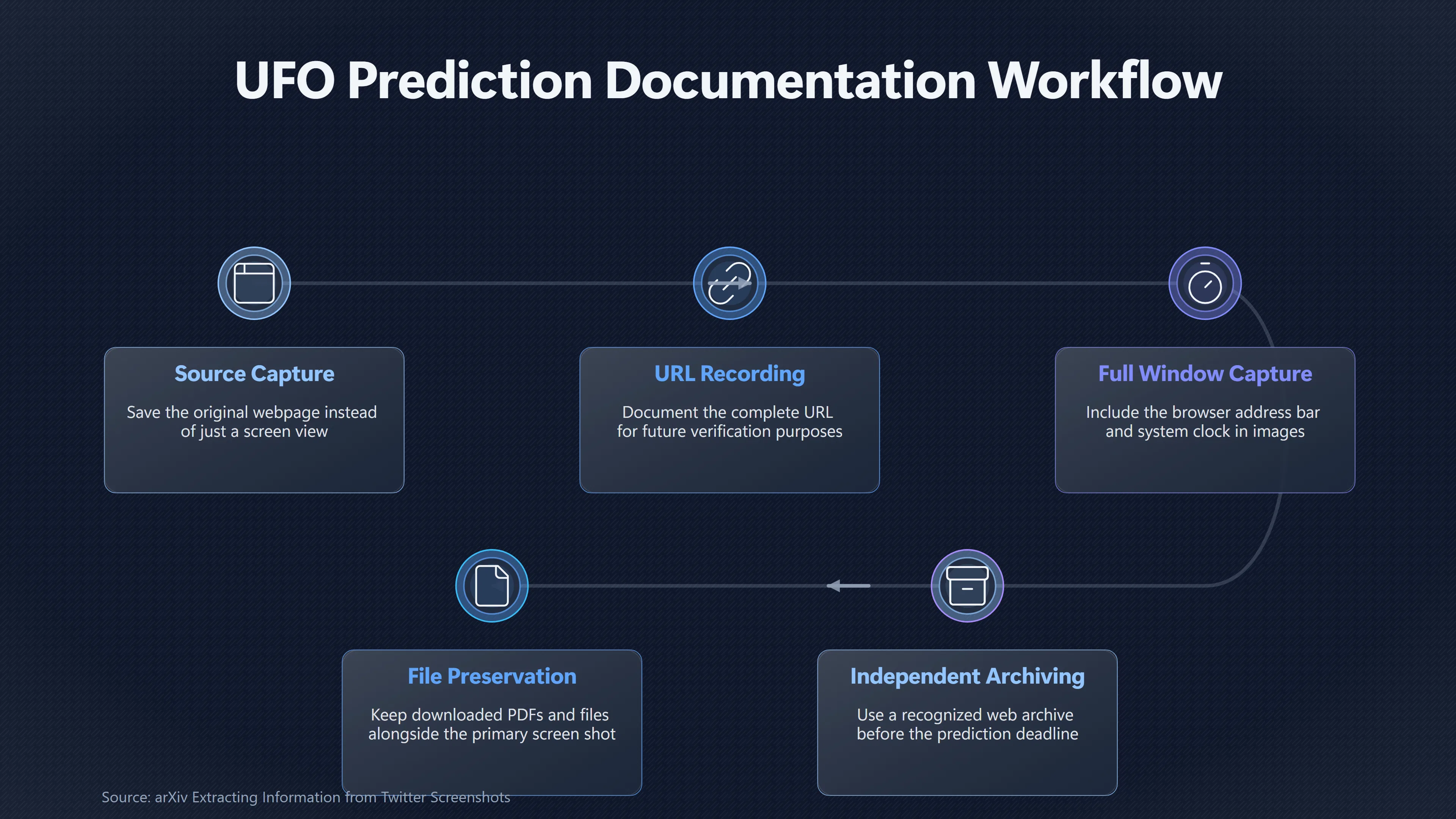
For documenting failed UFO predictions, a sensible preservation workflow is:
- Save the original webpage rather than only the visible screen.
- Record the complete URL.
- Capture a full-window screenshot that includes the browser address bar and, where practical, the system clock.
- Archive the page using an independent web-archiving service before the prediction deadline.
- Preserve downloaded files or PDFs alongside the screenshot.
- Record when and how the material was collected.
- Compare later versions against the preserved record instead of relying on memory or reposted images.
This approach allows future readers to distinguish between the claimant’s original prediction and any explanations, revisions or reinterpretations published after the predicted event failed to occur.
Why this distinction matters
Many disputes over failed UFO predictions do not concern whether a screenshot exists, but whether the screenshot accurately represents the original claim at the relevant point in time. A compelling image may persuade casual readers, yet it cannot by itself establish authorship, publication history or authenticity.
For that reason, screenshots should be viewed as visual aids rather than complete historical records. They preserve appearance, but they often lose the contextual and technical information required to verify a prediction before its deadline. Combining screenshots with archived originals, stable URLs and independent timestamps produces a far more reliable basis for evaluating whether a UFO prediction genuinely failed according to the terms originally presented.
Amazon book picks
Further Reading
Books and field guides related to Why a Screenshot Is Not Enough Proof. Use these as the next step if you want deeper reading beyond the article.
Calling Bullshit
Bullshit isn’t what it used to be. Now, two science professors give us the tools to dismantle misinformation and think clearly in a world...
The Demon-Haunted World
Rating: 4.5/5 from 43 Google Books ratings
NEW YORK TIMES BESTSELLER • From the renowned astronomer and author of Cosmos comes a “powerful [and] stirring defense of informed ration...
Bad Science
Ben Goldacre takes us on a journey through the bad science we are fed daily by hacks and quacks.
eBay marketplace picks
Marketplace Samples
Live-tested eBay searches with available results related to this page.
Selected fromUFO poster oneBay.co.uk.

Current eBay listing
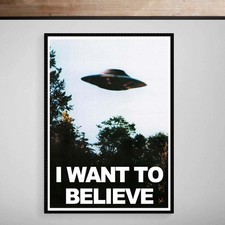
I Want To Believe UFO Poster Giclée Fine Art Heavyweight Print


Current eBay listing
VINTAGE UFO FLYING SAUCERS COMIC ADVERTISING A2 POSTER PRINT
Endnotes
1.
Source: arxiv.org
Title: arXiv Extracting Information from Twitter Screenshots
Link:https://arxiv.org/abs/2306.08236
Source snippet
Extracting Information from Twitter ScreenshotsJune 14, 2023...
Published: June 14, 2023
2.
Source: arxiv.org
Title: arXiv Web Archives for Verifying Attribution in Twitter Screenshots
Link:https://arxiv.org/abs/2510.22939
3.
Source: arxiv.org
Link:https://arxiv.org/abs/2410.06443
Source snippet
Categorizing Social Media Screenshots for Identifying Author MisattributionOctober 9, 2024...
Published: October 9, 2024
4.
Source: nist.gov
Link:https://www.nist.gov/publications/media-forensics-challenge-image-provenance-evaluation-and-state-art-analysis-large
Source snippet
Media Forensics Challenge Image Provenance Evaluation and State-of-the-Art Analysis on Large-Scale Benchmark Datasets | NISTOctober 2...
5.
Source: csrc.nist.gov
Link:https://csrc.nist.gov/glossary/term/provenance
6.
Source: nist.gov
Title: user guide nist media forensic challenge mfc datasets
Link:https://www.nist.gov/publications/user-guide-nist-media-forensic-challenge-mfc-datasets
7.
Source: nist.gov
Link:https://www.nist.gov/publications/media-forensics-challenge-image-provenance-evaluation-and-state-art-analysis-large-0
8.
Source: nist.gov
Link:https://www.nist.gov/digital-evidence
9.
Source: csrc.nist.gov
Link:https://csrc.nist.gov/glossary/term/snapshot
Additional References
10.
Source: getproofsnap.com
Title: Save Web Pages as Court-Admissible Evidence | Proof Snap
Link:https://getproofsnap.com/
Source snippet
Vayner, Griffin v. State, and Serrano v. Cruz-Angeles all rejected screenshot evidence. Here's why. NO TIMESTAMP PROOF File timestamps ca...
11.
Source: inet-investigation.com
Title: Inet Investigation Evidence Handling & Metadata for Investigators
Link:https://www.inet-investigation.com/evidence-handling-metadata-for-investigators/
Source snippet
Inet InvestigationEvidence Handling & Metadata for Investigators - Public Record Research & Online Investigation Guides...
12.
Source: validatefacts.com
Title: Screenshot evidence: reliability without source links | V…
Link:https://validatefacts.com/fact-check/can-screenshots-prove-claims-without-source-links
Source snippet
> "Verify whether screenshots of posts or messages are reliable evidence without source links...
13.
Source: metopedia.com
Title: Digital evidence standards
Link:https://metopedia.com/Metopedia%3ADigital_evidence_standards
Source snippet
Digital evidence standardsJuly 23, 2026 — METOPEDIA DIGITAL EVIDENCE STANDARDS * Project page * Discussion [Input] English * Re...
Published: July 23, 2026
14.
Source: computerforensicslab.co.uk
Title: The wording looks harmless
Link:https://computerforensicslab.co.uk/guide-to-disclosure-of-metadata/
Source snippet
A Guide to Disclosure of MetadataMay 10, 2026 — A GUIDE TO DISCLOSURE OF METADATA digital forensic investigations A GUIDE TO DISCLOSURE O...
Published: May 10, 2026
15.
Source: youtube.com
Title: How to Use In VID for Fact-Checking | A Step-by-Step Guide by Trufy
Link:https://www.youtube.com/watch?v=3HFgtEqdW2Y
Source snippet
How to verify fake screenshots online verification How to identify fake social media screenshots DUBAWA...
16.
Source: bdforensics.com
Link:https://bdforensics.com/blog/why-a-screenshot-isn-t-enough-authenticating-text-messages-in-criminal-cases
17.
Source: sourcecheck.net
Link:https://sourcecheck.net/screenshot-checker
18.
Source: americanbar.org
Link:https://www.americanbar.org/groups/litigation/resources/newsletters/pretrial-practice-discovery/screenshots-evidence-important-considerations-preparing-your-case/
19.
Source: shotomatic.com
Link:https://www.shotomatic.com/glossary/screenshot-evidence