Within Comet UFOs
Why Hale Bopp's Third Tail Looked So Mysterious
Hale-Bopp's unusual third tail was a real scientific discovery, but its novelty could be detached from its physical explanation and folded into UFO claims.
On this page
- The discovery of Hale Bopp's neutral sodium tail
- How radiation pressure and photoionisation shaped it
- Why genuine comet surprises can strengthen unrelated UFO stories
Page outline Jump by section
Introduction
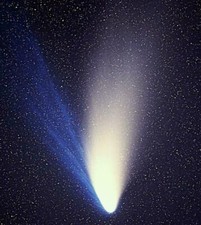
Comet Hale–Bopp became famous in 1997 not only because of its extraordinary brightness but also because it revealed something astronomers had never clearly documented before: a distinct third tail made of neutral sodium atoms. This was a genuine scientific discovery that expanded understanding of cometary physics. However, because the feature was unfamiliar, visually striking and widely reported, it also became easier for UFO enthusiasts to detach the observation from its scientific explanation. Rather than seeing the sodium tail as evidence of previously unknown comet behaviour, some commentators folded it into broader claims that Hale–Bopp concealed an alien spacecraft or exhibited impossible characteristics. In retrospect, the episode illustrates how authentic scientific surprises can unintentionally reinforce unrelated UFO narratives without providing evidence for them.[arXiv]arxiv.orgarXiv Neutral sodium from comet Hale-Bopp: a third type of tailNeutral sodium from comet Hale-Bopp: a third type of tailOctober 2, 1997…
The discovery of Hale–Bopp’s neutral sodium tail
Until Hale–Bopp, comets were generally described as displaying two principal tails:[eso.org]eso.orgComet Hale-BoppComet Hale-Bopp
- a dust tail, consisting of tiny solid particles pushed away by sunlight;
- an ion (plasma) tail, composed of electrically charged gas carried by the solar wind.
During observations in early 1997, astronomers identified a third, separate structure consisting of neutral sodium atoms. Unlike earlier hints of sodium emissions close to comet nuclei, Hale–Bopp displayed an extended and clearly identifiable sodium tail that could be mapped independently of both the dust and ion tails. The discovery was significant enough to be published as a separate research result in The Astrophysical Journal Letters.[arXiv]arxiv.orgarXiv Neutral sodium from comet Hale-Bopp: a third type of tailNeutral sodium from comet Hale-Bopp: a third type of tailOctober 2, 1997…
The finding was independently confirmed through multiple observing programmes, including observations from NASA’s POLAR spacecraft. Rather than overturning existing comet science, the sodium tail added a new physical component to comet behaviour that researchers could investigate using spectroscopy and dynamical modelling.[NASA PWG]pwg.gsfc.nasa.govPWGPOLAR Hale-Bopp News ReleaseNASA PWGPOLAR Hale-Bopp News ReleaseApril 25, 1997…
How radiation pressure and photoionisation shaped it
The sodium tail behaved differently because the particles involved differed fundamentally from those in the better-known tails.
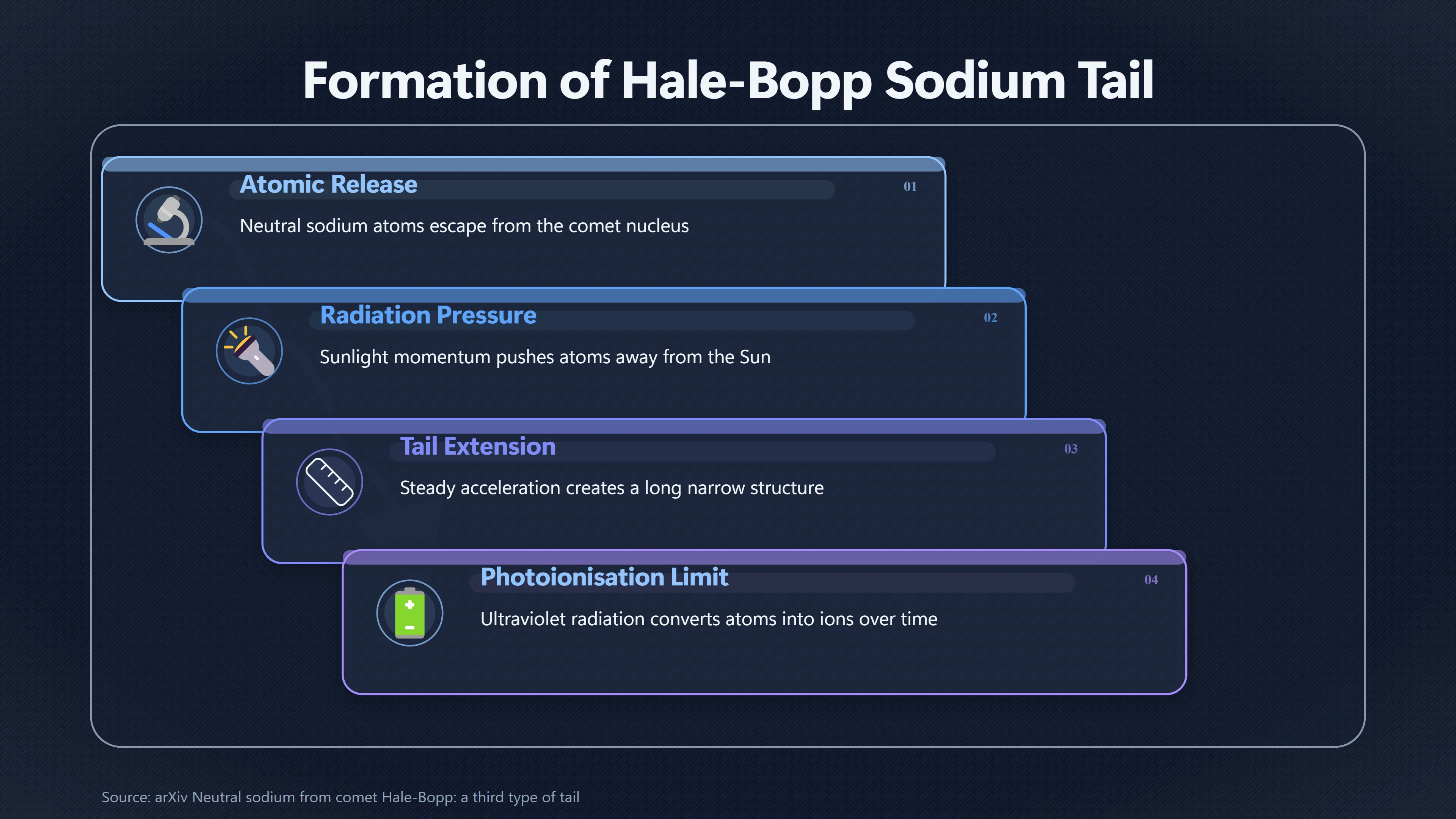
Neutral sodium atoms released from the comet absorb sunlight very efficiently at the sodium D spectral lines. Each absorption and re-emission of light transfers a tiny amount of momentum. Over time, this solar radiation pressure steadily accelerates the atoms away from the Sun, creating a long, narrow tail.
The tail does not persist indefinitely because ultraviolet radiation from the Sun gradually removes electrons from the sodium atoms, converting them into ions. This process, known as photoionisation, limits the lifetime of each neutral atom and therefore determines how long the sodium tail can remain visible before the material joins the ionised environment around the comet. The observed dimensions and brightness of Hale–Bopp’s sodium tail matched calculations based on these well-understood physical processes.[arXiv]arxiv.orgarXiv Neutral sodium from comet Hale-Bopp: a third type of tailNeutral sodium from comet Hale-Bopp: a third type of tailOctober 2, 1997…
Subsequent studies suggested that sodium probably originated from more than one source. Some atoms appeared to come directly from the comet’s nucleus, while others were likely released from dust grains after they had already left the nucleus. This helped explain why the sodium tail sometimes differed in direction and width from the dust and ion tails without requiring any exotic mechanism.[AGU Publications]agupubs.onlinelibrary.wiley.comAGU Publications Three tails of comet Hale‐BoppAGU PublicationsThree tails of comet Hale‐Bopp - Wilson - 1998 - Geophysical Research Letters - Wiley Online LibraryFebruary 1, 1998…
Why a genuine scientific surprise encouraged UFO speculation
The sodium tail illustrates an important pattern in the history of UFO claims: authentic discoveries can become detached from their scientific context.
Several factors made the feature especially vulnerable to reinterpretation.
It was genuinely new. News reports accurately described the sodium tail as a previously unknown type of comet tail. Outside astronomy, “newly discovered” was easily reinterpreted as “previously hidden” or “inexplicable”, even though the discovery itself was accompanied by a conventional physical explanation.[European Southern Observatory]eso.orgEuropean Southern Observatory The Unusual Tails of Comet Hale-Bopp | ESOEuropean Southern Observatory The Unusual Tails of Comet Hale-Bopp | ESO
It produced unusual images. Narrow-band filters designed to isolate sodium emission created photographs that looked markedly different from ordinary comet images. Readers unfamiliar with astronomical imaging could mistake these specialised observations for evidence that the comet was changing shape or displaying anomalous structures.
It coincided with existing spacecraft rumours. By late 1996 and early 1997, rumours of an enormous alien craft travelling behind Hale–Bopp were already circulating through paranormal radio programmes, early internet forums and chain emails. Once those narratives existed, every unusual scientific announcement about the comet risked being interpreted as indirect support for the underlying claim rather than as an independent astronomical finding.
This illustrates a common feature of conspiracy thinking: unrelated pieces of information become linked because they concern the same object, even when no causal relationship exists.
The gap between the science and the UFO claims
Importantly, the sodium tail never addressed the central UFO allegation.
The spacecraft rumour claimed that a massive artificial object accompanied Hale–Bopp and would eventually become apparent as the comet approached the inner Solar System. The sodium tail, by contrast, was:
- detected through spectroscopy rather than visual identification of a solid object;
- composed of diffuse neutral atoms spread over millions of kilometres;
- predicted by known interactions between sunlight and sodium atoms;
- independently observed by multiple research groups using different instruments.[arxiv.org]arxiv.orgarXiv Neutral sodium from comet Hale-Bopp: a third type of tailNeutral sodium from comet Hale-Bopp: a third type of tailOctober 2, 1997…
Nothing about the sodium tail implied the presence of a spacecraft, concealed structure or intelligent control. Instead, the discovery demonstrated that cometary environments were more chemically and dynamically complex than previously recognised.
What the episode reveals about failed UFO predictions
Within the broader history of failed UFO predictions, Hale–Bopp’s sodium tail shows how legitimate scientific novelty can inadvertently strengthen unsupported claims.
The prediction made by promoters of the spacecraft story was not that astronomers would discover new comet physics. It was that Hale–Bopp concealed or was accompanied by an alien craft whose existence would ultimately be confirmed. That prediction failed. The comet behaved as a natural comet throughout its passage, while subsequent research explained its unusual third tail through radiation pressure, sodium emission and photoionisation rather than any artificial phenomenon.[arxiv.org]arxiv.orgarXiv Neutral sodium from comet Hale-Bopp: a third type of tailNeutral sodium from comet Hale-Bopp: a third type of tailOctober 2, 1997…
The lasting lesson is that scientific surprises do not automatically validate extraordinary interpretations. Hale–Bopp genuinely expanded knowledge of cometary behaviour, but the evidence that made the sodium tail scientifically important also showed that it was a natural consequence of well-understood physical processes rather than evidence of an alien spacecraft.
Amazon book picks
Further Reading
Books and field guides related to Why Hale Bopp's Third Tail Looked So Mysterious. Use these as the next step if you want deeper reading beyond the article.
Comet
WHAT ARE THESE GRACEFUL VISITORS TO OUR SKIES? WE NOW KNOW THAT THEY BRING BOTH LIFE AND DEATH AND TEACH US ABOUT OUR ORIGINS. Comet begi...
Introduction to Comets
We have now reached an exciting time in cometary research. With several missions launched or about to be launched in the near future, com...
The Demon-Haunted World
NEW YORK TIMES BESTSELLER • From the renowned astronomer and author of Cosmos comes a “powerful [and] stirring defense of informed ration...
Bad Astronomy
A clever, thought-provoking guide that attacks common astronomical misconceptions What is Bad Astronomy? Anything that accidentally or in...
eBay marketplace picks
Marketplace Samples
Live-tested eBay searches with available results related to this page.
Selected fromHale-Bopp poster oneBay.co.uk.
Endnotes
1.
Source: arxiv.org
Title: arXiv Neutral sodium from comet Hale-Bopp: a third type of tail
Link:https://arxiv.org/abs/astro-ph/9710022
Source snippet
Neutral sodium from comet Hale-Bopp: a third type of tailOctober 2, 1997...
Published: October 2, 1997
2.
Source: pwg.gsfc.nasa.gov
Title: PWGPOLAR Hale-Bopp News Release
Link:https://pwg.gsfc.nasa.gov/istp/events/halebopp/incoming/press/news.html
Source snippet
NASA PWGPOLAR Hale-Bopp News ReleaseApril 25, 1997...
Published: April 25, 1997
3.
Source: eso.org
Title: European Southern Observatory The Unusual Tails of Comet Hale-Bopp | ESO
Link:https://www.eso.org/public/news/eso9806/
4.
Source: agupubs.onlinelibrary.wiley.com
Title: AGU Publications Three tails of comet Hale‐Bopp
Link:https://agupubs.onlinelibrary.wiley.com/doi/abs/10.1029/97GL03704
Source snippet
AGU PublicationsThree tails of comet Hale‐Bopp - Wilson - 1998 - Geophysical Research Letters - Wiley Online LibraryFebruary 1, 1998...
Published: February 1, 1998
5.
Source: agupubs.onlinelibrary.wiley.com
Title: We report on new d
Link:https://agupubs.onlinelibrary.wiley.com/doi/full/10.1029/2007GL032337
Source snippet
the sources and full extent of the sodium tail of the planet Mercury - Baumgardner - 2008 - Geophysical Research Letters - Wiley Online L...
6.
Source: eso.org
Title: Comet Hale-Bopp (
Link:https://www.eso.org/public/poland/events/astro-evt/hale-bopp/comet-hale-bopp-summary-may16-97-rw/?lang=
Additional References
7.
Source: pure.qub.ac.uk
Link:https://pure.qub.ac.uk/en/publications/neutral-sodium-from-comet-hale-bopp-a-third-type-of-tail/
Source snippet
Queen's University BelfastNeutral sodium from comet Hale-Bopp: A third type of tail - Queen's University Belfast...
8.
Source: researchgate.net
Title: (PDF) Neutral Sodium from Comet Hale-Bopp: A Third Type of Tail
Link:https://www.researchgate.net/publication/224995263_Neutral_Sodium_from_Comet_Hale-Bopp_A_Third_Type_of_Tail
Source snippet
December 1, 1997 — Article PDF Available NEUTRAL SODIUM FROM COMET HALE-BOPP: A THIRD TYPE OF TAIL * December 1997 * The Astrophysical Jo...
Published: December 1, 1997
9.
Source: sciencedirect.com
Title: ScienceDirect Sodium Velocities and Sources in Hale–Bopp
Link:https://www.sciencedirect.com/science/article/pii/S0019103598959413
Source snippet
Sodium Velocities and Sources in Hale–Bopp - ScienceDirectAugust 1, 1998 — ICARUS Volume 134, Issue 2, August 1998, Pages 228-234 Regular...
Published: August 1, 1998
10.
Source: youtube.com
Title: Away Team: The Story of Heaven’s Gate
Link:https://www.youtube.com/watch?v=SkHOxRb7Lko
Source snippet
True Crime: Heaven's Gate: The Cult Of All Cults Like You Have Never Seen Before...
11.
Source: youtube.com
Link:https://www.youtube.com/watch?v=nKCOqcL-nUw
Source snippet
USA - Brightest comet visible to naked eye...
12.
Source: youtube.com
Title: Hale-Bopp: The Electric Comet | Space News
Link:https://www.youtube.com/watch?v=6H7C57PVb-4
Source snippet
Comet Hale–Bopp and its Appearance in 1997...
13.
Source: youtube.com
Title: True Crime: Heaven’s Gate: The Cult Of All Cults Like You Have Never Seen Before
Link:https://www.youtube.com/watch?v=Cv1yRd2lg14
14.
Source: youtube.com
Link:https://www.youtube.com/watch?v=NGKGtPFhfRU
Source snippet
Away Team: The Story of Heaven's Gate...
15.
Source: iac.es
Title: neutral sodium comet hale bopp third type tail
Link:https://iac.es/es/ciencia-y-tecnologia/publicaciones/neutral-sodium-comet-hale-bopp-third-type-tail
16.
Source: iac.es
Title: neutral sodium comet hale bopp third type tail
Link:https://www.iac.es/en/science-and-technology/publications/neutral-sodium-comet-hale-bopp-third-type-tail?base_route_name=entity.node.canonical&overridden_route_name=entity.node.canonical&page_manager_page=node_view&page_manager_page_variant=node_view-panels_variant-5&page_manager_page_variant_weight=10