Within Prediction Records
Which Words Make a UFO Prediction Testable?
Dates, locations, visibility, duration and conditions determine whether a UFO claim offers a clear public test or an easy escape.
On this page
- The commitments hidden inside prediction wording
- Certain claims versus vague possibilities
- How escape clauses change the test
Page outline Jump by section
Introduction
When assessing failed predictions relating to UFOs, the decisive issue is often not whether something unusual happened, but whether the original wording committed the claimant to an outcome that could clearly succeed or fail. Small differences in language determine whether a prediction is genuinely testable or can be reinterpreted after the deadline. A statement promising that “a craft will appear over London on 14 October at sunset and remain visible for three hours” creates an objective public test. By contrast, a statement that “many people may sense increased extraterrestrial activity around mid-October” does not, because no agreed observation could prove it wrong.
This distinction matters when documenting predictions before the deadline. Preserving the exact wording allows later readers to judge whether the prediction actually failed, rather than relying on retrospective summaries or revised interpretations.
The Commitments Hidden Inside Prediction Wording
A prediction becomes testable only when its language commits the speaker to observable facts. Every additional detail reduces the range of possible reinterpretations.
The most important commitments are:
- A definite time rather than an open-ended period.
- A specific location or clearly defined area.
- An observable event that independent witnesses could recognise.
- An identifiable audience, such as “visible to everyone” rather than “visible only to the spiritually prepared.”
- A measurable duration where relevant.
- An outcome that can plainly occur or fail to occur.
These features mirror the broader idea of falsifiability in the philosophy of science. A claim becomes genuinely testable when it is possible to specify observations that would contradict it rather than merely support it. Popper described empirical “basic statements” as observations occurring at identifiable places and times that can serve as tests of broader claims.[Internet Encyclopedia of Philosophy]iep.utm.eduOpen source on utm.edu.
For UFO predictions, the principle is practical rather than philosophical: if nobody can describe in advance what would count as failure, the prediction cannot later be evaluated fairly.
Certain Claims Versus Vague Possibilities
The wording itself often reveals whether the author is making a commitment or merely suggesting a possibility.
A strong, testable prediction typically uses language such as:
- “will appear”
- “will land”
- “will be visible”
- “will occur on”
- “everyone will witness”
These phrases promise an event that either happens or does not.
By contrast, weaker formulations commonly include expressions such as:
- “may appear”
- “could happen”
- “might become apparent”
- “energy will increase”
- “those who are receptive will notice”
- “contact may occur on a higher level”
These statements provide no single observation whose absence would clearly demonstrate failure. Because almost any later experience can be presented as confirmation, they remain difficult or impossible to test objectively.
The distinction is not that cautious wording is automatically wrong. Rather, cautious wording often reduces the predictive content. A forecast expressed only as a possibility makes far fewer commitments than one expressed as a certainty.
How Escape Clauses Change the Test
One of the most important features to document is the presence of escape clauses.
An escape clause is wording that allows a prediction to survive almost any outcome by introducing conditions that become relevant only after the deadline.
Common examples include statements that:
- humanity was “not ready”;
- extraterrestrials changed their plans;
- the event occurred in another dimension;
- only spiritually advanced observers could perceive it;
- the timeline shifted;
- negative human thoughts prevented manifestation.
Such conditions may genuinely reflect the claimant’s beliefs, but they fundamentally change how the prediction should be evaluated. Instead of promising a public event, they introduce additional assumptions that can prevent any clear disconfirmation.
For this reason, documenting the original wording before the predicted date is essential. If these conditions already appeared in the original text, they form part of the prediction and should be recorded accurately. If they appear only after the event failed to occur, they represent a later explanation rather than part of the original claim.
Why Single Words Can Decide Whether a Prediction Failed
Minor wording differences can completely alter whether a missed prediction counts as a genuine failure.
Consider these examples:
Original wordingTestability”A spacecraft will appear over New York on 1 July.”Clearly testable.”A spacecraft may appear around early July.”Considerably weaker.”Many people will feel the presence of visitors.”Difficult to test objectively.”Visitors will reveal themselves to world governments.”Publicly testable.”Disclosure has already begun energetically.”Effectively immune to straightforward testing.
The differences appear slight, yet each changes what evidence could demonstrate success or failure.
A Practical Example
Blossom Goodchild’s widely discussed 2008 prediction illustrates why preserving exact wording matters. The published prediction specified a visible appearance of a Federation of Light craft on 14 October 2008, lasting three days and intended to demonstrate the existence of other life. Those concrete commitments—date, visibility and duration—created a prediction that could be evaluated against public observation. Later explanations issued after the event can therefore be distinguished from the original forecast because the original wording was publicly preserved before the deadline.[Wikipedia]WikipediaOpen source on wikipedia.org.
The lesson is not about whether particular beliefs are true or false. Rather, it shows that precise wording allows later discussion to focus on what was actually promised instead of on retrospective paraphrases.

Recording the Exact Language Fairly
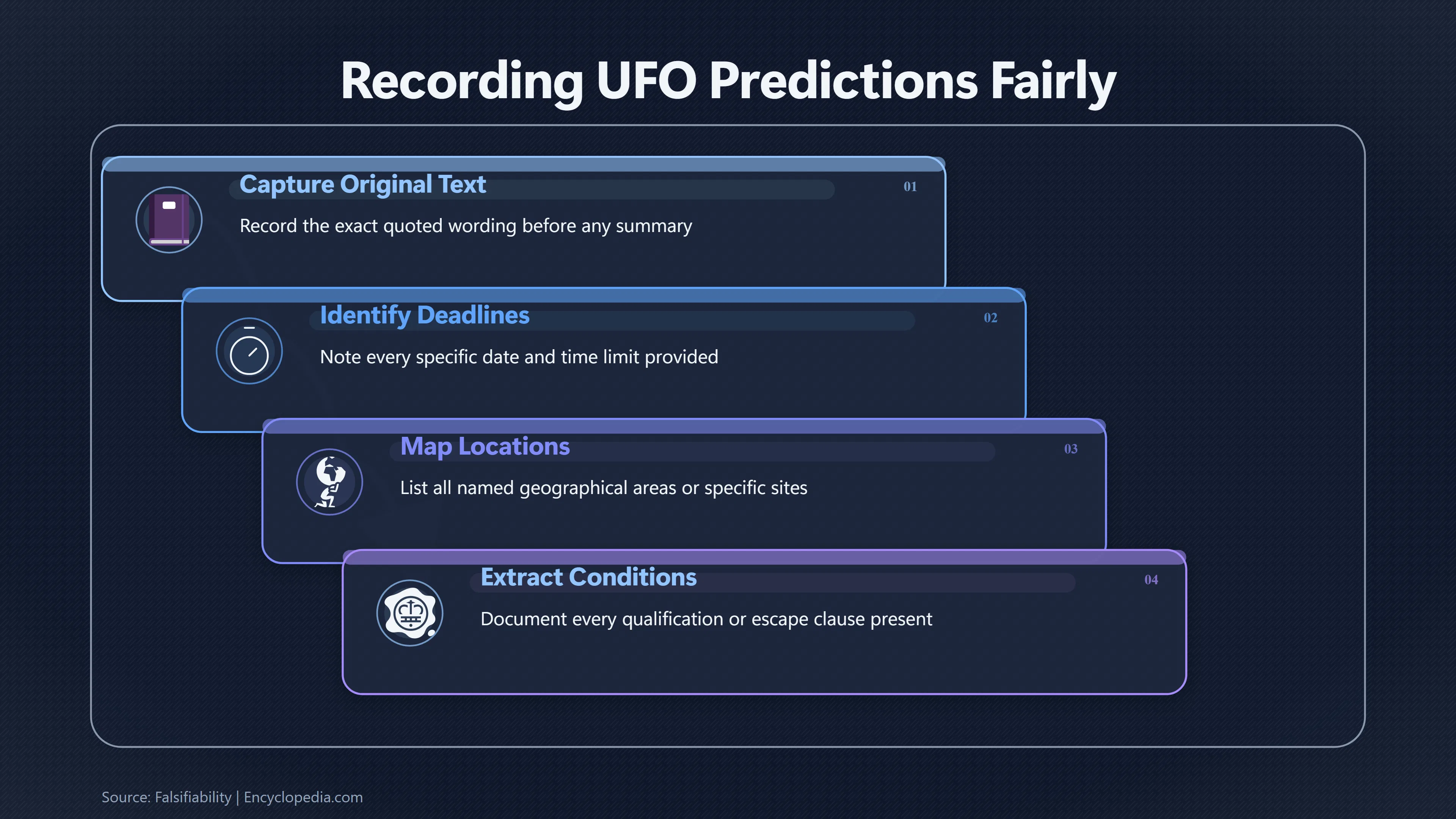
When documenting a UFO prediction for later evaluation, the safest practice is to preserve the claimant’s own words before extracting any summary.
A reliable record should capture:
- the exact quoted prediction;
- the publication date;
- every stated deadline;
- any named locations;
- who was expected to observe the event;
- whether the wording expressed certainty or possibility;
- every condition or qualification already present in the original text.
Only after preserving those details should researchers summarise the prediction. This prevents later disputes over whether critics exaggerated the claim or supporters softened it after the fact.
In practice, the exact wording is often the most important piece of evidence. The difference between a failed prediction and an untestable claim frequently lies not in the event itself, but in the precise words chosen before the deadline.
Amazon book picks
Further Reading
Books and field guides related to Which Words Make a UFO Prediction Testable?. Use these as the next step if you want deeper reading beyond the article.
The Demon-Haunted World
Rating: 4.5/5 from 43 Google Books ratings
NEW YORK TIMES BESTSELLER • From the renowned astronomer and author of Cosmos comes a “powerful [and] stirring defense of informed ration...
Calling Bullshit
Bullshit isn’t what it used to be. Now, two science professors give us the tools to dismantle misinformation and think clearly in a world...
Bad Science
Ben Goldacre takes us on a journey through the bad science we are fed daily by hacks and quacks.
eBay marketplace picks
Marketplace Samples
Live-tested eBay searches with available results related to this page.
Selected fromUFO poster oneBay.co.uk.

Current eBay listing
I Want To Believe UFO Poster Giclée Fine Art Heavyweight Print
Current eBay listing
VINTAGE UFO FLYING SAUCERS COMIC ADVERTISING A2 POSTER PRINT
Endnotes
1.
Source: Wikipedia
Link:https://en.wikipedia.org/wiki/Falsifiability
2.
Source: encyclopedia.com
Title: Falsifiability | Encyclopedia.com
Link:https://www.encyclopedia.com/science-and-technology/physics/science-general/falsifiability
3.
Source: encyclopedia.com
Title: popper karl raimund 1902 1994
Link:https://www.encyclopedia.com/humanities/encyclopedias-almanacs-transcripts-and-maps/popper-karl-raimund
4.
Source: youtube.com
Link:https://www.youtube.com/watch?v=61JJKpX0z4E
Source snippet
FALSIFIABILITY - Which Hypothesis Do We Test? (14-3)...
5.
Source: youtube.com
Link:https://www.youtube.com/watch?v=yLzYy_Rs8C4
Source snippet
What if UFOs were real? | UNT's The Lab...
6.
Source: iep.utm.edu
Link:https://iep.utm.edu/pop-sci/
7.
Source: plato.sydney.edu.au
Title: Plato’s Philosophy Karl Popper (Stanford Encyclopedia of Philosophy)
Link:https://plato.sydney.edu.au/entries/popper/
Source snippet
BASIC STATEMENTS, FALSIFIABILITY AND CONVENTION Popper draws a clear distinction between the logic of falsifiability and its applied meth...
8.
Source: plato.stanford.edu
Link:https://plato.stanford.edu/archives/spr2001/entries/popper/
9.
Source: www-personal.umd.umich.edu
Link:https://www-personal.umd.umich.edu/~delittle/Encyclopedia%20entries/falsifiability.htm
10.
Source: opendoubt.com
Link:https://opendoubt.com/glossary/falsifiability
Additional References
11.
Source: qeios.com
Title: Publishing Test-Ready Hypotheses When Experiments Are Out of Reach
Link:https://www.qeios.com/read/C2YEE6
Source snippet
Consistent with the conditional rationale above, an idea paper (without new data) is not a promotional document. It should include: (1) a...
12.
Source: nileshoak.wordpress.com
Title: scientific evaluation of nilesh oaks theory and claim
Link:https://nileshoak.wordpress.com/2026/04/05/scientific-evaluation-of-nilesh-oaks-theory-and-claim/
Source snippet
evaluation of Nilesh Oak’s theory and claim | Nilesh Nilkanth OakApril 5, 2026 — NILESH NILKANTH OAK ANCIENT INDIAN HISTORY SCIENTIFIC EV...
Published: April 5, 2026
13.
Source: scienceinsights.org
Title: What Makes a Hypothesis Testable: 5 Key Criteria
Link:https://scienceinsights.org/what-makes-a-hypothesis-testable-5-key-criteria/
Source snippet
March 12, 2026 — WHAT MAKES A HYPOTHESIS TESTABLE: 5 KEY CRITERIA * March 12, 2026 A hypothesis is testable when it makes...
Published: March 12, 2026
14.
Source: philosophy.stackexchange.com
Title: comphilosophy of science
Link:https://philosophy.stackexchange.com/questions/99719/if-we-encounter-what-appears-to-be-an-advanced-extraterrestrial-technological-de?noredirect=1
Source snippet
Philosophy Stack ExchangeJune 5, 2023 — IF WE ENCOUNTER WHAT APPEARS TO BE AN ADVANCED EXTRATERRESTRIAL TECHNOLOGICAL DEVICE, WOULD THE C...
Published: June 5, 2023
15.
Source: youtube.com
Title: What if UFOs were real? | UNT’s The Lab
Link:https://www.youtube.com/watch?v=hptpZGqBA1g
Source snippet
This video on Karl Popper's Theory of Falsification explains how specific, testable commitments allow hypotheses to be proven false, dire...
16.
Source: youtube.com
Link:https://www.youtube.com/watch?v=oVEDvohe5ho
Source snippet
How scientists use math to help explain UFO videos...
17.
Source: plato.stanford.edu
Title: It is easy, he ar
Link:https://plato.stanford.edu/archives/spr2019/entries/popper/
Source snippet
Popper (Stanford Encyclopedia of Philosophy/Spring 2019 Edition)August 7, 2018 — Popper accordingly repudiates induction and rejects the...
Published: August 7, 2018
18.
Source: nullens.org
Link:https://nullens.org/charles-darwin/part-3-other-theories/11-scientific-theories-concepts-and-opinions-about-evolution/11-21-what-differentiates-science-from-beliefs/
19.
Source: libquotes.com
Link:https://libquotes.com/karl-popper/quote/lbx5y0g
20.
Source: wilhelmreich.gr
Link:https://wilhelmreich.gr/en/popper-about-science-2/