Within Not Ready
Who Must Prove Humanity Was Ready?
The predictor no longer has to prove aliens intended to land; the public must instead prove an undefined level of worthiness.
On this page
- The original evidential burden
- How worthiness replaces verification
- Why an undefined standard cannot be met
Page outline Jump by section
Introduction
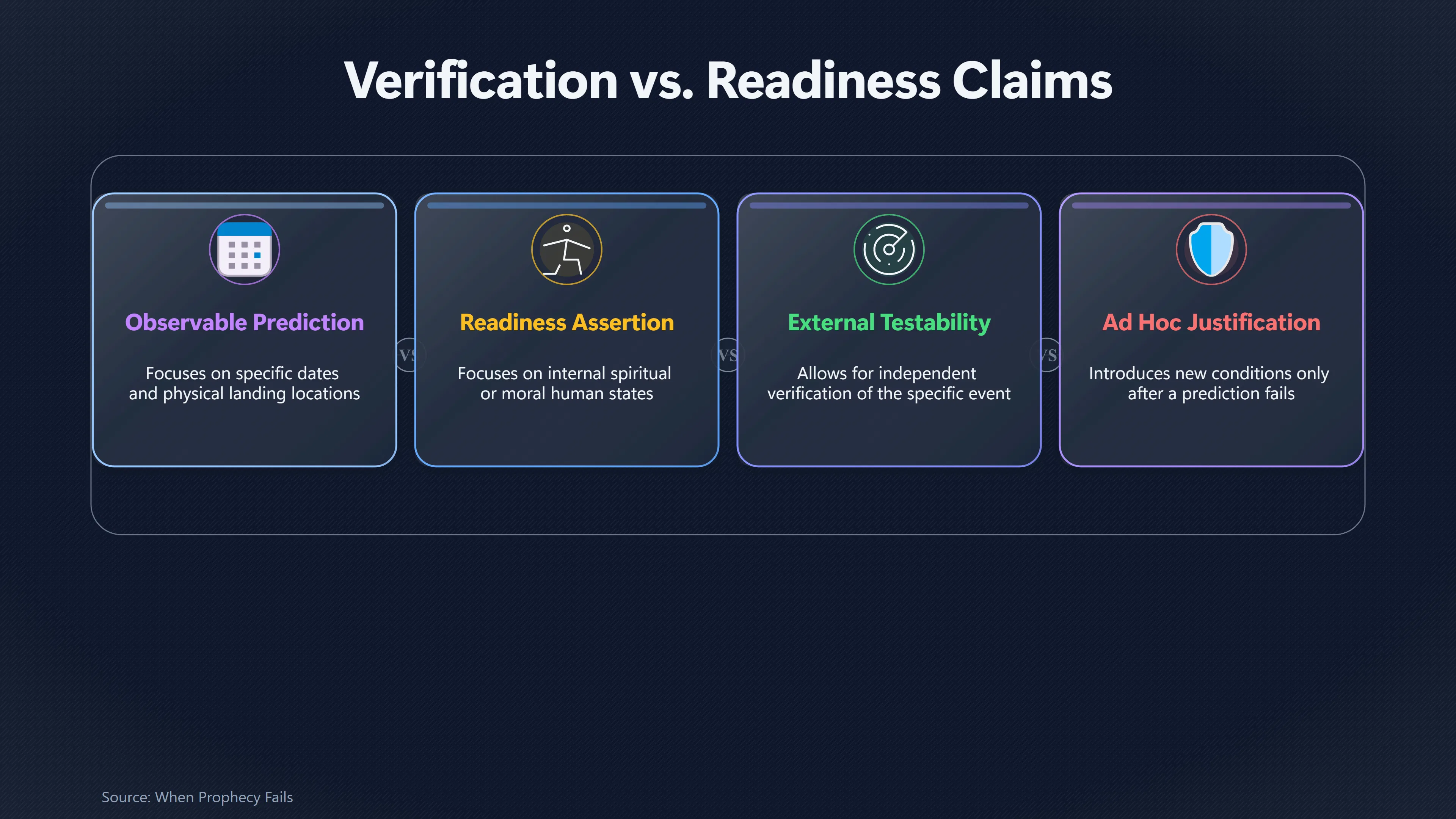
When a predicted UFO landing fails to occur, the original claim is straightforward to evaluate: either the announced event happened or it did not. A later assertion that “humanity was not ready” changes the nature of the discussion. Instead of the person who made the prediction needing to explain why the forecast failed, the audience is asked to accept that an unseen moral, psychological or spiritual condition prevented success. The debate therefore shifts from verifying a public prediction to debating an undefined state of collective worthiness.

This matters because it reverses the normal burden of proof. A dated prediction is externally testable. A claim about humanity’s readiness is not, unless its standards were specified before the prediction and can be independently assessed. Without those safeguards, the explanation becomes difficult to falsify and almost impossible to distinguish from an ad hoc justification introduced after the event. Philosophers of science describe this kind of move as the addition of an auxiliary hypothesis, whose legitimacy depends on whether it can itself be independently tested rather than merely protecting the original claim from failure.[DOI]doi.orgThe Bayesian Treatment of Auxiliary Hypotheses | The British Journal for the Philosophy of Science: Vol 52, No 3September 1, 2001…
The Original Evidential Burden
Before any missed prediction, the evidential responsibility is relatively clear. Someone claims that extraterrestrial craft will land at a particular time or under identifiable circumstances. Because the prediction concerns an observable event, the claimant carries the burden of providing evidence that the event occurred or explaining why the prediction should still be regarded as reliable after it did not.
This follows ordinary standards of reasoning used well beyond UFO debates. The person making a positive factual claim is expected to support it with evidence. If the predicted event fails to occur, confidence in the prediction normally decreases unless there is independently verifiable evidence that another factor genuinely intervened. Simply introducing a new explanation after the fact does not automatically restore the original claim’s credibility. Philosophical discussions of auxiliary hypotheses emphasise that such additions should generate their own testable expectations rather than merely insulating a theory from contrary evidence.[DOI]doi.orgThe Bayesian Treatment of Auxiliary Hypotheses | The British Journal for the Philosophy of Science: Vol 52, No 3September 1, 2001…
The distinction is important because failed predictions are not unusual in many fields. What determines whether confidence should remain is not the existence of an explanation but the quality and independent support for that explanation.
How Worthiness Replaces Verification
The readiness explanation changes the question being asked.
Instead of asking:
- Did the predicted landing occur?
- Was the original forecast accurate?
the discussion becomes:
- Was humanity spiritually mature enough?
- Were enough people peaceful or enlightened?
- Did collective fear delay contact?
These are fundamentally different questions. The first concerns observable events. The second concerns qualities that have no universally accepted definition or measurement.
This shift effectively transfers responsibility from the predictor to the audience. Rather than demonstrating that extraterrestrials genuinely postponed their plans, believers are invited to explain the absence of evidence by pointing to deficiencies in humanity itself. Because virtually any social problem—war, political conflict, environmental damage or public scepticism—can be cited as proof that humanity remains unready, the explanation can accommodate almost any outcome without placing the original prediction at further risk.
The result is not merely an additional claim but a different evidential standard. Verification of the landing becomes secondary to acceptance of an unobservable condition.
Why an Undefined Standard Cannot Be Met
For a condition to function as part of a genuine prediction, it should be identifiable before the event.
A statement such as “contact will occur when humanity reaches readiness” raises several questions that typically remain unanswered:
- What exactly counts as readiness?
- Who determines whether the threshold has been reached?
- How can independent observers measure it?
- Could observers know beforehand whether success or failure should be expected?
In most readiness-based explanations, none of these questions receives an operational answer.
Unlike measurable conditions such as population size, atmospheric conditions or technological capability, collective spiritual readiness has no agreed metric. There is no recognised authority capable of determining whether humanity has achieved it, and no independent access to the alleged extraterrestrial decision-making process. Consequently, the same source that made the original prediction usually also declares that humanity failed the unseen test.
From an evidential standpoint, this creates an asymmetry. Any failed prediction can be explained by asserting that the hidden threshold had not yet been crossed, while no observable outcome can demonstrate that the explanation itself is incorrect.
Why This Reversal Weakens Falsifiability
A useful prediction should expose itself to the possibility of being wrong.
If a forecast specifies a date, location or observable event, failure provides information about the prediction’s reliability. Confidence can then be updated in light of new evidence.
The readiness explanation weakens that process because it removes any clear point at which the underlying claim could fail. Every missed landing can be interpreted not as evidence against extraterrestrial intentions but as evidence that humanity still lacks the necessary moral or spiritual qualities.
Philosophers of science have long distinguished between legitimate refinements to a theory and ad hoc modifications introduced primarily to preserve it. Auxiliary assumptions are common in science, but they are expected to increase explanatory power while remaining independently open to confirmation or rejection. If a new assumption cannot itself be tested, it risks reducing rather than increasing the theory’s empirical value.[DOI]doi.orgThe Bayesian Treatment of Auxiliary Hypotheses | The British Journal for the Philosophy of Science: Vol 52, No 3September 1, 2001…
The practical consequence is that negative evidence loses its force. The absence of the predicted event no longer challenges the prediction because every failure is reclassified as another demonstration that humanity has not yet qualified.
Lessons from Failed Prophecy Research
Research on failed prophecy has repeatedly examined how belief systems respond when public predictions do not occur. The classic study When Prophecy Fails popularised the idea that believers often reinterpret disconfirmation rather than abandoning their convictions. Although aspects of that famous case have recently been challenged by archival research, the broader question remains relevant: organisations and belief systems frequently develop explanations that preserve core commitments after observable predictions fail.[wikipedia.org]WikipediaWhen Prophecy FailsWhen Prophecy Fails
Within UFO-related movements, the readiness explanation illustrates one particular mechanism. Instead of arguing that the original prediction was mistaken, it argues that external circumstances changed because humanity itself failed an invisible test. Whether or not participants sincerely believe this explanation, its evidential effect is the same: the focus moves away from assessing the prediction and towards assessing an undefined human condition that lacks agreed standards of verification.
What the Burden of Proof Should Remain
From an evidence-based perspective, the burden of proof does not disappear because a new condition is introduced after a failed prediction.
If a claimant argues that extraterrestrials postponed contact because humanity was not ready, that new proposition also requires evidence. At minimum, readers would need reasons to believe:
- extraterrestrials intended to land in the first place;
- they evaluate humanity according to identifiable readiness criteria;
- those criteria actually prevented the predicted event; and
- independent observations support that explanation rather than simply asserting it.
Without such evidence, the readiness claim functions primarily as a reinterpretation of failure rather than as a demonstrated explanation for it.
The key issue is therefore not whether humanity could, in principle, be “ready” for contact. It is that, in the context of failed UFO predictions, an undefined standard of readiness transfers the evidential burden away from the original prediction and onto a condition that cannot be independently measured, verified or conclusively shown ever to have been satisfied.

Amazon book picks
Further Reading
Books and field guides related to Who Must Prove Humanity Was Ready?. Use these as the next step if you want deeper reading beyond the article.
When Prophecy Fails
The study reported in this volume grew out of some theoretical work, one phase of which bore specifically on the behavior of individuals...
The Demon-Haunted World
NEW YORK TIMES BESTSELLER • From the renowned astronomer and author of Cosmos comes a “powerful [and] stirring defense of informed ration...
Why People Believe Weird Things
Rating: 4.0/5 from 7 Google Books ratings
Revised and Expanded Edition. In this age of supposed scientific enlightenment, many people still believe in mind reading, past-life regr...
The Believing Brain
Synthesizing thirty years of research, psychologist and science historian, Michael Shermer upends the traditional thinking about how huma...
eBay marketplace picks
Marketplace Samples
Live-tested eBay searches with available results related to this page.
Selected fromUFO poster oneBay.co.uk.

Current eBay listing
I Want To Believe UFO Poster Giclée Fine Art Heavyweight Print

Current eBay listing
VINTAGE UFO FLYING SAUCERS COMIC ADVERTISING A2 POSTER PRINT

Endnotes
1.
Source: doi.org
Link:https://doi.org/10.1093/bjps/52.3.515
Source snippet
The Bayesian Treatment of Auxiliary Hypotheses | The British Journal for the Philosophy of Science: Vol 52, No 3September 1, 2001...
Published: September 1, 2001
2.
Source: Wikipedia
Title: When Prophecy Fails
Link:https://en.wikipedia.org/wiki/When_Prophecy_Fails
3.
Source: onlinelibrary.wiley.com
Title: Online Library Debunking “When Prophecy Fails”
Link:https://onlinelibrary.wiley.com/doi/full/10.1002/jhbs.70043
Source snippet
“When Prophecy Fails” - Kelly - 2026 - Journal of the History of the Behavioral Sciences - Wiley Online LibraryNovember 4, 2025 — Volume...
Published: November 4, 2025
4.
Source: onlinelibrary.wiley.com
Link:https://onlinelibrary.wiley.com/doi/abs/10.1002/jhbs.70043
Source snippet
“When Prophecy Fails” - Kelly - 2026 - Journal of the History of the Behavioral Sciences - Wiley Online LibraryNovember 4, 2025 — ORIGINA...
Published: November 4, 2025
5.
Source: onlinelibrary.wiley.com
Link:https://onlinelibrary.wiley.com/doi/abs/10.1002/jhbs.70043?campaign=woletoc
Source snippet
“When Prophecy Fails” - Kelly - 2026 - Journal of the History of the Behavioral Sciences - Wiley Online LibraryNovember 4, 2025 — Volume...
Published: November 4, 2025
6.
Source: youtube.com
Title: Burden of Proof
Link:https://www.youtube.com/watch?v=2RRyhq_oMus
Source snippet
Russell's Teapot - (Religious Beliefs & The Burden of Proof)...
Additional References
7.
Source: cambridge.org
Link:https://www.cambridge.org/core/journals/philosophy-of-science/article/abs/confirmation-and-hypothesis/0CF6F7D388CD3A78CE8599F8FA5E7BCE
Source snippet
Cambridge University PressConfirmation and Hypothesis | Philosophy of Science | Cambridge Core...
8.
Source: researchgate.net
Title: Debunking “When Prophecy Fails”
Link:https://www.researchgate.net/publication/397254906_Debunking_When_Prophecy_Fails
Source snippet
November 1, 2025 — DEBUNKING “WHEN PROPHECY FAILS” Journal of the History of the Behavioral Sciences * November 2025 * 62(1) DOI:10.1002/...
Published: November 1, 2025
9.
Source: sciencedirect.com
Title: ScienceDirect When Festinger Fails: Prophecy and the Watch Tower
Link:https://www.sciencedirect.com/science/article/pii/S0048721X84710256
Source snippet
When Festinger Fails: Prophecy and the Watch Tower - ScienceDirect...
10.
Source: youtube.com
Title: Why Religions Survive When Prophecies Fail
Link:https://www.youtube.com/watch?v=nH-pwULIGzs
Source snippet
"Burden of proof" "[falsifiability]({{ 'falsifiability/' | relative_url }})" OR "unfalsifiable" Burden of Proof: Conspiracy "Theory" Logic #2 (Satire) DrBSully | Crime, Law, Justice...
11.
Source: youtube.com
Title: Russell’s Teapot
Link:https://www.youtube.com/watch?v=QO667BQ8LHA
Source snippet
Logical Fallacies - Shifting the burden of proof...
12.
Source: cambridge.org
Link:https://www.cambridge.org/core/journals/philosophy-of-science/article/abs/confirming-power-of-observations-metricized-for-decisions-among-hypotheses/CB26F237FDB7FB53BB303FA6CF913063
13.
Source: youtu.be
Title: Dr BSully | Crime, Law, Justice
Link:https://youtu.be/lr3fWRk5hS0
Source snippet
Russell's Teapot - (Religious Beliefs & The Burden of Proof) Philosophy Vibe...
14.
Source: youtu.be
Title: Terje Oseberg
Link:https://youtu.be/xRAw7yeDO-c
Source snippet
The Falsity of Popper's "Science as Falsification" Part 1: Intro (Backup Recording) 28Dec2022 GoldAcademy...
15.
Source: youtube.com
Title: Logical Fallacies
Link:https://www.youtube.com/watch?v=WnKNcbYTlPo
Source snippet
Ad Hoc Hypothesis - Debunk The Funk #9...
16.
Source: pubmed.ncbi.nlm.nih.gov
Link:https://pubmed.ncbi.nlm.nih.gov/41186060/