Within Prediction Records
Can Digital Proof Show a File Was Untouched?
Checksums reveal later file changes, while trusted timestamps can support the claim that preserved material existed before a specified time.
On this page
- How checksums expose file changes
- What trusted timestamps actually establish
- When stronger integrity controls are worth using
Page outline Jump by section
Introduction
When a UFO prediction is later disputed, one of the first questions is whether the published wording is the same as it was before the prediction’s deadline. Cryptographic hashes and trusted timestamps cannot prove that a prediction was true, but they can make it far harder to alter digital evidence without detection. A hash acts as a unique fingerprint of a file, while a trusted timestamp provides independent evidence that the specific fingerprint already existed at or before a particular time. Together, these tools strengthen the integrity of archived prediction records and reduce later arguments over whether dates, wording or conditions were quietly rewritten after a prediction failed.[RFC Editor]rfc-editor.orgRFC EditorRFC 3161: Internet X.509 Public Key Infrastructure Time-Stamp Protocol (TSP) | RFC Editor…
Can Digital Proof Show a File Was Untouched?
The answer is partly yes. Digital integrity tools do not establish that a document is truthful or authentic in every respect, but they can provide strong evidence that a particular version has not changed since it was preserved.
Suppose a researcher saves a webpage predicting that a UFO fleet will appear on a specified date. If the page is stored together with a modern cryptographic hash such as SHA-256, anyone can later calculate the file’s hash again. If the newly calculated value matches the original, the file is almost certainly identical bit for bit. If even a single character, image or punctuation mark has changed, the hash value will also change dramatically. This property makes hashes an effective tamper-evident mechanism. Modern guidance recommends SHA-2 or SHA-3 family algorithms rather than the older SHA-1 for new integrity records because of advances in collision attacks against SHA-1.[NIST Computer Security Resource Center]csrc.nist.govComputer Security Resource Center Hash Functions | CSRCNIST Computer Security Resource CenterHash Functions | CSRC…
For documenting failed UFO predictions, this matters because disputes often concern subtle edits rather than wholesale rewrites. A changed deadline, an added qualification or a removed certainty claim will all produce a different hash.
How checksums expose file changes
A checksum or cryptographic hash is best understood as a digital fingerprint.[csrc.nist.gov]csrc.nist.govcryptographic hash functioncryptographic hash function
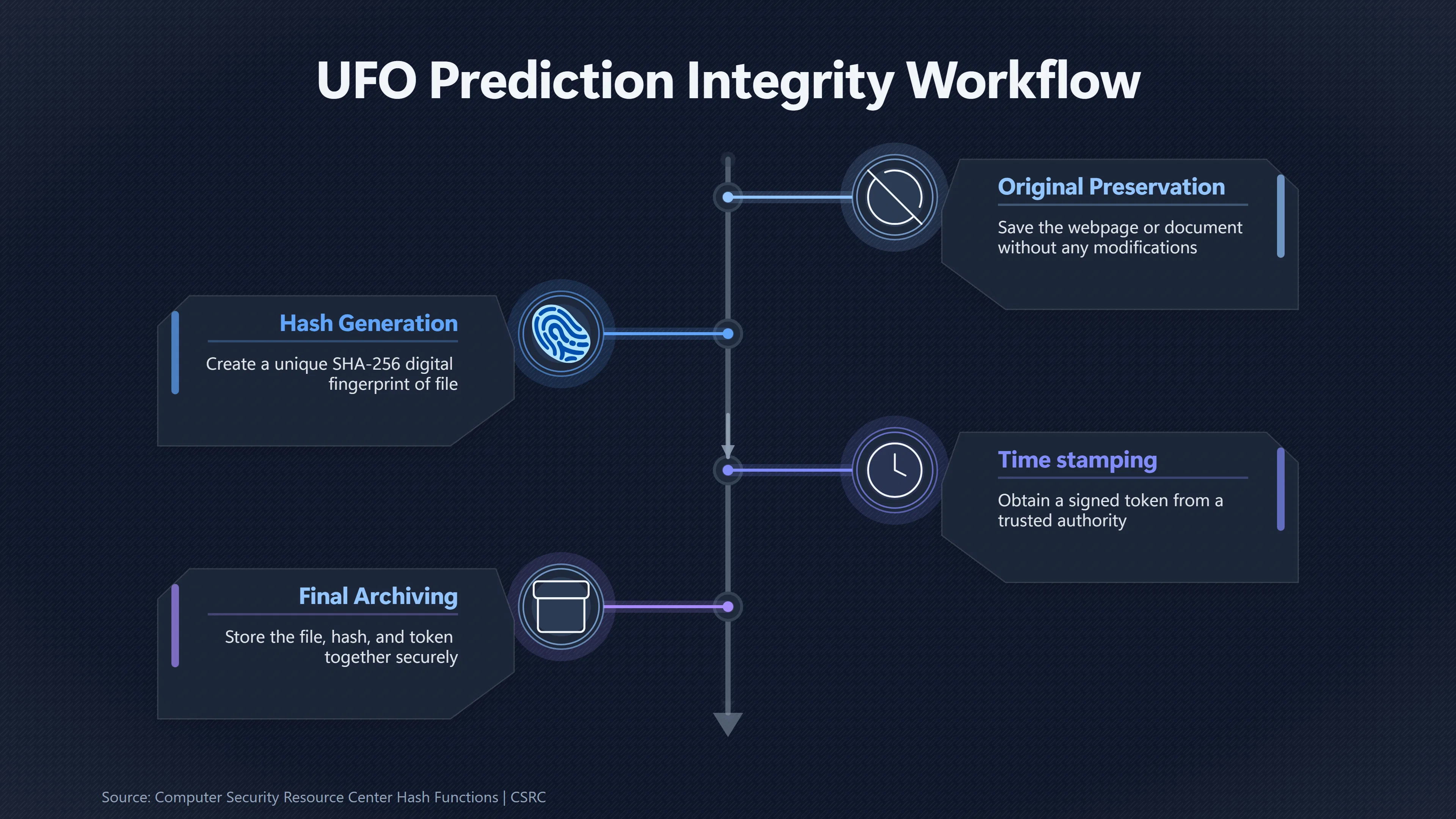
For preserved UFO prediction material, the normal workflow is straightforward:
- Save the original webpage, PDF, image or document without modification.
- Generate a SHA-256 hash of that exact file.
- Record the resulting hash alongside the archive.
- Later, calculate the hash again from the preserved file.
- Compare the two values.
If the values differ, something has changed. The hash itself does not identify what changed, only that the preserved file is no longer identical to the original version.
This distinction is important. A matching hash demonstrates file integrity, not factual accuracy. A prediction may still be false or misleading while remaining perfectly preserved.
What Trusted Timestamps Actually Establish
A cryptographic hash alone does not answer when a file existed. Someone could theoretically generate a hash today for a document edited yesterday and simply claim it was produced years earlier.
Trusted timestamping addresses this weakness.
The Internet Engineering Task Force’s RFC 3161 standard describes a protocol in which a trusted timestamp authority (TSA) receives a hash—not the underlying document—and returns a digitally signed timestamp token. That signed token states that the specific hash existed before the recorded time. Because the authority signs the timestamp with its own cryptographic key, later alteration of either the timestamp or the associated hash becomes detectable.[RFC Editor]rfc-editor.orgRFC EditorRFC 3161: Internet X.509 Public Key Infrastructure Time-Stamp Protocol (TSP) | RFC Editor…
For UFO prediction records, this means a researcher can demonstrate that the exact preserved file already existed before the predicted event’s deadline without revealing the document to the timestamping service itself. Only the hash is submitted.
A trusted timestamp therefore establishes:[csrc.nist.gov]csrc.nist.govgovtrusted timestampgovtrusted timestamp
- that a particular digital fingerprint existed before the timestamp;[csrc.nist.gov]csrc.nist.govgovtrusted timestampgovtrusted timestamp
- that the timestamp originated from the trusted authority rather than the document owner;
- that later attempts to backdate a modified file cannot reproduce the original timestamp.
It does not establish:
- that the document’s contents are true;
- who originally wrote the document;
- whether the file existed before the timestamp;[proofstamper.com]proofstamper.comrfc 3161 explainedrfc 3161 explained
- that no earlier versions also existed.
As NIST notes, reliable digital timeliness depends on trusted timestamp authorities or equivalent mechanisms rather than simply embedding a date inside a document, since self-declared timestamps can easily be altered.[NIST]nist.govRecommendation for Digital Signature Timeliness | NISTRecommendation for Digital Signature Timeliness | NIST…

Why Hashes and Timestamps Work Better Together
Neither mechanism is sufficient on its own.
A hash proves integrity but not timing.
A timestamp proves that a particular hash existed at a given time but says nothing about the contents unless the original file is still available to recreate that hash.
Together they create a chain of evidence:
- Preserve the original prediction exactly as published.
- Generate a SHA-256 hash.
- Obtain an independent trusted timestamp for that hash.
- Keep both the preserved file and timestamp token.
- Verify the hash whenever the file is later examined.
If someone later edits the prediction to soften a failed claim—for example by changing “will appear on 14 October” to “may appear around October”—the altered file will no longer match the timestamped hash.
When Stronger Integrity Controls Are Worth Using
Many ordinary prediction records do not require sophisticated digital preservation. Archived webpages, dated publications and multiple independent copies often provide sufficient evidence.
Stronger integrity controls become worthwhile when:
- the prediction is likely to attract significant public attention;
- the original website may later be edited or deleted;
- only one digital copy exists;
- legal or academic scrutiny is anticipated;
- competing parties are expected to dispute the wording after the deadline.
In these situations, combining several independent preservation methods provides more robust evidence than relying on any single technique. A timestamped hash complements—not replaces—web archives, printed publications, email distribution, news reports and other contemporaneous records.
Some preservation systems also anchor hashes in public blockchains instead of, or alongside, traditional timestamp authorities. These approaches similarly aim to demonstrate that a particular file fingerprint existed before a given point in time, although they rely on different trust models and verification methods.[arXiv]arxiv.orgarXiv Decentralized Trusted Timestamping using the Crypto Currency BitcoinDecentralized Trusted Timestamping using the Crypto Currency BitcoinFebruary 13, 2015…
Practical Limits and Common Misunderstandings
Cryptographic protection has important limits that should not be overstated.
If a prediction is already inaccurate or fabricated before it is hashed, the hash merely preserves that inaccurate version. Likewise, timestamping cannot reveal whether earlier unpublished drafts existed or whether someone deliberately chose to preserve only a favourable version.
Another common misunderstanding is that ordinary file creation dates provide equivalent evidence. File-system timestamps are often easy to modify, can change when files are copied between devices and may be affected by system clocks. Trusted timestamps derive their evidential value from independent cryptographic signatures and verifiable trust chains rather than metadata stored by the operating system.[nist.gov]nist.govRecommendation for Digital Signature Timeliness | NISTRecommendation for Digital Signature Timeliness | NIST…
For documenting failed UFO predictions, the most persuasive record is therefore not a single technical safeguard but a combination of preserved original files, independent publication history, cryptographic hashes and trusted timestamps. Together, these measures make later alteration easier to detect and help ensure that assessments are based on what was actually predicted before the deadline, rather than on wording revised after events failed to occur.
Amazon book picks
Further Reading
Books and field guides related to Can Digital Proof Show a File Was Untouched?. Use these as the next step if you want deeper reading beyond the article.
The Demon-Haunted World
Rating: 4.5/5 from 43 Google Books ratings
NEW YORK TIMES BESTSELLER • From the renowned astronomer and author of Cosmos comes a “powerful [and] stirring defense of informed ration...
Real-World Cryptography
"A staggeringly comprehensive review of the state of modern cryptography. Essential for anyone getting up to speed in information securit...
Serious Cryptography
Crypto can be cryptic. Serious Cryptography, 2nd Edition arms you with the tools you need to pave the way to understanding modern crypto....
Understanding Digital Signatures
This volume explains the technology behind digital signatures and key infrastructures (PKI). These are the standards that make it absolut...
eBay marketplace picks
Marketplace Samples
Live-tested eBay searches with available results related to this page.
Selected fromUFO poster oneBay.co.uk.


Current eBay listing
I Want To Believe UFO Poster Giclée Fine Art Heavyweight Print


Current eBay listing
VINTAGE UFO FLYING SAUCERS COMIC ADVERTISING A2 POSTER PRINT
Endnotes
1.
Source: rfc-editor.org
Link:https://www.rfc-editor.org/info/rfc3161/
Source snippet
RFC EditorRFC 3161: Internet X.509 Public Key Infrastructure Time-Stamp Protocol (TSP) | RFC Editor...
2.
Source: csrc.nist.gov
Title: Computer Security Resource Center Hash Functions | CSRC
Link:https://csrc.nist.gov/projects/hash-functions/nist-policy-on-hash-functions
Source snippet
NIST Computer Security Resource CenterHash Functions | CSRC...
3.
Source: nist.gov
Title: Recommendation for Digital Signature Timeliness | NIST
Link:https://www.nist.gov/publications/recommendation-digital-signature-timeliness
Source snippet
Recommendation for Digital Signature Timeliness | NIST...
4.
Source: rfc-editor.org
Link:https://www.rfc-editor.org/rfc/inline-errata/rfc3161.html
Source snippet
RFC Editorrfc3161...
5.
Source: arxiv.org
Title: arXiv Decentralized Trusted Timestamping using the Crypto Currency Bitcoin
Link:https://arxiv.org/abs/1502.04015
Source snippet
Decentralized Trusted Timestamping using the Crypto Currency BitcoinFebruary 13, 2015...
Published: February 13, 2015
6.
Source: arxiv.org
Link:https://arxiv.org/abs/2501.00175
7.
Source: nvd.nist.gov
Link:https://nvd.nist.gov/vuln/detail/CVE-2026-39856
Source snippet
CVE-2026-39856April 9, 2026 — CVE-2026-39856 DETAIL DESCRIPTION osslsigncode is a tool that implements Authenticode signing and timestamping...
Published: April 9, 2026
8.
Source: csrc.nist.gov
Title: govhash function
Link:https://csrc.nist.gov/glossary/term/hash_function
9.
Source: nccoe.nist.gov
Link:https://www.nccoe.nist.gov/publication/1800-16/VolB/index.html
10.
Source: csrc.nist.gov
Title: hash functions
Link:https://csrc.nist.gov/Projects/hash-functions
11.
Source: csrc.nist.rip
Title: rip NIS T.gov
Link:https://csrc.nist.rip/groups/ST/hash/policy.html
12.
Source: csrc.nist.rip
Title: rip NIS T Policy on Hash Functions
Link:https://csrc.nist.rip/Projects/Hash-Functions/NIST-Policy-on-Hash-Functions
13.
Source: nist.gov
Title: secure hash standard
Link:https://www.nist.gov/publications/secure-hash-standard
14.
Source: csrc.nist.rip
Title: rip NIS T.gov
Link:https://csrc.nist.rip/groups/ST/hash/policy_Sept2012.html
15.
Source: csrc.nist.gov
Link:https://csrc.nist.gov/pubs/sp/800/107/r1/final
16.
Source: nist.gov
Title: authenticated ntp service
Link:https://www.nist.gov/pml/time-and-frequency-division/time-services/nist-authenticated-ntp-service
17.
Source: csrc.nist.rip
Link:https://csrc.nist.rip/pubs/sp/800/102/final
18.
Source: csrc.nist.gov
Link:https://csrc.nist.gov/pubs/sp/800/102/final
19.
Source: nist.gov
Title: recommendation obtaining assurances digital signature applications
Link:https://www.nist.gov/publications/recommendation-obtaining-assurances-digital-signature-applications
20.
Source: csrc.nist.gov
Link:https://csrc.nist.gov/pubs/sp/800/89/final
21.
Source: csrc.nist.rip
Title: rip NIS T.gov
Link:https://csrc.nist.rip/groups/ST/hash/policy_2006.html
22.
Source: rfc-editor.org
Link:https://www.rfc-editor.org/rfc/rfc4998.html
23.
Source: rfc-editor.org
Link:https://www.rfc-editor.org/info/rfc4998/
24.
Source: csrc.nist.gov
Title: govtrusted timestamp
Link:https://csrc.nist.gov/glossary/term/trusted_timestamp
25.
Source: csrc.nist.gov
Link:https://csrc.nist.gov/glossary/term/Timestamp
26.
Source: csrc.nist.gov
Title: cryptographic hash function
Link:https://csrc.nist.gov/glossary/term/cryptographic_hash_function
27.
Source: ncsc.gov.uk
Link:https://www.ncsc.gov.uk/collection/public-content-provenance-for-organisations/selecting-suitable-system-technologies
28.
Source: datatracker.ietf.org
Link:https://datatracker.ietf.org/doc/rfc3161/
29.
Source: datatracker.ietf.org
Link:https://datatracker.ietf.org/doc/html/rfc3161
Additional References
30.
Source: snapoena.com
Title: You noted the date and time. You saved the file. But w
Link:https://snapoena.com/blog/rfc-3161-timestamps-what-courts-accept
Source snippet
RFC 3161 Timestamps - What Courts Actually Accept as Digital Evidence - SnapoenaApril 2, 2026 — RFC 3161 TIMESTAMPS - WHAT COURTS ACTUALL...
Published: April 2, 2026
31.
Source: legalclarity.org
Title: Trusted Timestamping in Digital Signatures: How It Works
Link:https://legalclarity.org/trusted-timestamping-in-digital-signatures-how-it-works/
Source snippet
Your software creates a hash of the document you want to timestamp. A hash is a fixed-length...
32.
Source: youtube.com
Title: What is Cryptographic Hash?
Link:https://www.youtube.com/watch?v=nylZx0Np4E0
Source snippet
How Hashing Works & Its Importance in Cybersecurity...
33.
Source: youtube.com
Title: Rules for forensic duplication|Digital Forensics|SNS Institutions
Link:https://www.youtube.com/watch?v=GXWmxapYJm8
Source snippet
What is Cryptographic Hash?...
34.
Source: youtube.com
Title: How Hashing Works & Its Importance in Cybersecurity
Link:https://www.youtube.com/watch?v=U9hXnrjMFZQ
Source snippet
Hashing Functions Explained...
35.
Source: youtube.com
Title: Hashing Functions Explained
Link:https://www.youtube.com/watch?v=2BldESGZKB8
Source snippet
Cryptographic Hash Functions - SHA256...
36.
Source: ec.europa.eu
Title: eu Digital Signature Service
Link:https://ec.europa.eu/digital-building-blocks/DSS/webapp-demo/doc/dss-documentation.html
37.
Source: getsnapproof.com
Title: rfc 3161 timestamps
Link:https://getsnapproof.com/learn/rfc-3161-timestamps/
38.
Source: proofstamper.com
Title: rfc 3161 explained
Link:https://proofstamper.com/en/guide/rfc-3161-explained/