Within Specificity
How Debunking Can Amplify a UFO Prediction
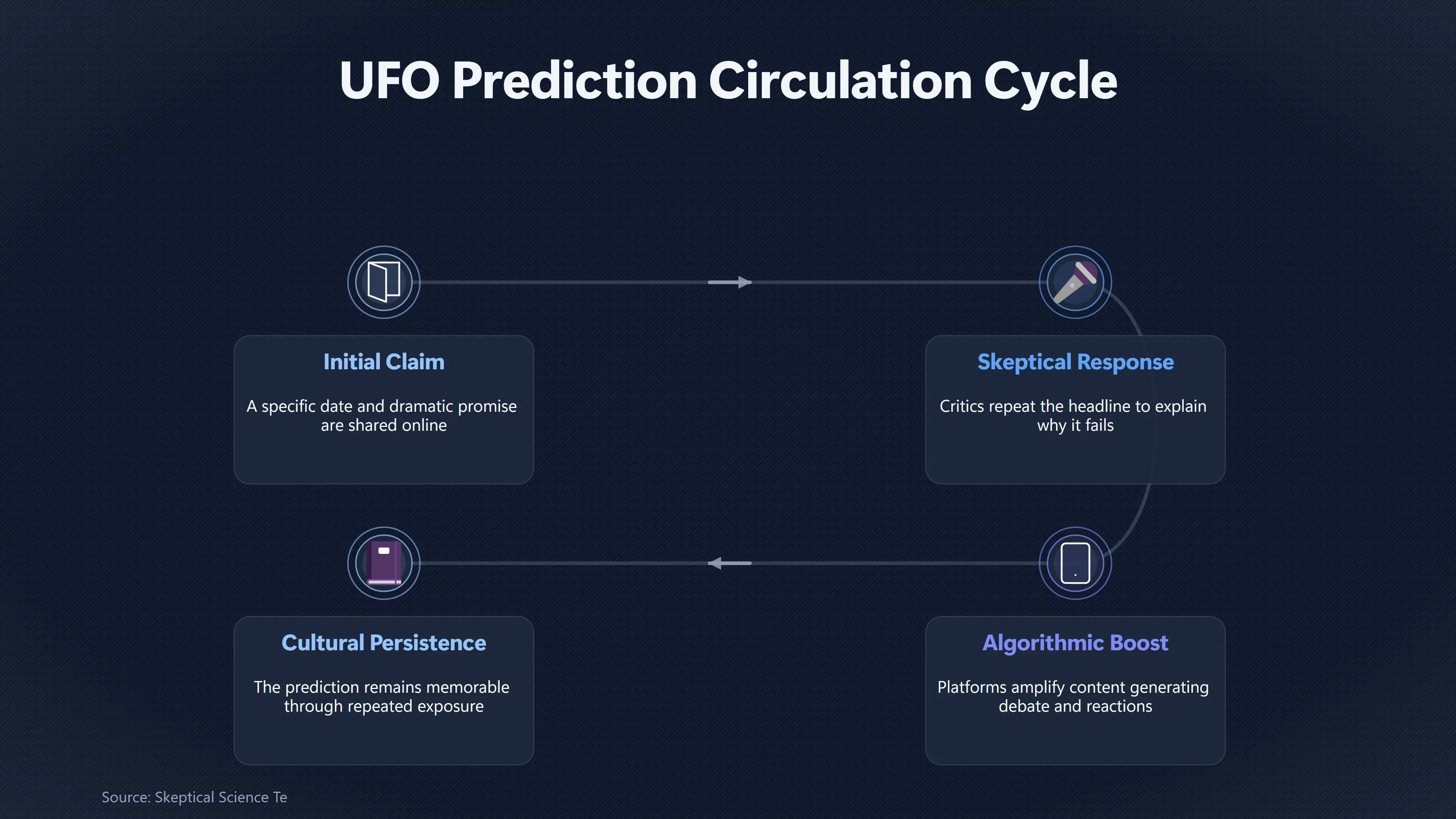
Mockery, rebuttals and fact-checking can enlarge a prediction's audience by repeating its most memorable date and promise.
On this page
- Why disagreement increases circulation
- The role of reaction videos and forums
- How to challenge claims without boosting them
Page outline Jump by section
Introduction
Failed UFO predictions often become more widely known because people argue against them. A specific prediction with a date and a dramatic promise is inherently shareable, but sceptical responses can extend its reach by repeating the same headline claim, discussing the countdown and encouraging audiences to watch what happens. As a result, many people first encounter a failed UFO prediction through criticism rather than through believers themselves.
This does not mean scepticism causes belief. In most cases, debunking reduces acceptance of false claims. However, communication research shows that repeated exposure increases familiarity, and familiar claims are easier to remember and more likely to circulate, even when they are accompanied by criticism. Understanding this dynamic helps explain why some failed UFO predictions remain culturally prominent long after the predicted date has passed.
Why disagreement increases circulation
Public disagreement creates attention. When a UFO prediction names a specific day for alien contact, sceptics, journalists, science communicators and curious observers all have an obvious reason to discuss it before and after the deadline.
Several mechanisms contribute to this wider circulation:
- The prediction becomes newsworthy. A precise claim creates a scheduled event that media outlets can anticipate, cover and revisit once the prediction fails.
- Criticism repeats the memorable elements. Headlines often restate the prediction’s date, location or promise before explaining why it is unlikely.
- Algorithms reward engagement. Social media platforms tend to amplify content that generates comments, debate and reactions regardless of whether those reactions are supportive or critical.
- Shared curiosity broadens the audience. Many viewers consume debunking videos simply because they want to know what was predicted and whether anything happened.
The result is that opposition can inadvertently perform free publicity. People who would never have searched for a particular UFO prophecy may encounter it through fact-checks, reaction videos or discussions mocking the prediction.
Communication research helps explain why this matters. Repetition increases familiarity, and familiarity can make information seem more credible or at least more mentally available—a phenomenon known as the illusory truth effect. Importantly, this effect concerns repeated exposure rather than evidence, and it does not imply that every repeated falsehood becomes believed. Nevertheless, repeated mention helps keep a claim in public awareness.[PubMed]pubmed.ncbi.nlm.nih.govThe illusory truth effect: A review of how repetition increases belief in misinformation - PubMed…
The role of reaction videos and forums
Online platforms make the amplification cycle especially visible.
Countdown content creates repeated exposure
As a prediction approaches, creators often publish videos asking whether the claim could be true, explaining why it is doubtful or counting down to the promised event. Each upload introduces the prediction to viewers who might otherwise never encounter it.
After the date passes, a second wave of content usually appears analysing the failure, discussing believers’ reactions or examining why the prediction gained attention. Even though these videos reject the original claim, they continue repeating its most memorable features.
Forums work similarly. Threads frequently begin by quoting or summarising the prediction before members debate it. Long discussions keep the prediction visible through replies, reposts and recommendations.
Debate can outlive the prediction
Many failed UFO predictions persist online because discussions continue after the event itself. Instead of disappearing once the prediction fails, the conversation shifts towards questions such as:
- Why did people believe it?
- Why did the prediction spread so widely?
- How did believers explain the failure?
- Did sceptics respond fairly?
In this way, the failed prediction becomes part of internet culture independently of its factual accuracy.
Failed predictions as shared cultural events
Several well-known UFO prediction episodes illustrate this pattern. Predictions tied to widely publicised dates—such as forecasts of mass spacecraft appearances or extraterrestrial contact—often received extensive sceptical coverage before the deadline. Newspapers, television programmes, science blogs and online commentators explained why experts expected nothing unusual to occur.
When the date passed without the promised event, the prediction received another round of attention as commentators documented the failure. The prediction’s public visibility therefore depended not only on believers promoting it but also on critics reporting its collapse.
This pattern differs from private or obscure predictions that receive little outside attention. Many failed UFO forecasts vanish unnoticed because few people discuss them. Those that become famous often do so because disagreement itself generates sustained public interest.
How to challenge claims without boosting them
Research on misinformation suggests that effective correction requires balancing accuracy with the risk of unnecessary repetition. Modern guidance generally rejects the idea that debunking is inherently counterproductive. Instead, evidence indicates that corrections usually reduce false beliefs, even though they necessarily repeat the claim being corrected.[Skeptical Science]skepticalscience.comSkeptical Science TeDebunking Handbook…
Practical approaches include:
- Lead with accurate information. Begin by stating the verified facts before introducing the unsupported prediction.
- Avoid sensational repetition. Do not repeat dramatic headlines more often than necessary.
- Explain why the prediction failed. Replacing the false claim with a clear alternative explanation helps readers update their understanding.
- Focus on evidence rather than personalities. Evaluating claims by their supporting evidence avoids turning criticism into publicity for charismatic prediction-makers.
- Keep corrections proportional. Extremely obscure predictions may not warrant widespread coverage if doing so introduces them to a much larger audience.
These approaches recognise that visibility and persuasion are different. A correction may increase awareness of a claim while still reducing belief in it.

The broader lesson
Failed UFO predictions demonstrate that public attention is not driven solely by believers. Sceptics, journalists, scientists and online commentators all contribute to the information environment surrounding a prediction. Every rebuttal, reaction thread or fact-check repeats the central promise, making the prediction easier to find, remember and discuss.
At the same time, the available evidence indicates that thoughtful debunking generally remains worthwhile. The challenge is not whether to correct unsupported UFO predictions, but how to do so in ways that maximise accurate information while minimising unnecessary amplification of memorable but unsupported claims.[Skeptical Science]skepticalscience.comSkeptical Science TeDebunking Handbook…
Amazon book picks
Further Reading
Books and field guides related to How Debunking Can Amplify a UFO Prediction. Use these as the next step if you want deeper reading beyond the article.
The Influential Mind: What the Brain Reveals About Our Power...
Selected as a best book of 2017 by Forbes, The Times, Huffington Post, Bloomberg, Greater Good Magazine, Stanford Business School and mor...
Calling Bullshit: The Art of Skepticism in a Data-Driven World
Bullshit isn’t what it used to be. Now, two science professors give us the tools to dismantle misinformation and think clearly in a world...
The Skeptics' Guide to the Universe: How to Know What's Reall...
An all-encompassing guide to skeptical thinking from podcast host and academic neurologist at Yale University School of Medicine Steven N...
Why People Believe Weird Things
Rating: 4.5/5 from 5 Google Books ratings
"This sparkling book romps over the range of science and anti-science." --Jared Diamond, author of Guns, Germs, and Steel Revised and Exp...
eBay marketplace picks
Marketplace Samples
Live-tested eBay searches with available results related to this page.
Selected fromUFO poster oneBay.co.uk.

Current eBay listing
VINTAGE UFO FLYING SAUCERS COMIC ADVERTISING A2 POSTER PRINT
Current eBay listing
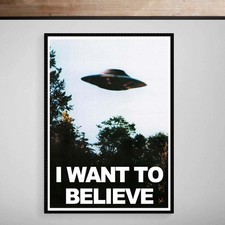
I Want To Believe UFO Poster Giclée Fine Art Heavyweight Print


Endnotes
1.
Source: pubmed.ncbi.nlm.nih.gov
Link:https://pubmed.ncbi.nlm.nih.gov/38113667/
Source snippet
The illusory truth effect: A review of how repetition increases belief in misinformation - PubMed...
2.
Source: skepticalscience.com
Title: Skeptical Science Te
Link:https://skepticalscience.com/docs/DebunkingHandbook2020.pdf
Source snippet
Debunking Handbook...
3.
Source: pubmed.ncbi.nlm.nih.gov
Link:https://pubmed.ncbi.nlm.nih.gov/40860910/
Source snippet
The truth sandwich format does not enhance the correction of misinformation - PubMed...
4.
Source: skeptic.com
Title: Ufology: From Fringe to Mainstream to Fringe?
Link:https://www.skeptic.com/article/ufology-from-fringe-to-mainstream-to-fringe/
Source snippet
Nick Pope February 20, 2026 - 16 min read A little over eight years ago The New York Times published a story that had profound implicatio...
Published: February 20, 2026
5.
Source: pubmed.ncbi.nlm.nih.gov
Link:https://pubmed.ncbi.nlm.nih.gov/38852171/
6.
Source: ncbi.nlm.nih.gov
Link:https://www.ncbi.nlm.nih.gov/books/NBK609028/
7.
Source: pmc.ncbi.nlm.nih.gov
Link:https://pmc.ncbi.nlm.nih.gov/articles/PMC8116821/
8.
Source: pubmed.ncbi.nlm.nih.gov
Link:https://pubmed.ncbi.nlm.nih.gov/33983553/
9.
Source: skepticalscience.com
Link:https://skepticalscience.com/print.php?n=4890
10.
Source: pmc.ncbi.nlm.nih.gov
Link:https://pmc.ncbi.nlm.nih.gov/articles/PMC7447737/
11.
Source: pmc.ncbi.nlm.nih.gov
Link:https://pmc.ncbi.nlm.nih.gov/articles/PMC12377696/
12.
Source: youtube.com
Title: Illusory Truth Effect
Link:https://www.youtube.com/watch?v=cXFxRkjZNiw
Source snippet
When “When Prophecy Fails” Fails (E350)...
13.
Source: youtube.com
Title: Why people believe weird things | Michael Shermer
Link:https://www.youtube.com/watch?v=8T_jwq9ph8k
Source snippet
Illusory Truth Effect...
Additional References
14.
Source: nature.com
Link:https://www.nature.com/articles/s41467-026-70041-x
Source snippet
February 27, 2026 — Systematic review and meta-analysis of the evidence for an illusory truth effect and its determinants Download PDF Do...
Published: February 27, 2026
15.
Source: tandfonline.com
Link:https://www.tandfonline.com/doi/full/10.1080/10410236.2026.2623508
Source snippet
February 11, 2026 — Health Communication Latest Articles Submit an article Journal homepage Open access 715 Views 0 CrossRef citations to...
Published: February 11, 2026
16.
Source: clearskyscience.com
Link:https://www.clearskyscience.com/en/10.1038/s41467-026-70041-x/
Source snippet
February 27, 2026 — SYSTEMATIC REVIEW AND META-ANALYSIS OF THE EVIDENCE FOR AN ILLUSORY TRUTH EFFECT AND ITS DETERMINANTS 2026-02-27 · Ba...
Published: February 27, 2026
17.
Source: youtube.com
Title: The Backfire Effect: Can fact-checking make false beliefs stronger?
Link:https://www.youtube.com/watch?v=9xXcLsFNByw
Source snippet
Why people believe weird things | Michael Shermer...
18.
Source: research.sabanciuniv.edu
Link:https://research.sabanciuniv.edu/id/eprint/54047/
Source snippet
Disentangling the competing effects of repetition and fact-checking corrections of brand misinformation - Sabanci University Research Dat...
19.
Source: skepticalinquirer.org
Link:https://skepticalinquirer.org/2026/06/boosting-facts-and-busting-myths-about-mythbusting/
20.
Source: skepticalinquirer.org
Link:https://skepticalinquirer.org/2021/08/csi-statement-expresses-concerns-about-ufo-coverage-offers-tips-for-reporters/
21.
Source: sciencedirect.com
Link:https://www.sciencedirect.com/science/article/pii/S0950329325002794
22.
Source: research-information.bris.ac.uk
Link:https://research-information.bris.ac.uk/en/publications/can-corrections-spread-misinformation-to-new-audiences-testing-fo/
23.
Source: shs.cairn.info
Link:https://shs.cairn.info/journal-raisons-politiques-2012-4-page-33?lang=en