Within Sunk Costs
Why Going Public Can Lock Belief In
Jobs quit, possessions sold and public claims defended can make a failed UFO prediction harder to reject than a belief held privately.
On this page
- Material and reputational investments before the deadline
- How personal responsibility fuels escalation of commitment
- What initiation research suggests about valuing costly groups
Page outline Jump by section
Introduction
When a public UFO prediction fails, changing one’s mind is often harder than it would have been had the belief remained private. The reason is not simply that believers have invested time or money. Public declarations, visible sacrifices and personal advocacy create reputational and psychological commitments that can make retraction feel like an admission of personal failure rather than a straightforward revision of evidence. Social psychology has long argued that beliefs tied to costly public actions are especially resistant to change, although recent historical research has challenged aspects of the classic UFO case that originally inspired this literature. The broader findings from laboratory and field research nevertheless remain relevant: people who have publicly committed themselves to a position are often more motivated to defend it after receiving disconfirming evidence than those whose commitment was private.[nih.gov]pmc.ncbi.nlm.nih.govOpen source on nih.gov.
Material and reputational investments before the prediction deadline
Public commitment changes the nature of a failed prediction because the consequences extend beyond whether the claim proved correct. Before a predicted UFO landing or extraterrestrial intervention, some believers may have:
- Left employment or education.
- Sold possessions or relocated.
- Encouraged friends and relatives to join.
- Given media interviews or spoken at public meetings.
- Defended the prediction repeatedly on social media or in local communities.
Each action creates an observable record. Once these commitments are visible, abandoning the belief can threaten a person’s reputation, relationships and self-image simultaneously.
This mechanism was central to Leon Festinger and colleagues’ original discussion of failed prophecy. They argued that beliefs become especially resistant when they have motivated significant, difficult-to-reverse actions. The prediction is no longer merely an opinion; it has become part of the believer’s public identity.[Wikipedia]WikipediaWhen Prophecy FailsWhen Prophecy Fails
Importantly, this does not mean every committed believer remains loyal. Recent archival research by Timothy Kelly argues that the famous 1954 UFO group surrounding Dorothy Martin did not respond exactly as When Prophecy Fails described. According to newly examined records, Martin herself recanted and the group largely dissolved rather than launching the dramatic post-failure recruitment campaign portrayed in the classic account. That revision affects the historical interpretation of one influential case but does not overturn the broader body of experimental evidence showing that public commitment often increases resistance to changing course.[wiley.com]onlinelibrary.wiley.comOnline Library Debunking “When Prophecy Fails”Wiley Online LibraryDebunking “When Prophecy Fails” - Kelly - 2026 - Journal of the History of the Behavioral Sciences - Wiley Online Lib…
How personal responsibility drives escalation of commitment
Public commitment also increases a sense of personal responsibility. Once individuals believe they freely chose to advocate a prediction, abandoning it may imply that their own judgement—not merely the prediction—was flawed.
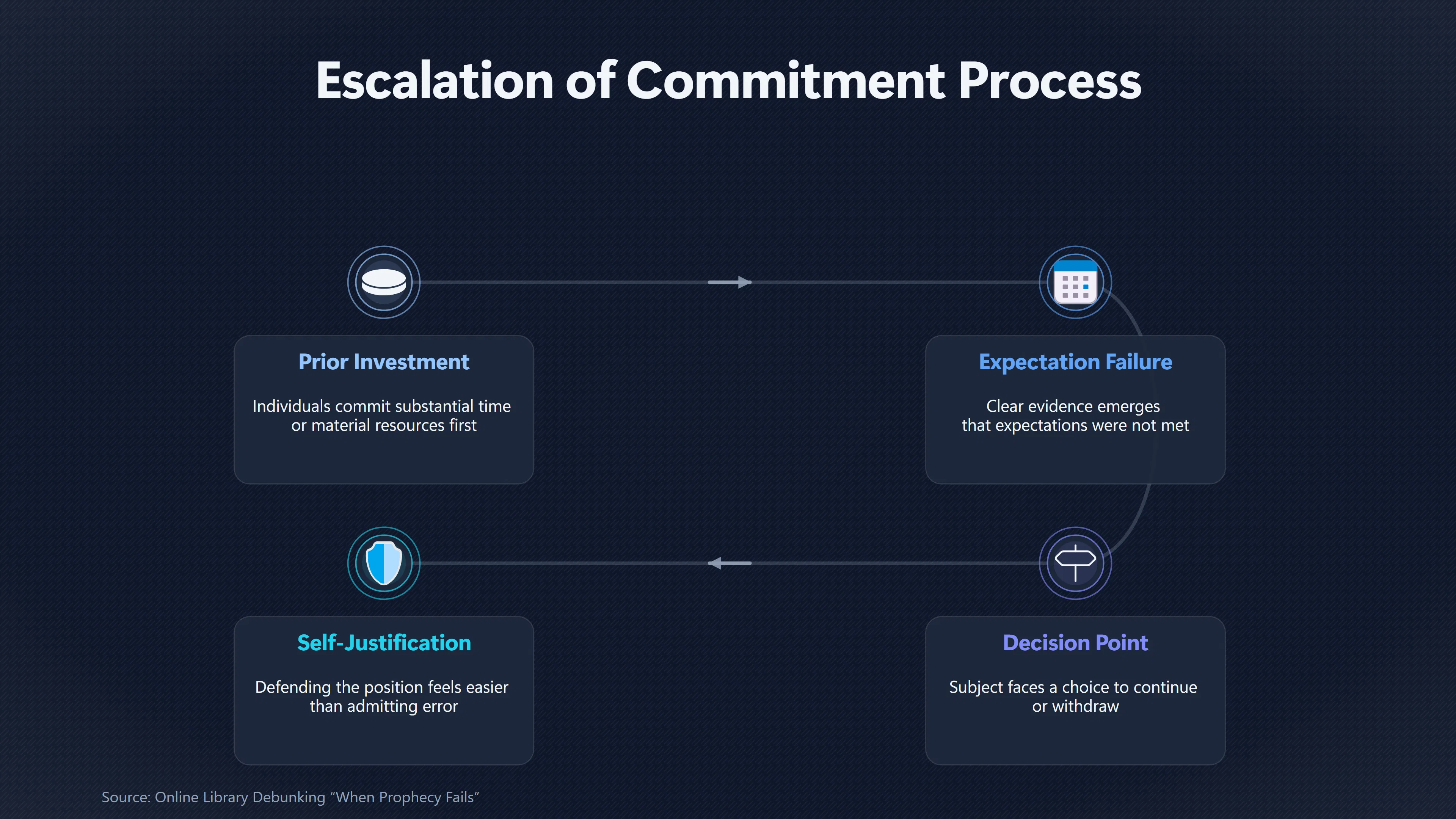
Research on escalation of commitment consistently finds that people are more likely to continue supporting unsuccessful decisions when three ingredients are present:
- substantial prior investment;
- clear evidence that expectations have not been met; and
- a decision about whether to continue or withdraw.
Under those conditions, self-justification becomes a powerful motivation. Continuing to defend the original position can feel psychologically easier than accepting that earlier sacrifices produced no intended result.[PubMed Central (PMC)]pmc.ncbi.nlm.nih.govOpen source on nih.gov.
Modern work has refined this picture further. Rather than viewing escalation solely as a response to sunk costs, researchers argue that negative feedback itself often creates pressure to “do something.” If continuing support is framed as taking action while withdrawing feels like passively admitting defeat, people may become even more likely to escalate their commitment. This helps explain why some adherents respond to failed UFO predictions by producing new explanations, revised timelines or additional interpretations instead of simply abandoning the original framework.[PubMed]pubmed.ncbi.nlm.nih.govOpen source on nih.gov.

Why public embarrassment raises the psychological stakes
Retraction after a public commitment often carries two different social costs.
First is external reputation. Friends, relatives and critics may remember confident predictions long after the deadline passes. Admitting error may seem to validate previous scepticism.
Second is internal consistency. People generally prefer to view themselves as competent and rational. Publicly reversing course can threaten that self-concept, particularly if the individual persuaded others to participate.
These pressures help explain why failed predictions sometimes produce reinterpretation instead of outright rejection. New explanations can preserve continuity between the believer’s previous public identity and present reality without requiring a complete admission of error.
Crucially, these mechanisms increase the probability of continued commitment—they do not determine it. Many people confronted with failed prophecies quietly disengage, revise their views or leave the movement altogether, especially if supportive social networks weaken or trusted leaders abandon the original claim.[nih.gov]pubmed.ncbi.nlm.nih.govPromoting de-escalation of commitment: a regulatory-focus perspective on sunk costs - PubMed…
What initiation research suggests about costly groups
Evidence from classic initiation research offers another perspective on why costly commitment matters.
In the well-known experiment by Elliot Aronson and Judson Mills, participants who underwent a more embarrassing initiation subsequently evaluated an otherwise ordinary discussion group more positively than participants who entered with little effort. The study suggested that people often increase the perceived value of groups when entry required significant personal cost.
Although the experiment did not involve UFO beliefs, it illustrates a broader psychological principle: expensive or uncomfortable commitments can increase attachment rather than weaken it. When membership requires visible sacrifice, those sacrifices themselves may become evidence—at least psychologically—that the group or cause must have been worthwhile.
Applied cautiously to failed UFO predictions, this helps explain why believers who made conspicuous sacrifices may experience greater difficulty withdrawing than casual followers who merely observed events from a distance. The investment becomes part of the reason the commitment feels valuable.
Modern researchers generally treat this as one contributing process among several rather than a complete explanation. Group support, identity, leadership responses and available alternative interpretations all influence whether costly commitment strengthens loyalty or whether members eventually disengage.[nih.gov]pmc.ncbi.nlm.nih.govOpen source on nih.gov.
What public commitment adds to understanding failed UFO predictions
Public commitment explains why failed UFO predictions sometimes prove psychologically difficult to abandon even when the factual prediction has clearly failed. Material sacrifices, public advocacy and personal responsibility increase the emotional cost of admitting error because the issue extends beyond whether extraterrestrials arrived as predicted. It also concerns protecting one’s reputation, relationships and sense of self.
At the same time, the historical record cautions against assuming a single pattern. The influential Dorothy Martin case has been substantially reinterpreted by recent archival research, reminding researchers that individual prophecy failures can unfold in very different ways. The strongest conclusion supported by the broader evidence is therefore probabilistic rather than absolute: visible, costly public commitments often make retraction more difficult, but they neither guarantee continued belief nor prevent eventual disengagement.[wiley.com]onlinelibrary.wiley.comOnline Library Debunking “When Prophecy Fails”Wiley Online LibraryDebunking “When Prophecy Fails” - Kelly - 2026 - Journal of the History of the Behavioral Sciences - Wiley Online Lib…
Amazon book picks
Further Reading
Books and field guides related to Why Going Public Can Lock Belief In. Use these as the next step if you want deeper reading beyond the article.
Mistakes Were Made (But Not by Me): Why We Justify Foolish Be...
Why is it so hard to say "I made a mistake"-and really believe it? When we make mistakes, cling to outdated attitudes, or mistreat other...
When Prophecy Fails
The study reported in this volume grew out of some theoretical work, one phase of which bore specifically on the behavior of individuals...
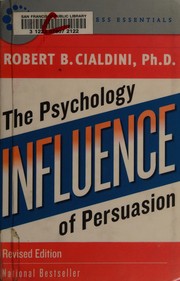
Influence: The Psychology of Persuasion
Rating: 3.9/5 from 68 Google Books ratings
This is a Summary of the original book, Influence: The Psychology of Persuasion by Robert Cialdini.The book is an authoritative work on t...
Influence
Rating: 3.9/5 from 68 Google Books ratings
This is a Summary of the original book, Influence: The Psychology of Persuasion by Robert Cialdini.The book is an authoritative work on t...
eBay marketplace picks
Marketplace Samples
Live-tested eBay searches with available results related to this page.
Selected fromUFO poster oneBay.co.uk.

Current eBay listing
VINTAGE UFO FLYING SAUCERS COMIC ADVERTISING A2 POSTER PRINT

Current eBay listing
I Want To Believe UFO Poster Giclée Fine Art Heavyweight Print


Endnotes
1.
Source: onlinelibrary.wiley.com
Title: Online Library Debunking “When Prophecy Fails”
Link:https://onlinelibrary.wiley.com/doi/10.1002/jhbs.70043
Source snippet
Wiley Online LibraryDebunking “When Prophecy Fails” - Kelly - 2026 - Journal of the History of the Behavioral Sciences - Wiley Online Lib...
2.
Source: Wikipedia
Title: When Prophecy Fails
Link:https://en.wikipedia.org/wiki/When_Prophecy_Fails
3.
Source: onlinelibrary.wiley.com
Link:https://onlinelibrary.wiley.com/doi/abs/10.1002/jhbs.70043
Source snippet
“When Prophecy Fails” - Kelly - 2026 - Journal of the History of the Behavioral Sciences - Wiley Online LibraryNovember 4, 2025 — ORIGINA...
Published: November 4, 2025
4.
Source: pmc.ncbi.nlm.nih.gov
Link:https://pmc.ncbi.nlm.nih.gov/articles/PMC5904751/
5.
Source: pubmed.ncbi.nlm.nih.gov
Link:https://pubmed.ncbi.nlm.nih.gov/21106888/
Source snippet
Promoting de-escalation of commitment: a regulatory-focus perspective on sunk costs - PubMed...
6.
Source: pubmed.ncbi.nlm.nih.gov
Title: Pub Med Debunking “When Prophecy Fails”
Link:https://pubmed.ncbi.nlm.nih.gov/41186060/
Source snippet
Debunking "When Prophecy Fails" - PubMed...
7.
Source: pubmed.ncbi.nlm.nih.gov
Link:https://pubmed.ncbi.nlm.nih.gov/11302222/
8.
Source: pubmed.ncbi.nlm.nih.gov
Link:https://pubmed.ncbi.nlm.nih.gov/29401001/
9.
Source: pubmed.ncbi.nlm.nih.gov
Link:https://pubmed.ncbi.nlm.nih.gov/15779532/
Additional References
10.
Source: psychologicalscience.org
Link:https://www.psychologicalscience.org/journals/psychological-science/0956797617739368/
Source snippet
Association for Psychological ScienceWhen Action-Inaction Framing Leads to Higher Escalation of Commitment: A New Inaction-Effect Perspec...
11.
Source: youtube.com
Link:https://www.youtube.com/watch?v=SmfH9OXfGpg
Source snippet
For further context on how psychological commitment and failed expectations interact, you can watch InPresence 0211: When Prophecy Fails...
12.
Source: researchgate.net
Title: Debunking “When Prophecy Fails”
Link:https://www.researchgate.net/publication/397254906_Debunking_When_Prophecy_Fails
Source snippet
November 1, 2025 — DEBUNKING “WHEN PROPHECY FAILS” Journal of the History of the Behavioral Sciences * November 2025 * 62(1) DOI:10.1002/...
Published: November 1, 2025
13.
Source: youtube.com
Title: When Prophecy Fails — Why Failed Beliefs Get Stronger
Link:https://www.youtube.com/watch?v=3sOV0HENbkE
Source snippet
Biblical Scholar DESTROYS Christian Missionary Claims Used to Convert Hindus | Dr. Bart Ehrman...
14.
Source: youtube.com
Title: When “When Prophecy Fails” Fails (E350)
Link:https://www.youtube.com/watch?v=IhblbZDXfZU
Source snippet
The UFO Cult That Inspired Cognitive [Dissonance]({{ 'dissonance/' | relative_url }}) | Dorothy Martin & The Seekers...
15.
Source: youtube.com
Title: The UFO Cult That Inspired Cognitive Dissonance | Dorothy Martin & The Seekers
Link:https://www.youtube.com/watch?v=vvFV1v8l-PI
Source snippet
InPresence 0211: When Prophecy Fails...
16.
Source: sciencedirect.com
Title: Pride before the fall: (Over)confidence predicts escalation of public commitment
Link:https://www.sciencedirect.com/science/article/pii/S0022103116300968
17.
Source: youtube.com
Link:https://www.youtube.com/watch?v=6d6SJd5sxnM
Source snippet
When Prophecy Fails — Why Failed Beliefs Get Stronger...
18.
Source: journals.aom.org
Link:https://journals.aom.org/doi/abs/10.5465/amr.1986.4283111