Within False Corroboration
Can Viral Attention Ever Verify a UFO Prediction?
High view counts measure attention and distribution, not whether anyone independently observed, documented or verified the predicted event.
On this page
- What engagement numbers actually measure
- How popularity becomes a credibility shortcut
- Evidence that would count instead
Page outline Jump by section
Introduction
A UFO prediction does not become more credible because it attracts millions of views, thousands of reposts or widespread discussion. High engagement measures how far a claim has travelled through an information network, not whether the underlying prediction has gained new evidence. Within the context of failed UFO predictions, this distinction is essential. A prediction that spreads across dozens of platforms may still depend entirely on a single unsupported source, even though its online popularity creates the impression that many independent observers have confirmed it.
This matters because social media can make attention look like corroboration. A viral prediction often acquires an aura of legitimacy simply because so many people have encountered it. Yet unless those additional posts introduce independently verifiable observations, documents, measurements or witnesses, the evidence remains exactly what it was before the prediction went viral.
What engagement numbers actually measure
Views, likes, reposts and comments are metrics of audience behaviour rather than indicators of factual accuracy. They record how people interacted with content, not whether anyone established that the content was true.
For a UFO prediction, engagement figures usually reflect factors such as:
- Curiosity about an extraordinary claim.
- Algorithmic recommendation and platform promotion.
- Debate between believers and sceptics.
- Coverage by news organisations reporting on the controversy.
- Reposting across multiple communities.
None of these activities independently tests whether the predicted event occurred.
For example, a prediction that “a fleet of UFOs will appear on a specific date” may receive hundreds of thousands of views before the date arrives. If nothing unusual happens, those historical engagement numbers remain unchanged. They document public attention, not successful prediction.
This distinction mirrors broader research on online misinformation. Studies consistently show that repetition and visibility affect what people notice and remember, but these factors are separate from empirical verification.[University of Edinburgh Research]research.ed.ac.ukOpen source on ed.ac.uk.
How popularity becomes a credibility shortcut
People often use mental shortcuts when judging unfamiliar claims. One of these is social proof—the tendency to assume that if many other people appear interested in something, it is more likely to deserve attention or belief.
Online platforms strengthen this shortcut because they display popularity metrics alongside content. Large view counts, trending labels and rapidly increasing repost numbers can create several misleading impressions:
- Popularity appears to signal agreement. Users may assume thousands of shares indicate widespread acceptance, even when many shares are critical.
- Visibility is mistaken for verification. Seeing the same prediction repeatedly across different accounts can create the impression that multiple sources independently support it.
- Familiarity becomes persuasive. Simply encountering the same prediction several times makes it easier to remember, which can increase subjective feelings that it is credible.
Psychological research refers to this as the illusory truth effect: repeated statements are often judged as more believable simply because they feel familiar, even when no additional evidence has appeared.
None of these cognitive effects changes the quality of the underlying evidence. A repeated unsupported prediction remains unsupported.
Reposts usually duplicate information rather than add it
One repost is rarely equivalent to one new source.
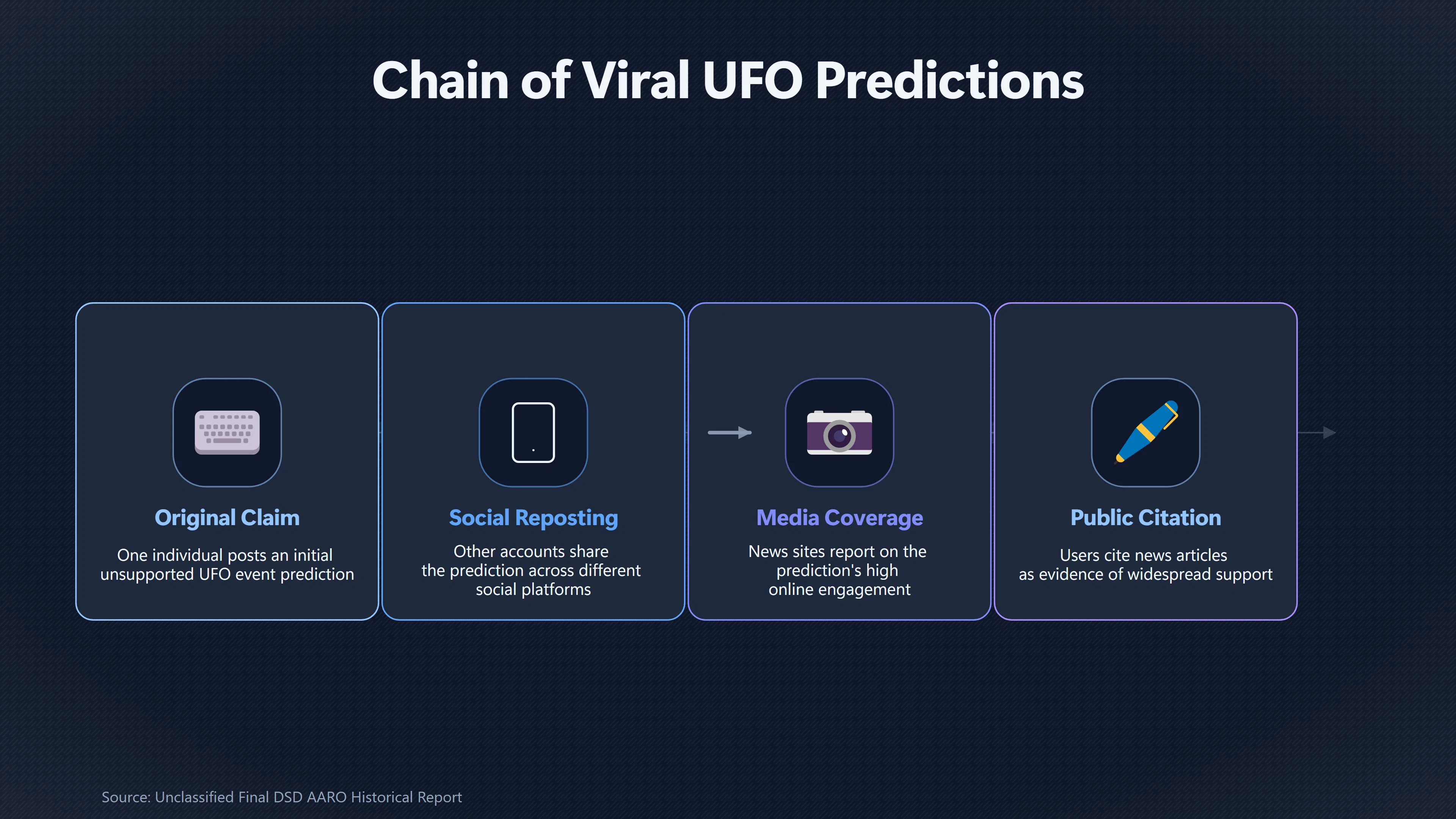
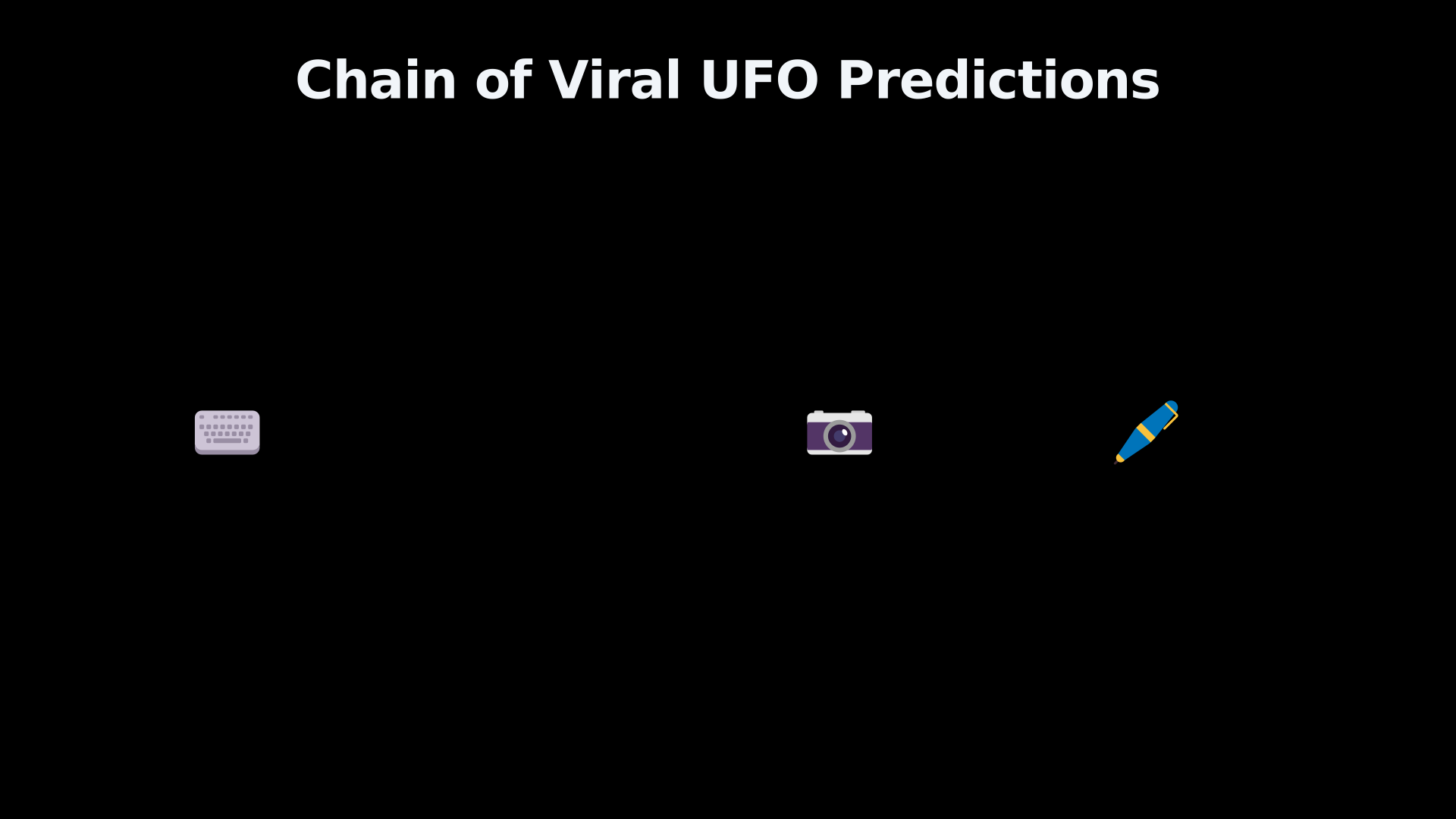
Instead, online sharing often creates long chains in which every post ultimately traces back to the same original claim. A typical sequence might look like this:
- One individual predicts a UFO event.
- Another account reposts the prediction.
- A video creator discusses the repost.
- News sites report that the prediction is attracting attention.
- Social media users cite those articles as evidence that “many sources” are reporting the prediction.
Although numerous webpages now exist, they may all depend on the identical initial statement.
This is why investigators distinguish between the number of publications and the number of independent evidential origins. One original unsupported claim copied a thousand times still represents one unsupported claim.
Why failed predictions can still look successful online
Even after a predicted UFO event fails to occur, viral posts often remain easier to find than later corrections.
Several mechanisms contribute to this:
- Original prediction posts may accumulate engagement for weeks before the predicted date.
- Debunking articles frequently attract smaller audiences than sensational forecasts.
- Older viral posts continue circulating after the prediction has already failed.
- New audiences encounter archived posts without seeing the later outcome.
As a result, someone discovering the prediction months later may see impressive engagement figures while never encountering the evidence that the forecast failed.
This persistence of popular but incorrect material is well documented across online misinformation research, where initial claims often achieve wider distribution than subsequent corrections.[University of Edinburgh Research]research.ed.ac.ukOpen source on ed.ac.uk.
Official investigations separate attention from evidence
Investigators examining unidentified anomalous phenomena (UAP), the modern official term often replacing UFO, do not evaluate claims by counting online popularity.
Instead, they seek evidence such as:
- independently collected sensor data;
- contemporaneous witness accounts;
- photographs or video with verifiable provenance;
- radar or flight records;
- physical measurements;
- documentation that can be authenticated.
The U.S. Department of Defense’s All-domain Anomaly Resolution Office (AARO) has explicitly warned against circular reporting, concluding that some longstanding UFO narratives became reinforced because individuals repeatedly cited claims originating within the same small network rather than producing independent corroboration. The office stresses that conclusions should be based on verifiable evidence rather than repetition or widespread circulation.[U.S. Department of War]defense.govU.S. Department of WarDOD Report Discounts Sightings of Extraterrestrial Technology > U.S. Department of Defense > Defense Department New…
The principle applies equally to predictions. Whether a prediction receives 100 reposts or 10 million, investigators still ask the same questions:
- Did the predicted event occur?
- Is there independently verifiable documentation?
- Can multiple independent sources confirm the event?
- Can the evidence withstand critical examination?
Popularity cannot answer these questions.
Evidence that would count instead
If viral attention does not verify a UFO prediction, what would?
Useful evidence would involve independent observations that arise because the predicted event actually happened, rather than because people discussed the prediction.
Examples include:
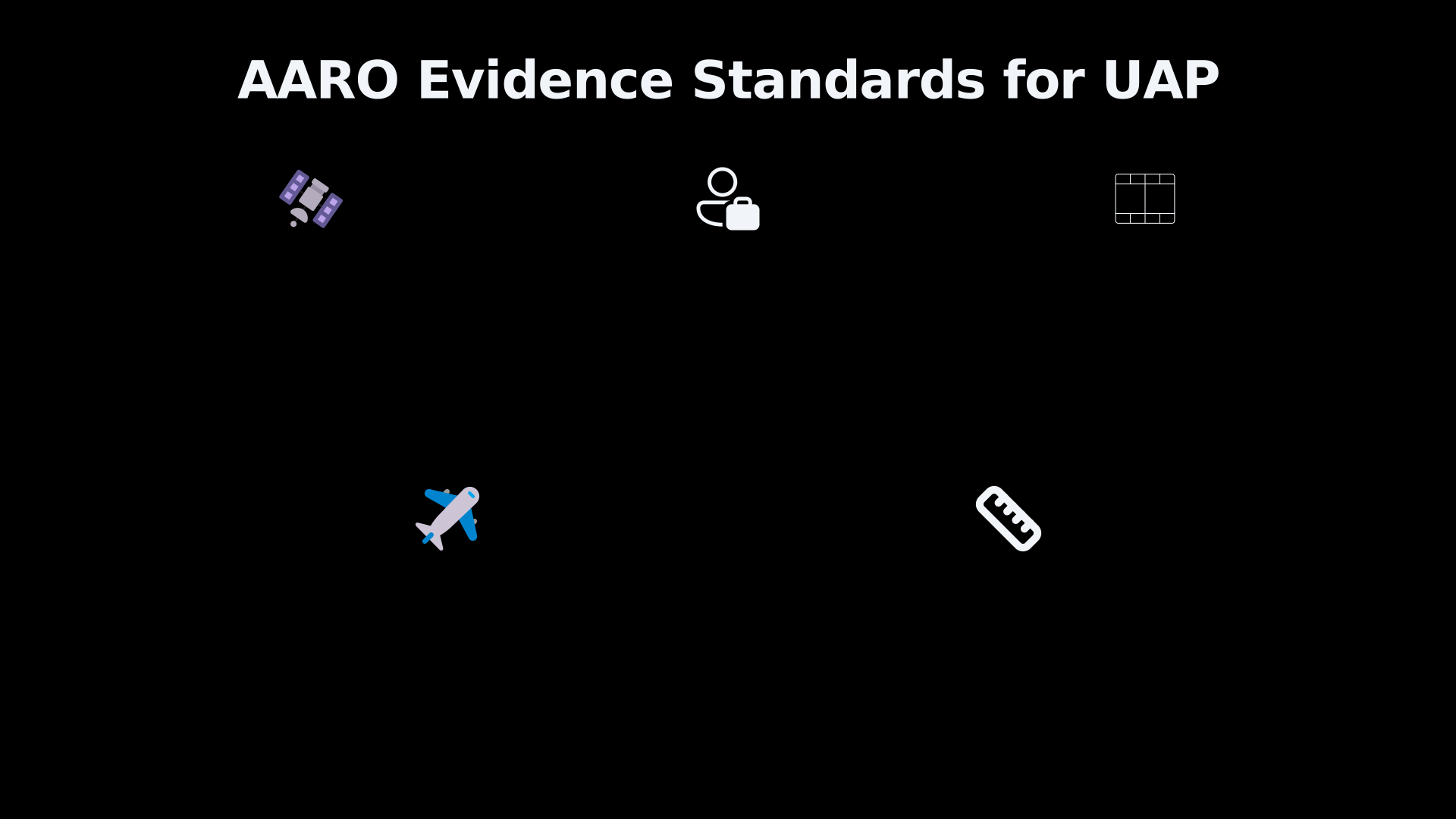
- Multiple independent observers documenting the same event without relying on one another.
- Time-stamped recordings from separate locations showing the predicted phenomenon.
- Corroborating radar, satellite or other instrument data where appropriate.
- Documentation whose provenance can be established and independently examined.
- Successful predictions containing precise, testable details that were unlikely to have been guessed and were confirmed before later discussion influenced observers.
Importantly, this evidence must exist independently of online engagement. A prediction supported by robust documentation remains strong even if few people see it, while a prediction supported only by millions of views remains weak regardless of its popularity.
The key distinction
Within discussions of failed UFO predictions, online popularity should be understood as a measure of distribution rather than confirmation.
Views indicate exposure.
Reposts indicate copying or redistribution.
Comments indicate discussion.
None of these metrics demonstrates that additional witnesses observed the predicted event, that independent investigators verified it, or that new empirical evidence emerged. Viral attention can make a prediction appear more credible by increasing familiarity and creating the impression of broad support, but it does not transform unsupported claims into verified ones. The evidential status changes only when genuinely independent, verifiable information is added—not when the same claim reaches a larger audience.
Amazon book picks
Further Reading
Books and field guides related to Can Viral Attention Ever Verify a UFO Prediction?. Use these as the next step if you want deeper reading beyond the article.
The Chaos Machine: The Inside Story of How Social Media Rewir...
'The Chaos Machine is an essential book for our times' - Ezra Klein The Chaos Machine is the story of how the world was driven mad by soc...
The Hype Machine: How Social Media Disrupts Our Elections, Ou...
NAMED ONE OF THE BEST BOOKS OF THE YEAR BY WIRED In this brilliant smart-thinking book about the power and influence of social media, Pro...
Trust Me, I'm Lying: Confessions of a Media Manipulator
The cult classic that predicted the rise of fake news—revised and updated for the post-Trump, post-Gawker age. Hailed as "astonishing and...
The Misinformation Age: How False Beliefs Spread
"Empowering and thoroughly researched, this book offers useful contemporary analysis and possible solutions to one of the greatest threat...
eBay marketplace picks
Marketplace Samples
Live-tested eBay searches with available results related to this page.
Selected fromUFO poster oneBay.co.uk.

Current eBay listing
VINTAGE UFO FLYING SAUCERS COMIC ADVERTISING A2 POSTER PRINT


Current eBay listing
I Want To Believe UFO Poster Giclée Fine Art Heavyweight Print

Endnotes
1.
Source: defense.gov
Link:https://www.defense.gov/News/News-Stories/Article/Article/3701297/dod-report-discounts-sightings-of-extraterrestrial-technology/
Source snippet
U.S. Department of WarDOD Report Discounts Sightings of Extraterrestrial Technology > U.S. Department of Defense > Defense Department New...
2.
Source: defense.gov
Link:https://www.defense.gov/News/Transcripts/Transcript/Article/3702219/media-engagement-with-acting-aaro-director-tim-phillips-on-the-historical-recor/
3.
Source: aaro.mil
Title: Unclassified Final DSD AARO Historical Report
Link:https://www.aaro.mil/Portals/136/PDFs/AARO_Historical_Record_Report_Vol_1_2024.pdf?emci=622cd777-b774-f011-8dc9-6045bda9d96b&emdi=ea000000-0000-0000-0000-000000000001&sourceid=1070813
Source snippet
Unclassified Final DSD AARO Historical Report...
4.
Source: defense.gov
Link:https://www.defense.gov/News/News-Stories/Article/Article/3965403/dod-examining-unidentified-anomalous-phenomena/
5.
Source: defense.gov
Link:https://www.defense.gov/News/Releases/Release/Article/3700894/statement-by-pentagon-press-secretary-maj-gen-pat-ryder-on-the-historical-recor/
6.
Source: defense.gov
Link:https://www.defense.gov/News/Releases/Release/Article/3513171/the-department-of-defense-launches-the-all-domain-anomaly-resolution-office-web/
7.
Source: aaro.mil
Link:https://www.aaro.mil/FAQ/
8.
Source: aaro.mil
Link:https://www.aaro.mil/
9.
Source: aaro.mil
Title: Congressional Press Products
Link:https://www.aaro.mil/Congressional-Press-Products/
10.
Source: research.ed.ac.uk
Link:https://www.research.ed.ac.uk/en/publications/the-amplification-of-exaggerated-and-false-news-on-social-media-t/
Additional References
11.
Source: nature.com
Link:https://www.nature.com/articles/s41467-026-70041-x
Source snippet
February 27, 2026 — Systematic review and meta-analysis of the evidence for an illusory truth effect and its determinants Download PDF Do...
Published: February 27, 2026
12.
Source: arxiv.org
Link:https://arxiv.org/abs/2207.07562
Source snippet
How many others have shared this? Experimentally investigating the effects of social cues on engagement, misinformation, and unpredi...
13.
Source: vanityfair.com
Link:https://www.vanityfair.com/news/2018/03/what-jack-dorseys-plan-to-verify-all-users-gets-right-and-wrong-about-fake-news
Source snippet
Analyzing 126,000 rumors tweeted over 4.5 million times by 3 million people, the findings reveal that false information spreads significa...
14.
Source: nature.com
Title: This approach is based on the idea that the biases and e
Link:https://www.nature.com/articles/s41467-026-72597-0
Source snippet
Community-based fact-checking reduces the spread of misleading posts on X (formerly Twitter) | Nature CommunicationsMay 5, 2026 — As a re...
Published: May 5, 2026
15.
Source: youtube.com
Title: Neil de Grasse Tyson on UFOs, alien life & historic hearings
Link:https://www.youtube.com/watch?v=UzgYBXTaxHI
Source snippet
This video features astrophysicist Neil deGrasse Tyson discussing how online visibility, viral interest, and unverified UFO claims do not...
16.
Source: pmc.ncbi.nlm.nih.gov
Link:https://pmc.ncbi.nlm.nih.gov/articles/PMC13066098/
Source snippet
2026 Feb 27;17:3270. doi: 10.1038/s41467-026-70041-x SYSTEMATIC REVIEW AND META-ANALYSIS OF THE EVIDENCE FOR AN ILLUSORY TRUTH EFFECT AND...
17.
Source: oecd.org
Link:https://www.oecd.org/en/topics/sub-issues/disinformation-and-misinformation.html
18.
Source: nature.com
Link:https://www.nature.com/articles/s41586-023-06883-y
19.
Source: youtube.com
Title: How to Spot Misinformation Without Losing Your Mind
Link:https://www.youtube.com/watch?v=97JbluMfNng
Source snippet
Why We Believe In Conspiracy Theories with Michael Shermer...
20.
Source: sciencedirect.com
Link:https://www.sciencedirect.com/science/article/pii/S0747563224000530