Within UFO Deadlines
How to Preserve a UFO Prediction for Testing
Archived posts, recordings, printed notices, and dated messages are essential for proving what was actually predicted before an event failed.
On this page
- What records establish a prior claim
- Capturing dates, wording, and promised events
- Avoiding retrospective reconstruction
Page outline Jump by section
Introduction
A UFO prediction can only be tested fairly when its wording is preserved before the promised event is due. The essential record is not a later summary saying that someone “predicted contact”, but a dated copy showing exactly what was claimed: the deadline, location, duration, visibility, named participants and any conditions attached to success.
Good documentation prevents two opposite errors. It stops critics from making a vague claim sound more precise than it was, and it stops a failed prediction from being softened after the deadline into something symbolic, private or conditional. The strongest record combines the original material with independent proof of when it existed: an archived webpage, circulated email, contemporary newspaper report, recording, printed notice or trusted timestamp. No single format is perfect, so important predictions should be preserved through several independent channels.
What establishes a genuine prior claim?
The first question is not whether a prediction later appeared to fail. It is whether there is reliable evidence that the relevant wording existed before the deadline.
A useful record must establish four things:
- Authorship: who issued or endorsed the prediction.
- Content: what observable event was promised.
- Timing: when the statement was made and when the event was due.
- Stability: whether the preserved wording can be distinguished from later edits.
The best evidence is usually a primary source preserved by an independent system. For example, a webpage written by the claimant is valuable because it gives the claimant’s own language; an archived capture made before the deadline adds external evidence that the page existed in that form by the capture date. The Internet Archive’s Wayback Machine records capture times within archived URLs and allows users to preserve pages deliberately through its Save Page Now service.[Internet Archive Help Center]help.archive.orgInternet Archive Help CenterUsing the Wayback MachineWhen you are surfing an incomplete archived site the Wayback Machine will grab the c…
Contemporary circulation also matters. A prediction emailed to many recipients, discussed in a dated newspaper, printed on a leaflet or played on a recorded radio programme becomes harder to rewrite retrospectively. Multiple recipients may retain separate copies, while publication by an independent outlet shows that the claim was already public. Such corroboration is especially important when the claimant’s own website is later altered or removed.
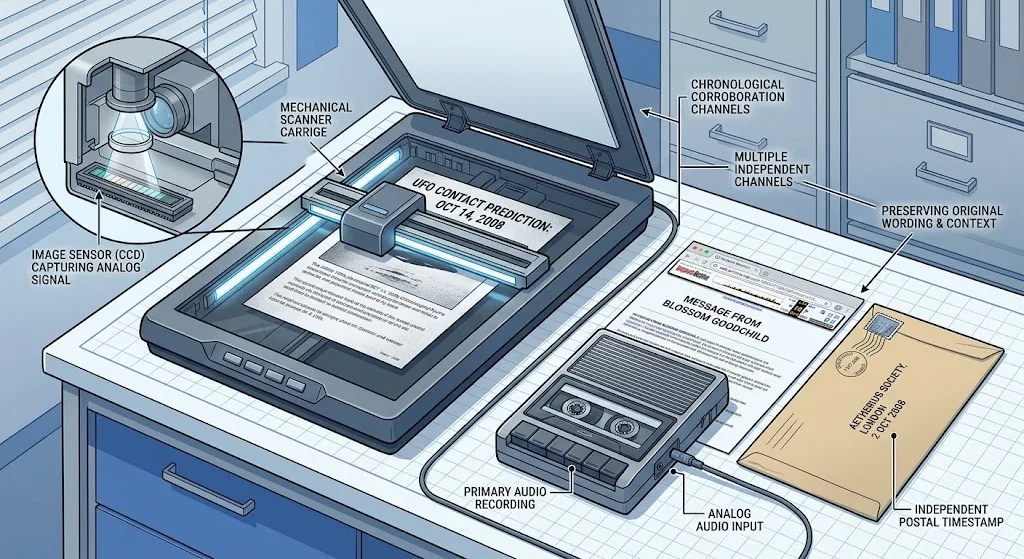
Blossom Goodchild’s 2008 prediction illustrates the value of preserving the claimant’s wording rather than relying on retrospective paraphrase. Her site stated that a Federation of Light craft would appear on 14 October 2008, remain for three days and be visible in a manner intended to demonstrate the existence of other life forms. Those details make the claim testable: it named a date, a duration and a publicly observable event. Her own later index also distinguishes messages issued before 14 October from those posted after the non-appearance, allowing the prediction and its subsequent explanation to be examined separately.[Blossom Goodchild]blossomgoodchild.comBlossom GoodchildEyes To The SkiesIn her most recent encounters with them they have announced that one of their craft will appear in our…
Capture the wording, not merely the theme
A weak record says, “Aliens were predicted to arrive in October.” A strong one preserves the complete statement and separates its individual commitments.
For testing purposes, the record should reproduce the claimant’s exact words and then extract the promised elements without rewriting them. Researchers should note:
- the precise date, time and time zone;
- whether the event concerns a landing, visible craft, catastrophe, rescue or official announcement;
- the stated geographical area;
- who should be able to observe it;
- how long it should last;
- what physical or public evidence was promised;
- any stated conditions, escape clauses or acceptable delays;
- whether the claimant described the date as certain, probable or provisional.
This distinction matters because later disputes often turn on one overlooked phrase. A prediction that says a craft “will appear worldwide for three days” is materially different from one saying that unusual lights “may be noticed by receptive observers”. Both concern UFOs, but only the first offers a clear public test.
The original form should be retained wherever possible. For webpages, save the page’s URL, visible text, images and linked files. For audio or video, keep the full recording rather than a short extract, together with its title, running time, publication page and surrounding discussion. For print, photograph or scan the whole notice, including masthead, page number, date and adjacent material that helps identify the publication. Cropping away that context can make a genuine item look less reliable.
Screenshots are useful as quick visual records, but they should not stand alone. A screenshot can omit the URL, hide edits, lose embedded material or be misattributed to the wrong account. Research on social-media screenshots treats attribution as a distinct verification problem and uses handles, visible timestamps, text and archived copies to locate the original post.[arXiv]arxiv.orgarXiv Web Archives for Verifying Attribution in Twitter ScreenshotsWeb Archives for Verifying Attribution in Twitter ScreenshotsOctober 27, 2025…
Dates require more than one timestamp
A visible date on a blog post or message is evidence, but not conclusive evidence. Website owners may edit pages while retaining the original publication date, computers may have incorrect clocks, and a copied document can preserve text while losing its transmission history.
For that reason, the most useful chronology distinguishes at least three dates:
- Claimed publication date: the date displayed by the author or platform.
- Independent capture or transmission date: when an archive, mail server, broadcaster, newspaper or recipient recorded the material.
- Prediction deadline: when the promised event was supposed to occur.
The independent date is the crucial bridge between the claim and its deadline. A web archive capture made on 10 October can establish that a page was available no later than 10 October, even if the page itself claims to have been posted on 1 October. It does not necessarily prove that 1 October was the true publication date.
Wayback Machine records must also be read carefully. The Internet Archive warns that archived sites may be incomplete and that missing links can lead to material from another capture date or, in some circumstances, the live web. Researchers should therefore check the timestamp embedded in each archived URL rather than assuming that every element displayed on an archived page came from the same capture.[Internet Archive Help Center]help.archive.orgInternet Archive Help CenterUsing the Wayback MachineWhen you are surfing an incomplete archived site the Wayback Machine will grab the c…
Web archiving is selective rather than continuous. Studies of archive coverage have found substantial gaps and large differences in how frequently pages are captured. A page first archived after a failed deadline may preserve the wording, but it cannot by itself prove that the wording was present beforehand.[arXiv]arxiv.orgarXiv How Much of the Web Is Archived?How Much of the Web Is Archived?December 26, 2012…
Email can provide stronger chronological detail when the native message is retained. The full headers may contain a Message-ID and a sequence of “Received” fields showing passage through mail servers. The sender’s visible date can be inaccurate or manipulated, so it should be compared with the server-generated routing times. A printout or screenshot that excludes those headers removes much of the evidence needed to test the date.[University of London Press]read.uolpress.co.ukOpen source on uolpress.co.uk.

Build a small evidence package
The practical goal is not to create an elaborate forensic laboratory for every online rumour. It is to assemble a compact package that another researcher can independently inspect.
A sound preservation package should contain:
The original object. Save the webpage, email, audio file, video, document or high-resolution scan in its native or highest-quality available form.
A readable copy. Create a PDF, screenshot or transcript for convenient review, but retain the original alongside it.
Source details. Record the author, account name, URL, publication title, date displayed, date collected and collector’s name.
The exact prediction. Transcribe the relevant wording without silently correcting grammar or substituting clearer language.
A structured claim sheet. List the deadline, location, expected observers, promised event, duration and stated conditions.
Independent date evidence. Add an archive URL, received email copy, newspaper page, broadcast schedule or other dated corroboration created before the deadline.
Integrity information. Generate a cryptographic checksum, sometimes called a hash, for each digital file. A changed file produces a different value, making later alteration detectable. The US National Archives describes checksums as a method of verifying that preserved files have not changed and recommends retaining relevant preservation metadata with digital records.[Records Express]records-express.blogs.archives.govRecords Express Metadata in Electronic Records ManagementRecords Express Metadata in Electronic Records Management
For unusually important or disputed predictions, a trusted timestamp can strengthen the package. The Internet standard RFC 3161 defines a system in which a timestamping authority can support the assertion that particular data existed before a specified time. The service timestamps a digital representation of the material rather than relying solely on the claimant’s own clock.[RFC Editor]rfc-editor.orgOpen source on rfc-editor.org.
Redundancy is more valuable than technical sophistication alone. A cryptographic timestamp proves little about authorship if the wrong file was submitted; a newspaper report may abbreviate the wording; a webpage capture may omit a video. When the claimant’s page, an archived copy, a recipient’s email and an independent contemporary report all agree, the evidential position becomes much stronger.
Preserve revisions as separate records
Prediction pages frequently change as the deadline approaches. Details may be clarified, softened or expanded; qualifications may appear only after publicity grows. Overwriting the earlier copy destroys precisely the evidence needed to understand that evolution.
Each materially different version should therefore be saved as a new item. A simple version log can record:
VersionDate first observedMaterial change13 SeptemberCraft promised on a named date29 SeptemberDuration and geographical scope added313 OctoberVisibility made conditional415 OctoberPost-event explanation published
The log should describe changes neutrally. It should not assume that every edit was deceptive: authors correct errors and answer questions. The evidential point is that a claim must be evaluated according to the version available before the deadline, not a later composite assembled from several stages.
Goodchild’s published index makes this distinction unusually visible. It identifies a final message before 14 October 2008 and then separately lists the first post-deadline message, in which disappointment and reasons for the non-appearance were discussed. Keeping that boundary intact prevents the explanation for failure from being mistaken for part of the original prediction.[Blossom Goodchild]blossomgoodchild.comBlossom Goodchild Channelling Indexes | Blossom GoodchildBlossom Goodchild Channelling Indexes | Blossom Goodchild
Avoid retrospective reconstruction
The greatest threat to a fair assessment is often not outright fabrication but gradual reconstruction. Years later, participants may sincerely remember a prediction as more exact, more widely circulated or more conditional than the surviving record shows.
Several common practices should be avoided.
Do not merge different statements into one prediction. A date from one message, a location from another and a dramatic description from a third may create a claim that no single source actually made.
Do not treat a later memoir as proof of prior wording. Memoirs and interviews are useful accounts of what participants remember, but they are secondary evidence unless supported by contemporary documents.
Do not infer certainty from publicity. A headline may present a speculative statement as a firm promise. The claimant’s own wording must remain the primary reference.
Do not add conditions after the event. If invisibility, spiritual fulfilment, human readiness or government interference was not stated before the deadline, it cannot retrospectively become part of the original test.
Do not equate missing records with vindication. Failure to locate an archived page does not prove that the prediction was never made. Web archives are incomplete. The correct conclusion is that the surviving evidence is insufficient to establish the claim with confidence.[British Library]bl.iro.bl.ukOpen source on bl.uk.
Do not preserve only hostile commentary. A critic’s summary may omit qualifications just as a believer’s later account may add them. Preserve the primary statement and the criticism separately.
This discipline protects both sides of the evaluation. It prevents an alleged UFO prophet from being judged against wording they never used, while also preventing a well-documented failed promise from dissolving into a vaguer claim after nothing happens.
A practical test for future cases
Before classifying a UFO prediction as failed, ask whether the evidence package permits clear answers to five questions:
- Can the original or near-original wording be inspected?
- Is there independent evidence that this wording existed before the deadline?
- Does the statement promise an observable event rather than a private experience?
- Are the deadline and success conditions sufficiently definite?
- Have post-deadline explanations been kept separate from the prior claim?
A prediction that satisfies all five can be assessed against what actually occurred. One that fails the second question should be labelled retrospectively reported, not confidently documented. One that fails the third or fourth may be too elastic to test at all.
The difference is fundamental. Failed UFO predictions are meaningful evidence only when the historical record fixes the claim before reality has supplied the answer. Without that constraint, every missed landing, absent spacecraft or postponed revelation remains vulnerable to later rewriting—and the apparent failure may tell us more about memory and record-keeping than about what was originally predicted.
Amazon book picks
Further Reading
Books and field guides related to How to Preserve a UFO Prediction for Testing. Use these as the next step if you want deeper reading beyond the article.
UFOs: Generals, Pilots, and Government Officials Go on the Re...
NEW YORK TIMES BESTSELLER • Impeccably researched, this riveting journalistic investigation separates fact from fiction, and documents th...
The Demon-Haunted World
Rating: 4.5/5 from 43 Google Books ratings
NEW YORK TIMES BESTSELLER • From the renowned astronomer and author of Cosmos comes a “powerful [and] stirring defense of informed ration...
Bad Science
Ben Goldacre takes us on a journey through the bad science we are fed daily by hacks and quacks.
eBay marketplace picks
Marketplace Samples
Live-tested eBay searches with available results related to this page.
Selected fromUFO poster oneBay.co.uk.

Current eBay listing
VINTAGE UFO FLYING SAUCERS COMIC ADVERTISING A2 POSTER PRINT

Current eBay listing
I Want To Believe UFO Poster Giclée Fine Art Heavyweight Print


Endnotes
1.
Source: help.archive.org
Link:https://help.archive.org/help/using-the-wayback-machine/
Source snippet
Internet Archive Help CenterUsing the Wayback MachineWhen you are surfing an incomplete archived site the Wayback Machine will grab the c...
2.
Source: help.archive.org
Title: The Internet Archive has been saving web pages for 20 years.Read more
Link:https://help.archive.org/help/save-pages-in-the-wayback-machine/
Source snippet
Internet Archive Help CenterSave Pages in the Wayback MachineGo to a page you want to archive, click the icon in your toolbar, and select...
3.
Source: wayback.archive.org
Title: Wayback Machine
Link:https://wayback.archive.org/
Source snippet
Internet ArchiveNow SAVE PAGE Capture a web page as it appears now for use as a trusted citation in the future. email info@archive.org if...
4.
Source: arxiv.org
Title: arXiv Web Archives for Verifying Attribution in Twitter Screenshots
Link:https://arxiv.org/abs/2510.22939
Source snippet
Web Archives for Verifying Attribution in Twitter ScreenshotsOctober 27, 2025...
Published: October 27, 2025
5.
Source: arxiv.org
Link:https://arxiv.org/abs/2410.06443
6.
Source: arxiv.org
Title: arXiv How Much of the Web Is Archived?
Link:https://arxiv.org/abs/1212.6177
Source snippet
How Much of the Web Is Archived?December 26, 2012...
Published: December 26, 2012
7.
Source: arxiv.org
Title: arXiv Longitudinal Sampling of URLs From the Wayback Machine
Link:https://arxiv.org/abs/2507.14752
8.
Source: records-express.blogs.archives.gov
Title: Records Express Metadata in Electronic Records Management
Link:https://records-express.blogs.archives.gov/2016/11/21/metadata-in-electronic-records-management/
9.
Source: archives.gov
Title: National Archives Video Born-Digital Original
Link:https://www.archives.gov/preservation/products/products/vid-p4
10.
Source: rfc-editor.org
Link:https://www.rfc-editor.org/info/rfc3161/
11.
Source: rfc-editor.org
Link:https://www.rfc-editor.org/rfc/inline-errata/rfc3161.html
12.
Source: archives.gov
Title: digital preservation strategy 2022 2026
Link:https://www.archives.gov/files/preservation/digital-preservation/digital-preservation-strategy-2022-2026.pdf
13.
Source: archives.gov
Title: Video Maximum Manual Capture
Link:https://www.archives.gov/preservation/products/products/vid-p1
14.
Source: archives.gov
Title: system arch design 29sept2006
Link:https://www.archives.gov/files/foia/pdf/system-arch-design-29sept2006.pdf
15.
Source: archives.gov
Title: system design review minutes 19may2005
Link:https://www.archives.gov/files/foia/pdf/system-design-review-minutes-19may2005.pdf
16.
Source: trumpwhitehouse.archives.gov
Title: Desirable Characteristics RFC Comments
Link:https://trumpwhitehouse.archives.gov/wp-content/uploads/2017/11/Desirable-Characteristics-RFC-Comments.pdf
17.
Source: blog.archive.org
Title: wayback machine playback now with timestamps
Link:https://blog.archive.org/2017/10/05/wayback-machine-playback-now-with-timestamps/
18.
Source: blog.archive.org
Title: want to help preserve the web save page now
Link:https://blog.archive.org/2025/03/13/want-to-help-preserve-the-web-save-page-now/
19.
Source: blossomgoodchild.com
Link:https://www.blossomgoodchild.com/eyes-to-the-skies/
Source snippet
Blossom GoodchildEyes To The SkiesIn her most recent encounters with them they have announced that one of their craft will appear in our...
20.
Source: blossomgoodchild.com
Title: Blossom Goodchild Channelling Indexes | Blossom Goodchild
Link:https://www.blossomgoodchild.com/channelling-indexes/
21.
Source: read.uolpress.co.uk
Link:https://read.uolpress.co.uk/read/electronic-evidence-and-electronic-signatures/section/c20988ac-e18c-4b42-9cba-473e3256d0f1
22.
Source: bl.iro.bl.uk
Link:https://bl.iro.bl.uk/downloads/ce6a17f4-a0e0-4501-addf-2b48d7320d86
23.
Source: ncsc.gov.uk
Link:https://www.ncsc.gov.uk/collection/public-content-provenance-for-organisations/selecting-suitable-system-technologies
24.
Source: csrc.nist.rip
Link:https://csrc.nist.rip/pubs/sp/800/102/final
25.
Source: blossomgoodchild.blogspot.com
Title: BLOSSO M GOODCHILD: Lawrence’s ‘Light Lollies’
Link:https://blossomgoodchild.blogspot.com/2009/06/lawrences-light-lollies.html?m=1
26.
Source: blossomgoodchild.blogspot.com
Title: BLOSSO M GOODCHILD: INTERESTING PERSPECTIVE ON 10-14-08
Link:https://blossomgoodchild.blogspot.com/2009/02/interesting-perspective-on-10-14-08.html?m=1
27.
Source: datatracker.ietf.org
Link:https://datatracker.ietf.org/doc/rfc3161/
28.
Source: datatracker.ietf.org
Link:https://datatracker.ietf.org/doc/rfc3161/history/
29.
Source: bl.iro.bl.uk
Link:https://bl.iro.bl.uk/downloads/7152dd7a-5b7b-4810-a7cf-f33b905c1f37?locale=de
30.
Source: bl.iro.bl.uk
Link:https://bl.iro.bl.uk/concern/conference_items/56e68edf-2f8b-430d-a956-2885f888319c
31.
Source: bl.iro.bl.uk
Link:https://bl.iro.bl.uk/downloads/60109a47-6ae5-4144-8f34-3a9eabbbf691?locale=fr
32.
Source: bl.iro.bl.uk
Link:https://bl.iro.bl.uk/downloads/2a24c628-e373-4b64-a972-d287a3922f65?locale=en%29
33.
Source: bl.iro.bl.uk
Link:https://bl.iro.bl.uk/downloads/c50a0f9b-0134-476f-a518-5905da73da55?locale=fr
34.
Source: bl.iro.bl.uk
Link:https://bl.iro.bl.uk/downloads/14a22cd9-0a40-424d-8a02-17dadfc6f031?locale=zh
35.
Source: bl.iro.bl.uk
Link:https://bl.iro.bl.uk/downloads/0c1e1cc1-93c2-432b-a1cb-d053a1948c0f
36.
Source: bl.iro.bl.uk
Link:https://bl.iro.bl.uk/downloads/689a4e97-9ce5-4ad4-98f1-47e1041c8589?locale=en
37.
Source: Wikipedia
Link:https://en.wikipedia.org/wiki/Internet
38.
Source: Wikipedia
Link:https://pt.wikipedia.org/wiki/Internet
39.
Source: Wikipedia
Title: Wayback Machine
Link:https://en.wikipedia.org/wiki/Wayback_Machine
40.
Source: datatracker.ietf.org
Link:https://datatracker.ietf.org/doc/html/rfc3161
41.
Source: blossomgoodchild.com
Link:https://www.blossomgoodchild.com/the-federation-of-light/
42.
Source: blossomgoodchild.com
Title: SNAPSHOT with Index
Link:https://www.blossomgoodchild.com/wp-content/uploads/2020/04/SNAPSHOT-with-Index.pdf
43.
Source: oxygenites.com
Title: wayback machine
Link:https://oxygenites.com/wayback-machine/
Additional References
44.
Source: youtube.com
Title: What OSINT Tool Can CAPTURE Entire Websites Before They Disappear Forever?
Link:https://www.youtube.com/watch?v=Y-Id9GPOHYc
Source snippet
Forensic Acquisition of Websites, Webpages and Online Services with Open Source Tools [OSDFCon 2021]...
45.
Source: youtube.com
Title: Find and Use Historical Web Evidence for Your Case with the Wayback Machine
Link:https://www.youtube.com/watch?v=ycYixk6zQCg
Source snippet
What OSINT Tool Can CAPTURE Entire Websites Before They Disappear Forever?...
46.
Source: loc.gov
Link:https://www.loc.gov/programs/web-archiving/for-researchers/searching-the-web-archive/
47.
Source: blogs.loc.gov
Link:https://blogs.loc.gov/ofthepeople/2024/09/behind-the-scenes-of-the-community-collections-grants-preserving-and-ensuring-accessibility-of-project-collections/
48.
Source: youtube.com
Title: Karl Popper’s Falsification
Link:https://www.youtube.com/watch?v=wf-sGqBsWv4
Source snippet
Wayback machine internet archive documenting web pages timestamp How to use the Wayback Machine...
49.
Source: gijn.org
Link:https://gijn.org/resource/4-more-essential-tips-for-using-the-wayback-machine/
50.
Source: epo.org
Link:https://www.epo.org/en/legal/guidelines-epc/2025/g_iv_7_5_4.html
51.
Source: brookguitars.com
Link:https://www.brookguitars.com/author/stve/
52.
Source: reddit.com
Link:https://www.reddit.com/r/privacy/comments/eut3na/can_i_get_personal_information_removed_from_the/
53.
Source: hawkeyeforensic.com
Link:https://hawkeyeforensic.com/email-headers-and-metadata-in-forensic/