Within Comet UFOs
How Astronomers Would Test a Comet Companion
A genuine craft following Hale-Bopp would shift with the comet across the stellar background and appear consistently in independent observations.
On this page
- Tracking motion against fixed background stars
- Comparing independent observations across nights
- Using repeated positions to calculate an orbit
Page outline Jump by section
Introduction
Claims that an alien spacecraft was travelling behind Comet Hale–Bopp can be evaluated with a straightforward astronomical test. If a genuine companion object had been flying with the comet, it would not simply have appeared close to the comet in a single photograph. It would have shared the comet’s motion across the sky, maintained a consistent relative position over time, and been detected independently by observatories around the world. These are measurable predictions rather than matters of interpretation. The failure of the alleged companion to satisfy these tests is one reason the Hale–Bopp episode is regarded as a failed UFO prediction rather than an unresolved astronomical mystery. Astronomers rely on repeated positional measurements, not image appearance, to determine whether two objects are physically associated.[European Southern Observatory]eso.orgEuropean Southern Observatory Hale-Bopp companions?!?European Southern Observatory Hale-Bopp companions?!?
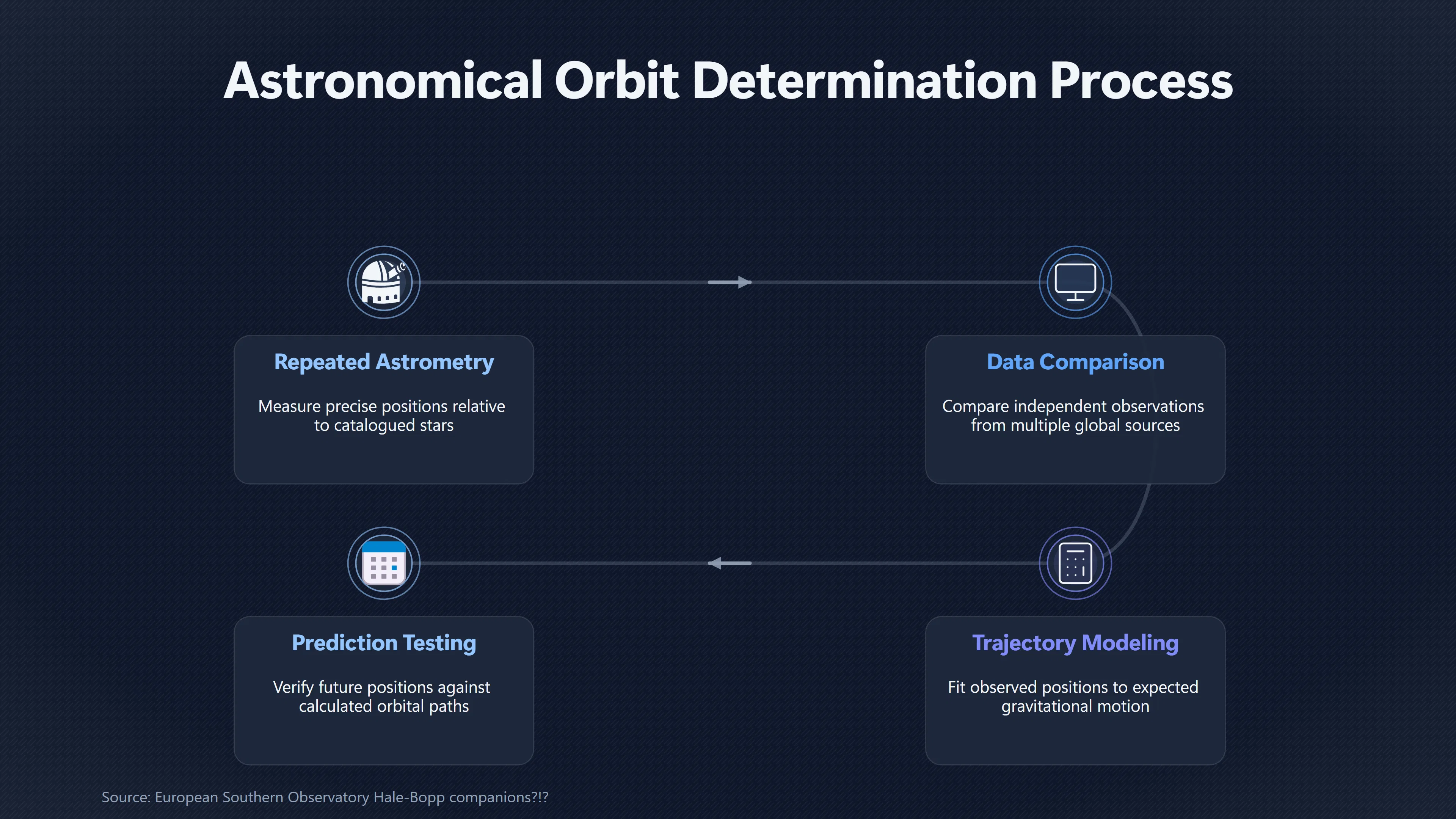
How astronomers would test a comet companion
The critical question is not whether an object appears near a comet on one night, but whether it continues to behave like a companion over many observations.
Every comet moves across the celestial sphere against the apparently fixed background of distant stars. Because this motion is predictable, astronomers repeatedly record the comet’s position relative to known stars. If another object is genuinely accompanying the comet, it should display nearly the same apparent motion and remain close to the comet despite both objects moving together across the star field.[Astronomy Magazine]astronomy.comMagazine How do astronomers determine what is an asteroid or a comet?Astronomy MagazineHow do astronomers determine what is an asteroid or a comet?…
Conversely, a background star behaves differently. As the comet advances along its orbit, the star remains fixed at its catalogue position while the comet gradually moves away from it. An apparent alignment seen on one night naturally disappears over subsequent nights without requiring any unusual explanation. This is precisely the kind of distinction that positional astronomy is designed to measure.[European Southern Observatory]eso.orgEuropean Southern Observatory Hale-Bopp companions?!?European Southern Observatory Hale-Bopp companions?!?
Tracking motion against fixed background stars
The first implementation step is repeated astrometry: measuring an object’s precise position on the sky relative to accurately catalogued stars.
If a spacecraft accompanied Hale–Bopp, observers would expect to see several consistent features:
- The object would shift across the sky at almost exactly the same rate as the comet.
- Its separation from the comet would remain approximately constant or change in a physically consistent way.
- Independent observers using different telescopes would measure essentially the same relative positions.
- Those measurements could be predicted in advance for future observing dates.
These expectations are not unique to spacecraft claims. They are the same principles astronomers use to identify binary stars, moons of planets, and natural companion objects throughout the Solar System. Repeated positional agreement is far more important than an object’s visual appearance in a processed image.[Astronomy Magazine]astronomy.comMagazine How do astronomers determine what is an asteroid or a comet?Astronomy MagazineHow do astronomers determine what is an asteroid or a comet?…

Comparing independent observations across multiple nights
One photograph cannot establish that two objects are travelling together. Independent observations are essential because they eliminate explanations involving image processing, detector artefacts or chance alignments.
During the Hale–Bopp observations, professional observatories, amateur astronomers and space-based archives all imaged the comet. A genuine companion would have appeared consistently in these independent datasets with the expected relative motion. Instead, alleged companions repeatedly proved to be ordinary background stars already listed in star catalogues or imaging artefacts created by CCD detectors and processing methods. Different claims referred to different stars or instrumental effects rather than a single persistent object accompanying the comet.[European Southern Observatory]eso.orgEuropean Southern Observatory Hale-Bopp companions?!?European Southern ObservatoryHale-Bopp companions?!?January 16, 1997…
This distinction matters because independent confirmation in astronomy means obtaining the same positional result from separate observations—not repeating the same interpretation of one image.
Using repeated positions to calculate an orbit
Once astronomers obtain positions from multiple observing times, they can determine an object’s trajectory mathematically. This process, known as orbit determination, fits the observed positions to the gravitational motion expected within the Solar System.
Had a real companion existed, astronomers could have calculated whether it:
- orbited the Sun alongside Hale–Bopp,(#endnote-5 “Endnote 5”)[eso.org]eso.orgComet Hale-BoppComet Hale-Bopp
- orbited the comet itself,
- or followed an entirely different trajectory.
As additional observations accumulated, the calculated orbit would become increasingly precise and would allow accurate predictions of future positions. If later observations failed to match those predictions, the companion hypothesis would quickly collapse. This same approach is routinely used for newly discovered comets, asteroids and interstellar objects.[Astronomy Magazine]astronomy.comMagazine How do astronomers determine what is an asteroid or a comet?Astronomy MagazineHow do astronomers determine what is an asteroid or a comet?…
Why the Hale–Bopp claim failed the movement test
The movement test did not support the spacecraft interpretation.
The object highlighted in Chuck Shramek’s original image was identified as the catalogue star SAO 141894, whose position had already been recorded long before Hale–Bopp entered that region of the sky. As the comet continued along its orbit, it moved away from the star exactly as expected for a foreground comet passing a distant background object. Other purported companions similarly proved to be known stars, detector defects or manipulated imagery rather than objects sharing the comet’s trajectory.[European Southern Observatory]eso.orgEuropean Southern Observatory Hale-Bopp companions?!?European Southern Observatory Hale-Bopp companions?!?
If an enormous spacecraft had genuinely accompanied one of the most intensively observed comets in modern history, its changing position relative to the comet would have been measurable night after night by observers worldwide. Instead, the positional evidence consistently supported ordinary astronomical explanations.
What this demonstrates about failed UFO predictions
The Hale–Bopp companion story illustrates an important principle in evaluating UFO claims associated with astronomical objects. Extraordinary interpretations generate concrete, testable predictions. In this case, the prediction was simple: a real companion should move with the comet and remain detectable in independent observations.
That prediction failed. Rather than producing a coherent track across repeated measurements, the alleged companions resolved into fixed background stars, imaging artefacts and unsupported image claims. The episode therefore demonstrates how ordinary positional astronomy provides an objective way to distinguish a genuine celestial companion from a chance alignment or mistaken interpretation, without relying on witness testimony or the visual appearance of a single photograph.[European Southern Observatory]eso.orgEuropean Southern Observatory Hale-Bopp companions?!?European Southern Observatory Hale-Bopp companions?!?
Amazon book picks
Further Reading
Books and field guides related to How Astronomers Would Test a Comet Companion. Use these as the next step if you want deeper reading beyond the article.
Fundamental Astronomy
Fundamental Astronomy is a well-balanced, comprehensive introduction to classical and modern astronomy. While emphasizing both the astron...
Orbital Motion
Long established as one of the premier references in the fields of astronomy, planetary science, and physics, the fourth edition of Orbit...
Turn Left at Orion
With over 100,000 copies sold since first publication, this is one of the most popular astronomy books of all time. It is a unique guideb...
Bad Astronomy
A clever, thought-provoking guide that attacks common astronomical misconceptions What is Bad Astronomy? Anything that accidentally or in...
eBay marketplace picks
Marketplace Samples
Live-tested eBay searches with available results related to this page.
Selected fromcomet model oneBay.co.uk.



Endnotes
1.
Source: eso.org
Title: European Southern Observatory Hale-Bopp companions?!?
Link:https://www.eso.org/~ohainaut/Hale_Bopp/hb_ufo.html
2.
Source: astronomy.com
Title: Magazine How do astronomers determine what is an asteroid or a comet?
Link:https://www.astronomy.com/science/ask-astro-how-do-astronomers-know-if-an-object-came-from-another-star/
Source snippet
Astronomy MagazineHow do astronomers determine what is an asteroid or a comet?...
3.
Source: eso.org
Title: European Southern Observatory Hale-Bopp companions?!?
Link:https://www.eso.org/~ohainaut/Hale_Bopp/hb_ufo_list.html
Source snippet
European Southern ObservatoryHale-Bopp companions?!?January 16, 1997...
Published: January 16, 1997
4.
Source: eso.org
Link:https://eso.org/public/news/eso0108/
5.
Source: eso.org
Title: Comet Hale-Bopp
Link:https://eso.org/public/news/eso9933/
6.
Source: eso.org
Link:https://www.eso.org/public/news/eso9726/
7.
Source: hq.eso.org
Link:https://www.hq.eso.org/public/news/eso9624/
8.
Source: eso.org
Title: First NTT Image of Comet Hale-Bopp after Solar Conjunction | ESO Polska
Link:https://www.eso.org/public/poland/news/eso9609/
9.
Source: eso.org
Link:https://eso.org/public/news/eso9523/
10.
Source: eso.org
Link:https://eso.org/public/news/eso9520/
11.
Source: sciencedirect.com
Link:https://www.sciencedirect.com/topics/earth-and-planetary-sciences/astrometry
12.
Source: youtube.com
Title: The Strange End of the Heretical Heaven’s Gate Cult
Link:https://www.youtube.com/watch?v=tdOSZbkiBOg
Source snippet
Astrometry - Find and Identify Asteroids and Comets...
13.
Source: youtube.com
Link:https://www.youtube.com/watch?v=lhpEBbv4tDg
Additional References
14.
Source: britastro.org
Link:https://britastro.org/2022/estimating-the-coma-size-and-brightness-of-comets
Source snippet
November 8, 2022 — BRITISH ASTRONOMICAL ASSOCIATION Supporting amateur astronomers since 1890 2022 November 8 ESTIMATING THE COMA SIZE AN...
Published: November 8, 2022
15.
Source: cambridge.org
Title: Comet and meteoroid orbits (Chapter 5)
Link:https://www.cambridge.org/core/books/meteor-showers-and-their-parent-comets/comet-and-meteoroid-orbits/EF1FC8979FA314FC96712760F9B15B36
Source snippet
Meteor Showers and their Parent CometsJuly 5, 2015 — 5 - COMET AND METEOROID ORBITS from Part I - Introduction Published online by Cambri...
Published: July 5, 2015
16.
Source: astroedu.iau.org
Title: measuring average speed of a comet
Link:https://astroedu.iau.org/activities/measuring-average-speed-of-a-comet/
Source snippet
the average speed of a comet | astroEDUJuly 8, 2022 — DISCUSSION Discussion 1: direction of the movement of the cometWe have carried out...
Published: July 8, 2022
17.
Source: youtube.com
Title: True Crime: Heaven’s Gate: The Cult Of All Cults Like You Have Never Seen Before
Link:https://www.youtube.com/watch?v=Cv1yRd2lg14
Source snippet
Comet Hale–Bopp and its Appearance in 1997...
18.
Source: academic.oup.com
Link:https://academic.oup.com/mnras/article/530/3/2526/7644362
Source snippet
white dwarfs with Oort cloud comets | Monthly Notices of the Royal Astronomical Society | Oxford AcademicApril 4, 2024 — 3 ANALYTIC THEOR...
Published: April 4, 2024
19.
Source: science.nasa.gov
Title: c 1995 o1 hale bopp
Link:https://science.nasa.gov/solar-system/comets/c-1995-o1-hale-bopp/
Source snippet
NASA ScienceC/1995 O1 (Hale-Bopp) - NASA Science...
20.
Source: aanda.org
Link:https://www.aanda.org/articles/aa/full_html/2012/05/aa18762-11/aa18762-11.html
21.
Source: youtube.com
Title: “On Comets… and Other Things” by Alan Hale
Link:https://www.youtube.com/watch?v=3prAGsBVzOw
Source snippet
The Strange End of the Heretical Heaven's Gate Cult...
22.
Source: youtube.com
Link:https://www.youtube.com/watch?v=nKCOqcL-nUw
Source snippet
“On Comets... and Other Things” by Alan Hale...
23.
Source: blogs.esa.int
Title: int How to determine the orbit of a comet? – Mars Express
Link:https://blogs.esa.int/mex/2014/03/07/how-to-determine-the-orbit-of-a-comet/