Within Failure Timeline
Did the Prediction Fail Even if History Is Disputed?
A timeline can confirm that an event failed while separately noting disputes about researcher conduct, publicity and believer reactions.
On this page
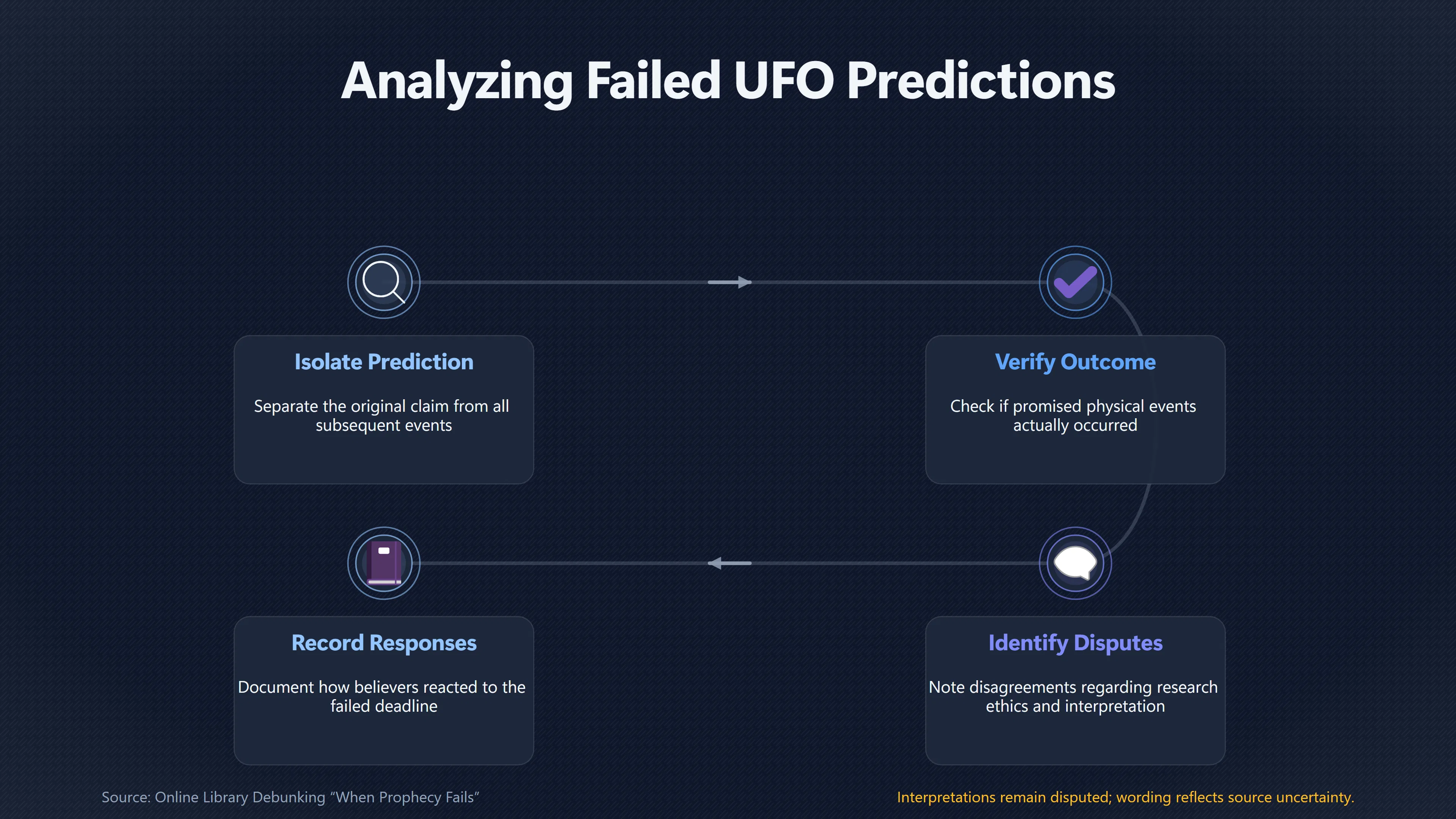
- Recording the observable outcome independently
- Summarising disputes over participant behaviour
- Preventing criticism of researchers from becoming proof of fulfilment
Page outline Jump by section
Introduction
A failed UFO prediction and later disputes about the people who documented it are two separate historical questions. A timeline of failed UFO promises should first establish whether the promised event happened by the stated deadline. Only after that question has been answered should it examine disagreements about investigators, journalists, researchers or former participants. Keeping those issues distinct prevents debates over methodology, ethics or publicity from being mistaken for evidence that an unfulfilled prediction somehow came true.
This distinction matters because several famous UFO-related prophecy cases have acquired long afterlives. Arguments about how a group was studied, whether researchers influenced believers, or whether later commentators misrepresented events can reshape historical interpretation. They do not, however, alter the observable outcome of a prediction that specified a physical flood, spacecraft landing or public rescue.
Recording the Observable Outcome Independently
The first task in any timeline is to isolate the prediction from everything that happened afterwards.
For each case, ask only one initial question:
Did the promised event occur in the way originally described?
That question should be answered using evidence available at the predicted time, such as:
- whether a specified date passed;
- whether the announced flood, landing or rescue occurred;
- whether independent observers documented the event;
- whether the predicted physical evidence appeared.
Only once this factual record has been established should later controversies be introduced.
For example, Dorothy Martin’s 1954 prediction involved a catastrophic flood and the rescue of believers by extraterrestrial spacecraft. The deadline passed without the predicted flood or rescue. Whatever disagreements later emerged over how observers described the group, that observable result remains unchanged.[Wiley Online Library]onlinelibrary.wiley.comOnline Library Debunking “When Prophecy Fails”Wiley Online LibraryDebunking “When Prophecy Fails” - Kelly - 2026 - Journal of the History of the Behavioral Sciences - Wiley Online Lib…
The same principle applies to later UFO contact movements that predicted visible landings. If no publicly observable landing occurred on the announced date, the historical record first notes that failure before considering subsequent reinterpretations.
Why Historical Disputes Are Different Questions
Historical disputes generally concern one of three issues:
- Research conduct: whether investigators behaved ethically or influenced participants.
- Historical interpretation: whether later books accurately represented what happened.
- Public memory: how the story has been simplified or repeated over time.
None of these automatically changes the factual outcome of the original prediction.
A timeline therefore benefits from separating two parallel records:
QuestionEvidence usedDid the prediction occur?Contemporary observations, photographs, newspapers, official records, astronomical or weather evidence where applicableHow has the event been interpreted?Later scholarship, memoirs, archival discoveries, debates over research methods and historical narratives
Keeping these records separate prevents readers from confusing criticism of an investigator with confirmation of a prophecy.
The Dorothy Martin Case Shows Why Separation Matters
The best-known example involves Dorothy Martin (also known as Marian Keech), whose group became the subject of Leon Festinger and colleagues’ influential book When Prophecy Fails.
For decades, the case was widely presented as a classic demonstration of how believers respond after failed prophecy. More recently, historian Thomas Kelly argued—using archival material released decades later—that the published account overstated or misrepresented important aspects of the group’s behaviour and that the researchers themselves played a more active role than previously acknowledged. Kelly also criticised aspects of the study’s ethics and interpretation.[Wiley Online Library]onlinelibrary.wiley.comOnline Library Debunking “When Prophecy Fails”Wiley Online LibraryDebunking “When Prophecy Fails” - Kelly - 2026 - Journal of the History of the Behavioral Sciences - Wiley Online Lib…
Whether every element of Kelly’s critique ultimately gains broad scholarly acceptance is a separate question from the prediction itself. The underlying historical sequence remains straightforward:
- a flood was predicted;
- extraterrestrial rescue was promised;
- the deadline passed;
- the predicted physical events did not occur.
The newer archival debate concerns how researchers documented the aftermath—not whether the flood or rescue actually happened.[Wiley Online Library]onlinelibrary.wiley.comOnline Library Debunking “When Prophecy Fails”Wiley Online LibraryDebunking “When Prophecy Fails” - Kelly - 2026 - Journal of the History of the Behavioral Sciences - Wiley Online Lib…
Summarising Disputes Over Participant Behaviour
Historical disagreements often concern what believers did after a prediction failed.
Questions may include:
- Did members abandon the movement immediately?
- Did they intensify recruitment?
- Did they reinterpret the prediction spiritually?
- Did the group fragment?
- Were observers influencing behaviour while claiming neutrality?
These are legitimate historical questions because they affect understanding of religious movements and social psychology.
However, they describe responses to failure, not evidence that the original prediction succeeded.
Even when scholars disagree sharply about participant behaviour, they usually agree on the basic chronology of whether the announced UFO arrival, rescue or catastrophe occurred.
Preventing Criticism of Researchers from Becoming Proof of Fulfilment
One common reasoning error is:
“If researchers behaved improperly, perhaps the prediction was not really disproved.”
This does not follow logically.
Problems with observation or interpretation may justify re-examining conclusions about group dynamics or psychological theory. They do not create evidence for an event that lacked independent confirmation.
For example:
- criticism of participant observation methods does not produce a documented spacecraft landing;
- criticism of media reporting does not establish that a predicted rescue occurred;
- criticism of later historians does not demonstrate that a foretold flood happened.
A timeline therefore keeps these categories separate rather than allowing criticism in one area to substitute for evidence in another.

Applying the Same Principle to Later UFO Predictions
The same analytical approach helps with later UFO prediction cases involving announced landings or public manifestations.
Many movements revised explanations after failed deadlines by suggesting:
- humanity was spiritually unprepared;
- extraterrestrials postponed contact;
- the event occurred invisibly;
- the prediction referred to spiritual rather than physical change.
These reinterpretations are historically important because they explain how belief systems evolved after disconfirmed expectations. They should be recorded alongside the failed prediction, not merged with the original claim.
Likewise, later disputes over journalists, sceptics or researchers may illuminate public reception, but they do not alter whether a promised observable landing took place on the announced date. Studies of groups such as Unarius have similarly distinguished the empirical failure of predicted dates from the evolving theological explanations offered afterward.[OUP Academic]academic.oup.comOUP AcademicHow Prophecy Never Fails | When Prophecy Never Fails: Myth and Reality in a Flying-Saucer Group | Oxford Academic…
A Practical Framework for Timeline Builders
When documenting failed UFO promises, it is useful to record events in two distinct layers.
Layer 1: Observable chronology
- original prediction;
- announced date;
- expected physical event;
- documented outcome.
Layer 2: Historical interpretation
- immediate believer responses;
- revised explanations;
- researcher accounts;
- later archival discoveries;
- scholarly disagreements;
- media narratives.
Maintaining this structure allows readers to distinguish between what can be established as historical fact and what remains the subject of ongoing scholarly debate.
In practice, this means that a later controversy over researcher conduct, archival interpretation or public memory may significantly change historians’ understanding of a movement’s aftermath without changing the central chronological conclusion that the predicted UFO landing, rescue or catastrophe did not occur as originally promised.
Amazon book picks
Further Reading
Books and field guides related to Did the Prediction Fail Even if History Is Disputed?. Use these as the next step if you want deeper reading beyond the article.
The Demon-Haunted World
Rating: 4.5/5 from 43 Google Books ratings
NEW YORK TIMES BESTSELLER • From the renowned astronomer and author of Cosmos comes a “powerful [and] stirring defense of informed ration...
The Chicago Guide to Fact-Checking
Why we fact-check -- What we fact-check -- How we fact-check -- Checking different types of facts -- Sourcing -- Record keeping -- Test y...

The Craft of Research
Rating: 4.3/5 from 6 Google Books ratings
Since 1995, students, researchers, and professionals have turned to The Craft of Research for clear and helpful guidance on how to conduc...
The Data Detective
From “one of the great (greatest?) contemporary popular writers on economics” (Tyler Cowen) comes a smart, lively, and encouraging rethin...
eBay marketplace picks
Marketplace Samples
Live-tested eBay searches with available results related to this page.
Selected fromUFO memorabilia oneBay.co.uk.



Endnotes
1.
Source: onlinelibrary.wiley.com
Title: Online Library Debunking “When Prophecy Fails”
Link:https://onlinelibrary.wiley.com/doi/full/10.1002/jhbs.70043
Source snippet
Wiley Online LibraryDebunking “When Prophecy Fails” - Kelly - 2026 - Journal of the History of the Behavioral Sciences - Wiley Online Lib...
2.
Source: academic.oup.com
Link:https://academic.oup.com/book/7811/chapter/152989636
Source snippet
OUP AcademicHow Prophecy Never Fails | When Prophecy Never Fails: Myth and Reality in a Flying-Saucer Group | Oxford Academic...
3.
Source: academic.oup.com
Link:https://academic.oup.com/book/7811/chapter-abstract/152989636
Source snippet
OUP AcademicHow Prophecy Never Fails | When Prophecy Never Fails: Myth and Reality in a Flying-Saucer Group | Oxford Academic...
4.
Source: onlinelibrary.wiley.com
Link:https://onlinelibrary.wiley.com/doi/10.1002/jhbs.70043
Source snippet
“When Prophecy Fails” - Kelly - 2026 - Journal of the History of the Behavioral Sciences - Wiley Online LibraryNovember 4, 2025 — Volume...
Published: November 4, 2025
5.
Source: onlinelibrary.wiley.com
Link:https://onlinelibrary.wiley.com/doi/abs/10.1002/jhbs.70043
Source snippet
“When Prophecy Fails” - Kelly - 2026 - Journal of the History of the Behavioral Sciences - Wiley Online LibraryNovember 4, 2025 — ORIGINA...
Published: November 4, 2025
6.
Source: onlinelibrary.wiley.com
Link:https://onlinelibrary.wiley.com/doi/abs/10.1002/jhbs.70043?campaign=woletoc
Source snippet
“When Prophecy Fails” - Kelly - 2026 - Journal of the History of the Behavioral Sciences - Wiley Online LibraryNovember 4, 2025 — Volume...
Published: November 4, 2025
7.
Source: academic.oup.com
Link:https://academic.oup.com/book/7811/chapter/152994882
8.
Source: doi.org
Title: Debunking “When Prophecy Fails”
Link:https://doi.org/10.1002%2Fjhbs.70043
Source snippet
Kelly - 2026 - Journal of the History of the Behavioral Sciences - Wiley Online LibraryNovember 4, 2025 — DEBUNKING “WHEN PROPHECY FAILS”...
Published: November 4, 2025
Additional References
9.
Source: newyorker.com
Link:https://www.newyorker.com/culture/the-lede/is-cognitive-[dissonance
Source snippet
The theory posits that people experience psychological discomfort when confronted with contradictions between their beliefs and behaviors...
10.
Source: youtube.com
Title: The Seekers: When UFO Prophecy Failed and the Cult Stayed
Link:https://www.youtube.com/watch?v=Xlp4qETDQL8
Source snippet
The UFO Cult That Inspired Cognitive Dissonance | Dorothy Martin & The Seekers...
11.
Source: youtube.com
Title: The UFO Cult That Inspired Cognitive Dissonance | Dorothy Martin & The Seekers
Link:https://www.youtube.com/watch?v=vvFV1v8l-PI
Source snippet
235-Leon Festinger and the Alien Apocalypse...
12.
Source: pubmed.ncbi.nlm.nih.gov
Title: Pub Med Debunking “When Prophecy Fails”
Link:https://pubmed.ncbi.nlm.nih.gov/41186060/
Source snippet
Debunking "When Prophecy Fails" - PubMed...
13.
Source: youtube.com
Title: When “When Prophecy Fails” Fails (E350)
Link:https://www.youtube.com/watch?v=IhblbZDXfZU
Source snippet
The Seekers: When UFO Prophecy Failed and the Cult Stayed...
14.
Source: sciencedirect.com
Title: When Festinger Fails: Prophecy and the Watch Tower
Link:https://www.sciencedirect.com/science/article/pii/S0048721X84710256
15.
Source: youtube.com
Title: 235-Leon Festinger and the Alien Apocalypse
Link:https://www.youtube.com/watch?v=fy06VDrnh7A
Source snippet
InPresence 0211: When Prophecy Fails...
16.
Source: researchgate.net
Title: 396169045 Debunking When Prophecy Fails
Link:https://www.researchgate.net/publication/396169045_Debunking_When_Prophecy_Fails
17.
Source: researchgate.net
Title: Debunking “When Prophecy Fails”
Link:https://www.researchgate.net/publication/397254906_Debunking_When_Prophecy_Fails
18.
Source: youtube.com
Link:https://www.youtube.com/watch?v=6d6SJd5sxnM