Within Failure Timeline
What Would Count as a UFO Prediction Success?
A useful timeline states exactly what observers should have seen, where it should have appeared and how long the event was expected to last.
On this page
- Defining the promised event in visible terms
- Recording location, duration and public accessibility
- Distinguishing the central test from incidental reports
Page outline Jump by section
Introduction
A timeline of failed UFO predictions is only as useful as the tests built into it. To evaluate whether a promised landing, fleet appearance or mass sighting succeeded or failed, the claim must first be translated into an observable event. That means identifying exactly what should have been seen, where it should have been visible, when it should have occurred, who should have been able to witness it and what evidence should have remained afterwards. Without those details, a prediction can be reinterpreted indefinitely after its deadline passes.
This approach does not assume that all UFO claims are false. Instead, it applies the same principle used in evaluating any empirical claim: a prediction gains evidential value when it specifies observations that could either confirm or contradict it. Philosophers of science describe this as making a claim testable or falsifiable, while astronomers and investigators emphasise independent, repeatable observation rather than retrospective interpretation.[nih.gov]pmc.ncbi.nlm.nih.govPub Med Central (PMC)Do Extraordinary Claims Require Extraordinary Evidence?PubMed Central (PMC)Do Extraordinary Claims Require Extraordinary Evidence? - PMCOctober 20, 2016…
What Would Count as a UFO Prediction Success?
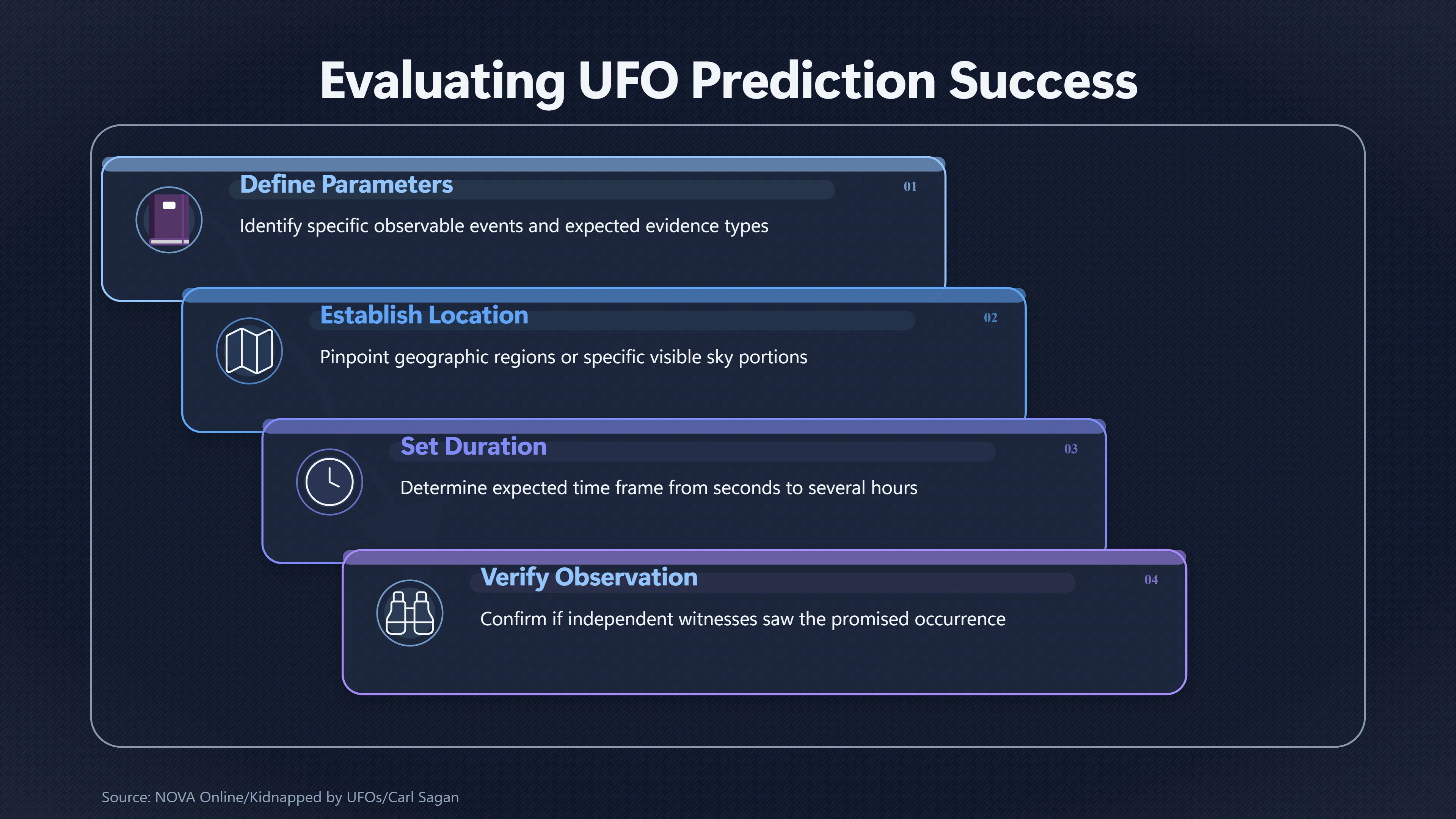
For a promised UFO event to count as a successful prediction, it must describe an occurrence that independent observers could reasonably verify.
A useful observable test answers questions such as:
- What appears? A single craft, multiple objects, a landing, rescue vehicles or a prolonged aerial display.
- Where? A named location, geographic region or visible portion of the sky.
- When? An exact date, time or tightly defined interval.
- For how long? Seconds, hours or days.
- Who can observe it? Everyone present, only invited participants or the general public worldwide.
- What evidence should remain? Photographs, radar tracks, physical traces, multiple independent witness reports or other lasting records.
The more precisely these questions are answered before the event, the less room there is for later reinterpretation. Conversely, statements such as “contact is approaching” or “humanity will experience higher vibrations” provide no clear observational benchmark and therefore cannot easily be evaluated as successful or unsuccessful predictions. This distinction reflects the broader scientific idea that meaningful predictions prohibit certain outcomes rather than accommodating every possible result.[Wikipedia]wikipedia.orgFalsifiabilityFalsifiability
Defining the Promised Event in Visible Terms
Many historical UFO predictions begin with vivid language but become difficult to evaluate because the central claim is never translated into concrete observations.
Instead of recording only that “a spacecraft will arrive,” an evidence-oriented timeline asks:
- Would the craft be visible to the naked eye?
- Was it expected to land?
- Would it hover for a measurable period?
- Would ordinary members of the public be able to watch it?
- Was interaction with people expected?
These distinctions matter because they separate physical claims from symbolic or spiritual expectations.
For example, the widely publicised prediction promoted by Blossom Goodchild in 2008 was unusually testable because it described a large Federation of Light spacecraft becoming plainly visible in Earth’s skies on a specific date. That promise generated a straightforward observational question: did a widely observable craft appear as described? When no such globally verified event occurred, the original prediction could be compared directly with the recorded outcome before later explanations altered its meaning.[PBS]pbs.orgNOVA Online/Kidnapped by UFOs/Carl SaganNOVA Online/Kidnapped by UFOs/Carl Sagan…
Likewise, predictions involving mass landings or rescue craft differ fundamentally from claims of private visions or personal experiences. A public landing implies evidence accessible to numerous unrelated observers, making it much easier to evaluate than experiences reported only by individual participants.
Recording Location, Duration and Public Accessibility
Observable tests become substantially stronger when they include practical details about where and how the event should have unfolded.
A robust timeline records three closely related features.
Location
The prediction should identify the expected observation area as precisely as possible.
Examples include:
- a named town;
- a specific mountain or landing site;
- a particular country;
- worldwide visibility.
Broad statements such as “somewhere on Earth” dramatically weaken later evaluation because almost any isolated report can be presented as partial fulfilment.
Duration
Predictions that specify a visible event lasting several minutes or several hours are easier to investigate than claims involving instantaneous appearances.
Longer durations increase opportunities for:
- multiple witnesses;
- independent photography;
- astronomical observation;
- media coverage;
- official records.
A promised fleet hovering over a city for hours should produce far more observable evidence than a fleeting light lasting one second.
Public accessibility
An especially important distinction concerns whether everyone was expected to witness the event.
Many failed UFO promises originally predicted unmistakable public demonstrations but were later reframed as experiences visible only to spiritually prepared individuals or selected witnesses. Recording the original expectation prevents this shift from obscuring whether the initial prediction actually succeeded.

Distinguishing the Central Test from Incidental Reports
After a prediction fails, attention often shifts towards isolated anecdotes that resemble parts of the original claim.
An effective timeline separates these from the principal test.
For example:
- a few unusual lights do not automatically satisfy a prediction of a worldwide spacecraft display;
- one witness reporting contact does not fulfil a promise of a publicly observable landing;
- unrelated UFO reports occurring near the predicted date are not evidence that the specific forecast succeeded.
This distinction prevents the central prediction from gradually changing into a much broader collection of loosely associated stories.
The key question remains:
Did the promised event itself occur under the stated conditions?
If the answer is no, then later reports may still deserve investigation on their own merits, but they should not be counted retrospectively as fulfilment of a different prediction.
Preventing Goalposts from Moving
One of the recurring patterns in failed UFO prophecies is that the observable claim changes after the deadline.
Common post-deadline reinterpretations include:
- the spacecraft arrived but remained invisible;
- humanity was spiritually unprepared;
- extraterrestrials deliberately postponed contact;
- the prediction referred to an unseen spiritual event rather than a physical appearance;
- the successful outcome was preventing a catastrophe instead of producing the promised landing.
Recording the observable test before the event helps distinguish the original prediction from these later explanations. It does not evaluate the sincerity of believers or claimants; it simply preserves the historical sequence so readers can compare the initial promise with what independent observers actually had the opportunity to witness.
This mirrors standard approaches to testing hypotheses in many fields: predictions are specified in advance so that later reinterpretation cannot redefine success after the outcome is already known.[Wikipedia]wikipedia.orgFalsifiabilityFalsifiability

A Practical Template for Timeline Entries
For each UFO prediction, an evidence-focused timeline should preserve a concise observational record:
ElementQuestion to recordPredicted eventWhat physical occurrence was promised?Date and timeExactly when was it expected?LocationWhere should observers have looked?VisibilityWho was expected to see it?DurationHow long should it have remained observable?Expected evidenceWhat photographs, recordings or physical traces should have resulted?OutcomeWhat was actually observed?Later reinterpretationHow, if at all, was the original prediction redefined after the deadline?
Using this structure keeps the focus on observable evidence rather than later narrative changes. It also allows different historical UFO predictions—from promised landings to forecasts of mass sightings—to be compared consistently using the same empirical standard, making patterns of fulfilled, failed or reinterpreted predictions much easier to recognise.
Amazon book picks
Further Reading
Books and field guides related to What Would Count as a UFO Prediction Success?. Use these as the next step if you want deeper reading beyond the article.
The Demon-Haunted World: Science as a Candle in the Dark
NEW YORK TIMES BESTSELLER • From the renowned astronomer and author of Cosmos comes a “powerful [and] stirring defense of informed ration...
The Logic of Scientific Discovery
2014 Reprint of Original 1959 Edition. Exact facsimile of the original edition, not reproduced with Optical Recognition Software. This bo...
The Skeptics' Guide to the Universe: How to Know What's Reall...
An all-encompassing guide to skeptical thinking from podcast host and academic neurologist at Yale University School of Medicine Steven N...
Bad Science
Ben Goldacre takes us on a journey through the bad science we are fed daily by hacks and quacks.
eBay marketplace picks
Marketplace Samples
Live-tested eBay searches with available results related to this page.
Selected fromUFO sighting poster oneBay.co.uk.




Endnotes
1.
Source: Wikipedia
Link:https://en.wikipedia.org/wiki/[Falsifiability
2.
Source: pbs.org
Title: NOVA Online/Kidnapped by UFOs/Carl Sagan
Link:https://www.pbs.org/wgbh/nova/aliens/carlsagan.html
Source snippet
NOVA Online/Kidnapped by UFOs/Carl Sagan...
3.
Source: youtube.com
Link:https://www.youtube.com/watch?v=5u-rgdcoa2w
Source snippet
Megalithic Construction — A Structural Hypothesis for Prehistoric Engineering...
4.
Source: pmc.ncbi.nlm.nih.gov
Title: Pub Med Central (PMC)Do Extraordinary Claims Require Extraordinary Evidence?
Link:https://pmc.ncbi.nlm.nih.gov/articles/PMC6099700/
Source snippet
PubMed Central (PMC)Do Extraordinary Claims Require Extraordinary Evidence? - PMCOctober 20, 2016...
Published: October 20, 2016
5.
Source: encyclopedia.com
Title: Falsifiability | Encyclopedia.com
Link:https://www.encyclopedia.com/science-and-technology/physics/science-general/falsifiability
6.
Source: carlsagan.com
Title: The Search for Signals From Space
Link:https://carlsagan.com/the-search-for-signals-from-space/
7.
Source: pubmed.ncbi.nlm.nih.gov
Link:https://pubmed.ncbi.nlm.nih.gov/5528429/
8.
Source: pmc.ncbi.nlm.nih.gov
Link:https://pmc.ncbi.nlm.nih.gov/articles/PMC2996198/
9.
Source: sciencedirect.com
Link:https://www.sciencedirect.com/topics/mathematics/falsifiability
Additional References
10.
Source: scienceinsights.org
Title: Science Insights What Makes a Hypothesis Testable: 5 Key Criteria
Link:https://scienceinsights.org/what-makes-a-hypothesis-testable-5-key-criteria/
Source snippet
What Makes a Hypothesis Testable: 5 Key Criteria - ScienceInsightsMarch 12, 2026 — WHAT MAKES A HYPOTHESIS TESTABLE: 5 KEY CRITERIA * Mar...
Published: March 12, 2026
11.
Source: en.wikiquote.org
Title: On the other hand, mere critical thinki
Link:https://en.wikiquote.org/wiki/Carl_Sagan
Source snippet
Sagan - WikiquoteFebruary 26, 2026 — 189) * There is no way to tell whether the patterns extracted by the right hemisphere are real or im...
Published: February 26, 2026
12.
Source: cosmicvarietyshow.com
Title: 2026 03 25 uap the honest assessment
Link:https://cosmicvarietyshow.com/posts/2026-03-25-uap-the-honest-assessment/
Source snippet
Image: The Honest Assessment 34 THE HONEST ASSESSMENT What the Astronomer Sees in the Sky — and What He Does Not Mar...
13.
Source: youtube.com
Title: Bill Nye The Science Guy
Link:https://www.youtube.com/watch?v=HacSwNLKhc4
Source snippet
Mysterious Transients Found in 1950s Sky Survey — What Really Happened? (FFP Story | EP. 15)...
14.
Source: youtube.com
Link:https://www.youtube.com/watch?v=xWEFC9TsNxI
Source snippet
Avi Loeb: Multiverse, Elon Musk, AI, Religion...
15.
Source: mdpi.com
Link:https://www.mdpi.com/2218-1997/11/10/326
Source snippet
Toward a Reliability Scale for Assessing Reports of Unidentified Anomalous Phenomena (UAP)September 25, 2025 — ^{5} Independent Researche...
Published: September 25, 2025
16.
Source: plato.stanford.edu
Link:https://plato.stanford.edu/entries/popper/
Source snippet
BASIC STATEMENTS, FALSIFIABILITY AND CONVENTION Popper draws a clear distinction between the logic of falsifiability and its applied meth...
17.
Source: opendoubt.com
Link:https://opendoubt.com/extraordinary-claims
18.
Source: skepticalinquirer.org
Link:https://skepticalinquirer.org/2025/08/is-extraordinary-evidence-unreasonable/
19.
Source: sfu.ca
Link:https://www.sfu.ca/~swartz/popper.htm