Within Sunk Costs
What Believers Risk by Admitting They Were Wrong
Rejecting a failed UFO prophecy can also mean losing close relationships, social status and the identity built around being chosen or informed.
On this page
- How group membership can replace outside relationships
- Why contactee and chosen witness identities become costly to abandon
- What makes quiet disengagement easier than public reversal
Page outline Jump by section
Introduction
When a specific UFO prediction fails, changing one’s mind is often only part of the challenge. For highly committed believers, admitting the prophecy was wrong can also mean risking friendships, family ties, social standing and a personal identity built around being one of the few who supposedly understood an extraordinary truth. In many cases, the greatest barrier to leaving is not the failed prediction itself but the prospect of losing an entire way of life.
This helps explain why reactions to failed UFO prophecies vary. Some people leave quickly, others quietly drift away, while a minority reinterpret the failure or remain loyal to the movement. The decisive factor is frequently social rather than intellectual: what relationships, status and sense of purpose would disappear if the belief were abandoned? Although classic discussions of failed prophecy often emphasise cognitive dissonance, more recent scholarship argues that social identity, community and individual circumstances deserve equal attention when explaining why some believers stay and others leave.[oup.com]academic.oup.comOUP AcademicHow Prophecy Never Fails | When Prophecy Never Fails: Myth and Reality in a Flying-Saucer Group | Oxford AcademicJuly 1, 2005…
How group membership can replace outside relationships
Participation in UFO prophecy movements often reshapes a person’s social world long before any predicted event arrives. Members may spend increasing amounts of time with fellow believers, attend meetings, travel together, consume the same media and adopt a shared vocabulary. Over time, the movement can become the centre of everyday life.
This has practical consequences if a prophecy fails. Leaving is no longer simply rejecting an idea; it may involve:
- Losing close friends who remain committed.
- Straining marriages or family relationships if partners disagree about leaving.
- Losing respected positions within the group.
- Rebuilding social networks outside the movement after years of distance.
Many high-commitment groups, whether centred on UFO contact claims or other prophetic expectations, encourage members to regard sceptics as uninformed, hostile or spiritually unprepared. Even without formal isolation, this mindset can reduce outside support just when members need it most after disappointment. Researchers studying disengagement from ideological groups consistently find that social belonging is one of the strongest forces keeping members involved and one of the greatest obstacles to leaving.[Charles Sturt University Research Output]researchoutput.csu.edu.auCharles Sturt University Research OutputLeaving ideological groups behind: A model of disengagement - Charles Sturt University Research O…
The result is a difficult calculation. A believer considering departure may have to choose between accepting uncomfortable evidence and preserving the relationships that give daily life meaning.
Why chosen-witness identities become costly to abandon
The social role adopted inside many UFO movements can become just as important as belief in the prediction itself.
Some members come to see themselves as:
- chosen witnesses preparing humanity;
- trusted interpreters of extraterrestrial messages;
- contactees with unique spiritual insight;
- members of an enlightened minority who recognise truths ignored by the wider public.
These identities offer more than explanations for unusual events. They provide purpose, recognition and a coherent life story. Public talks, online communities, media interviews or years spent defending a contactee can all reinforce this self-image.
After a failed prediction, abandoning the belief may therefore require revising an entire personal narrative. Rather than merely acknowledging an incorrect forecast, former believers may feel they must admit that years of emotional investment, public advocacy and personal sacrifice were misplaced.
Research on movements influenced by failed prophecies suggests that identity maintenance often becomes more important than preserving every original claim. Followers may reinterpret what happened, redefine the prediction in symbolic terms or conclude that the message was misunderstood rather than entirely false. Diana Tumminia’s work on UFO-related religious movements illustrates how reinterpretation can preserve members’ identities even as specific predictions are revised.[OUP Academic]academic.oup.comOUP AcademicHow Prophecy Never Fails | When Prophecy Never Fails: Myth and Reality in a Flying-Saucer Group | Oxford AcademicJuly 1, 2005…

Why admitting error can threaten social status
Status inside committed groups is rarely distributed at random. Members who invest heavily often receive greater trust and influence.
Those who have:
- organised meetings,
- recruited new followers,
- defended the prophecy publicly,
- or claimed personal contact with extraterrestrial intelligences
may have considerably more to lose than ordinary participants.
Publicly reversing course can threaten credibility not only within the movement but also outside it. Former sceptical relatives, friends or colleagues may respond with “I told you so”, making departure emotionally costly even when the person recognises the prediction failed.
This helps explain why some believers prefer gradual reinterpretation over dramatic public renunciation. Maintaining continuity allows them to preserve dignity while avoiding an abrupt collapse of social standing.
What makes quiet disengagement easier than public reversal
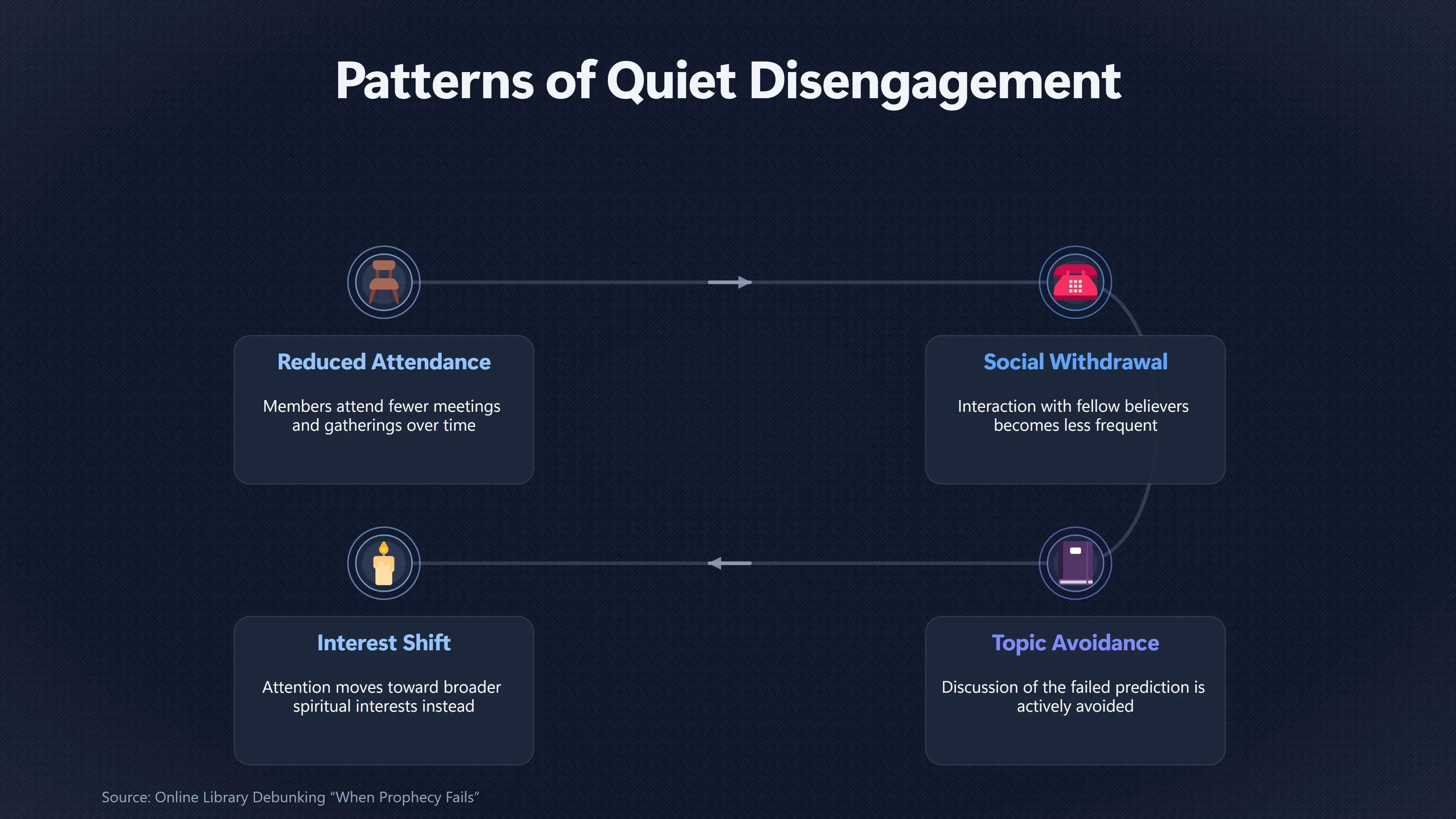
Research on ideological disengagement shows that leaving is often a gradual process rather than a single moment of conversion. Instead of issuing public statements admitting error, many people simply reduce participation.
Common patterns include:
- attending fewer meetings;
- interacting less with fellow believers;
- avoiding discussion of the failed prediction;
- shifting attention towards broader spiritual interests;
- maintaining personal friendships while abandoning prophetic claims.
This “quiet exit” can reduce conflict with both believers and sceptics. It also allows individuals to rebuild relationships outside the movement without the emotional pressure of a highly visible reversal.
Studies of disengagement across diverse ideological groups suggest that departures frequently begin when members perceive increasing conflict between the group’s expectations and their own values or lived experience. Importantly, successful exits often depend on developing alternative identities and supportive social networks rather than merely changing beliefs.[Charles Sturt University Research Output]researchoutput.csu.edu.auCharles Sturt University Research OutputLeaving ideological groups behind: A model of disengagement - Charles Sturt University Research O…
The varied outcomes after failed UFO predictions
Classic discussions of failed prophecy often cite When Prophecy Fails, Leon Festinger’s influential study of Dorothy Martin’s UFO group, as evidence that believers intensify commitment after disconfirmation. However, recent historical research based on newly available archival material challenges important parts of that traditional account. According to Thomas Kelly’s 2025 analysis, Martin herself recanted, the group dissolved relatively quickly and widespread post-failure recruitment was far more limited than the classic narrative suggested.[Wiley Online Library]onlinelibrary.wiley.comOnline Library Debunking “When Prophecy Fails”Wiley Online LibraryDebunking “When Prophecy Fails” - Kelly - 2026 - Journal of the History of the Behavioral Sciences - Wiley Online Lib…
This revision reinforces an important point for understanding identity costs: there is no single psychological response to failed UFO predictions.
Documented outcomes include:
- immediate abandonment of the movement;
- gradual private disengagement;
- continued loyalty through reinterpretation;
- fragmentation into competing factions;
- preservation of friendships despite changing beliefs.
Rather than demonstrating an inevitable tendency to double down, the historical record suggests that responses depend heavily on individual investments, available social support and whether members can construct a new identity outside the prophetic community.[Wiley Online Library]onlinelibrary.wiley.comOnline Library Debunking “When Prophecy Fails”Wiley Online LibraryDebunking “When Prophecy Fails” - Kelly - 2026 - Journal of the History of the Behavioral Sciences - Wiley Online Lib…
Why the cost of leaving matters
Within the broader story of failed UFO predictions, identity and relationship costs help explain why evidence alone rarely determines what believers do next. A failed prophecy may invalidate a prediction, but it does not automatically replace friendships, restore damaged family relationships or provide a new sense of purpose.
For highly committed participants, leaving often requires rebuilding several parts of life at once: a social network, a public reputation and a personal identity. Those practical and emotional costs help explain why some believers remain, others reinterpret events and many choose a quieter path of gradual disengagement rather than a dramatic public admission that they were wrong.
Amazon book picks
Further Reading
Books and field guides related to What Believers Risk by Admitting They Were Wrong. Use these as the next step if you want deeper reading beyond the article.
Take Back Your Life: Recovering from Cults and Abusive Relati...
Lalich explains the seductive draw that leads people into cults, provides information for assessing what happened, and tools for getting...
Terror, Love and Brainwashing: Attachment in Cults and Totali...
This book explains how people can be radically manipulated by extreme groups and leaders to engage in incomprehensible and often dangerou...
Escaping Utopia: Growing Up in a Cult, Getting Out, and Start...
We think of cults as bizarre, inexplicable, or otherworldly places that only strange people inhabit, but cults and other abusive and high...

Influence
Rating: 3.9/5 from 68 Google Books ratings
This is a Summary of the original book, Influence: The Psychology of Persuasion by Robert Cialdini.The book is an authoritative work on t...
eBay marketplace picks
Marketplace Samples
Live-tested eBay searches with available results related to this page.
Selected fromalien contact poster oneBay.co.uk.



Endnotes
1.
Source: academic.oup.com
Link:https://academic.oup.com/book/7811/chapter/152989636
Source snippet
OUP AcademicHow Prophecy Never Fails | When Prophecy Never Fails: Myth and Reality in a Flying-Saucer Group | Oxford AcademicJuly 1, 2005...
Published: July 1, 2005
2.
Source: onlinelibrary.wiley.com
Title: Online Library Debunking “When Prophecy Fails”
Link:https://onlinelibrary.wiley.com/doi/full/10.1002/jhbs.70043
Source snippet
Wiley Online LibraryDebunking “When Prophecy Fails” - Kelly - 2026 - Journal of the History of the Behavioral Sciences - Wiley Online Lib...
3.
Source: onlinelibrary.wiley.com
Link:https://onlinelibrary.wiley.com/doi/10.1002/jhbs.70043
Source snippet
“When Prophecy Fails” - Kelly - 2026 - Journal of the History of the Behavioral Sciences - Wiley Online LibraryNovember 4, 2025 — Volume...
Published: November 4, 2025
4.
Source: onlinelibrary.wiley.com
Link:https://onlinelibrary.wiley.com/doi/abs/10.1002/jhbs.70043
Source snippet
“When Prophecy Fails” - Kelly - 2026 - Journal of the History of the Behavioral Sciences - Wiley Online LibraryNovember 4, 2025 — ORIGINA...
Published: November 4, 2025
5.
Source: onlinelibrary.wiley.com
Link:https://onlinelibrary.wiley.com/doi/abs/10.1002/jhbs.70043?campaign=woletoc
Source snippet
“When Prophecy Fails” - Kelly - 2026 - Journal of the History of the Behavioral Sciences - Wiley Online LibraryNovember 4, 2025 — Volume...
Published: November 4, 2025
6.
Source: academic.oup.com
Link:https://academic.oup.com/book/7811/chapter/152994882
7.
Source: academic.oup.com
Link:https://academic.oup.com/book/7811/chapter-abstract/152994882
8.
Source: academic.oup.com
Link:https://academic.oup.com/book/7811/chapter-abstract/152988567
9.
Source: researchoutput.csu.edu.au
Link:https://researchoutput.csu.edu.au/en/publications/leaving-ideological-groups-behind-a-model-of-disengagement/
Source snippet
Charles Sturt University Research OutputLeaving ideological groups behind: A model of disengagement - Charles Sturt University Research O...
10.
Source: doi.org
Title: Debunking “When Prophecy Fails”
Link:https://doi.org/10.1002%2Fjhbs.70043
Source snippet
Kelly - 2026 - Journal of the History of the Behavioral Sciences - Wiley Online LibraryNovember 4, 2025 — DEBUNKING “WHEN PROPHECY FAILS”...
Published: November 4, 2025
11.
Source: doi.org
Title: Weaker the gang, harder the exit
Link:https://doi.org/10.1111/1745-9125.70008
12.
Source: books.google.com
Title: When Prophecy Fails
Link:https://books.google.com/books/about/When_Prophecy_Fails.html?id=GRVRvgAACAAJ
13.
Source: ro.ecu.edu.au
Link:https://ro.ecu.edu.au/ecuworkspost2013/3968/
Additional References
14.
Source: researchgate.net
Title: Debunking “When Prophecy Fails”
Link:https://www.researchgate.net/publication/397254906_Debunking_When_Prophecy_Fails
Source snippet
November 1, 2025 — DEBUNKING “WHEN PROPHECY FAILS” Journal of the History of the Behavioral Sciences * November 2025 * 62(1) DOI:10.1002/...
Published: November 1, 2025
15.
Source: pubmed.ncbi.nlm.nih.gov
Title: Pub Med Debunking “When Prophecy Fails”
Link:https://pubmed.ncbi.nlm.nih.gov/41186060/
Source snippet
Debunking "When Prophecy Fails" - PubMed...
16.
Source: youtube.com
Link:https://www.youtube.com/watch?v=ljTd682NYKA
Source snippet
The Psychology Of Starting Over | Why Some People Can Just Walk Away...
17.
Source: researchgate.net
Link:https://www.researchgate.net/publication/315346278_Leaving_ideological_groups_behind_A_model_of_disengagement
18.
Source: sciencedirect.com
Link:https://www.sciencedirect.com/science/article/abs/pii/S0022103111002459
19.
Source: rti.org
Link:https://www.rti.org/publication/becoming-ex-extremist-stopping-hate-embracing-new-identity
20.
Source: tandfonline.com
Link:https://www.tandfonline.com/doi/abs/10.1080/19434472.2017.1299782
21.
Source: researchgate.net
Link:https://www.researchgate.net/publication/316581825_Of_flying_saucers_and_social_scientists_A_re-reading_of_when_prophecy_fails_and_of_cognitive_dissonance
22.
Source: scholars.wlu.ca
Link:https://scholars.wlu.ca/etd/1041
23.
Source: youtube.com
Title: When Prophecy Fails — Why Failed Beliefs Get Stronger
Link:https://www.youtube.com/watch?v=3sOV0HENbkE
Source snippet
The Real Benefits of Leaving Your Religion...