Within Failure Timeline
Why Every UFO Promise Needs Two Dates
Recording when a claim was issued as well as when it was due shows how long it circulated and prevents hindsight from compressing the timeline.
On this page
- The difference between issue date and deadline
- How publicity grows during the waiting period
- Common timeline errors caused by date compression
Page outline Jump by section
Introduction
When building a timeline of failed UFO predictions, every entry should contain two separate dates: the date the claim was publicly announced and the date the promised event was supposed to occur. Keeping those dates distinct is not a clerical detail. It reveals how long a prediction circulated, how much time it had to attract followers, media attention or financial commitment, and whether later accounts accurately describe the original sequence of events. If those dates are merged into a single timeline marker, hindsight compresses the history and obscures how belief developed before the prediction could be tested.

Within the study of failed UFO promises, separating announcement dates from event deadlines allows researchers to reconstruct the historical record rather than merely recording that a prediction eventually failed. It turns a list of missed prophecies into a chronology of claims, publicity and verification.[Wikipedia]WikipediaWhen Prophecy FailsWhen Prophecy Fails
The Difference Between an Issue Date and a Deadline
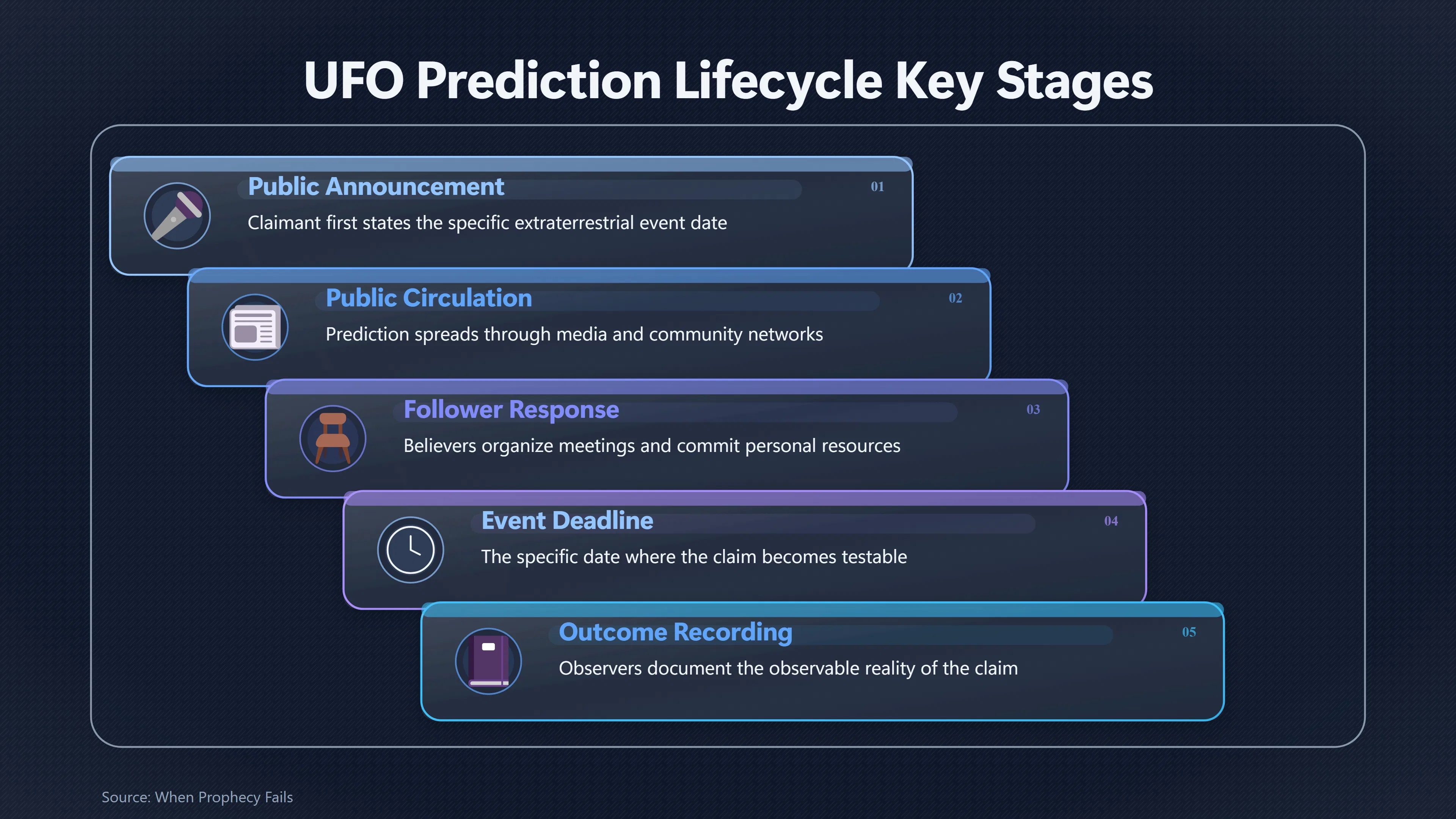
An announcement date marks the beginning of a prediction’s public life. It records when a claimant first stated that a specific extraterrestrial event, landing, rescue or disclosure would occur.
An event deadline marks the point at which the claim became testable. Only after that date can the prediction be evaluated against observable reality.
These dates answer different historical questions.
- Announcement date: When did people first hear the claim?
- Deadline: When could observers determine whether the claim succeeded or failed?[onlinelibrary.wiley.com]onlinelibrary.wiley.com“When Prophecy Fails” - Kelly - 2026 - Journal of the History of the Behavioral Sciences - Wiley Online LibraryNovember 4, 2025 — Volume…
Keeping both dates makes it possible to calculate the prediction’s active lifespan. A prophecy announced years before its deadline represents a much longer period of influence than one issued only days beforehand, even if both ultimately failed.
For UFO prediction research, this distinction also preserves the original wording before later reinterpretations, revised calendars or retrospective editing alter the narrative.[Wikipedia]WikipediaWhen Prophecy FailsWhen Prophecy Fails
How Publicity Grows During the Waiting Period
The period between announcement and deadline is often the most historically significant part of a failed UFO prediction.
During this interval, several measurable developments can occur:
- media coverage increases;
- followers recruit new believers;
- public meetings or lectures are organised;
- money or property may be committed;
- expectations become increasingly specific;
- sceptics begin documenting the prediction before the deadline.
Without recording the announcement date, these developments disappear from the historical record.
The well-known 1954 Dorothy Martin case illustrates this point. The prediction of catastrophic flooding and rescue by flying saucers circulated before the promised date of 21 December 1954, allowing believers to organise around it and researchers to observe the group before the prophecy reached its test. Whether one follows the traditional interpretation presented in When Prophecy Fails or more recent archival reassessments challenging aspects of that narrative, the chronology only makes sense because the prediction existed publicly before its deadline.[Wikipedia]WikipediaWhen Prophecy FailsWhen Prophecy Fails
Likewise, later UFO-related predictions, including highly publicised channelled announcements such as Blossom Goodchild’s expected appearance of a Federation of Light spacecraft on 14 October 2008, generated discussion, anticipation and media attention for weeks before the promised date arrived. Recording only the failed deadline would erase that period of public expectation and make the event appear to have emerged suddenly rather than developing over time.[Wikipedia]WikipediaList of dates predicted for apocalyptic eventsList of dates predicted for apocalyptic events
Why Two Dates Improve Historical Comparisons
Maintaining separate announcement and deadline fields allows different UFO predictions to be compared fairly.
For example, two failed predictions might share the same promised event date but differ dramatically in their history:
Timeline featurePrediction APrediction BAnnouncementTwo years before deadlineThree days before deadlinePublic exposureExtended books, interviews and meetingsLimited circulationOpportunity for verificationLong period of documented claimsMinimal pre-event documentationHistorical significanceLarge public recordSmall archival footprint
Without the announcement date, both would appear equally important because only the failure date survives.
This distinction also allows historians to identify changing communication patterns. Earlier contactee movements often spread predictions through newsletters, meetings and printed books over many months, whereas modern internet claims can reach worldwide audiences almost instantly while still retaining a clearly identifiable publication date.
Common Timeline Errors Caused by Date Compression
Combining announcement and deadline into a single date creates several recurring historical mistakes.
It makes predictions appear shorter-lived
If only the deadline is recorded, readers may assume a prediction emerged shortly before it failed. In reality, some UFO promises circulated for months or years, shaping communities long before they were disproved.
It hides changing expectations
Many predictions evolve between announcement and deadline. Dates may be refined, locations altered or additional promises added. Without the original issue date, these revisions become difficult to reconstruct.
It obscures evidence created before failure
Newspaper reports, newsletters, recordings and eyewitness accounts produced before the deadline provide especially valuable evidence because they cannot be influenced by hindsight. Compressing the timeline encourages later summaries to replace these contemporaneous records.
It encourages retrospective reinterpretation
After a failed prediction, claimants sometimes redefine what the original promise meant. If historians begin their timeline only at the missed deadline, these later explanations can inadvertently become merged with the initial claim instead of being recognised as separate stages in the story.
Preserving Cause Before Outcome
A chronological timeline should always show cause before consequence.
The sequence ideally runs as follows:
- The prediction is announced.
- It circulates publicly.
- Followers respond.
- Independent observers document the claim.
- The deadline arrives.
- The observable outcome is recorded.
- Any reinterpretations or revised explanations are logged separately.
This ordering prevents later narratives from reshaping earlier events. It also makes it easier to distinguish between what was originally promised and what believers said after the promised event failed to occur.
Why Every UFO Promise Needs Two Dates
For historians, journalists and researchers studying failed UFO predictions, separating announcement dates from event deadlines is a simple but powerful safeguard against hindsight bias. The announcement date records when a claim entered public discussion, while the deadline records when reality could test it. Between those points lies the period in which expectations spread, commitments were made and evidence accumulated.
A timeline that preserves both dates therefore documents not only whether a UFO prediction failed, but also how long it influenced people before it could be judged, providing a clearer and more accurate historical record than a single-date chronology ever can.
Amazon book picks
Further Reading
Books and field guides related to Why Every UFO Promise Needs Two Dates. Use these as the next step if you want deeper reading beyond the article.
When Prophecy Fails
The study reported in this volume grew out of some theoretical work, one phase of which bore specifically on the behavior of individuals...

The Craft of Research
Rating: 4.3/5 from 6 Google Books ratings
Since 1995, students, researchers, and professionals have turned to The Craft of Research for clear and helpful guidance on how to conduc...
Doing Oral History
Oral history is vital to our understanding of the cultures and experiences of the past. Unlike written history, oral history forever capt...
The Chicago Guide to Fact-Checking
Why we fact-check -- What we fact-check -- How we fact-check -- Checking different types of facts -- Sourcing -- Record keeping -- Test y...
eBay marketplace picks
Marketplace Samples
Live-tested eBay searches with available results related to this page.
Selected fromUFO poster oneBay.co.uk.
Current eBay listing
I Want To Believe UFO Poster Giclée Fine Art Heavyweight Print



Current eBay listing
VINTAGE UFO FLYING SAUCERS COMIC ADVERTISING A2 POSTER PRINT
Endnotes
1.
Source: Wikipedia
Title: When Prophecy Fails
Link:https://en.wikipedia.org/wiki/When_Prophecy_Fails
2.
Source: Wikipedia
Title: List of dates predicted for apocalyptic events
Link:https://en.wikipedia.org/wiki/List_of_dates_predicted_for_apocalyptic_events
Additional References
3.
Source: onlinelibrary.wiley.com
Title: Online Library Debunking “When Prophecy Fails”
Link:https://onlinelibrary.wiley.com/doi/full/10.1002/jhbs.70043
Source snippet
“When Prophecy Fails” - Kelly - 2026 - Journal of the History of the Behavioral Sciences - Wiley Online LibraryNovember 4, 2025 — Volume...
Published: November 4, 2025
4.
Source: doi.org
Title: Debunking “When Prophecy Fails”
Link:https://doi.org/10.1002%2Fjhbs.70043
Source snippet
Kelly - 2026 - Journal of the History of the Behavioral Sciences - Wiley Online LibraryNovember 4, 2025 — DEBUNKING “WHEN PROPHECY FAILS”...
Published: November 4, 2025
5.
Source: researchgate.net
Title: Debunking “When Prophecy Fails”
Link:https://www.researchgate.net/publication/397254906_Debunking_When_Prophecy_Fails
Source snippet
November 1, 2025 — DEBUNKING “WHEN PROPHECY FAILS” Journal of the History of the Behavioral Sciences * November 2025 * 62(1) DOI:10.1002/...
Published: November 1, 2025
6.
Source: youtube.com
Title: When Prophecies Fail: Repent, Reframe, or Reject?
Link:https://www.youtube.com/watch?v=7LdI-27Yqvc
Source snippet
When Prophecy Fails failed predictions UFO prophecy cognitive [dissonance]({{ 'dissonance/' | relative_url }}) Video Nugget: When Prophecy Fails with Richard Smoley New Thinki...
7.
Source: youtube.com
Title: The Seekers: When UFO Prophecy Failed and the Cult Stayed
Link:https://www.youtube.com/watch?v=Xlp4qETDQL8
Source snippet
Strange UFO Cult Changed Psychology Forever | Origin of Cognitive Dissonance...
8.
Source: youtube.com
Title: End of Days Cults, the Day After | Cognitive Dissonance (Video Essay)
Link:https://www.youtube.com/watch?v=5yVuauQjkDc
Source snippet
When Prophecies Fail: Repent, Reframe, or Reject?...
9.
Source: onlinelibrary.wiley.com
Link:https://onlinelibrary.wiley.com/doi/abs/10.1002/jhbs.70043
Source snippet
“When Prophecy Fails” - Kelly - 2026 - Journal of the History of the Behavioral Sciences - Wiley Online LibraryNovember 4, 2025 — ORIGINA...
Published: November 4, 2025
10.
Source: onlinelibrary.wiley.com
Link:https://onlinelibrary.wiley.com/doi/10.1002/jhbs.70043
Source snippet
“When Prophecy Fails” - Kelly - 2026 - Journal of the History of the Behavioral Sciences - Wiley Online LibraryNovember 4, 2025 — Volume...
Published: November 4, 2025
11.
Source: onlinelibrary.wiley.com
Link:https://onlinelibrary.wiley.com/doi/abs/10.1002/jhbs.70043?campaign=woletoc
Source snippet
“When Prophecy Fails” - Kelly - 2026 - Journal of the History of the Behavioral Sciences - Wiley Online LibraryNovember 4, 2025 — Volume...
Published: November 4, 2025
12.
Source: goodreads.com
Link:https://www.goodreads.com/book/show/35525207-when-prophecy-fails