Within Vague Forecasts
Can Missing UFO Evidence Ever Count Against the Claim?
When promised contact is not visible, alleged secrecy can turn missing evidence into support for the original belief.
On this page
- How secrecy absorbs failed expectations
- Why absence becomes part of the story
- What would make a concealment claim testable
Page outline Jump by section
Introduction
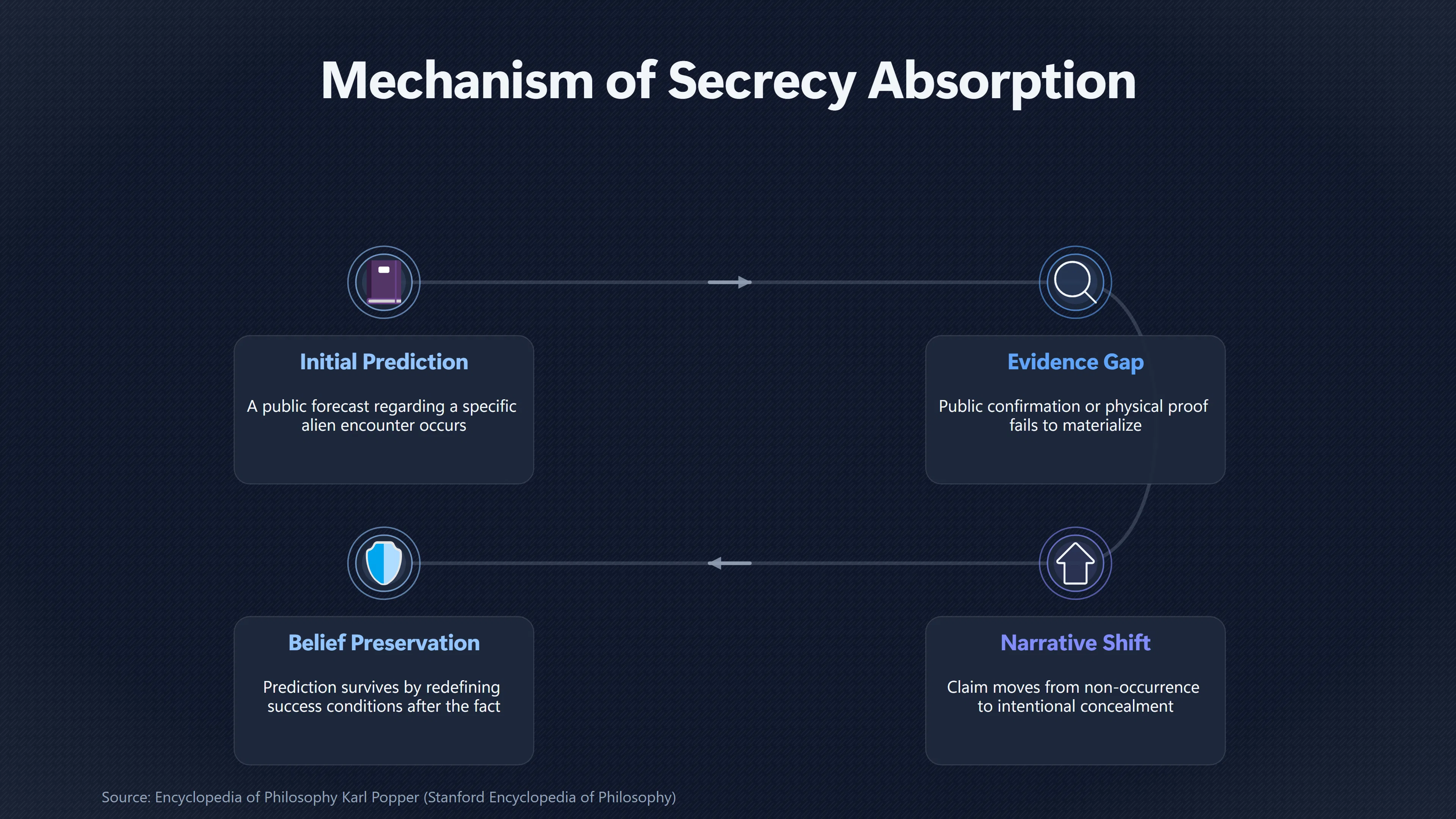
One reason some UFO predictions appear unusually resistant to failure is that missing public evidence can be reinterpreted as evidence of successful concealment. Instead of treating the absence of an announced landing, verified contact or released documents as a failed forecast, the prediction is reframed: the event supposedly happened, but governments, intelligence agencies or other powerful actors suppressed the proof. This mechanism does not demonstrate that secrecy is impossible—history contains genuine classified programmes—but it changes how predictions are evaluated. Once every missing observation can be explained by hidden evidence, it becomes increasingly difficult to identify what would count as a genuine failed prediction. Philosophers of science describe this as a problem of testability: a claim retains explanatory flexibility by absorbing contrary observations rather than specifying in advance what evidence would prove it wrong.[Stanford Encyclopedia of Philosophy]plato.stanford.eduEncyclopedia of Philosophy Karl Popper (Stanford Encyclopedia of PhilosophyStanford Encyclopedia of PhilosophyKarl Popper (Stanford Encyclopedia of Philosophy)September 12, 2022…
How secrecy absorbs failed expectations
Hidden-evidence claims typically emerge after a prediction has not been publicly confirmed. Rather than abandoning the original expectation, the explanation shifts from “the event did not occur” to “the event occurred but was concealed.”
In UFO belief systems this often takes familiar forms:
- Governments recovered alien craft but classified the evidence.
- Military or intelligence organisations prevented witnesses from speaking.
- Contact happened privately rather than publicly.
- Physical evidence was confiscated before independent examination.
- Disclosure was postponed because society was “not ready.”
Each explanation can preserve the original belief without requiring new publicly verifiable evidence. The prediction therefore survives not because it succeeded in its original form, but because its conditions for success have been redefined after the fact.
This resembles what Karl Popper criticised as the addition of ad hoc hypotheses—extra assumptions introduced primarily to protect a claim from apparent falsification rather than to generate new risky predictions. Popper did not argue that every auxiliary explanation is illegitimate; science often introduces additional hypotheses. The key question is whether those additions themselves become independently testable.[Stanford Encyclopedia of Philosophy]plato.stanford.eduEncyclopedia of Philosophy Karl Popper (Stanford Encyclopedia of PhilosophyStanford Encyclopedia of PhilosophyKarl Popper (Stanford Encyclopedia of Philosophy)September 12, 2022…
Why absence becomes part of the story
The distinctive feature of secrecy narratives is that they reverse the normal evidential relationship.
Ordinarily, if a prediction states that observable evidence will appear by a certain time, failure to observe that evidence counts against the prediction. Under a concealment explanation, however, the same missing evidence becomes compatible with the claim:
- No official confirmation may be interpreted as proof of institutional suppression.
- Missing documents may be attributed to classification or destruction.
- Witness silence may be explained by intimidation or secrecy agreements.
- Contradictory statements may be treated as deliberate disinformation.
Because each negative observation receives an explanation consistent with the original belief, opportunities for genuine disconfirmation become increasingly rare.
Philosophers discussing conspiracy theories sometimes describe this tendency as becoming self-sealing or epistemically self-insulating when contrary evidence is routinely reinterpreted as further evidence of the conspiracy. At the same time, recent philosophical work cautions against treating every conspiracy claim as automatically irrational or perfectly immune to evidence. The important distinction is whether reinterpretation remains proportionate and evidence-based, or expands without practical limits.[Cambridge University Press]cambridge.orgCambridge University PressAre Conspiracy Theories Problematically Self-Sealing? | Episteme | Cambridge CoreApril 22, 2026…
Genuine secrecy versus unfalsifiable secrecy
Recognising this mechanism does not require assuming that governments never keep secrets.
History provides many examples of classified military projects, intelligence operations and technological programmes that remained hidden for years before becoming public. The existence of real secrecy means that concealment is sometimes a reasonable hypothesis.
The critical question is different:
Does the concealment claim itself generate observable consequences?
For example, a secrecy claim becomes stronger when it predicts evidence that later emerges independently, such as:
- archives expected to be declassified,
- identifiable witnesses whose testimony can be checked,
- physical artefacts available for examination,
- records whose existence can be confirmed through multiple independent sources.
By contrast, a concealment explanation that continually expands whenever evidence fails to appear becomes progressively harder to distinguish from a claim that simply cannot fail.
This distinction explains why appeals to secrecy are not automatically invalid but also cannot automatically rescue unsuccessful predictions.
What would make a concealment claim testable?
A hidden-evidence claim becomes more informative when it specifies in advance what should eventually become observable.
Examples of testable commitments include:
- identifying which organisation supposedly possesses the evidence;
- specifying what kind of material exists;
- stating when or under what circumstances it should become public;
- predicting independent corroboration from identifiable sources;
- explaining what observations would count against the concealment hypothesis.
These commitments create opportunities for meaningful evaluation rather than indefinite postponement.
Without such commitments, concealment functions mainly as an explanatory shield. It preserves belief while reducing opportunities to determine whether the original prediction actually succeeded.
Why this matters when judging failed UFO predictions
Within the broader pattern of failed UFO forecasts, hidden-evidence claims occupy a distinctive role. Unlike vague timing or symbolic reinterpretation, they change the evidential standard itself. The issue is no longer whether predicted public events occurred, but whether their absence can always be attributed to successful concealment.
That shift makes prediction failure unusually difficult to establish. Every missing confirmation becomes potentially consistent with the original claim, allowing forecasts to survive despite repeated unmet expectations.
For readers assessing UFO predictions critically, the practical question is therefore not whether secrecy is conceivable. It is whether the secrecy explanation increases future testability or merely postpones it indefinitely. A concealment claim that specifies independent evidence capable of proving or disproving it remains open to evaluation. One that explains every possible outcome after the fact provides progressively less predictive content and makes distinguishing successful forecasts from failed ones increasingly difficult.[Stanford Encyclopedia of Philosophy]plato.stanford.eduEncyclopedia of Philosophy Karl Popper (Stanford Encyclopedia of PhilosophyStanford Encyclopedia of PhilosophyKarl Popper (Stanford Encyclopedia of Philosophy)September 12, 2022…
Amazon book picks
Further Reading
Books and field guides related to Can Missing UFO Evidence Ever Count Against the Claim?. Use these as the next step if you want deeper reading beyond the article.
Republic of Lies
_______ ‘Timely and troubling’ Evening Standard ‘A necessary book’ David Aaronovitch ‘Frequently jaw-dropping’ Huffington Post From UFOs...
A Culture of Conspiracy
It is well known that some Americans are obsessed with conspiracies. Films, best-selling books, and television shows talk about plots by...
Why People Believe Weird Things
Rating: 4.0/5 from 7 Google Books ratings
Revised and Expanded Edition. In this age of supposed scientific enlightenment, many people still believe in mind reading, past-life regr...
Suspicious Minds
Suspicious Minds decodes the psychology of why we all believe in conspiracy theories--some of us just hide it better than others.
eBay marketplace picks
Marketplace Samples
Live-tested eBay searches with available results related to this page.
Selected fromalien poster oneBay.co.uk.



Endnotes
1.
Source: plato.stanford.edu
Title: Encyclopedia of Philosophy Karl Popper (Stanford Encyclopedia of Philosophy)
Link:https://plato.stanford.edu/entries/popper/
Source snippet
Stanford Encyclopedia of PhilosophyKarl Popper (Stanford Encyclopedia of Philosophy)September 12, 2022...
Published: September 12, 2022
2.
Source: cambridge.org
Title: University Press On Ad Hoc Hypotheses | Philosophy of Science | Cambridge Core
Link:https://www.cambridge.org/core/journals/philosophy-of-science/article/abs/on-ad-hoc-hypotheses/EE289E1F40825CEEB93B7F3DD12AC201
Source snippet
Cambridge University PressOn Ad Hoc Hypotheses | Philosophy of Science | Cambridge Core...
3.
Source: cambridge.org
Link:https://www.cambridge.org/core/journals/episteme/article/are-conspiracy-theories-problematically-selfsealing/58BAC2A2347BF7F7F59A64BC94752539
Source snippet
Cambridge University PressAre Conspiracy Theories Problematically Self-Sealing? | Episteme | Cambridge CoreApril 22, 2026...
Published: April 22, 2026
4.
Source: philosophy.institute
Title: Science, in this view
Link:https://philosophy.institute/logic/popper-falsification-scientific-progress/
Source snippet
Falsification: Popper's Method for Scientific Progress • Philosophy InstituteDecember 18, 2025 — The Stanford Encyclopedia notes that a t...
Published: December 18, 2025
5.
Source: plato.stanford.edu
Title: prediction accommodation
Link:https://plato.stanford.edu/archives/fall2025/entries/prediction-accommodation/
6.
Source: cambridge.org
Link:https://www.cambridge.org/core/product/identifier/S2053447722000276/type/journal_article
7.
Source: cambridge.org
Title: On Ad Hoc Hypotheses | Philosophy of Science | Cambridge Core
Link:https://www.cambridge.org/core/services/aop-cambridge-core/content/view/EE289E1F40825CEEB93B7F3DD12AC201/S0031824800014355a.pdf/on_ad_hoc_hypotheses.pdf
8.
Source: cambridge.org
Title: Ad Hoc Hypotheses and the Argument from Coherence (Chapter 5)
Link:https://www.cambridge.org/core/books/abs/theoretical-virtues-in-science/ad-hoc-hypotheses-and-the-argument-from-coherence/D68DA91E6C88E2FBDB4739A8022B8E44
9.
Source: cambridge.org
Title: Ad Hoc Hypotheses and the Argument from Coherence (Chapter 5)
Link:https://www.cambridge.org/core/books/theoretical-virtues-in-science/ad-hoc-hypotheses-and-the-argument-from-coherence/D68DA91E6C88E2FBDB4739A8022B8E44
10.
Source: plato.sydney.edu.au
Title: He rejected verifiability
Link:https://plato.sydney.edu.au/entries/pseudo-science/
Source snippet
and Pseudo-Science (Stanford Encyclopedia of Philosophy)July 28, 2025 — 4.3 POPPER’S FALSIFICATIONISM Karl Popper described the demarcati...
Published: July 28, 2025
11.
Source: plato.sydney.edu.au
Link:https://plato.sydney.edu.au/entries/prediction-accommodation/index.html
12.
Source: plato.sydney.edu.au
Title: sydney.edu.au Scientific Method (Stanford Encyclopedia of Philosophy)
Link:https://plato.sydney.edu.au/entries///scientific-method/
13.
Source: plato.sydney.edu.au
Title: sydney.edu.au Imre Lakatos (Stanford Encyclopedia of Philosophy)
Link:https://plato.sydney.edu.au/entries/lakatos/
14.
Source: tildesites.bowdoin.edu
Link:https://tildesites.bowdoin.edu/~j.knockel/falsification/
Additional References
15.
Source: dergipark.org.tr
Link:https://dergipark.org.tr/en/pub/felsefedunyasi/article/1630485
Source snippet
The Philosophy WorldJuly 15, 2025 — KEYWORDS * Ad hoc hipotez * Yanlışlanabilirlik * Karl Popper * Bilimsel yöntem * Sözdebilim THE ROLE...
Published: July 15, 2025
16.
Source: pubmed.ncbi.nlm.nih.gov
Link:https://pubmed.ncbi.nlm.nih.gov/41101213/
Source snippet
2026 Feb:67:102193. doi: 10.1016/j.copsyc.2025.102193. Epub 2025 Oct 8. "A COMMUNITY OF UNKNOWLEDGE": A SOCIAL-PSYCHOLOGICAL MODEL OF THE...
17.
Source: youtube.com
Title: Not As They Seem
Link:https://www.youtube.com/watch?v=ciopi2r7j-k
Source snippet
The pattern behind self-deception | Michael Shermer...
18.
Source: youtube.com
Title: The pattern behind self-deception | Michael Shermer
Link:https://www.youtube.com/watch?v=b_6-iVz1R0o
Source snippet
UFO skeptic shares explanation for declassified videos ahead of Pentagon report release...
19.
Source: youtube.com
Title: Are We Losing the War on Truth? | Michael Shermer
Link:https://www.youtube.com/watch?v=ZNJ6A-jAkdI
Source snippet
Not As They Seem - Mick West on UFOs, Conspiracy Theories, and Pseudoscience...
20.
Source: link.springer.com
Link:https://link.springer.com/article/10.1007/s12144-026-09351-8
Source snippet
role of the conspiracy narrative triad in operationalizing conspiracy beliefs | Current Psychology | Springer Nature LinkApril 9, 2026 —...
Published: April 9, 2026
21.
Source: youtube.com
Link:https://www.youtube.com/watch?v=wqXkonM8wLU
Source snippet
Interview: Mick West, Identifying UFOs...
22.
Source: researchgate.net
Link:https://www.researchgate.net/publication/278024306_The_hypothesis_that_saves_the_Day_Ad_Hoc_reasoning_in_pseudoscience
23.
Source: frontiersin.org
Link:https://www.frontiersin.org/journals/psychology/articles/10.3389/fpsyg.2023.1026144/full
24.
Source: psychologytoday.com
Link:https://www.psychologytoday.com/gb/blog/insight-therapy/202004/true-false-believers-the-psychology-conspiracy-theories