Within Failure Timeline
How Should a Failed UFO Event Be Recorded?
Neutral outcome language can record a failed central event without erasing gatherings, reported lights, media visits or new claimant messages.
On this page
- Writing literal and testable outcome statements
- Preserving subsidiary events without inflating them
- Avoiding ridicule, advocacy and ambiguous verdicts
Page outline Jump by section
Introduction
When documenting failed UFO predictions, the phrase “nothing happened” is too vague to be historically useful. A timeline is intended to record whether a specific, testable prediction came true, not to summarise an entire day or movement with a single dismissive phrase. Around many failed UFO prophecies there were genuine gatherings, media attention, reported lights in the sky, follow-up messages from claimants, and sometimes lasting organisational consequences. Those surrounding events are historically real, but they are distinct from the central prediction being tested. A precise timeline therefore separates the promised observable event, the actual observable outcome, and the subsequent reactions or reinterpretations. Doing so allows readers to distinguish between an unsuccessful prediction and the social history that unfolded around it, while avoiding both sceptical caricature and uncritical acceptance.

Why “Nothing Happened” Fails as Historical Language
The principal weakness of “nothing happened” is that it conflates two different questions:
- Did the predicted event occur?
- Did anything else occur on or after the predicted date?
In historical writing, those questions require different answers.
Suppose a claimant predicts that a fleet of extraterrestrial spacecraft will become plainly visible over a major city on a specified day. If no such appearance occurs, the prediction has failed in its own stated terms. However, followers may still gather, journalists may report extensively on the prediction, police may manage crowds, amateur sky-watchers may report ordinary astronomical phenomena, and the claimant may immediately publish revised messages explaining the absence of the promised event.
Describing that entire sequence simply as “nothing happened” erases events that are historically significant while simultaneously failing to state clearly what actually failed.
A timeline is therefore better served by language such as:
Predicted event: Public appearance of a visible extraterrestrial spacecraft.
Outcome: No independently documented appearance matching the announced prediction occurred during the stated time window.
That wording identifies the observable claim without implying that the surrounding day was uneventful.
The Central Principle: Record the Test, Not the Atmosphere
A timeline of failed UFO promises functions most effectively when each entry is treated as a historical test.
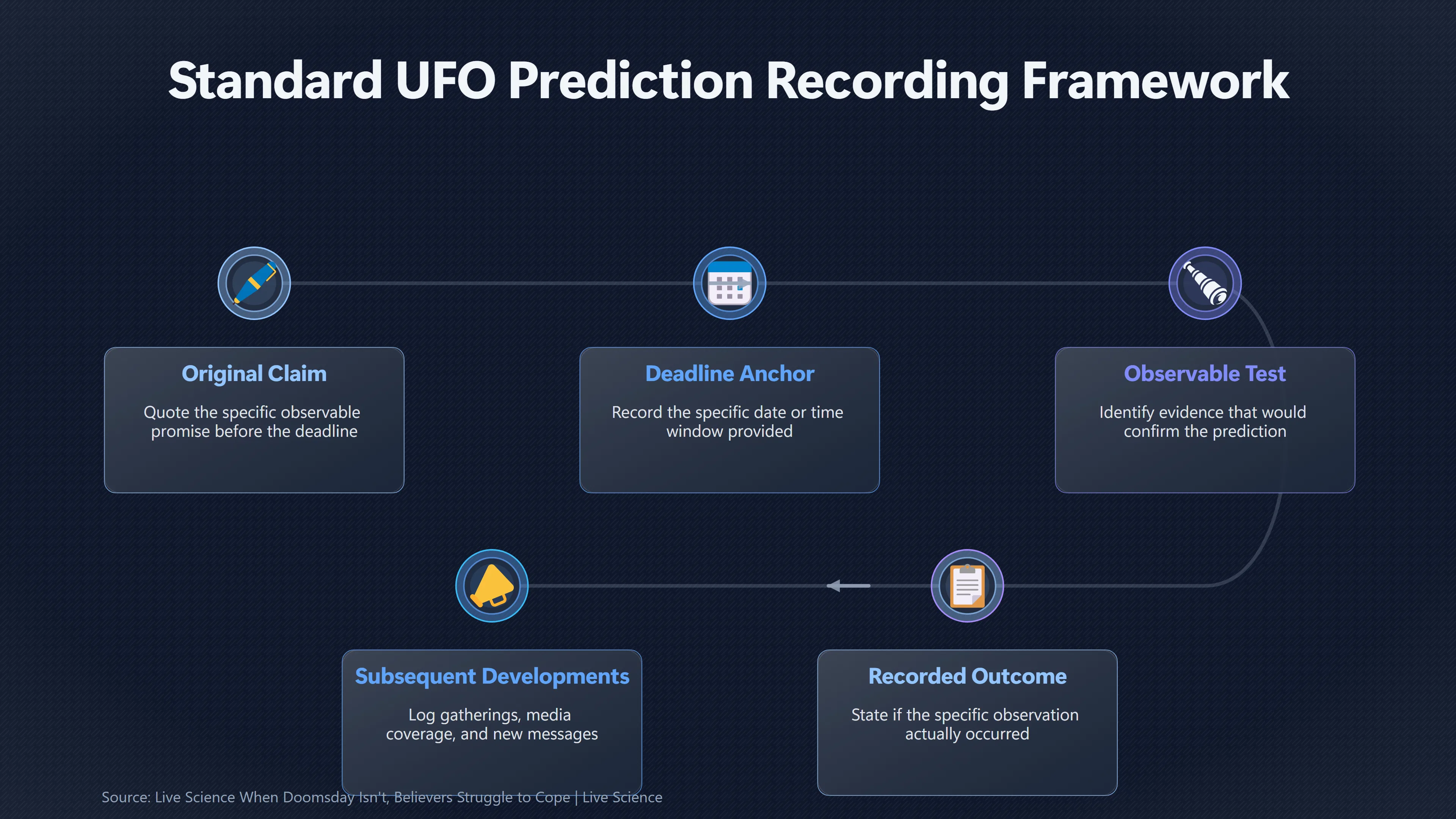
Every prediction contains four elements that should remain separate:
- the original claim;
- the expected observable event;
- the deadline;
- the recorded outcome.
Everything else belongs in supporting context rather than in the outcome itself.
For example, compare these two entries.
Weak entry
Nothing happened.
Stronger entry
The predicted public landing of extraterrestrial spacecraft was not observed during the announced period. Followers nevertheless gathered at the expected location, and the claimant later issued messages explaining the non-appearance.
The second version communicates substantially more information while remaining neutral.
It neither ridicules believers nor suggests that later explanations validated the original prediction.
Writing Literal and Testable Outcome Statements
Good timeline language is deliberately literal. It avoids broad verdicts in favour of statements that readers could independently verify.
Useful outcome statements typically answer three straightforward questions.
What was promised?
The wording should reproduce the observable promise rather than later interpretations.
For example:
- a spacecraft would land;
- extraterrestrials would rescue followers;
- a fleet would remain visible for several days;
- humanity would witness an unmistakable public appearance.
What observation would confirm the prediction?
The timeline should identify the expected evidence.
Examples include:
- public visual observation;
- physical landing;
- radar detection where specifically claimed;
- worldwide visibility;
- survival from an announced catastrophe through extraterrestrial intervention.
What was recorded?
The outcome should simply report whether those observations occurred.
Examples include:
- no documented landing occurred;
- no publicly verified worldwide appearance was reported;
- no independently confirmed rescue event took place.
This method prevents later reinterpretations from replacing the original promise.
Preserving Subsidiary Events Without Inflating Their Importance
Failed UFO predictions frequently generate genuine historical events.
These may include:
- organised gatherings;
- media interviews;
- television coverage;
- police involvement;
- increased publication of newsletters;
- reported lights or astronomical observations;
- new prophetic messages after the deadline;
- organisational splits or renewed recruitment.
These developments deserve preservation because they help explain the movement’s history.
However, they should not be merged into the outcome column of a timeline.
For example, if followers spent the night awaiting a landing that never occurred, the gathering itself is historically important. It demonstrates commitment, public interest and organisational behaviour. Yet the gathering does not constitute evidence that the predicted spacecraft arrived.
Separating these categories prevents a common historical distortion in which later narratives gradually replace the original prediction with memories of the surrounding excitement.
Dorothy Martin: Why “Nothing Happened” Is an Incomplete Description
Dorothy Martin’s 1954 prophecy remains one of the clearest illustrations of this distinction.
Martin claimed to receive communications from extraterrestrial beings warning of catastrophic floods while promising that faithful followers would be rescued by flying saucers before the destruction. Her small group assembled in anticipation while social psychologist Leon Festinger and colleagues observed the movement, producing the influential book When Prophecy Fails (1956). When the expected rescue failed to materialise, Martin announced that the group’s faith had persuaded God to spare the world, allowing believers to reinterpret the failed prediction rather than abandon it.[livescience.com]livescience.comLive Science When Doomsday Isn't, Believers Struggle to Cope | Live ScienceLive ScienceWhen Doomsday Isn't, Believers Struggle to Cope | Live ScienceMay 21, 2011…
If a timeline merely records:
Nothing happened.
it loses several historically significant facts:
- followers genuinely gathered;
- the predicted rescue did not occur;
- new messages appeared immediately afterwards;
- the group’s interpretation changed after the deadline;
- the episode became foundational in later discussions of cognitive dissonance.
Modern historical scholarship has also complicated the traditional story. Recent research examining archival material argues that aspects of Festinger’s famous account have been simplified or overstated in later retellings, reminding historians that even well-known narratives require careful source criticism.[Apple Podcasts]podcasts.apple.comPodcasts284: When Prophecy-Science Fai…–Conspirituality – Apple PodcastsApple Podcasts284: When Prophecy-Science Fai…–Conspirituality – Apple PodcastsNovember 20, 2025…
A careful timeline therefore distinguishes between:
Observable prediction
Extraterrestrial rescue before catastrophe.
Observable outcome
No documented rescue occurred.
Subsequent developments
New explanations asserted that catastrophe had been prevented because of the group’s spiritual actions.
That sequence preserves both the failed prediction and the movement’s later response.
Blossom Goodchild: Separating the Failed Prediction from the Continuing Narrative
The same principle applies to Blossom Goodchild’s widely publicised 2008 prediction concerning the Federation of Light.
The central public claim was straightforward: a large extraterrestrial craft would become plainly visible over Earth on 14 October 2008.
After the date passed without the predicted global appearance, subsequent channelled messages offered explanations for the absence of the expected event and continued the broader narrative.
A useful timeline therefore records:
- Prediction: unmistakable visible spacecraft.
- Outcome: no publicly documented appearance matching the prediction.
- Later developments: revised explanations and continued communications.
Recording only “nothing happened” omits the fact that extensive discussion continued after the deadline and that the claimant publicly addressed the failed prediction.
Equally, describing the later messages as evidence that the prediction somehow occurred would confuse reinterpretation with fulfilment.
Avoiding Ambiguous Verdicts
Several common expressions reduce historical clarity.
“The prophecy failed.”
Although broadly correct, this wording does not identify which part of the prediction was testable.
“Nothing happened.”
This ignores genuine historical events surrounding the deadline.
“The event was controversial.”
Controversy is not an observable outcome.
“Some people believed it happened spiritually.”
This merges later theological or metaphysical interpretations with the original public prediction.
Instead, timelines benefit from separating observation from interpretation.
For example:
No publicly observable spacecraft matching the announced prediction appeared during the specified period. Afterwards, the claimant stated that the visitors had altered their plans or that the event had occurred in a non-physical sense.
This wording records both facts without adopting either viewpoint.
Why Neutral Wording Improves Credibility
Neutral language benefits readers regardless of their views about UFO phenomena.
Ridiculing language such as:
- “the absurd prophecy collapsed”;
- “obviously nothing happened”;
- “followers were fooled”;
introduces editorial judgement.
Conversely, language such as:
- “the visitors arrived on a higher plane”;
- “the mission succeeded spiritually”;
accepts claims that are no longer describing the original observable prediction.
Historical writing gains credibility by remaining descriptive.
It records:
- what was promised;
- what observers could reasonably test;
- what was documented;
- how participants interpreted the outcome afterwards.
That approach neither dismisses participants nor validates their interpretations.
A Consistent Recording Framework
A reliable UFO prediction timeline can avoid ambiguity by using a standard structure for every entry.
Prediction
Quote or accurately paraphrase the original observable claim before the deadline.
Deadline
Record the announced date or time window.
State what independent observers would have expected to witness if the prediction were fulfilled.
Outcome
Describe only whether that observable event occurred.
Subsequent developments
Record gatherings, media coverage, reported lights, organisational responses, revised messages or reinterpretations separately.
This format allows readers to compare different cases without confusing failed predictions with the social activity surrounding them.
Why Precision Matters for Historical Comparison
The long-term value of a UFO prediction timeline lies in comparability. Readers should be able to examine dozens of cases and answer consistent questions:
- Which predictions specified exact dates?
- Which promised publicly observable events?
- Which failed outright?
- Which were subsequently reinterpreted?
- Which generated significant media or organisational activity despite the failure?
These comparisons become difficult if outcomes are reduced to the blanket phrase “nothing happened.”
Instead, precise wording preserves the distinction between the failure of a specific prediction and the historical events that followed from belief in that prediction. That distinction makes timelines more accurate, more transparent and more useful for understanding recurring patterns in failed UFO promises, including the tendency for narratives to evolve after a missed deadline while leaving the original prediction available for clear historical evaluation.
Amazon book picks
Further Reading
Books and field guides related to How Should a Failed UFO Event Be Recorded?. Use these as the next step if you want deeper reading beyond the article.
The UFO Experience
Cited by the New York Review of Books as “the best brief for visitation,” this classic study presents an analysis of UFO reports and conc...
The Chicago Guide to Fact-Checking
Why we fact-check -- What we fact-check -- How we fact-check -- Checking different types of facts -- Sourcing -- Record keeping -- Test y...

The Craft of Research
Rating: 4.3/5 from 6 Google Books ratings
Since 1995, students, researchers, and professionals have turned to The Craft of Research for clear and helpful guidance on how to conduc...
The Data Detective
From “one of the great (greatest?) contemporary popular writers on economics” (Tyler Cowen) comes a smart, lively, and encouraging rethin...
eBay marketplace picks
Marketplace Samples
Live-tested eBay searches with available results related to this page.
Selected fromUFO poster oneBay.co.uk.
Current eBay listing
I Want To Believe UFO Poster Giclée Fine Art Heavyweight Print


Current eBay listing
VINTAGE UFO FLYING SAUCERS COMIC ADVERTISING A2 POSTER PRINT
Endnotes
1.
Source: livescience.com
Title: Live Science When Doomsday Isn’t, Believers Struggle to Cope | Live Science
Link:https://www.livescience.com/14262-doomsday-predictions-fail.html
Source snippet
Live ScienceWhen Doomsday Isn't, Believers Struggle to Cope | Live ScienceMay 21, 2011...
Published: May 21, 2011
2.
Source: theguardian.com
Link:https://www.theguardian.com/world/2011/may/20/end-of-world-doomsday-prophets
3.
Source: podcasts.apple.com
Title: Podcasts284: When Prophecy-Science Fai…–Conspirituality – Apple Podcasts
Link:https://podcasts.apple.com/ca/podcast/284-when-prophecy-science-fails-w-thomas-kelly/id1515827446?i=1000737576944
Source snippet
Apple Podcasts284: When Prophecy-Science Fai…–Conspirituality – Apple PodcastsNovember 20, 2025...
Published: November 20, 2025
Additional References
4.
Source: unz.com
Link:https://www.unz.com/factcheck/factcheck-american-pravda-ufos-alien-abductions-and-other-strange-things/
Source snippet
The article correctly relays what Dolan wrote: Uhouse’s extraordinary allegation unz.com. It’s made clear this is a claim from UFO enthus...
5.
Source: researchgate.net
Title: (PDF) Ontology Gap in UAP Analysis: Why U.S
Link:https://www.researchgate.net/publication/399958889_Ontology_Gap_in_UAP_Analysis_Why_US_Government_Reporting_Can%27t_See_the_Interface
Source snippet
Government Reporting Can't See the InterfaceJanuary 21, 2026 — conclusions under me pressure, polical scruny, and severe informaon as...
Published: January 21, 2026
6.
Source: space.com
Title: Apocalypse Now? Doomsday Predictions Are Just Recycled Bogus Theories | Space
Link:https://www.space.com/38249-ancient-theories-fuel-doomsday-predictions.html
Source snippet
Apocalypse Now? Doomsday Predictions Are Just Recycled Bogus Theories | Space...
7.
Source: youtube.com
Title: When Prophecies Fail: Repent, Reframe, or Reject?
Link:https://www.youtube.com/watch?v=7LdI-27Yqvc
Source snippet
Failed UFO predictions history psychological rationalization 1950s False Prophets: UFO Doomsday Contactees Were Always Wrong (But Believe...
8.
Source: youtube.com
Link:https://www.youtube.com/watch?v=zYvdk6znuLA
Source snippet
The Seekers: When UFO Prophecy Failed and the Cult Stayed...
9.
Source: youtube.com
Title: End of Days Cults, the Day After | Cognitive Dissonance (Video Essay)
Link:https://www.youtube.com/watch?v=5yVuauQjkDc
Source snippet
When Prophecies Fail: Repent, Reframe, or Reject?...
10.
Source: badpsychics.com
Title: Bad Psychics.com
Link:https://www.badpsychics.com/2025/
Source snippet
A Skeptical Journey Exposing The Frauds: 2025December 30, 2025 — 13 DECEMBER 2025 THE CHRISTMAS THAT NEVER CAME: DOROTHY MARTIN’S FAILED...
Published: December 30, 2025
11.
Source: youtube.com
Title: 235-Leon Festinger and the Alien Apocalypse
Link:https://www.youtube.com/watch?v=fy06VDrnh7A
Source snippet
End of Days Cults, the Day After | Cognitive Dissonance (Video Essay)...
12.
Source: youtube.com
Title: The Seekers: When UFO Prophecy Failed and the Cult Stayed
Link:https://www.youtube.com/watch?v=Xlp4qETDQL8
Source snippet
235-Leon Festinger and the Alien Apocalypse...
13.
Source: skepticalinquirer.org
Link:https://skepticalinquirer.org/2025/10/a-closer-look-at-emencounters-em-and-the-ariel-school-sighting/