Within Irreversible Risk
When Doubt Becomes Betrayal Instead of Protection
When questions are treated as betrayal or spiritual failure, believers may lose the social permission needed to reconsider a lethal claim.
On this page
- How factual questions acquire a moral cost
- Why belonging can outweigh contradictory evidence
- What a genuinely safe route out would require
Page outline Jump by section
Introduction
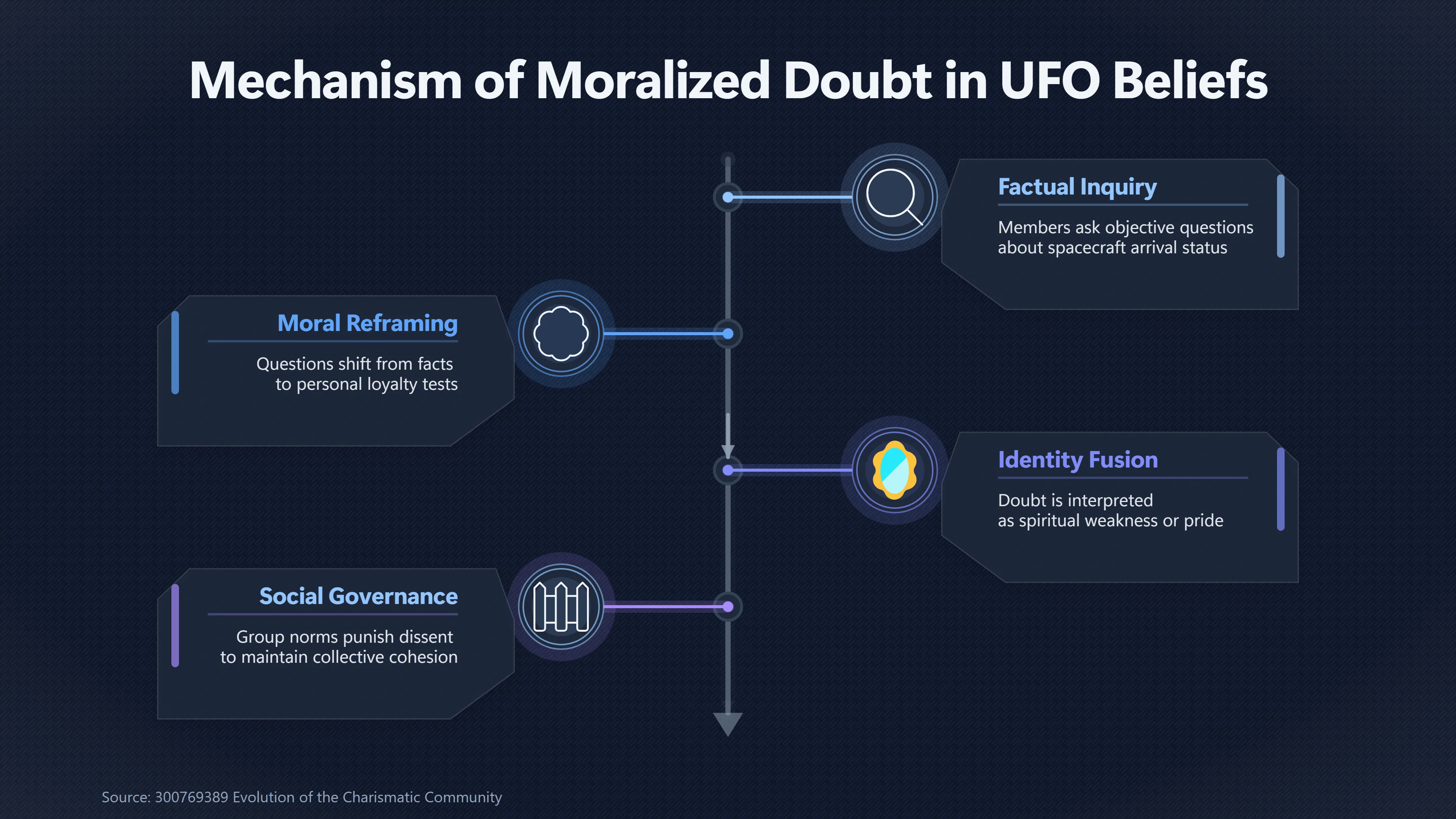
When failed UFO predictions are embedded within a closed belief system, the greatest danger may not be the prediction itself but the loss of a socially acceptable way to question it. If doubt becomes treated as betrayal, spiritual weakness or disloyalty rather than as a legitimate response to contradictory evidence, believers can lose the psychological and social permission needed to reconsider increasingly dangerous claims. This mechanism is especially significant in the context of suicide risk because it weakens one of the most important protective factors against irreversible decisions: the ability to raise objections, change one’s mind and leave without catastrophic personal consequences.
Research on high-control groups, including studies of Heaven’s Gate, shows that this dynamic is better understood as a system of social governance than as simple gullibility. Beliefs become tied to identity, relationships and moral worth. As a result, failed predictions need not weaken commitment. Instead, questioning them may become more personally costly than accepting ever more implausible explanations.[OUP Academic]academic.oup.comOUP AcademicBounded Choice: True Believers and Charismatic Cults | California Scholarship Online | Oxford AcademicSeptember 15, 2004…
How Factual Questions Acquire a Moral Cost
In ordinary communities, asking whether a prediction has failed is a factual question. Evidence can support or contradict the claim, and disagreement need not threaten a person’s membership or character.
Within a closed UFO belief system, however, the same question may gradually acquire a moral meaning. Instead of asking, “Did the spacecraft arrive?”, members may come to hear, “Are you loyal?”, “Do you trust the teachers?” or “Have you become spiritually compromised?”
This shift changes the function of doubt.
Rather than serving as a safeguard against error, doubt is reframed as evidence of personal failure. Members may be taught that:
- scepticism reflects attachment to the material world;
- hesitation shows insufficient spiritual development;
- requests for independent evidence demonstrate pride or ego;
- critics are morally corrupted or incapable of understanding higher truths.
Once these interpretations become established, contradictory evidence no longer competes only with belief. It competes with a person’s identity as a good, faithful or spiritually advanced member.
Studies of Heaven’s Gate describe an increasingly comprehensive system in which charismatic authority, shared ideology, social influence and behavioural controls reinforced one another. Within this environment, disagreement was not merely an intellectual difference but a challenge to the entire structure through which members interpreted reality.[OUP Academic]academic.oup.comOUP AcademicEvolution of the Charismatic Community | Bounded Choice: True Believers and Charismatic Cults | California Scholarship Online…
Why Belonging Can Outweigh Contradictory Evidence
Human beings rarely make important decisions in isolation. Family, friendships, reputation and community all shape how evidence is interpreted. In closed UFO groups these normal social influences may become unusually concentrated because the movement increasingly replaces members’ previous support networks.
The practical consequences of leaving can therefore become severe:
- loss of one’s closest relationships;
- loss of purpose and shared identity;
- fear of becoming spiritually condemned;
- public humiliation or social exclusion;
- uncertainty about rebuilding life outside the group.
When these costs accumulate, remaining committed may appear less frightening than admitting error.
This helps explain why failed predictions do not automatically produce mass departures. The immediate choice facing a believer is often not simply between “true” and “false”. It is between preserving every meaningful relationship or risking complete social collapse.
Janja Lalich’s theory of “bounded choice” argues that decisions inside such systems become progressively constrained because members’ available options narrow over time. What appears irrational from outside may appear internally consistent once authority, identity, social expectations and transcendent purpose become tightly interconnected.[oup.com]academic.oup.comOUP AcademicBounded Choice: True Believers and Charismatic Cults | California Scholarship Online | Oxford AcademicSeptember 15, 2004…

When Failed Predictions Become Tests of Loyalty
Within the broader topic of failed UFO predictions, this mechanism has an important consequence.
A prediction that fails publicly could have become an opportunity for reassessment. Instead, leaders or committed members may reinterpret the failure as a test:
- faithful members continue believing despite appearances;
- apparent failure proves outsiders cannot understand the plan;
- revised explanations become demonstrations of deeper insight;
- continued commitment becomes evidence of spiritual maturity.
The prediction therefore changes function.
Instead of forecasting an observable event, it becomes an instrument for sorting loyalty from doubt. The more obviously the prediction fails, the more valuable continued belief may become as a visible sign of commitment.
In Heaven’s Gate, doctrinal revisions after earlier expectations failed—including reinterpretations following Bonnie Nettles’ death—allowed contradictions to be incorporated into the existing worldview rather than accepted as disconfirmation. Later, the claimed spacecraft associated with Comet Hale–Bopp no longer required public verification. This increasingly insulated the core claim from ordinary factual testing.[OUP Academic]academic.oup.comOUP AcademicDenouement | Bounded Choice: True Believers and Charismatic Cults | California Scholarship Online | Oxford AcademicSeptember…
Why Punished Doubt Removes a Protective Exit
From a suicide-prevention perspective, the most significant issue is not unusual belief by itself but the disappearance of safe correction mechanisms.
Healthy communities usually contain several protective features:
- disagreement can be expressed without expulsion;
- leaders may admit mistakes;
- predictions can fail without destroying members’ identity;
- leaving remains socially and emotionally possible.
Punished doubt weakens each of these safeguards.
If every question becomes interpreted as betrayal, members may stop expressing uncertainty even when privately unconvinced. Silence can then create the false impression that unanimous confidence exists, reinforcing the belief that everyone else remains certain.
This dynamic increases isolation precisely when people most need permission to reconsider.
Research on Heaven’s Gate suggests that social influence within the group extended well beyond formal rules. Shared norms, peer expectations and mutual modelling reinforced commitment, making the organisational environment increasingly resistant to disconfirming evidence.[ResearchGate]researchgate.net300769389 Evolution of the Charismatic CommunityEvolution of the Charismatic Community | Request PDFSeptember 1, 2004…

What a Genuinely Safe Route Out Would Require
The opposite of punished doubt is not hostility towards unusual beliefs. It is the preservation of conditions under which revision remains psychologically and socially possible.
A genuinely safe exit would include several governance features:
- Questions remain morally neutral. Members can ask for evidence without being portrayed as disloyal or spiritually deficient.
- Predictions remain falsifiable. Failed forecasts are acknowledged rather than continually reinterpreted.
- Identity extends beyond the movement. People retain relationships, work, education or family connections outside the belief community.
- Leaving is not treated as moral collapse. Former members are not automatically characterised as evil, deceived or irredeemable.
- Leadership remains accountable. Those making extraordinary claims can themselves be questioned when predictions fail.
These features do not determine whether a UFO claim is true or false. Instead, they preserve ordinary mechanisms through which people can evaluate evidence without risking complete social exclusion.
Why This Mechanism Matters
Within the specific context of suicide risk in unfalsifiable UFO beliefs, moralised doubt is dangerous because it removes one of the last remaining opportunities for self-correction.
A failed prediction does not automatically become safer simply because reality contradicts it. If questioning the prediction carries greater personal cost than believing it, evidence may lose its corrective power. Believers are no longer choosing only between competing factual claims. They may also be choosing between preserving their entire social world or losing it.
For that reason, the presence or absence of a safe, non-punitive route out of a closed belief system can be as important as the content of the prediction itself. Where doubt remains compatible with belonging, failed predictions can encourage reassessment. Where doubt is moralised into betrayal, even obvious contradictions may fail to provide a practical exit from increasingly hazardous beliefs.
Amazon book picks
Further Reading
Books and field guides related to When Doubt Becomes Betrayal Instead of Protection. Use these as the next step if you want deeper reading beyond the article.
Combating Cult Mind Control
This 2018 30th anniversary edition honors the 40th anniversary of the tragedy in Jonestown, Guyana. On November 18th, 1978, over 900 peop...
Take Back Your Life
Lalich explains the seductive draw that leads people into cults, provides information for assessing what happened, and tools for getting...
The Believing Brain
Synthesizing thirty years of research, psychologist and science historian, Michael Shermer upends the traditional thinking about how huma...
Why People Believe Weird Things
Rating: 4.0/5 from 7 Google Books ratings
Revised and Expanded Edition. In this age of supposed scientific enlightenment, many people still believe in mind reading, past-life regr...
eBay marketplace picks
Marketplace Samples
Live-tested eBay searches with available results related to this page.
Selected fromUFO poster oneBay.co.uk.

Current eBay listing
VINTAGE UFO FLYING SAUCERS COMIC ADVERTISING A2 POSTER PRINT
Current eBay listing
I Want To Believe UFO Poster Giclée Fine Art Heavyweight Print


Endnotes
1.
Source: academic.oup.com
Link:https://academic.oup.com/california-scholarship-online/book/19464
Source snippet
OUP AcademicBounded Choice: True Believers and Charismatic Cults | California Scholarship Online | Oxford AcademicSeptember 15, 2004...
Published: September 15, 2004
2.
Source: academic.oup.com
Link:https://academic.oup.com/california-scholarship-online/book/19464/chapter-abstract/178112866
Source snippet
OUP AcademicEvolution of the Charismatic Community | Bounded Choice: True Believers and Charismatic Cults | California Scholarship Online...
3.
Source: academic.oup.com
Link:https://academic.oup.com/california-scholarship-online/book/19464/chapter-abstract/178114305
Source snippet
OUP AcademicDenouement | Bounded Choice: True Believers and Charismatic Cults | California Scholarship Online | Oxford AcademicSeptember...
4.
Source: academic.oup.com
Link:https://academic.oup.com/california-scholarship-online/book/19464/chapter-abstract/178111671
Source snippet
OUP AcademicThe Beginning: “The Two” Arrive | Bounded Choice: True Believers and Charismatic Cults | California Scholarship Online | Oxfo...
5.
Source: researchgate.net
Title: 300769389 Evolution of the Charismatic Community
Link:https://www.researchgate.net/publication/300769389_Evolution_of_the_Charismatic_Community
Source snippet
Evolution of the Charismatic Community | Request PDFSeptember 1, 2004...
Published: September 1, 2004
6.
Source: researchgate.net
Link:https://www.researchgate.net/publication/404903292_The_Cost_of_Belonging-and_Leaving_Structure_Predictors_and_Mental_Health_Outcomes_of_Costly_Religious_Exits
Source snippet
May 17, 2026 — THE COST OF BELONGING—AND LEAVING: STRUCTURE, PREDICTORS, AND MENTAL HEALTH OUTCOMES OF COSTLY RELIGIOUS EXITS * May 2026...
Published: May 17, 2026
7.
Source: academic.oup.com
Link:https://academic.oup.com/jaar/article/90/3/599/7049418
8.
Source: researchgate.net
Title: 249981757 Bounded Choice True Believers And Charismatic Cults
Link:https://www.researchgate.net/publication/249981757_Bounded_Choice_True_Believers_And_Charismatic_Cults
9.
Source: academic.oup.com
Link:https://academic.oup.com/california-scholarship-online/book/19464/chapter-abstract/178109460
10.
Source: academic.oup.com
Link:https://academic.oup.com/california-scholarship-online/book/19464/chapter-abstract/178119036
11.
Source: researchgate.net
Title: 364934999 Bounded ChoiceTrue Believers and Charismatic Cults
Link:https://www.researchgate.net/publication/364934999_Bounded_ChoiceTrue_Believers_and_Charismatic_Cults
12.
Source: researchgate.net
Title: 300769472 Bounded ChoiceCult Formation and the Development of the True Believer
Link:https://www.researchgate.net/publication/300769472_Bounded_ChoiceCult_Formation_and_the_Development_of_the_True_Believer
13.
Source: researchgate.net
Link:https://www.researchgate.net/publication/300895694_The_True_BelieverThe_Fusion_of_Personal_Freedom_and_Self-renunciation
14.
Source: lalichcenter.org
Title: Lalich Center What is Bounded Choice | Lalich Center on Cults and Coercion
Link:https://www.lalichcenter.org/what-is-bounded-choice/
15.
Source: books.google.com
Title: Bounded Choice
Link:https://books.google.com/books/about/Bounded_Choice.html?id=idYGEAAAQBAJ
16.
Source: lalichcenter.org
Title: Bounded Choice | Lalich Center on Cults and Coercion
Link:https://www.lalichcenter.org/blog/bounded-choice/
17.
Source: books.google.com
Title: Bounded Choice
Link:https://books.google.com/books/about/Bounded_Choice.html?id=16YwDwAAQBAJ
18.
Source: books.google.com
Title: Bounded Choice
Link:https://books.google.com/books/about/Bounded_Choice.html?id=p2Udi37GljsC
19.
Source: books.google.com
Title: Bounded Choice
Link:https://books.google.com/books/about/Bounded_Choice.html?id=D1Ayf63SfnwC
Additional References
20.
Source: pure.roehampton.ac.uk
Title: (Speaker) * Bapir-Tardy, S. (Speaker) * School of Psychology * Centre for R
Link:https://pure.roehampton.ac.uk/portal/en/activities/moral-injury-after-religious-exit-a-qualitative-study-of-former-m/
Source snippet
Injury After Religious Exit: A Qualitative Study of Former Members of High-Control Faith Communities - University of Roehampton Research...
21.
Source: youtube.com
Title: 10 Doomsday Cults That Got It Wrong | When Prophecy Fails
Link:https://www.youtube.com/watch?v=5V6FmVS_Gr0
Source snippet
The UFO Cult That Inspired Cognitive [Dissonance]({{ 'dissonance/' | relative_url }}) | [Dorothy Martin]({{ 'dorothy-martin/' | relative_url }}) & The Seekers...
22.
Source: youtube.com
Title: When Prophecy Fails — Why Failed Beliefs Get Stronger
Link:https://www.youtube.com/watch?v=3sOV0HENbkE
Source snippet
10 Doomsday Cults That Got It Wrong | When Prophecy Fails...
23.
Source: sciencedirect.com
Link:https://www.sciencedirect.com/science/article/pii/S2352853216300037
24.
Source: youtube.com
Title: The UFO Cult That Inspired Cognitive Dissonance | Dorothy Martin & The Seekers
Link:https://www.youtube.com/watch?v=vvFV1v8l-PI
Source snippet
Episode 749: The Heaven's Gate Tragedy...
25.
Source: researchoutput.csu.edu.au
Title: csu.edu.au Leaving ideological groups behind: A model of disengagement
Link:https://researchoutput.csu.edu.au/en/publications/leaving-ideological-groups-behind-a-model-of-disengagement/
26.
Source: tandfonline.com
Link:https://www.tandfonline.com/doi/full/10.1080/10508619.2025.2553407
27.
Source: cris.bgu.ac.il
Link:https://cris.bgu.ac.il/en/publications/the-search-for-meaning-and-belonging-after-leaving-a-high-cost-re-2/
28.
Source: youtube.com
Title: Episode 749: The Heaven’s Gate Tragedy
Link:https://www.youtube.com/watch?v=OtNseh3LOTw
Source snippet
InPresence 0211: When Prophecy Fails...
29.
Source: janjalalich.com
Title: bc in csr
Link:https://janjalalich.com/wp-content/uploads/bc_in_csr.pdf
Source snippet
CULTIC STUDIES REVIEW, Vol. 3, No. 3, 2004...