Within Disaster Averted
How Do You Test a Disaster That Never Happened?
Claims about what would have happened without a vigil depend on an alternative history that cannot be directly observed.
On this page
- The missing baseline problem
- Estimating outcomes without intervention
- Why plausible stories are not causal proof
Page outline Jump by section
Introduction
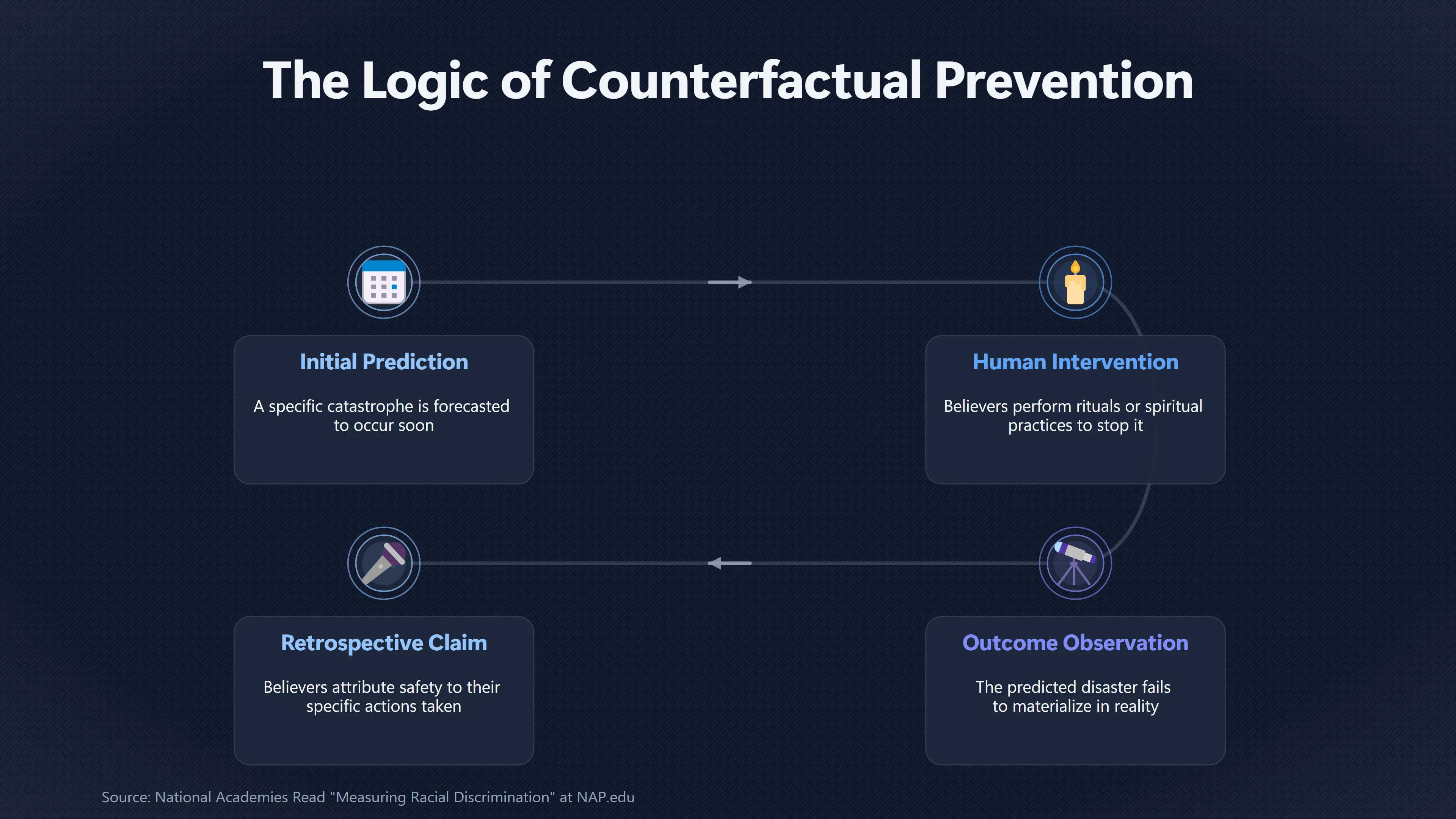
Claims that a predicted UFO-related catastrophe was prevented by believers present a distinctive evidential problem: they rely on a counterfactual—a claim about what would have happened in an alternative version of history that never occurred. Unlike an ordinary failed prediction, the explanation is shifted from “the prediction was wrong” to “the prediction was correct, but events changed because people acted”. The central difficulty is that the alleged disaster and the alleged prevention cannot both be observed. Without an independent way to estimate what would have happened in the absence of the vigil, prayer or spiritual practice, there is no direct test of whether anything was prevented at all. This is why counterfactual prevention claims are far more difficult to evaluate than ordinary predictions and why they remain resistant to straightforward confirmation or refutation.[National Academies]nationalacademies.orgNational Academies Read "Measuring Racial Discrimination" at NAP.eduNational Academies Read "Measuring Racial Discrimination" at NAP.edu
The Missing Baseline Problem
Testing a prevention claim requires a baseline: a credible estimate of what would have happened if the supposed intervention had never occurred. In causal inference—the branch of statistics concerned with cause-and-effect questions—this missing baseline is known as the counterfactual outcome. Researchers describe it as fundamentally unobservable because only one history actually takes place. A community either performs the vigil or it does not; the world either continues peacefully or it does not. The alternative history cannot be replayed for comparison.[National Academies]nationalacademies.orgNational Academies Read "Measuring Racial Discrimination" at NAP.eduNational Academies Read "Measuring Racial Discrimination" at NAP.edu
This creates a sharp contrast with conventional predictions:
- A prediction that a flood will occur on a specific date can be checked against observation.
- A claim that the flood was prevented by collective belief cannot be checked in the same way because the alleged flood never becomes observable evidence.
The claim therefore depends on accepting an unseen alternative history rather than comparing two measurable outcomes.
Within discussions of failed UFO prophecies, this matters because a missed prediction can always be reinterpreted as evidence of successful intervention unless an independent method exists to estimate the missing baseline.
Estimating Outcomes Without the Alleged Intervention
In medicine, engineering and public health, prevention claims are often testable because investigators can estimate what would probably have happened without the intervention.
For example:
- Vaccines can be evaluated by comparing infection rates between treated and untreated groups.
- Safety regulations can be assessed by examining accident rates before and after implementation while accounting for other factors.
- Weather evacuations can be compared with storm measurements and documented impacts.
These approaches are imperfect, but they attempt to approximate the missing counterfactual through control groups, natural experiments or statistical modelling. The key point is that the estimate does not depend solely on the authority of the person making the prediction.[National Academies]nationalacademies.orgNational AcademiesRead "Advancing the Framework for Assessing Causality of Health and Welfare Effects to Inform National Ambient Air Qual…
Belief-based disaster prevention claims usually lack comparable evidence. There is typically:
- no independently verified imminent hazard,
- no measurable mechanism connecting the ritual to the alleged prevention,
- no comparison group representing a world without the intervention, and
- no predictive model established before the deadline that could later be evaluated.
Without these elements, the proposed counterfactual remains speculative rather than empirically testable.
Why Plausible Stories Are Not Causal Proof
Humans naturally construct explanations after important events. If a feared catastrophe fails to occur, it is psychologically satisfying to identify a reason.
A prevention narrative often has several appealing features:
- it preserves the credibility of the original prediction;
- it gives participants a meaningful role in world events;
- it explains why the forecast appeared to fail without requiring the underlying belief to be abandoned.
None of these features, however, establish causation. In modern causal inference, a convincing story and a demonstrated causal effect are different things. Showing that one event happened before another—or that participants sincerely believed their actions mattered—does not demonstrate that those actions changed the outcome. Establishing causation requires evidence linking intervention and result while ruling out alternative explanations as far as possible.[Proceedings of Machine Learning Research]proceedings.mlr.pressProceedings of Machine Learning Research Causal InferenceProceedings of Machine Learning Research Causal Inference
This distinction is especially important because prevention claims frequently emerge only after the predicted event fails to occur. When the explanation is introduced retrospectively, it cannot easily be distinguished from an ad hoc reinterpretation designed to accommodate the failed prediction.
The Dorothy Martin Example as a Counterfactual Claim
The well-known 1954 case surrounding Dorothy Martin illustrates this evidential difficulty. Followers expected destructive flooding and anticipated rescue by extraterrestrial beings. When neither occurred, the reported explanation was that the group’s spiritual devotion had generated sufficient “light” to spare the Earth.
Whether this explanation is accepted depends entirely on the counterfactual proposition that, without the group’s actions, global destruction would have taken place. No independent observations exist from that unrealised alternative history, and no objective baseline was established beforehand against which the claim could later be tested.
The prevention claim therefore changes the question from “Did the prediction come true?” to “Would disaster have happened otherwise?” That second question cannot be answered by simply observing the historical record because the relevant comparison world does not exist.
Why the Claim Becomes Difficult to Falsify
Counterfactual disaster claims often become resistant to empirical testing because every observable outcome can be interpreted as compatible with the underlying belief.
If disaster occurs, believers may argue that the warning was accurate.
If disaster does not occur, they may argue that belief, prayer or spiritual action prevented it.
Since the crucial evidence lies in an unobservable alternative history, ordinary observation cannot distinguish between:
- a disaster that genuinely would have occurred but was somehow prevented;
- a disaster that was never going to occur in the first place; or
- a failed prediction that was later reinterpreted.
This does not automatically prove that every prevention claim is false. Rather, it explains why such claims are exceptionally difficult to evaluate using ordinary standards of evidence. The inability to observe both the actual outcome and its counterfactual alternative is recognised across modern causal inference as a fundamental limitation in establishing causal claims.[National Academies]nationalacademies.orgNational Academies Read "Measuring Racial Discrimination" at NAP.eduNational Academies Read "Measuring Racial Discrimination" at NAP.edu
Amazon book picks
Further Reading
Books and field guides related to How Do You Test a Disaster That Never Happened?. Use these as the next step if you want deeper reading beyond the article.
The Book of Why
The hugely influential book on how the understanding of causality revolutionized science and the world, by the pioneer of artificial inte...
The Art of Statistics
'A statistical national treasure' Jeremy Vine, BBC Radio 2 'Required reading for all politicians, journalists, medics and anyone who trie...
Why People Believe Weird Things
Rating: 4.0/5 from 7 Google Books ratings
Revised and Expanded Edition. In this age of supposed scientific enlightenment, many people still believe in mind reading, past-life regr...
Counterfactuals and Causal Inference
This new edition aims to convince social scientists to take a counterfactual approach to the core questions of their fields.
eBay marketplace picks
Marketplace Samples
Live-tested eBay searches with available results related to this page.
Selected fromUFO wall art oneBay.co.uk.




Endnotes
1.
Source: nationalacademies.org
Title: National Academies Read “Measuring Racial Discrimination” at NAP.edu
Link:https://www.nationalacademies.org/read/10887/chapter/9
2.
Source: proceedings.mlr.press
Title: Proceedings of Machine Learning Research Causal Inference
Link:https://proceedings.mlr.press/v6/pearl10a.html
3.
Source: nationalacademies.org
Link:https://www.nationalacademies.org/read/26612/chapter/5
Source snippet
National AcademiesRead "Advancing the Framework for Assessing Causality of Health and Welfare Effects to Inform National Ambient Air Qual...
4.
Source: nationalacademies.org
Link:https://www.nationalacademies.org/read/11908/chapter/27
5.
Source: nationalacademies.org
Link:https://www.nationalacademies.org/read/11693/chapter/18
6.
Source: nap.nationalacademies.org
Link:https://nap.nationalacademies.org/skim.php?chap=77-89&record_id=10887
7.
Source: nationalacademies.org
Link:https://www.nationalacademies.org/read/26612/chapter/10
8.
Source: nationalacademies.org
Link:https://www.nationalacademies.org/read/26612/chapter/16
Additional References
9.
Source: plato.sydney.edu.au
Link:https://plato.sydney.edu.au/entries/causation-counterfactual/
Source snippet
Theories of Causation (Stanford Encyclopedia of Philosophy)April 1, 2024 — COUNTERFACTUAL THEORIES OF CAUSATION First published Wed Jan 1...
Published: April 1, 2024
10.
Source: pubmed.ncbi.nlm.nih.gov
Link:https://pubmed.ncbi.nlm.nih.gov/30519524/
Source snippet
2018;226(2):110-121. doi: 10.1027/2151-2604/a000327. Epub 2018 Mar 14. BELIEF AND COUNTERFACTUALITY: A TELEOLOGICAL THEORY OF BELIEF ATTR...
11.
Source: cambridge.org
Title: Markus [Opens in a new window] Show au
Link:https://www.cambridge.org/core/journals/economics-and-philosophy/article/abs/causal-effects-and-counterfactual-conditionals-contrasting-rubin-lewis-and-pearl/755592D88BA42EBB7288C68844F1599B
Source snippet
Causal effects and counterfactual conditionals: contrasting Rubin, Lewis and Pearl | Economics & Philosophy | Cambridge CoreFebruary 11...
12.
Source: youtube.com
Title: When Prophecy Fails — Why Failed Beliefs Get Stronger
Link:https://www.youtube.com/watch?v=3sOV0HENbkE
Source snippet
This selection of videos directly addresses how counterfactual disaster prevention claims within UFO prophecy groups are structured, eval...
13.
Source: youtube.com
Title: The UFO Cult That Inspired Cognitive [Dissonance]({{ ‘dissonance/’ | relative_url }}) | Dorothy Martin & The Seekers
Link:https://www.youtube.com/watch?v=vvFV1v8l-PI
Source snippet
When Prophecy Fails — Why Failed Beliefs Get Stronger...
14.
Source: pmc.ncbi.nlm.nih.gov
Link:https://pmc.ncbi.nlm.nih.gov/articles/PMC9629435/
Source snippet
Counterfactuals, hypotheticals and causal judgements - PMCOctober 31, 2022 — (A). COUNTERFACTUALS VERSUS HYPOTHETICALS: SAME, SAME BUT D...
Published: October 31, 2022
15.
Source: pmc.ncbi.nlm.nih.gov
Title: Pub Med Central (PMC)An
Link:https://pmc.ncbi.nlm.nih.gov/articles/PMC2836213/
Source snippet
PubMed Central (PMC)An Introduction to Causal Inference - PMC...
16.
Source: youtube.com
Link:https://www.youtube.com/watch?v=6d6SJd5sxnM
Source snippet
The UFO Cult That Inspired Cognitive Dissonance | Dorothy Martin & The Seekers...
17.
Source: youtube.com
Title: When “When Prophecy Fails” Fails (E350)
Link:https://www.youtube.com/watch?v=IhblbZDXfZU
Source snippet
10 Doomsday Cults That Got It Wrong | When Prophecy Fails...
18.
Source: youtube.com
Title: 10 Doomsday Cults That Got It Wrong | When Prophecy Fails
Link:https://www.youtube.com/watch?v=5V6FmVS_Gr0
Source snippet
InPresence 0211: When Prophecy Fails...