Within Dissonance
How the Group Makes Failure Feel Believable
Shared explanations, emotional solidarity and repeated agreement can make a failed UFO prophecy feel credible again.
On this page
- How members compare and reinforce explanations
- Why emotional unity can feel like evidence
- What happens to dissent inside the group
Page outline Jump by section
Introduction
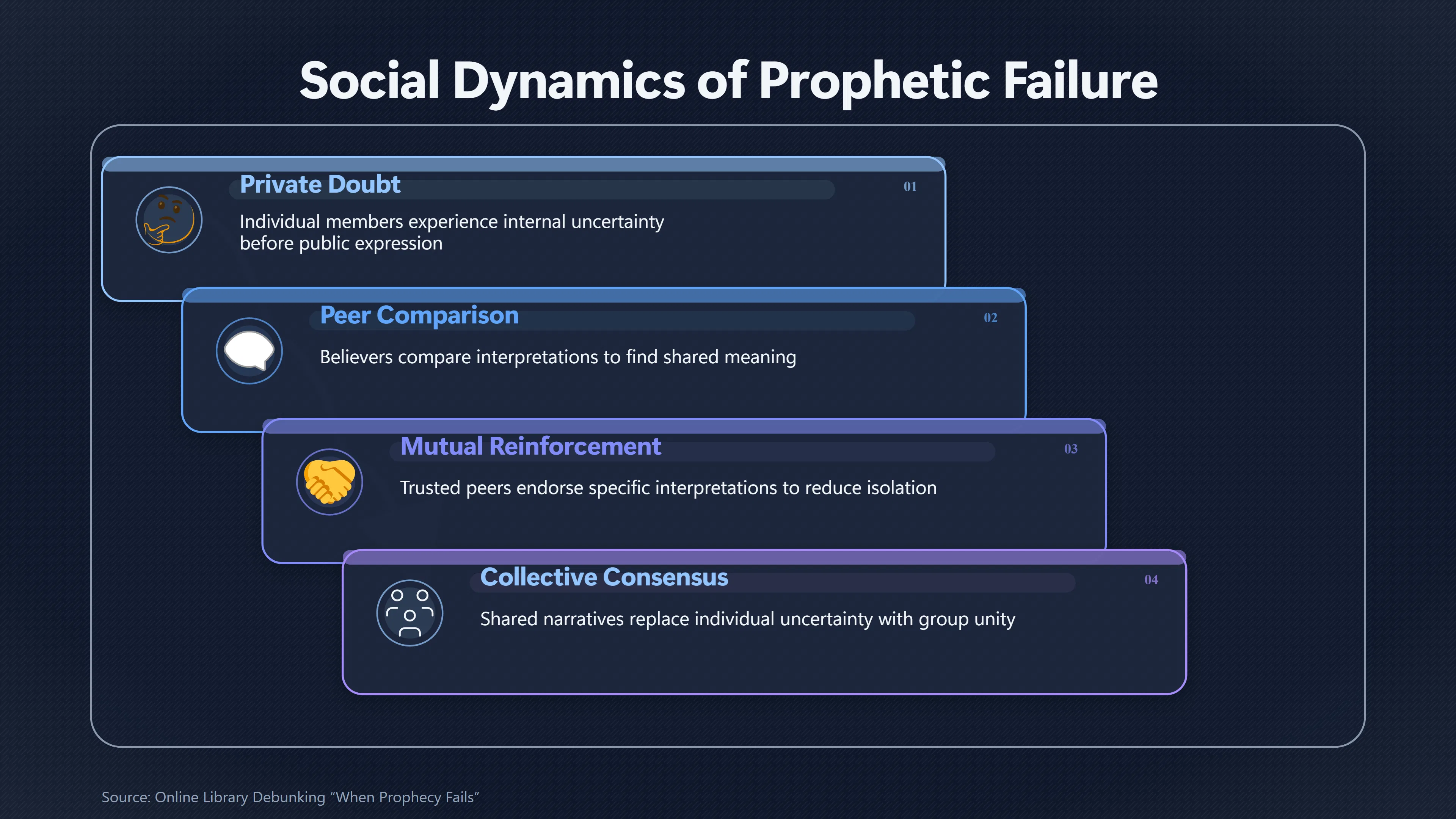
When a specific UFO prophecy fails, individual members often experience private doubt long before they express it publicly. Whether those doubts grow into disbelief depends not only on the evidence but also on the social environment surrounding the believer. Within a close-knit prophetic group, reassurance from trusted peers can make failure feel less like disconfirmation and more like a puzzle that has already been solved. Shared explanations, emotional solidarity and repeated agreement can reduce uncertainty without producing any new external evidence. This social process helps explain why some believers continue after a failed prediction, even when the original claim was clearly time-specific. At the same time, recent historical research cautions against treating this mechanism as universal: the classic UFO case that inspired cognitive dissonance theory has itself become the subject of significant scholarly criticism.[Wiley Online Library]onlinelibrary.wiley.comOnline Library Debunking “When Prophecy Fails”Wiley Online LibraryDebunking “When Prophecy Fails” - Kelly - 2026 - Journal of the History of the Behavioral Sciences - Wiley Online Lib…
How members compare and reinforce explanations
A failed prophecy rarely leaves every member equally convinced or equally doubtful. Instead, believers typically begin comparing interpretations with one another. In groups centred on UFO contact or channelling, conversations often shift from asking whether the prediction failed to asking how it should now be understood.
Several patterns commonly emerge:
- The prediction was genuine, but the date was misunderstood.
- Extraterrestrial beings altered their plans in response to changing conditions.
- The predicted intervention happened on a spiritual or invisible level.
- Human disbelief supposedly prevented open contact.
- The prophecy succeeded because believers’ actions averted the disaster it had warned about.
What matters psychologically is not that these explanations are independently verified, but that they are mutually reinforced. Hearing multiple trusted members endorse the same interpretation reduces the feeling of standing alone with uncertainty. Social agreement itself becomes reassuring.
Research on new religious movements has repeatedly found that prophetic communities often possess established interpretive traditions that allow disappointing events to be incorporated into a broader worldview rather than treated as decisive falsification. In these settings, preserving the overall belief system may become more important than defending every individual prediction.[OUP Academic]academic.oup.comOUP AcademicHow Prophecy Endures | When Prophecy Never Fails: Myth and Reality in a Flying-Saucer Group | Oxford AcademicJuly 1, 2005…
Why emotional unity can feel like evidence
The emotional atmosphere of a group can influence how members judge reality. After an anticipated UFO landing or rescue fails to occur, members commonly gather to discuss what happened, share disappointment and seek reassurance. These interactions can reduce anxiety even though they do not provide new factual information.
Several mechanisms help explain why this happens:
- Trusted relationships carry weight. Members often value the judgement of long-standing companions more than criticism from outsiders.
- Shared confidence reduces uncertainty. If everyone else appears calm and convinced, an individual may conclude that their own doubts are the problem.
- Repeated narratives become familiar. Explanations repeated across meetings, newsletters or conversations can begin to feel increasingly plausible simply because they are consistently encountered.
- Collective emotion reinforces commitment. Relief, mutual encouragement and renewed purpose can replace the isolation that accompanies private scepticism.
In this way, emotional consensus can acquire the psychological force of evidence even when no additional empirical evidence exists. The sense that “everyone understands what really happened” helps reduce the discomfort created by the failed prediction.
Why leaving can feel harder than staying
Group reassurance becomes especially powerful when members have invested heavily in the prophecy. A believer who has publicly defended a contactee, donated money, travelled to predicted landing sites or strained family relationships faces more than an intellectual decision after failure. Leaving may require admitting mistakes, explaining past sacrifices and losing an important social network.
Remaining inside the group offers immediate emotional benefits:
- friendships remain intact;
- previous sacrifices continue to appear meaningful;
- respected leaders continue to validate members’ experiences; and
- uncertainty is replaced with a coherent collective explanation.
This does not mean members consciously ignore contradictory evidence. Rather, the social environment changes which interpretations feel emotionally acceptable and which seem personally costly.
Researchers studying prophetic movements have argued that enduring commitment often reflects the preservation of an entire “lifeworld”—a shared system of meaning, relationships and identity—rather than attachment to one failed prediction alone.[OUP Academic]academic.oup.comOUP AcademicHow Prophecy Endures | When Prophecy Never Fails: Myth and Reality in a Flying-Saucer Group | Oxford AcademicJuly 1, 2005…
What happens to dissent inside the group
Private doubt does not disappear simply because a group reaches a shared explanation. Instead, dissent often changes form.
Some members quietly suppress questions to avoid conflict. Others reinterpret their concerns as signs of inadequate faith or personal misunderstanding. Individuals who continue expressing scepticism may gradually withdraw, while those who remain become increasingly surrounded by people who accept the group’s revised account.
This process does not necessarily require formal punishment. Ordinary social dynamics can be enough:
- disagreement receives less encouragement than agreement;
- respected members are cited repeatedly as authoritative;
- conversations focus on confirming rather than testing explanations; and
- members who endorse the new interpretation receive emotional approval.
Over time, this selective reinforcement can create the impression that consensus is stronger than it actually is, making individual doubts seem unusual even when several members privately share them.

The classic UFO case and why it remains debated
The relationship between group reassurance and failed UFO prophecies is closely associated with When Prophecy Fails (1956), which described Dorothy Martin’s flying-saucer group after its predicted apocalypse did not occur. The authors argued that supportive social interaction helped committed believers reinterpret failure and continue their mission, making the case central to cognitive dissonance theory for decades.[Wikipedia]WikipediaWhen Prophecy FailsWhen Prophecy Fails
However, this famous example is no longer accepted uncritically. Diana Tumminia and other scholars have argued that many prophetic groups persist through broader systems of meaning rather than through cognitive dissonance alone. More recently, Thomas Kelly examined newly available archival material and contended that the original account substantially misrepresented what occurred, arguing that the group dissolved rather than mounting the sustained campaign of renewed evangelism described in the classic study. These criticisms challenge the historical interpretation of that specific case without eliminating the broader observation that social support can strengthen commitment under some conditions.[OUP Academic]academic.oup.comOUP AcademicHow Prophecy Never Fails | When Prophecy Never Fails: Myth and Reality in a Flying-Saucer Group | Oxford Academic…
The most balanced conclusion is therefore narrower than older summaries sometimes suggest. Group reassurance can override personal doubt after a failed UFO prophecy by supplying shared explanations, emotional validation and social continuity. Whether it actually does so depends on the group’s structure, the members’ level of commitment and the wider circumstances. Failed predictions do not produce a single predictable outcome: some groups reinterpret them collectively, while others fragment, lose confidence or dissolve altogether.[Wiley Online Library]onlinelibrary.wiley.comOnline Library Debunking “When Prophecy Fails”Wiley Online LibraryDebunking “When Prophecy Fails” - Kelly - 2026 - Journal of the History of the Behavioral Sciences - Wiley Online Lib…
Amazon book picks
Further Reading
Books and field guides related to How the Group Makes Failure Feel Believable. Use these as the next step if you want deeper reading beyond the article.
When Prophecy Fails
The study reported in this volume grew out of some theoretical work, one phase of which bore specifically on the behavior of individuals...
The Psychology of Totalitarianism
The world is in the grips of mass formation—a dangerous, collective type of hypnosis—as we bear witness to loneliness, free-floating anxi...
The Righteous Mind
'A landmark contribution to humanity's understanding of itself' The New York Times Why can it sometimes feel as though half the populatio...
eBay marketplace picks
Marketplace Samples
Live-tested eBay searches with available results related to this page.
Selected fromUFO poster oneBay.co.uk.



Current eBay listing
VINTAGE UFO FLYING SAUCERS COMIC ADVERTISING A2 POSTER PRINT

Current eBay listing
I Want To Believe UFO Poster Giclée Fine Art Heavyweight Print
Endnotes
1.
Source: onlinelibrary.wiley.com
Title: Online Library Debunking “When Prophecy Fails”
Link:https://onlinelibrary.wiley.com/doi/full/10.1002/jhbs.70043
Source snippet
Wiley Online LibraryDebunking “When Prophecy Fails” - Kelly - 2026 - Journal of the History of the Behavioral Sciences - Wiley Online Lib...
2.
Source: academic.oup.com
Link:https://academic.oup.com/book/7811/chapter/152989636
Source snippet
OUP AcademicHow Prophecy Never Fails | When Prophecy Never Fails: Myth and Reality in a Flying-Saucer Group | Oxford Academic...
3.
Source: academic.oup.com
Link:https://academic.oup.com/book/7811/chapter-abstract/152994882
Source snippet
OUP AcademicHow Prophecy Endures | When Prophecy Never Fails: Myth and Reality in a Flying-Saucer Group | Oxford AcademicJuly 1, 2005...
Published: July 1, 2005
4.
Source: academic.oup.com
Link:https://academic.oup.com/book/7811/chapter/152994882
Source snippet
OUP AcademicHow Prophecy Endures | When Prophecy Never Fails: Myth and Reality in a Flying-Saucer Group | Oxford AcademicJuly 1, 2005...
Published: July 1, 2005
5.
Source: Wikipedia
Title: When Prophecy Fails
Link:https://en.wikipedia.org/wiki/When_Prophecy_Fails
6.
Source: onlinelibrary.wiley.com
Link:https://onlinelibrary.wiley.com/doi/10.1002/jhbs.70043
Source snippet
“When Prophecy Fails” - Kelly - 2026 - Journal of the History of the Behavioral Sciences - Wiley Online LibraryNovember 4, 2025 — Volume...
Published: November 4, 2025
7.
Source: onlinelibrary.wiley.com
Link:https://onlinelibrary.wiley.com/doi/abs/10.1002/jhbs.70043
Source snippet
“When Prophecy Fails” - Kelly - 2026 - Journal of the History of the Behavioral Sciences - Wiley Online LibraryNovember 4, 2025 — ORIGINA...
Published: November 4, 2025
8.
Source: onlinelibrary.wiley.com
Link:https://onlinelibrary.wiley.com/doi/abs/10.1002/jhbs.70043?campaign=woletoc
Source snippet
“When Prophecy Fails” - Kelly - 2026 - Journal of the History of the Behavioral Sciences - Wiley Online LibraryNovember 4, 2025 — Volume...
Published: November 4, 2025
9.
Source: academic.oup.com
Link:https://academic.oup.com/book/7811/chapter-abstract/152989636
10.
Source: doi.org
Title: Debunking “When Prophecy Fails”
Link:https://doi.org/10.1002%2Fjhbs.70043
Source snippet
Kelly - 2026 - Journal of the History of the Behavioral Sciences - Wiley Online LibraryNovember 4, 2025 — DEBUNKING “WHEN PROPHECY FAILS”...
Published: November 4, 2025
Additional References
11.
Source: youtube.com
Title: The UFO Cult That Inspired Cognitive Dissonance | Dorothy Martin & The Seekers
Link:https://www.youtube.com/watch?v=vvFV1v8l-PI
Source snippet
Failed Prophecy, Group Loyalty, And The Making Of A Cult | John McKinnon | Episode 600...
12.
Source: youtube.com
Link:https://www.youtube.com/watch?v=dSKNReTxOSQ
Source snippet
When Prophecy Fails Cognitive Dissonance Prevails - Dr. Kipp Davis...
13.
Source: youtube.com
Title: 10 Doomsday Cults That Got It Wrong | When Prophecy Fails
Link:https://www.youtube.com/watch?v=5V6FmVS_Gr0
Source snippet
The UFO Cult That Inspired Cognitive Dissonance | Dorothy Martin & The Seekers...
14.
Source: youtube.com
Title: When Prophecy Fails — Why Failed Beliefs Get Stronger
Link:https://www.youtube.com/watch?v=3sOV0HENbkE
Source snippet
10 Doomsday Cults That Got It Wrong | When Prophecy Fails...
15.
Source: ixtheo.de
Link:https://ixtheo.de/Record/1816079103
16.
Source: guilfordjournals.com
Link:https://guilfordjournals.com/doi/full/10.1521/jscp.1984.2.1.25
17.
Source: youtube.com
Title: When “When Prophecy Fails” Fails (E350)
Link:https://www.youtube.com/watch?v=IhblbZDXfZU
Source snippet
When Prophecy Fails — Why Failed Beliefs Get Stronger...
18.
Source: sciencedirect.com
Title: Cognitive-style differences in belief persistence after evidential discrediting
Link:https://www.sciencedirect.com/science/article/abs/pii/0191886985900583
19.
Source: sciencedirect.com
Title: Cognitive-style differences in belief persistence after evidential discrediting
Link:https://www.sciencedirect.com/science/article/pii/0191886985900583
20.
Source: psychologytoday.com
Title: Why Do Doomsday Believers Double-Down When Prophecy Fails? | Psychology Today
Link:https://www.psychologytoday.com/us/blog/freedom-of-mind/202506/why-do-doomsday-believers-double-down-when-prophecy-fails