Within UFO Deadlines
Did Researchers Distort the Classic UFO Prophecy Case?
Later archival criticism argues that the famous 1954 study was less controlled and more researcher-influenced than its classic account suggests.
On this page
- What the 1956 book claimed
- Archival challenges to the narrative
- What conclusions still remain secure
Page outline Jump by section
Introduction
The UFO prediction at the centre of When Prophecy Fails unquestionably failed: neither the expected catastrophic flood nor the promised flying-saucer rescue occurred in December 1954. What is now disputed is the research narrative built around that failure. Leon Festinger, Henry Riecken and Stanley Schachter presented the group’s response as a striking confirmation of cognitive-dissonance theory: deeply committed believers supposedly reacted to disconfirmation by strengthening their faith and suddenly seeking converts. Their 1956 book became one of social psychology’s most memorable case studies.[Internet Archive]ia802802.us.archive.orgFestinger Riecken Schachter When Prophecy Fails 1956Lord would surely come “before another winter.” This convic- tion grew among others in…Read more…
Newly available archival material has sharpened long-standing doubts about that account. Thomas Kelly’s 2025 archival study argues that the group had already publicised its beliefs before the deadline, that important participants soon retreated from the failed prophecy, and that undercover researchers did not merely observe events but helped shape them. These claims do not make the vanished flood or absent spacecraft any less decisive. They do, however, make When Prophecy Fails a cautionary example of how a genuine failed prediction can be turned into an excessively tidy research story.[Wiley Online Library]onlinelibrary.wiley.comOnline Library Debunking “When Prophecy Fails”Wiley Online LibraryDebunking “When Prophecy Fails” - Kelly - 2026 - Wiley Online LibraryNovember 4, 2025 — Drawing on newly unsealed arc…
What the 1956 book claimed
Festinger and his colleagues entered Dorothy Martin’s small circle covertly after learning that she claimed to receive messages from extraterrestrial beings. The researchers were looking for a naturally occurring test of a specific hypothesis: when people hold a belief with deep conviction, take costly actions because of it and retain social support after it is clearly disproved, they may reduce the resulting psychological discomfort by defending the belief more vigorously and persuading others to accept it.[Internet Archive]ia802802.us.archive.orgFestinger Riecken Schachter When Prophecy Fails 1956Lord would surely come “before another winter.” This convic- tion grew among others in…Read more…
The case appeared unusually well suited to that argument. Martin’s followers expected selected believers to be collected by spacecraft before a flood devastated large areas on 21 December 1954. Some members reportedly made consequential decisions involving employment, education, relationships or possessions. When no rescue craft appeared and no flood followed, a message attributed the world’s survival to the group’s spiritual influence. In the book’s interpretation, the prophecy had been transformed from a failed forecast into evidence of the group’s importance.[Internet Archive]ia802802.us.archive.orgFestinger Riecken Schachter When Prophecy Fails 1956Lord would surely come “before another winter.” This convic- tion grew among others in…Read more…
The crucial claim was not simply that believers rationalised the failure. It was that committed members moved from relative secrecy to active proselytising after disconfirmation. According to the book, they became markedly more willing to contact newspapers, speak to outsiders and spread their message. That supposed before-and-after shift supplied the memorable behavioural evidence for the authors’ theory: failed prophecy had not merely survived but had generated evangelism.[The New Yorker]newyorker.comThe New Yorker Is Cognitive Dissonance Actually a Thing? | The New YorkerThe New Yorker Is Cognitive Dissonance Actually a Thing? | The New Yorker
This interpretation was always more qualified than its popular retelling. The authors did not claim that every disappointed believer invariably becomes more committed. Their model required prior conviction, costly commitment, an unambiguous failure and continuing social reinforcement. Even so, the Martin episode came to be cited as if it were a clean demonstration of a general rule about failed predictions. The vividness of the UFO setting helped the case travel far beyond the methodological limits of one small covert field study.[Internet Archive]ia802802.us.archive.orgFestinger Riecken Schachter When Prophecy Fails 1956Lord would surely come “before another winter.” This convic- tion grew among others in…Read more…
Did the researchers change the event they were studying?
The oldest methodological problem is reactivity: people may behave differently because researchers, journalists or other outsiders are present. In Martin’s circle, this was not a minor concern. Festinger’s team placed several covert observers inside a very small group, sometimes making trained infiltrators a substantial share of those attending. Later critics noted that the supposed natural setting was therefore densely populated by people whose real purpose was to test a theory.[Wikipedia]WikipediaWhen Prophecy FailsWhen Prophecy Fails
Kelly’s archival research presents stronger evidence that the observers were not consistently passive. The newly opened material includes research notes, telephone records, communications and transcripts held in Leon Festinger’s papers at the Bentley Historical Library. According to Kelly, these documents show that undercover participants sometimes reinforced the group’s assumptions, adopted spiritually significant roles and staged material that members could interpret as corroboration.[umich.edu]findingaids.lib.umich.eduumich bhl 90165umich bhl 90165
Henry Riecken appears to have become especially influential. Archival accounts indicate that Martin and other members treated him as more than an ordinary newcomer; he was regarded as spiritually important and was in a position to reassure or challenge leading believers. At the moment of failure, Riecken reportedly prompted Charles Laughead, another central participant, to defend the faith. Laughead then delivered an impassioned affirmation, which the researchers interpreted as evidence that disconfirmation had strengthened belief. The difficulty is obvious: the behaviour being counted as confirmation may have been elicited in part by a covert investigator.[The New Yorker]newyorker.comThe New Yorker Is Cognitive Dissonance Actually a Thing? | The New YorkerThe New Yorker Is Cognitive Dissonance Actually a Thing? | The New Yorker
Other interventions described in the archive were still more intrusive. Kelly reports that an observer pretended to experience prophetic dreams or psychic communications, while another became entangled in family and child-welfare concerns surrounding participants. One archival passage describes researchers discussing how their covert position had helped deflect an official investigation and influence decisions affecting children in a member’s household. These episodes raise ethical questions, but they also create an evidential problem: once investigators supply messages, authority, reassurance or practical assistance, it becomes difficult to separate the group’s spontaneous response from the researchers’ contribution.[PubMed]pubmed.ncbi.nlm.nih.govPub Med Debunking "When Prophecy FailsPub Med Debunking "When Prophecy Fails
The book itself did acknowledge that observers had joined the group undercover. What the later archive changes is the apparent degree of participation. A participant observer inevitably affects a setting to some extent; a covert researcher who becomes a trusted spiritual figure or introduces supposedly supernatural material is doing something much closer to intervention. The 1954 case therefore cannot be treated as a controlled observation of what the believers would have done if left alone.[Read-Me.Org]poodle-banjo-jhsp.squarespace.comProphecy FailsLEON FESTINGER. STANLEY SCHACHTER. A social and psychological study of a modern group that predicted the destruction of the…
Was post-failure evangelism really new?
Kelly’s most direct challenge concerns the central before-and-after comparison. When Prophecy Fails described the group as relatively publicity-shy before 21 December and unusually eager to recruit or attract press attention afterwards. Yet archival evidence indicates that Martin and Laughead had already attempted to spread their beliefs before the prophecy failed. They had written for specialist publications, circulated material and made contact with journalists; Laughead’s public advocacy had already created professional consequences.[The New Yorker]newyorker.comThe New Yorker Is Cognitive Dissonance Actually a Thing? | The New YorkerThe New Yorker Is Cognitive Dissonance Actually a Thing? | The New Yorker
That matters because an increase in publicity can support the book’s argument only if the baseline is represented accurately. Press activity after the deadline is not evidence of a psychological reversal if comparable activity was already occurring. Nor is speaking to reporters necessarily the same as recruiting converts. A small group surrounded by journalists, police, concerned relatives and covert researchers might communicate more simply because outsiders are demanding explanations.[Wikipedia]WikipediaWhen Prophecy FailsWhen Prophecy Fails
The media environment further complicates the record. Publicity about the prophecy attracted telephone calls, visitors and reporters, some of whom challenged or mocked the group. Such attention may have encouraged members to issue statements, defend themselves or reinterpret events. Those actions could reflect embarrassment, crisis management, spiritual commitment, interpersonal pressure or several motives at once. Treating all outward communication as dissonance-driven proselytising risks converting a messy public confrontation into a single psychological mechanism.[Internet Archive]ia802802.us.archive.orgFestinger Riecken Schachter When Prophecy Fails 1956Lord would surely come “before another winter.” This convic- tion grew among others in…Read more…
Kelly also argues that the group’s longer-term response was less resilient than the book implied. His reconstruction says Martin later distanced herself from the literal rescue forecast, while the immediate group dispersed and active promotion of the failed prophecy subsided. Martin continued to hold occult and contactee beliefs, but retaining a broad supernatural worldview is not the same as maintaining the precise claim that spacecraft would arrive before the December flood.[Gwern.net]gwern.net2025 kelly2025 kelly
This distinction is central to evaluating failed UFO predictions. Belief systems are rarely single propositions. A person may abandon a date, reinterpret a rescue claim, preserve belief in extraterrestrial guidance and later join a different spiritual network. Depending on which level is measured, the same person can appear to have recanted, adapted or remained committed. The 1956 account compressed these separate outcomes into a cleaner narrative of strengthened belief.
Why the archival case is serious but not the last word
Kelly’s paper makes forceful allegations, including that the book’s authors knew evidence contradicted their published account. The paper is peer-reviewed and grounded in previously sealed records, making it substantially more important than a retrospective objection based only on the published book. The archive’s existence and contents can also be independently investigated through the Bentley Historical Library’s Festinger collection.[wiley.com]onlinelibrary.wiley.comOnline Library Debunking “When Prophecy Fails”Wiley Online LibraryDebunking “When Prophecy Fails” - Kelly - 2026 - Wiley Online LibraryNovember 4, 2025 — Drawing on newly unsealed arc…
Nevertheless, several cautions remain appropriate. Archival reconstruction is itself interpretative. Private notes may reveal doubts, jokes, tactical decisions or contradictions that were omitted from publication, but individual passages still require context. It is also necessary to distinguish among three claims of increasing severity: that the original fieldwork was contaminated; that the authors selected evidence to fit their hypothesis; and that they deliberately published conclusions they believed were false. The newly released material strongly reinforces the first claim and provides important evidence for the second. The third depends on judgments about what the authors understood, when they understood it and how consciously they shaped the final narrative.
The dispute also does not by itself invalidate the entire concept of cognitive dissonance. When Prophecy Fails was one early observational case, not the sole basis for the theory. Elliot Aronson, who worked with Festinger, has described the UFO study as a weak form of evidence compared with controlled experiments and argues that problems in this case do not settle the wider psychological question. At the same time, he acknowledges that people can reduce inconsistency in many different ways, limiting how precisely the theory predicts their response.[The New Yorker]newyorker.comThe New Yorker Is Cognitive Dissonance Actually a Thing? | The New YorkerThe New Yorker Is Cognitive Dissonance Actually a Thing? | The New Yorker
Research on other failed prophecies has produced varied outcomes rather than a universal pattern. An ethnographic study of a millenarian Baha’i sect whose predicted nuclear catastrophe failed found that participants’ faith was badly shaken and the movement’s activity declined. Earlier work on another prophetic group reported continuity without the dramatic post-failure transformation predicted by a simple reading of Festinger’s model. These comparisons support a narrower conclusion: social support, prior commitment, leadership, external pressure and interpretive flexibility may influence reactions, but failure does not automatically produce increased evangelism.[ScholarWorks]scholarworks.umt.eduOpen source on umt.edu.
What conclusions remain secure?
The archival dispute changes how confidently the Martin episode can be used, but it does not leave the record empty.
The UFO prophecy failed in observable terms. The promised spacecraft did not collect the group, and the predicted flood did not occur. Later explanations cannot retroactively fulfil those testable claims.[Internet Archive]ia802802.us.archive.orgFestinger Riecken Schachter When Prophecy Fails 1956Lord would surely come “before another winter.” This convic- tion grew among others in…Read more…
At least some participants rationalised the failure. The claim that the group’s spiritual activity had prevented disaster is a documented reinterpretation. It shows that a failed forecast can be protected by changing what the absence of the event is said to mean. It does not, on its own, prove that every believer became more convinced or that recruitment increased because of dissonance.[The New Yorker]newyorker.comThe New Yorker Is Cognitive Dissonance Actually a Thing? | The New YorkerThe New Yorker Is Cognitive Dissonance Actually a Thing? | The New Yorker
The group’s reactions were mixed. Some members defended parts of the belief system, some expressed doubt, and the organisation did not continue as a stable, expanding movement centred on the December prophecy. Martin’s later spiritual activity demonstrates continuity in broader supernatural beliefs, not straightforward persistence of the exact failed prediction.[Wiley Online Library]onlinelibrary.wiley.comOnline Library Debunking “When Prophecy Fails”Wiley Online LibraryDebunking “When Prophecy Fails” - Kelly - 2026 - Wiley Online LibraryNovember 4, 2025 — Drawing on newly unsealed arc…
The study was not a neutral natural experiment. Covert observers, heavy press attention and direct researcher participation make causal claims hazardous. The evidence does not allow a clean comparison between how the group behaved before and after failure without outside influence.[Gwern.net]gwern.net2025 kelly2025 kelly
The safest reading, therefore, is narrower than the classic story. When Prophecy Fails preserves a valuable record of how one small UFO-oriented circle talked through a conspicuous disappointment. It also illustrates one possible defence against falsification: redefining non-occurrence as spiritual success. But it should no longer be cited as decisive proof that heavily committed believers naturally respond to a failed prophecy by becoming more evangelical. The prediction’s failure is clear; the celebrated explanation of what happened next is not.
Amazon book picks
Further Reading
Books and field guides related to Did Researchers Distort the Classic UFO Prophecy Case?. Use these as the next step if you want deeper reading beyond the article.
When Prophecy Never Fails
Of the approximately fifty percent of Americans who believe in UFOs, a fraction are devotees of one of the numerous UFO-based new religio...
When Prophecy Fails
The study reported in this volume grew out of some theoretical work, one phase of which bore specifically on the behavior of individuals...
Mistakes Were Made (but Not by Me)
Why is it so hard to say "I made a mistake"-and really believe it? When we make mistakes, cling to outdated attitudes, or mistreat other...
Research Ethics
A portable and imaginative aid to moral decision-making for students in all disciplines from social sciences to engineering.
eBay marketplace picks
Marketplace Samples
Live-tested eBay searches with available results related to this page.
Selected fromUFO poster oneBay.co.uk.

Current eBay listing
VINTAGE UFO FLYING SAUCERS COMIC ADVERTISING A2 POSTER PRINT


Current eBay listing
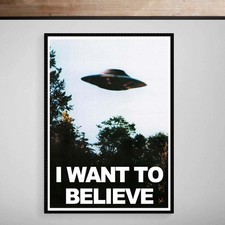
I Want To Believe UFO Poster Giclée Fine Art Heavyweight Print
Endnotes
1.
Source: ia802802.us.archive.org
Title: Festinger Riecken Schachter When Prophecy Fails 1956
Link:https://ia802802.us.archive.org/4/items/pdfy-eDNpDzTy_dR1b0iB/Festinger-Riecken-Schachter-When-Prophecy-Fails-1956.pdf
Source snippet
Lord would surely come “before another winter.” This convic- tion grew among others in...Read more...
2.
Source: archive.org
Title: whenprophecyfail00fest 0
Link:https://archive.org/details/whenprophecyfail00fest_0
Source snippet
Internet ArchiveWhen prophecy fails: Festinger, Leon, 1919-198930 Apr 2025 — When prophecy fails; Publication date: 1956; Topics: Prop...
3.
Source: onlinelibrary.wiley.com
Title: Online Library Debunking “When Prophecy Fails”
Link:https://onlinelibrary.wiley.com/doi/abs/10.1002/jhbs.70043
Source snippet
Wiley Online LibraryDebunking “When Prophecy Fails” - Kelly - 2026 - Wiley Online LibraryNovember 4, 2025 — Drawing on newly unsealed arc...
Published: November 4, 2025
4.
Source: gwern.net
Title: 2025 kelly
Link:https://gwern.net/doc/psychology/cognitive-bias/2025-kelly.pdf
5.
Source: Wikipedia
Title: When Prophecy Fails
Link:https://en.wikipedia.org/wiki/When_Prophecy_Fails
6.
Source: onlinelibrary.wiley.com
Title: Online Library Debunking “When Prophecy Fails”
Link:https://onlinelibrary.wiley.com/doi/10.1002/jhbs.70043
7.
Source: archive.org
Link:https://archive.org/details/whenprophecyfail00festrich
8.
Source: poodle-banjo-jhsp.squarespace.com
Link:https://poodle-banjo-jhsp.squarespace.com/s/when-prophesy-fails.pdf
Source snippet
Prophecy FailsLEON FESTINGER. STANLEY SCHACHTER. A social and psychological study of a modern group that predicted the destruction of the...
9.
Source: newyorker.com
Title: The New Yorker Is Cognitive Dissonance Actually a Thing? | The New Yorker
Link:https://www.newyorker.com/culture/the-lede/is-cognitive-dissonance-actually-a-thing
10.
Source: findingaids.lib.umich.edu
Title: umich bhl 90165
Link:https://findingaids.lib.umich.edu/catalog/umich-bhl-90165
11.
Source: pubmed.ncbi.nlm.nih.gov
Title: Pub Med Debunking “When Prophecy Fails”
Link:https://pubmed.ncbi.nlm.nih.gov/41186060/
12.
Source: scholarworks.umt.edu
Link:https://scholarworks.umt.edu/sociology_pubs/2/
13.
Source: scholarworks.umt.edu
Link:https://scholarworks.umt.edu/cgi/viewcontent.cgi?article=1000&context=sociology_pubs
14.
Source: books.google.com
Title: When Prophecy Fails
Link:https://books.google.com/books/about/When_Prophecy_Fails.html?id=pknuAAAAMAAJ
15.
Source: findingaids.lib.umich.edu
Title: umich bhl 90165 aspace 0e3f87e14fa25db8f51faba24c3b4a8b
Link:https://findingaids.lib.umich.edu/catalog/umich-bhl-90165_aspace_0e3f87e14fa25db8f51faba24c3b4a8b
Additional References
16.
Source: resolve.cambridge.org
Link:https://resolve.cambridge.org/core/services/aop-cambridge-core/content/view/3B6E3BA1B4BF1FC5A21F02C9953CBE63/9781845534677c11_p195-220_CBO.pdf/cultural_history_of_dissonance_theory.pdf
Source snippet
Nothing, it seems, that can help...Read more...
17.
Source: youtube.com
Title: Festinger’s When Prophecy Fails: What Happens After the World Doesn’t End
Link:https://www.youtube.com/watch?v=bkRjQ5juZXk
Source snippet
When Prophecy Fails Festinger cognitive dissonance Festinger Cognitive Dissonance.3gp...
18.
Source: youtube.com
Title: End of Days Cults, the Day After | Cognitive Dissonance (Video Essay)
Link:https://www.youtube.com/watch?v=5yVuauQjkDc
Source snippet
Festinger's When Prophecy Fails: What Happens After the World Doesn't End...
19.
Source: youtube.com
Title: The Seekers: When UFO Prophecy Failed and the Cult Stayed
Link:https://www.youtube.com/watch?v=Xlp4qETDQL8
Source snippet
End of Days Cults, the Day After | Cognitive Dissonance (Video Essay)...
20.
Source: youtube.com
Title: When Doomsday Doesn’t Come — The Famous Study May
Link:https://www.youtube.com/watch?v=jQDC7Q3WptM
Source snippet
The Seekers: When UFO Prophecy Failed and the Cult Stayed...
21.
Source: cambridge.org
Link:https://www.cambridge.org/core/journals/american-political-science-review/article/beyond-belief-change-the-persuasive-returns-of-targeting-attituderelevant-beliefs/85AFCCE25577522E99F8CB9913A1F5E4
22.
Source: cambridge.org
Link:https://www.cambridge.org/core/services/aop-cambridge-core/content/view/7D38C19E2F78F958316DAB07C81A0752/9781316515167ref_176-200.pdf/references.pdf
23.
Source: reddit.com
Link:https://www.reddit.com/r/AcademicPsychology/comments/1ov6kcw/when_prophecy_fails_the_case_study_that_helped/
24.
Source: christianscholars.com
Link:https://christianscholars.com/when-the-book-about-when-prophecy-fails-fails-the-lies-behind-the-famous-theory-of-cognitive-dissonance/
25.
Source: youtube.com
Title: When “When Prophecy Fails” Fails (E350)
Link:https://www.youtube.com/watch?v=IhblbZDXfZU
Source snippet
When Doomsday Doesn’t Come — The Famous Study May...