Within Channelled Claims
Can a Sincere UFO Channel Still Be Wrong?
A person may honestly experience a message as external while still being mistaken about its source, meaning or predictive accuracy.
On this page
- Why sincerity does not establish accuracy
- Altered states without automatic pathology
- How honest conviction affects failed predictions
Page outline Jump by section
Introduction
A person can be completely sincere about a channelled UFO message and still be wrong about what it predicts. This distinction is central to evaluating failed UFO prophecies. The key question is not whether the channel genuinely experienced an unusual state of consciousness, but whether the resulting claims about future, publicly observable events proved accurate. Researchers across psychology, psychiatry, anthropology and the study of religion consistently separate the authenticity of a person’s subjective experience from the objective truth of the information that experience appears to convey.[PubMed Central (PMC)]pmc.ncbi.nlm.nih.govPubMed Central (PMC)Channeling: A Non-pathological Possession and Dissociative Identity Experience or Something Else? - PMCJuly 1, 2021…
Within the history of UFO channeling, this distinction explains why failed predictions do not automatically imply deliberate deception. Some channelled predictions have been made by people who appeared deeply convinced of the messages they reported. Nevertheless, sincerity by itself cannot establish that an external intelligence was communicating, nor that specific forecasts about spacecraft, disasters or public contact were correct.
Why sincerity does not establish accuracy
People can report extraordinary experiences honestly while reaching mistaken conclusions about their source or meaning. This principle is widely accepted in psychology and the scientific study of religion. Researchers distinguish between two separate questions:
- Was the experience genuine to the individual?
- Were the factual claims derived from that experience true?
These questions are independent. Someone may sincerely believe they received a communication from extraterrestrials yet misidentify an internal experience as an external message. Equally, they may accurately describe having an unusual conscious experience while being mistaken about its interpretation.
This distinction matters especially for UFO predictions because channelled messages often contain claims that can be tested against later events. If a predicted mass landing, planetary evacuation or visible contact does not occur, the failure concerns the prediction itself rather than the sincerity of the person who reported receiving it.[nih.gov]pmc.ncbi.nlm.nih.govPubMed Central (PMC)Channeling: A Non-pathological Possession and Dissociative Identity Experience or Something Else? - PMCJuly 1, 2021…
Altered states do not automatically imply mental illness
An important point in contemporary research is that unusual experiences are not automatically regarded as signs of psychiatric disorder.
Modern discussions of channeling note that many practitioners report stable lives, voluntary control over their experiences and no evidence of clinical impairment. Likewise, psychiatric diagnostic criteria distinguish culturally accepted trance or possession experiences from disorders that cause distress or significant dysfunction. Simply entering an altered state or believing one has communicated with a non-ordinary intelligence is therefore not, by itself, evidence of pathology.[PubMed Central (PMC)]pmc.ncbi.nlm.nih.govPubMed Central (PMC)Channeling: A Non-pathological Possession and Dissociative Identity Experience or Something Else? - PMCJuly 1, 2021…
This creates an important middle position that is sometimes overlooked in public debate:
- A channel need not be consciously inventing messages.
- The experience need not indicate mental illness.
- The predictions can nevertheless be objectively incorrect.
Recognising this separation allows investigators to assess failed UFO prophecies without assuming either fraud or psychiatric illness.
How honest conviction can still produce failed UFO predictions
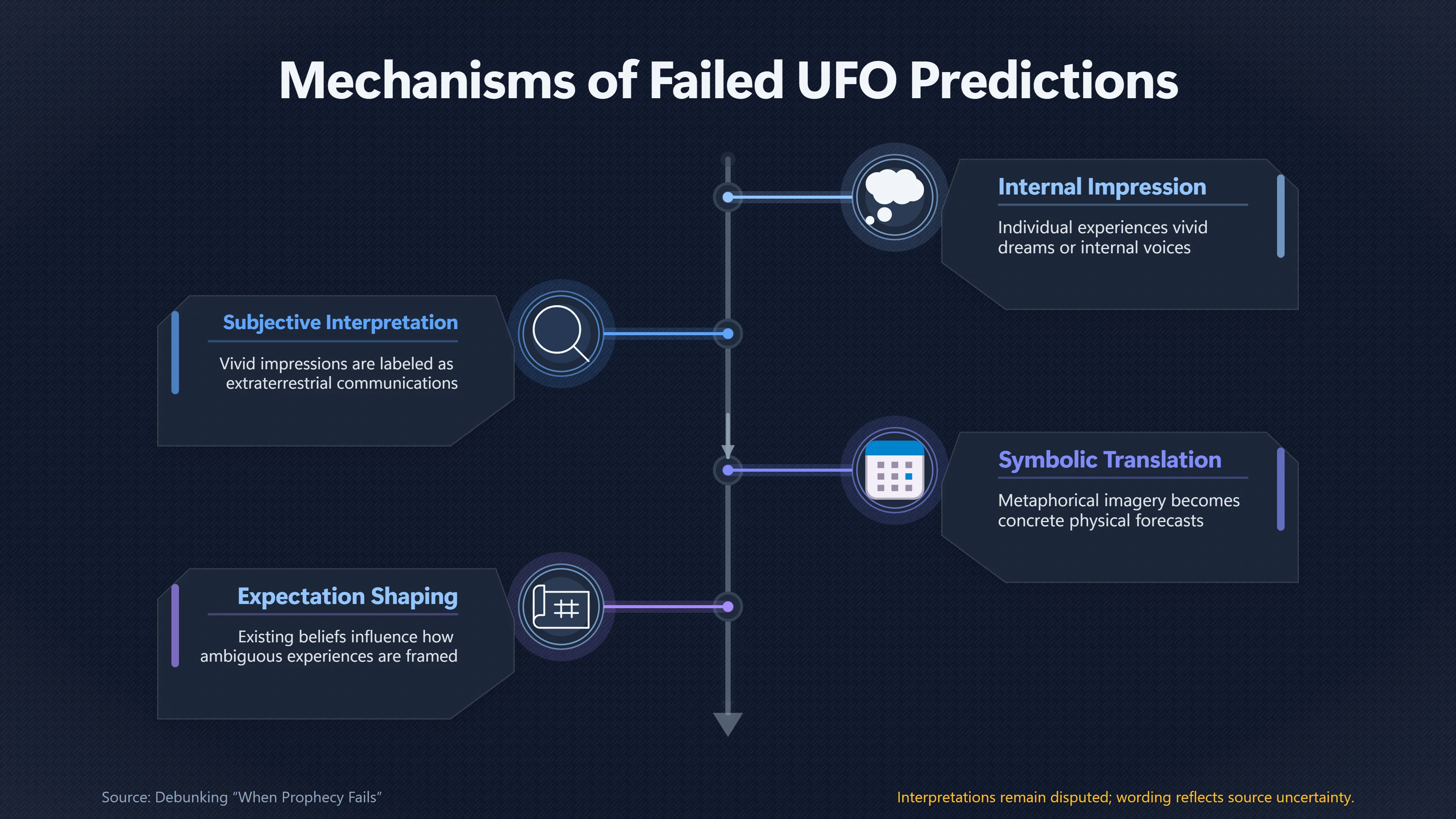
A sincere channel may produce false predictions through several non-exclusive mechanisms that do not require deliberate deception.
Interpretation errors. An individual may experience vivid impressions, dreams or internal voices and honestly interpret them as extraterrestrial communications when they originate from ordinary psychological processes or from meanings constructed by the individual.
Misunderstanding symbolic experiences. Some channelled communications contain symbolic imagery that later becomes interpreted as literal forecasts. A metaphorical experience may gradually acquire a concrete date or physical prediction that ultimately fails.
Expectation shaping perception. Existing beliefs about UFOs, spiritual evolution or impending planetary change can influence how ambiguous experiences are interpreted. The subjective experience may be genuine while the explanatory framework applied to it proves inaccurate.
Overconfidence in the source. Many UFO channelers describe their communicators as technologically or spiritually superior beings. If that authority is accepted without independent verification, predictions may be presented with unwarranted certainty despite having no external confirmation.
None of these mechanisms requires conscious fabrication. Instead, they illustrate how honest conviction and factual error can coexist.
Failed predictions do not reveal the source of the experience
When a channelled UFO prediction fails, observers can conclude that the prediction was inaccurate. What they cannot determine from the failure alone is why it failed.
Several competing explanations remain possible:
- no external communicating intelligence existed;
- the experience was psychological but sincerely interpreted as external;
- the message was misunderstood or mistranslated by the recipient;
- the claimed communicating entity, if assumed to exist, was itself unreliable.
Because the alleged source cannot be independently examined, evidence generally discriminates only between successful and unsuccessful predictions, not between these competing explanations.
For this reason, historians and researchers emphasise publicly observable outcomes rather than unverifiable explanations offered after a prediction fails.
Honest conviction after disconfirmation
The history of UFO prophecy shows that sincere believers do not all react identically when predictions fail.
Some abandon the belief entirely. Others reinterpret the failed prediction, perhaps arguing that humanity changed course, that a catastrophe was spiritually prevented or that the event occurred invisibly rather than publicly. Still others retain confidence in the channel while treating the failed prediction as a misunderstanding rather than evidence against the underlying communication.
The well-known case surrounding Dorothy Martin (Marian Keech) became foundational to discussions of failed prophecy after her 1954 prediction of rescue by flying saucers before a catastrophic flood did not occur. However, recent archival research has challenged aspects of the classic interpretation presented in When Prophecy Fails, arguing that the group’s later behaviour was more complex than long assumed and that the original research involved methodological and ethical problems. The broader lesson remains that responses to failed prophecy vary considerably between individuals and movements, rather than following a single psychological pattern.[doi.org]doi.orgDebunking “When Prophecy Fails”Debunking “When Prophecy Fails” - Kelly - 2026 - Journal of the History of the Behavioral Sciences - Wiley Online LibraryNovember 4, 2025…
What this means when evaluating UFO channeling
The strongest critical lesson is that sincerity is evidence about a person’s belief, not about the objective accuracy of a prediction.
A sincere channel may accurately report having an unusual subjective experience while incorrectly identifying its source or wrongly inferring future events from it. Researchers therefore evaluate channelled UFO predictions primarily by whether their publicly testable claims occur as described, not by judging the apparent honesty or emotional conviction of the individual making them.
This distinction allows two ideas to remain true simultaneously: a person may honestly believe they have received communications from non-human intelligences, and those communications may nevertheless produce demonstrably false predictions about observable UFO events.
Amazon book picks
Further Reading
Books and field guides related to Can a Sincere UFO Channel Still Be Wrong?. Use these as the next step if you want deeper reading beyond the article.
Why People Believe Weird Things
Rating: 4.0/5 from 7 Google Books ratings
Revised and Expanded Edition. In this age of supposed scientific enlightenment, many people still believe in mind reading, past-life regr...
The Varieties of Religious Experience
"Being the Gifford lectures on natural religion delivered at Edinburgh in 1901-1902."
The Believing Brain
Synthesizing thirty years of research, psychologist and science historian, Michael Shermer upends the traditional thinking about how huma...
eBay marketplace picks
Marketplace Samples
Live-tested eBay searches with available results related to this page.
Selected fromUFO poster oneBay.co.uk.

Current eBay listing
VINTAGE UFO FLYING SAUCERS COMIC ADVERTISING A2 POSTER PRINT

Current eBay listing
I Want To Believe UFO Poster Giclée Fine Art Heavyweight Print

Endnotes
1.
Source: link.springer.com
Link:https://link.springer.com/article/10.1007/s11013-021-09730-9
Source snippet
Channeling: A Non-pathological Possession and Dissociative Identity Experience or Something Else? | Culture, Medicine, and Psychi...
2.
Source: doi.org
Title: Debunking “When Prophecy Fails”
Link:https://doi.org/10.1002%2Fjhbs.70043
Source snippet
Debunking “When Prophecy Fails” - Kelly - 2026 - Journal of the History of the Behavioral Sciences - Wiley Online LibraryNovember 4, 2025...
Published: November 4, 2025
3.
Source: onlinelibrary.wiley.com
Title: Online Library Debunking “When Prophecy Fails”
Link:https://onlinelibrary.wiley.com/doi/10.1002/jhbs.70043
Source snippet
Wiley Online LibraryDebunking “When Prophecy Fails” - Kelly - 2026 - Journal of the History of the Behavioral Sciences - Wiley Online Lib...
4.
Source: onlinelibrary.wiley.com
Link:https://onlinelibrary.wiley.com/doi/abs/10.1002/jhbs.70043
5.
Source: onlinelibrary.wiley.com
Link:https://onlinelibrary.wiley.com/doi/full/10.1002/jhbs.70043
6.
Source: onlinelibrary.wiley.com
Link:https://onlinelibrary.wiley.com/doi/abs/10.1002/jhbs.70043?campaign=woletoc
7.
Source: pmc.ncbi.nlm.nih.gov
Link:https://pmc.ncbi.nlm.nih.gov/articles/PMC9034997/
Source snippet
PubMed Central (PMC)Channeling: A Non-pathological Possession and Dissociative Identity Experience or Something Else? - PMCJuly 1, 2021...
Published: July 1, 2021
8.
Source: pubmed.ncbi.nlm.nih.gov
Link:https://pubmed.ncbi.nlm.nih.gov/34212272/
9.
Source: pubmed.ncbi.nlm.nih.gov
Link:https://pubmed.ncbi.nlm.nih.gov/32268983/
10.
Source: books.google.com
Title: When Prophecy Fails
Link:https://books.google.com/books/about/When_Prophecy_Fails.html?id=koWJtwEACAAJ
11.
Source: pubmed.ncbi.nlm.nih.gov
Link:https://pubmed.ncbi.nlm.nih.gov/29416850/
12.
Source: pmc.ncbi.nlm.nih.gov
Link:https://pmc.ncbi.nlm.nih.gov/articles/PMC3500298/
13.
Source: ncbi.nlm.nih.gov
Link:https://www.ncbi.nlm.nih.gov/medgen/578752
14.
Source: pubmed.ncbi.nlm.nih.gov
Link:https://pubmed.ncbi.nlm.nih.gov/41186060/
Additional References
15.
Source: tandfonline.com
Link:https://www.tandfonline.com/doi/full/10.1080/02604027.2026.2656119
Source snippet
April 15, 2026 — Image: Publication Cover World Futures The Journal of New Paradigm Research Latest Articles Submit an article Journal ho...
Published: April 15, 2026
16.
Source: newyorker.com
Link:https://www.newyorker.com/culture/the-lede/is-cognitive-[dissonance
Source snippet
The theory posits that people experience psychological discomfort when confronted with contradictions between their beliefs and behaviors...
17.
Source: noetic.org
Link:https://noetic.org/publication/qualitative-structure-and-meaning-in-prospective-trance-channeled-communications-attributed-to-extraterrestrial-intelligences/
Source snippet
Qualitative Structure and Meaning in Prospective Trance-Channeled Communications Attributed to Extraterrestrial Intelligences – IONSApril...
18.
Source: noetic.org
Title: What Happens When Three Channelers Describe the Same Extraterrestrials?
Link:https://noetic.org/blog/channelers-describe-the-same-extraterrestrials/
Source snippet
IONSJune 24, 2026 — WHAT HAPPENS WHEN THREE CHANNELERS DESCRIBE THE SAME EXTRATERRESTRIALS? JUNE 24, 2026 IONS SCIENCE TEAM Unidentifie...
Published: June 24, 2026
19.
Source: youtube.com
Title: 10 Doomsday Cults That Got It Wrong | When Prophecy Fails
Link:https://www.youtube.com/watch?v=5V6FmVS_Gr0
Source snippet
The UFO Cult That Inspired Cognitive Dissonance | Dorothy Martin & The Seekers...
20.
Source: dictionary.apa.org
Title: Dictionary APA Dictionary of Psychology
Link:https://dictionary.apa.org/dissociative-trance-disorder
Source snippet
APA DictionaryAPA Dictionary of Psychology...
21.
Source: researchgate.net
Link:https://www.researchgate.net/publication/352900098_Channeling_A_Non-pathological_Possession_and_Dissociative_Identity_Experience_or_Something_Else
22.
Source: researchgate.net
Link:https://www.researchgate.net/publication/349981231_Channeling_a_non-pathological_possession_and_dissociative_identity_experience_or_something_else
23.
Source: tandfonline.com
Link:https://www.tandfonline.com/doi/abs/10.1080/02604027.2026.2656120
24.
Source: tandfonline.com
Link:https://www.tandfonline.com/doi/full/10.1080/02604027.2026.2656120?af=R