Within Dissonance
Why Some Believers Leave After a Failed Prophecy
Dissonance can lead to anger, quiet withdrawal or whistleblowing when members feel deceived and group support breaks down.
On this page
- What makes rationalisation collapse
- How betrayal changes the response to failure
- Why some leave quietly while others speak out
Page outline Jump by section
Introduction
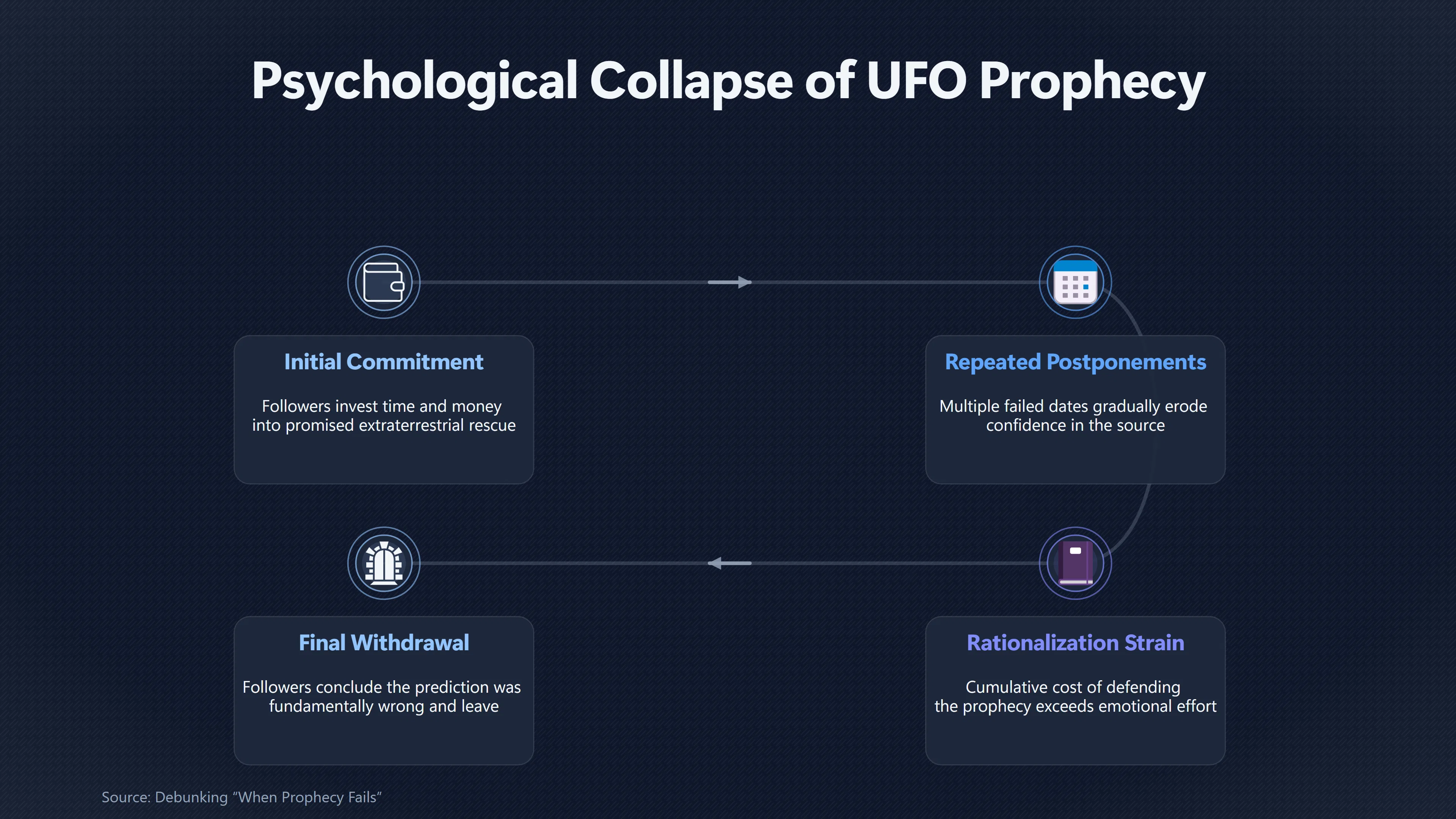
A failed UFO prophecy does not always strengthen commitment. Although cognitive dissonance theory is often associated with believers rationalising disappointment, another well-documented outcome is disillusionment followed by withdrawal from the movement. When an expected spacecraft fails to arrive, a predicted catastrophe never occurs or a promised extraterrestrial rescue does not materialise, some followers conclude that the prediction—not merely the timetable—was fundamentally wrong. They may leave quietly, distance themselves from the community or become outspoken critics of the leader they once trusted. Research into UFO-based prophetic groups suggests that departure becomes more likely when rationalisations lose credibility, social support weakens and members begin to interpret the failed prophecy as evidence of deception rather than misunderstanding.[DOI]doi.orgDebunking “When Prophecy Fails”Debunking “When Prophecy Fails” - Kelly - 2026 - Journal of the History of the Behavioral Sciences - Wiley Online LibraryNovember 4, 2025…
What makes rationalisation collapse
Not every believer experiences the same failed prediction in the same way. Some accept revised explanations, while others reach a point where further reinterpretation seems implausible.
Several factors make departure more likely:
- Repeated failed dates. A single failed prediction can sometimes be explained away, but repeated postponements gradually undermine confidence in the source of the prophecy.
- Observable contradiction. Predictions involving publicly visible events—such as mass UFO landings or global catastrophes on a specific day—are harder to reinterpret once everyone has seen that nothing occurred.
- Loss of trusted leadership. If a leader admits error, changes the story dramatically or appears inconsistent, followers may no longer believe that earlier sacrifices were justified.
- Weakening social reinforcement. Beliefs are easier to maintain within a cohesive group. When friends leave or meetings become less frequent, alternative explanations become easier to consider.
The critical shift is psychological rather than simply factual. Members often leave not because they have discovered one decisive piece of evidence, but because the cumulative cost of defending the prophecy exceeds the emotional cost of abandoning it. At that point, admitting error becomes less painful than maintaining an increasingly complex set of explanations.[OUP Academic]academic.oup.comOUP AcademicHow Prophecy Never Fails | When Prophecy Never Fails: Myth and Reality in a Flying-Saucer Group | Oxford Academic…
How betrayal changes the response to failure
Many former believers describe failed prophecy less as an intellectual mistake than as a breach of trust. They invested time, money, relationships or personal reputation because they believed the leader possessed genuine knowledge or contact with extraterrestrial intelligences.
When the prediction fails, disappointment may evolve into feelings of betrayal if members conclude that:
- the leader ignored obvious warning signs;
- earlier doubts were discouraged or punished;
- failed predictions were rewritten rather than acknowledged;
- followers’ sacrifices were minimised after the event.
This changes the emotional landscape. Instead of asking, “How can the prophecy still be true?”, the member begins asking, “Why did I trust this person?” Once that question replaces the earlier commitment to preserving belief, departure often accelerates.
Former members frequently report a period of embarrassment or grief as they reassess earlier experiences. This reassessment may extend beyond the failed prediction itself to relationships, finances, careers or family conflicts that arose because of participation in the movement. These practical consequences can reinforce the decision to leave rather than return.
Why some leave quietly while others speak out
Leaving a UFO prophetic movement does not produce a single pattern of behaviour.
Quiet departure
Many former believers simply disappear from the group. Several reasons encourage silence:
- avoiding public embarrassment;
- protecting family relationships;
- wishing to move on rather than revisit painful experiences;
- retaining uncertainty about broader paranormal beliefs while rejecting one particular prophecy.
These individuals may never publicly explain their departure, making exits less visible than continued commitment.

Public criticism and whistleblowing
Others become vocal critics after leaving. This is more likely when they believe the leadership knowingly misrepresented events or manipulated followers.
Former insiders sometimes:
- describe internal decision-making;
- challenge revised accounts of failed predictions;
- document financial or organisational practices;
- warn prospective recruits against joining.
Such testimony can be especially influential because it comes from people who once defended the movement. Former members often possess detailed knowledge of how explanations evolved before and after the prophecy failed, allowing them to compare public claims with internal discussions.
However, former members are not automatically impartial. Like committed believers, they may reinterpret earlier experiences through the lens of later conclusions. Their accounts are valuable historical evidence but are best evaluated alongside contemporary documents and independent records.
A notable case: the Seekers and the debate over When Prophecy Fails
For decades, the classic example of failed UFO prophecy came from Dorothy Martin’s “Seekers” group, whose expectation of flying-saucer rescue in December 1954 formed the basis of Leon Festinger and colleagues’ influential book When Prophecy Fails. The traditional interpretation held that disappointment increased commitment and stimulated evangelism.
Recent archival research has complicated that picture. Thomas Kelly argues that the historical record indicates a much greater degree of collapse than the famous account suggested. According to his analysis, Martin recanted, the group rapidly disbanded and many believers abandoned the movement rather than intensifying their commitment. Kelly also argues that the original researchers overstated post-failure proselytising and that later scholarship relied too heavily on their interpretation. These claims have reopened scholarly debate about whether this famous case should be treated as the standard model for responses to failed prophecy.[DOI]doi.orgDebunking “When Prophecy Fails”Debunking “When Prophecy Fails” - Kelly - 2026 - Journal of the History of the Behavioral Sciences - Wiley Online LibraryNovember 4, 2025…
The wider lesson is not that cognitive dissonance theory is invalid, but that responses to failed UFO prophecies are more varied than one famous case originally suggested. Some groups rationalise; others fragment. Some believers become more committed; others conclude that the prophecy itself was mistaken.
Leaving the prophecy without abandoning every unusual belief
Departure does not necessarily mean rejecting every paranormal or extraterrestrial idea.
Some former members distinguish between:
- belief in unidentified aerial phenomena and belief in a particular contactee;
- interest in spiritual experiences and confidence in prophetic dates;
- curiosity about extraterrestrial life and acceptance of apocalyptic predictions.
This selective reassessment helps explain why people can leave a UFO prophetic movement without adopting a wholly sceptical worldview. The failed prediction becomes evidence against one authority rather than against every extraordinary possibility.
What exit reveals about failed UFO prophecies
The possibility of departure is an important corrective to overly simple accounts of cognitive dissonance. Failed UFO prophecies do not inevitably produce stronger belief. They can also dissolve trust, weaken group cohesion and prompt members to reassess costly commitments.
Whether believers remain or leave depends on several interacting factors: the credibility of revised explanations, the behaviour of leaders after failure, the strength of social ties within the movement and the personal costs of continuing to defend an unsuccessful prediction. Recognising these different trajectories provides a more accurate picture of how UFO prophetic movements respond when specific forecasts fail.[OUP Academic]academic.oup.comOUP AcademicHow Prophecy Never Fails | When Prophecy Never Fails: Myth and Reality in a Flying-Saucer Group | Oxford Academic…
Amazon book picks
Further Reading
Books and field guides related to Why Some Believers Leave After a Failed Prophecy. Use these as the next step if you want deeper reading beyond the article.
When Prophecy Fails
The study reported in this volume grew out of some theoretical work, one phase of which bore specifically on the behavior of individuals...
Escaping Utopia
We think of cults as bizarre, inexplicable, or otherworldly places that only strange people inhabit, but cults and other abusive and high...
Take Back Your Life
Lalich explains the seductive draw that leads people into cults, provides information for assessing what happened, and tools for getting...
Cultish
The author of the widely praised Wordslut analyzes the social science of cult influence: how cultish groups from Jonestown and Scientolog...
eBay marketplace picks
Marketplace Samples
Live-tested eBay searches with available results related to this page.
Selected fromUFO poster oneBay.co.uk.

Current eBay listing
VINTAGE UFO FLYING SAUCERS COMIC ADVERTISING A2 POSTER PRINT

Current eBay listing
I Want To Believe UFO Poster Giclée Fine Art Heavyweight Print


Endnotes
1.
Source: doi.org
Title: Debunking “When Prophecy Fails”
Link:https://doi.org/10.1002%2Fjhbs.70043
Source snippet
Debunking “When Prophecy Fails” - Kelly - 2026 - Journal of the History of the Behavioral Sciences - Wiley Online LibraryNovember 4, 2025...
Published: November 4, 2025
2.
Source: academic.oup.com
Link:https://academic.oup.com/book/7811/chapter-abstract/152989636
Source snippet
OUP AcademicHow Prophecy Never Fails | When Prophecy Never Fails: Myth and Reality in a Flying-Saucer Group | Oxford Academic...
3.
Source: Wikipedia
Title: When Prophecy Fails
Link:https://en.wikipedia.org/wiki/When_Prophecy_Fails
4.
Source: onlinelibrary.wiley.com
Link:https://onlinelibrary.wiley.com/doi/full/10.1002/jhbs.70043
Source snippet
“When Prophecy Fails” - Kelly - 2026 - Journal of the History of the Behavioral Sciences - Wiley Online LibraryNovember 4, 2025 — Volume...
Published: November 4, 2025
5.
Source: onlinelibrary.wiley.com
Link:https://onlinelibrary.wiley.com/doi/abs/10.1002/jhbs.70043
Source snippet
“When Prophecy Fails” - Kelly - 2026 - Journal of the History of the Behavioral Sciences - Wiley Online LibraryNovember 4, 2025 — ORIGINA...
Published: November 4, 2025
6.
Source: onlinelibrary.wiley.com
Link:https://onlinelibrary.wiley.com/doi/abs/10.1002/jhbs.70043?campaign=woletoc
Source snippet
“When Prophecy Fails” - Kelly - 2026 - Journal of the History of the Behavioral Sciences - Wiley Online LibraryNovember 4, 2025 — Volume...
Published: November 4, 2025
7.
Source: books.google.com
Title: When Prophecy Fails
Link:https://books.google.com/books/about/When_Prophecy_Fails.html?id=koWJtwEACAAJ
Additional References
8.
Source: thedebrief.org
Link:https://thedebrief.org/alarm-bells-went-off-new-research-takes-a-critical-look-at-the-landmark-ufo-cult-study-when-prophecy-fails/
Source snippet
The DebriefNovember 13, 2025 — “ALARM BELLS WENT OFF”: NEW RESEARCH TAKES A CRITICAL LOOK AT THE LANDMARK UFO CULT STUDY ‘WHEN PROPHECY F...
Published: November 13, 2025
9.
Source: youtube.com
Title: The UFO Cult That Inspired Cognitive Dissonance | Dorothy Martin & The Seekers
Link:https://www.youtube.com/watch?v=vvFV1v8l-PI
Source snippet
This video provides important context on how failed UFO prophecies lead to disillusionment, group collapse, and member exits rather than...
10.
Source: onlinelibrary.wiley.com
Title: Online Library Debunking “When Prophecy Fails”
Link:https://onlinelibrary.wiley.com/doi/10.1002/jhbs.70043
Source snippet
“When Prophecy Fails” - Kelly - 2026 - Journal of the History of the Behavioral Sciences - Wiley Online LibraryNovember 4, 2025 — Volume...
Published: November 4, 2025
11.
Source: youtube.com
Title: End of Days Cults, the Day After | Cognitive Dissonance (Video Essay)
Link:https://www.youtube.com/watch?v=5yVuauQjkDc
Source snippet
The UFO Cult That Inspired Cognitive Dissonance | Dorothy Martin & The Seekers...
12.
Source: youtube.com
Title: 10 Doomsday Cults That Got It Wrong | When Prophecy Fails
Link:https://www.youtube.com/watch?v=5V6FmVS_Gr0
Source snippet
End of Days Cults, the Day After | Cognitive Dissonance (Video Essay)...
13.
Source: isitso.org
Link:https://www.isitso.org/guide/fails.html
14.
Source: jstor.org
Link:https://www.jstor.org/stable/j.ctt9qg80c
15.
Source: youtube.com
Title: When “When Prophecy Fails” Fails (E350)
Link:https://www.youtube.com/watch?v=IhblbZDXfZU
Source snippet
10 Doomsday Cults That Got It Wrong | When Prophecy Fails...
16.
Source: psychologytoday.com
Title: Why Do Doomsday Believers Double-Down When Prophecy Fails? | Psychology Today
Link:https://www.psychologytoday.com/us/blog/freedom-of-mind/202506/why-do-doomsday-believers-double-down-when-prophecy-fails
17.
Source: youtube.com
Title: 235-Leon Festinger and the Alien Apocalypse
Link:https://www.youtube.com/watch?v=fy06VDrnh7A
Source snippet
When “When Prophecy Fails” Fails (E350)...