Within Telescope Test
What Would Have Counted as a Failed Prediction?
The claim survived because believers never fixed conditions under which a failed sighting would require them to abandon it.
On this page
- The missing agreement on falsification
- How standards changed after non detection
- Why repeatable criteria matter in UFO claims
Page outline Jump by section
Introduction
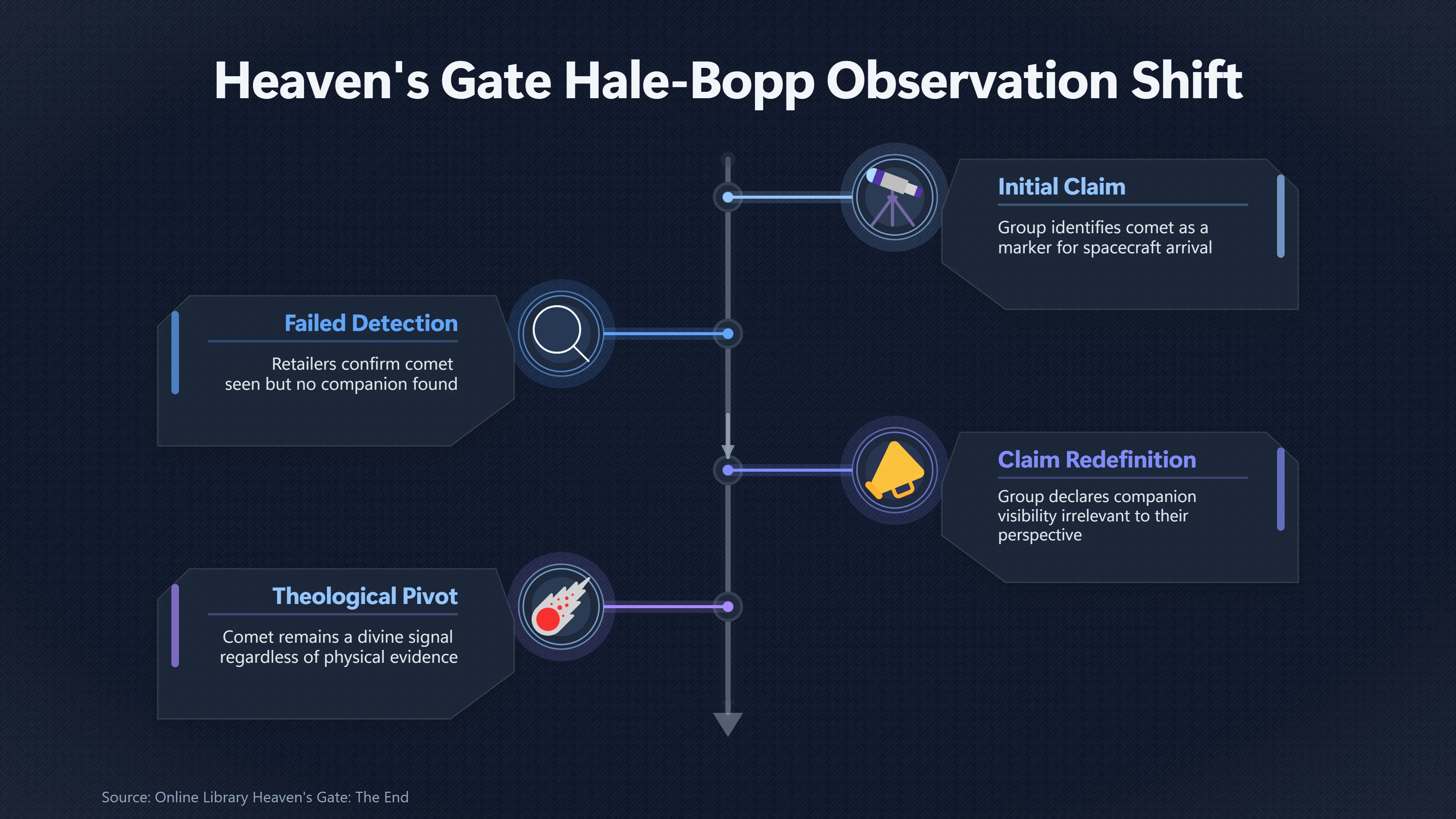
The reported failure to see a spacecraft near Comet Hale–Bopp did not function as a disproof because the belief was never tied to a clear, pre-agreed test. Although Heaven’s Gate members reportedly bought a telescope hoping to observe the alleged companion object, the absence of such an object was not accepted as a condition that required abandoning the broader belief. Instead, the claim itself was redefined: the comet remained the significant “marker”, while the supposed spacecraft no longer had to be visible through ordinary observation. This illustrates a broader mechanism found in some failed UFO predictions: when believers do not specify in advance what evidence would count against a claim, unsuccessful observations become easier to reinterpret than to accept as falsification.[The New Yorker]newyorker.comThe New Yorker The Wrong Stuff | The New YorkerThe New YorkerThe Wrong Stuff | The New YorkerApril 7, 1997…
The Missing Agreement on Falsification
Scientific predictions are ordinarily tested against criteria established before observations are made. A claim such as “a large spacecraft is following Hale–Bopp and can be seen with suitable equipment” has an obvious possible outcome: if capable observers repeatedly fail to detect it under the expected conditions, the prediction is weakened.
The Hale–Bopp companion story never reached that stage. Different supporters proposed different kinds of evidence, ranging from amateur photographs to remote viewing and anecdotal reports, without agreeing on:
- what instrument should be capable of detecting the object;
- where exactly it should appear;
- when it should be visible;
- how many unsuccessful observations would count as decisive;
- whether ordinary astronomy was even expected to detect it.
Without those boundaries, the claim remained flexible rather than genuinely testable. The absence of an agreed standard meant there was no shared point at which believers were obliged to conclude that the prediction had failed.[newyorker.com]newyorker.comThe New Yorker The Wrong Stuff | The New YorkerThe New YorkerThe Wrong Stuff | The New YorkerApril 7, 1997…
How Standards Changed After Non-Detection
The reported telescope episode demonstrates how evidential standards shifted after an unfavourable result.
According to accounts from the telescope retailer, members located Hale–Bopp but not the expected companion. Rather than treating that outcome as disproving the spacecraft claim, Heaven’s Gate soon published a statement declaring:
> “Whether Hale-Bopp has a ‘companion’ or not is irrelevant from our perspective.”[arxiv.org]arxiv.orgarXiv Falsification or Confirmation: From Logic to PsychologyarXiv Falsification or Confirmation: From Logic to Psychology
The group’s explanation no longer depended on the companion’s visibility. Instead, Hale–Bopp itself was presented as the divinely appointed signal that the time for departure had arrived. The alleged spacecraft therefore ceased to function as an observable astronomical object and instead became part of a theological framework that ordinary telescopes were not expected to verify.[sfgate.com]sfgate.comCultists Saw Hale-Bopp as a Heavenly Sign / It meant UFO on way to take them home…
This change did not merely reinterpret a disappointing observation. It altered the claim being tested. Once visibility was declared irrelevant, future observations—positive or negative—could no longer settle the question.
Why No Observation Could Settle the Claim
The mechanism worked because every possible observational outcome could be accommodated.
If observers believed they saw something unusual, it could be interpreted as confirmation.
If they saw nothing, several alternative explanations remained available, including:
- the spacecraft was hidden from ordinary instruments;
- it was intentionally concealed;
- it occupied a different physical or spiritual state;
- the comet’s role as a sign mattered more than any visible companion.
Each explanation preserved the central expectation while preventing any single failed observation from becoming decisive. As long as additional assumptions could be introduced after the fact, no individual observation had the authority to falsify the belief.[The New Yorker]newyorker.comThe New Yorker The Wrong Stuff | The New YorkerThe New YorkerThe Wrong Stuff | The New YorkerApril 7, 1997…
Why Repeatable Criteria Matter in UFO Claims
The Hale–Bopp episode illustrates a distinction that appears repeatedly in discussions of failed UFO predictions.
A prediction becomes genuinely testable only when three conditions are specified beforehand:
- What is expected. For example, a companion object of a particular size or brightness.
- Under what conditions. Such as specific dates, viewing geometry and suitable instruments.
- What outcome would count as failure. Repeated non-detection by competent observers using appropriate methods.
Without these conditions, every unsuccessful search can be dismissed by modifying one part of the claim instead of evaluating the prediction itself.
This does not prove that extraordinary claims are false. Rather, it means they cannot be decisively tested because the standards for success and failure remain fluid. From the standpoint of evaluating failed UFO predictions, the problem is methodological rather than merely observational.[Wiley Online Library]onlinelibrary.wiley.comOnline Library Heaven's Gate: The EndWiley Online LibraryHeaven's Gate: The End - Robinson - 1997 - Journal of Computer-Mediated Communication - Wiley Online Library…
The Broader Lesson from the Hale–Bopp Case
Within the history of UFO-related failed predictions, the significance of the telescope episode lies less in what was or was not visible than in how the meaning of the observation changed afterwards.
The companion-spacecraft claim initially appeared vulnerable to empirical testing because it referred to a physical object near a comet. After the reported non-detection, however, the group’s public position shifted so that the spacecraft’s detectability no longer mattered. The comet continued to serve as the prophetic marker, while the absence of visible evidence ceased to have any logical force against the underlying belief.[The New Yorker]newyorker.comThe New Yorker The Wrong Stuff | The New YorkerThe New YorkerThe Wrong Stuff | The New YorkerApril 7, 1997…
The result is a classic example of why some failed predictions resist disproof: when no explicit agreement exists about what would count as failure, unfavourable evidence does not terminate the claim. Instead, the standards of evaluation can change after the observation, allowing the central belief to survive even when the original expectation is not fulfilled.
Amazon book picks
Further Reading
Books and field guides related to What Would Have Counted as a Failed Prediction?. Use these as the next step if you want deeper reading beyond the article.
When Prophecy Fails
The study reported in this volume grew out of some theoretical work, one phase of which bore specifically on the behavior of individuals...
The Demon-Haunted World: Science as a Candle in the Dark
Rating: 4.5/5 from 43 Google Books ratings
NEW YORK TIMES BESTSELLER • From the renowned astronomer and author of Cosmos comes a “powerful [and] stirring defense of informed ration...
The Believing Brain
Synthesizing thirty years of research, psychologist and science historian, Michael Shermer upends the traditional thinking about how huma...
The Demon-Haunted World
Rating: 4.5/5 from 43 Google Books ratings
NEW YORK TIMES BESTSELLER • From the renowned astronomer and author of Cosmos comes a “powerful [and] stirring defense of informed ration...
eBay marketplace picks
Marketplace Samples
Live-tested eBay searches with available results related to this page.
Selected fromUFO art print oneBay.co.uk.



Endnotes
1.
Source: sfgate.com
Link:https://www.sfgate.com/news/article/Cultists-Saw-Hale-Bopp-as-a-Heavenly-Sign-It-2848671.php
Source snippet
Cultists Saw Hale-Bopp as a Heavenly Sign / It meant UFO on way to take them home...
2.
Source: onlinelibrary.wiley.com
Title: Online Library Heaven’s Gate: The End
Link:https://onlinelibrary.wiley.com/doi/full/10.1111/j.1083-6101.1997.tb00077.x
Source snippet
Wiley Online LibraryHeaven's Gate: The End - Robinson - 1997 - Journal of Computer-Mediated Communication - Wiley Online Library...
3.
Source: onlinelibrary.wiley.com
Link:https://onlinelibrary.wiley.com/doi/10.1002/jhbs.70043
4.
Source: onlinelibrary.wiley.com
Link:https://onlinelibrary.wiley.com/doi/abs/10.1002/jhbs.70043
5.
Source: onlinelibrary.wiley.com
Link:https://onlinelibrary.wiley.com/doi/abs/10.1002/jhbs.70043?campaign=woletoc
6.
Source: onlinelibrary.wiley.com
Title: j.1083 6101.1997.tb00077.x
Link:https://onlinelibrary.wiley.com/doi/10.1111/j.1083-6101.1997.tb00077.x
7.
Source: newyorker.com
Title: The New Yorker The Wrong Stuff | The New Yorker
Link:https://www.newyorker.com/magazine/1997/04/14/de-programming-heavens-gate-the-wrong-stuff
Source snippet
The New YorkerThe Wrong Stuff | The New YorkerApril 7, 1997...
Published: April 7, 1997
8.
Source: eso.org
Title: European Southern Observatory Hale-Bopp companions?!?
Link:https://www.eso.org/~ohainaut/Hale_Bopp/hb_ufo_tholen.html
9.
Source: crimelibrary.org
Title: Crime Library The Heaven’s Gate Cult – Crime Library
Link:https://crimelibrary.org/notorious_murders/mass/heavens_gate/
10.
Source: newyorker.com
Title: Is Cognitive [Dissonance]({{ ‘dissonance/’ | relative_url }}) Actually a Thing?
Link:https://www.newyorker.com/culture/the-lede/is-cognitive-dissonance-actually-a-thing
Source snippet
The New YorkerDecember 17, 2025 — IS COGNITIVE DISSONANCE ACTUALLY A THING? A foundational 1956 study of the concept, focussed on a U.F...
Published: December 17, 2025
11.
Source: doi.org
Title: Debunking “When Prophecy Fails”
Link:https://doi.org/10.1002%2Fjhbs.70043
12.
Source: doi.org
Link:https://doi.org/10.1111/j.1083-6101.1997.tb00077.x
Additional References
13.
Source: thedebrief.org
Link:https://thedebrief.org/alarm-bells-went-off-new-research-takes-a-critical-look-at-the-landmark-ufo-cult-study-when-prophecy-fails/
Source snippet
The DebriefNovember 13, 2025 — “ALARM BELLS WENT OFF”: NEW RESEARCH TAKES A CRITICAL LOOK AT THE LANDMARK UFO CULT STUDY ‘WHEN PROPHECY F...
Published: November 13, 2025
14.
Source: dailymotion.com
Title: Heaven’s Gate -The Cult of Cults
Link:https://www.dailymotion.com/video/x9va59g
Source snippet
03:48 This object is four times, approximately four times, the size of the planet Earth. 03:54 And it's headed our way. 03:56 Now, for me...
15.
Source: youtube.com
Title: When Prophecy Fails — Why Failed Beliefs Get Stronger
Link:https://www.youtube.com/watch?v=3sOV0HENbkE
Source snippet
Heaven's Gate: The suicide cult that shocked the world...
16.
Source: youtube.com
Title: Heaven’s Gate: The suicide cult that shocked the world
Link:https://www.youtube.com/watch?v=6Up1WH943xs
Source snippet
What is Karl Popper's Theory of Falsification?...
17.
Source: bibliotecapleyades.net
Link:https://www.bibliotecapleyades.net/halebopp/hg/
18.
Source: eso.org
Link:https://www.eso.org/~ohainaut/Hale_Bopp/hb_ufo.html
19.
Source: arxiv.org
Title: arXiv Falsification or Confirmation: From Logic to Psychology
Link:https://arxiv.org/abs/1511.01059
20.
Source: sciencedirect.com
Link:https://www.sciencedirect.com/science/article/abs/pii/S0048721X0500028X
21.
Source: youtube.com
Title: Science vs Pseudoscience
Link:https://www.youtube.com/watch?v=jsPBLSey_xs
Source snippet
When Prophecy Fails — Why Failed Beliefs Get Stronger...
22.
Source: sfchronicle.com
Link:https://www.sfchronicle.com/news/article/Cultists-Saw-Hale-Bopp-as-a-Heavenly-Sign-It-2848671.php