Within UFO Deadlines
When Does a UFO Claim Truly Fail?
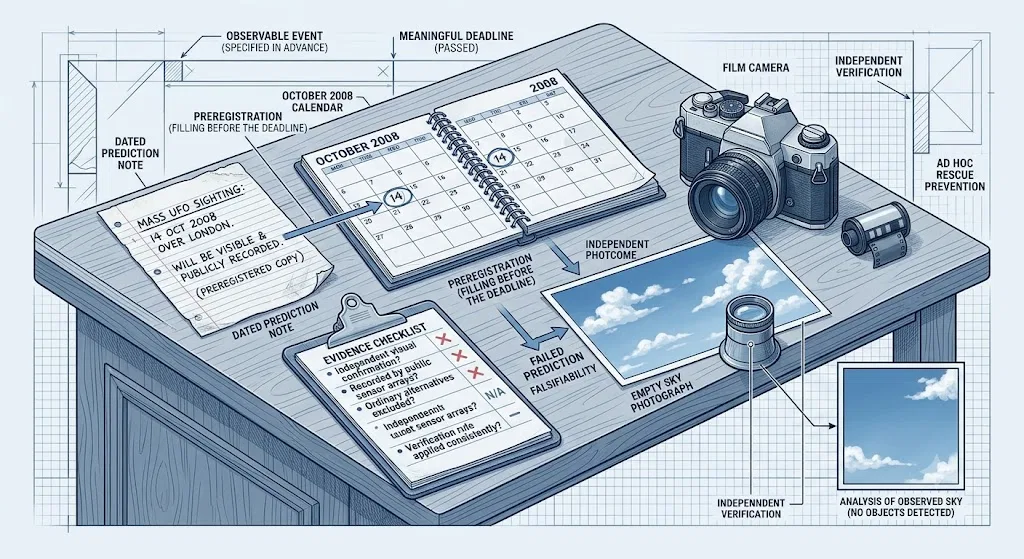
A fair test requires an observable event, a meaningful deadline, and documentation created before the promised date.
On this page
- Observable events versus vague promises
- Why deadlines matter
- The need for pre deadline records
Page outline Jump by section
Introduction
A UFO prediction becomes genuinely falsifiable when it risks being shown wrong. It must specify an observable event, set a meaningful deadline, and exist in a reliable record made before that deadline. Ideally, it should also state where the event will occur, what evidence will count, and who can verify the result independently.
These conditions separate a failed forecast from an open-ended belief. “A large spacecraft will remain visibly over a named city for several hours on 14 October” can be tested. “Humanity is approaching cosmic contact” cannot: no date passes, no observation is clearly excluded, and any later event can be presented as fulfilment. Philosopher Karl Popper’s influential account of falsifiability centred on this willingness to exclude possible observations rather than explaining every conceivable outcome. Modern forecasting and preregistration systems add practical safeguards by fixing the wording, deadline and decision rules in advance.[stanford.edu]plato.stanford.eduEncyclopedia of Philosophy Karl PopperStanford Encyclopedia of PhilosophyKarl Popper - Stanford Encyclopedia of Philosophyby S Thornton · 1997 · Cited by 448 — In later years…
Observable Events Versus Vague Promises
The first requirement is an outcome that different observers could recognise. A forecast should describe something in the external world, not merely an internal impression, symbolic change or private revelation.
For a UFO prediction, potentially observable outcomes include:
- a craft appearing at a named location for a stated period;
- an object large or close enough to be recorded by independent cameras or sensors;
- extraterrestrial beings landing publicly;
- a specified government issuing an identifiable announcement;
- a predicted physical event, such as a flood or communications interruption, occurring in a defined area.
The important question is not whether the event sounds extraordinary. It is whether the wording identifies observations that would count against it. A claim such as “a visible craft will hover over London for two hours” excludes a world in which no such object is seen. By contrast, “alien energies will enter Earth’s consciousness” supplies no agreed observation that would establish failure. Popper’s basic principle was that an empirical claim must be capable of clashing with experience; a theory that can accommodate every possible result has taken no comparable evidential risk.[Internet Encyclopedia of Philosophy]iep.utm.eduInternet Encyclopedia of PhilosophyKarl Popper: Philosophy of SciencePopper's falsificationist methodology holds that scientific theories…
Visibility is not enough without definitions
Even apparently concrete words can conceal ambiguity. “Visible”, “massive”, “public” and “official disclosure” need operational definitions: rules that say how the claim will be judged in practice.
Suppose someone predicts “a huge UFO will be seen over America”. Several questions immediately arise. Must it be visible to the unaided eye? Does “America” mean the United States, North America or somewhere in the Western Hemisphere? Would one disputed video qualify? Must the object remain unexplained after investigation? Could a balloon, aircraft or astronomical object be counted retrospectively?
A testable version would specify the geographical area, observation period, minimum duration, required forms of evidence and acceptable verification. Forecasting platforms use this approach by attaching explicit resolution criteria to questions and separating the closing date from the later date on which evidence is assessed. Good Judgment Open likewise publishes closing dates and resolution rules rather than allowing participants to redefine the question after events unfold.[gjopen.com]gjopen.comGood Judgment OpenFrequently Asked Questions (FAQ)The official closing date of the question will be listed in question description with t…
That does not mean every detail must be predicted correctly. It means the central promised event must be identifiable. Minor uncertainty about the craft’s colour need not invalidate a prediction of a prolonged public landing. Uncertainty about whether anything must be physically visible, however, prevents a fair test altogether.
Why Deadlines Matter
A prediction without a deadline may remain technically “pending” for ever. Expressions such as “soon”, “in the coming era” or “when humanity is ready” provide emotional urgency without creating a point at which observers may conclude that the forecast did not happen.
A useful deadline has three features. It is finite, understandable before the event, and appropriate to the promised outcome. “Before midnight on 14 October 2008” is meaningful. “During the coming transition” is not. A forecast may use a window rather than a single moment—such as “between 1 and 7 June”—but the window must eventually close.
Blossom Goodchild’s widely circulated 2008 claim illustrates why a date changes the evidential status of a UFO message. The prediction concerned the appearance of a vast spacecraft on 14 October 2008 and was being discussed publicly before that day; contemporary coverage encouraged observers to watch and record the sky. Because the date was explicit and the anticipated appearance was public, the absence of the promised mass manifestation counted against the forecast in a way that the looser claim “the visitors will reveal themselves when conditions are right” never could.[Religion Dispatches]religiondispatches.orgOpen source on religiondispatches.org.
A missed date cannot be silently extended
Changing a deadline after it passes creates a new prediction; it does not rescue the original one. The same applies when a promised landing is later described as an invisible spiritual contact, a physical catastrophe becomes a metaphorical cleansing, or a public event is reclassified as something witnessed only by receptive believers.
The 1954 Dorothy Martin case provides a sharp example. Her group expected destructive flooding on 21 December and believed flying saucers would rescue the faithful. The date, physical disaster and rescue expectation made the claim testable. Neither the catastrophe nor the promised collection occurred. A later message reportedly attributed the world’s survival to the group’s spiritual influence, converting the absence of the predicted disaster into supposed evidence of success. Whatever one thinks of the disputed research conducted around the group, that later explanation did not alter the status of the original forecast: it introduced a new, previously unstated causal story after the expected event had failed to appear.[nih.gov]pubmed.ncbi.nlm.nih.govOpen source on nih.gov.
This manoeuvre is sometimes called an ad hoc rescue: an auxiliary explanation added primarily to protect a claim from contrary evidence. Not every revision is illegitimate. Ordinary scientific theories may be adjusted when there is independent reason to suspect faulty equipment, mistaken background assumptions or incomplete models. The warning sign is a revision that appears only after failure, has no separate evidence, and ensures that no outcome could ever count against the central belief. Popper himself recognised that falsification in practice involves decisions about observations and supporting assumptions; the lesson is therefore not “one anomaly disproves everything”, but “the rules cannot be rewritten solely to guarantee survival”.[Stanford Encyclopedia of Philosophy]plato.stanford.eduEncyclopedia of Philosophy Karl PopperStanford Encyclopedia of PhilosophyKarl Popper - Stanford Encyclopedia of Philosophyby S Thornton · 1997 · Cited by 448 — In later years…
The Need for Pre-Deadline Records
A precise claim is of little evidential value if there is no proof that it was made before the event. Human memory is reconstructive, online text can be edited, and broad collections of statements make it easy to highlight a seeming success while forgetting numerous misses.
The strongest record is a dated, read-only or independently archived statement containing the original wording. Scientific preregistration serves a similar purpose: researchers post a time-stamped plan before seeing the results, preserving the distinction between prediction and explanation after the fact. The Center for Open Science describes preregistration as specifying a plan in advance, while the Open Science Framework provides time-stamped, read-only registrations intended to establish what was proposed before data collection or analysis.[osf.io]help.osf.io330 welcome to registrations330 welcome to registrations
For UFO forecasts, useful pre-deadline documentation might include a printed publication, dated broadcast, contemporaneous news report, repository registration or archived webpage. The record should preserve more than a headline. It should include the event, location, time window and any stated conditions.
Web archives can provide important corroboration, but they require care. The Internet Archive advises users to check the date code in archived addresses and warns that captures may be incomplete or may substitute material from a nearby date or the live web when resources are missing. An archived copy is therefore stronger when its capture clearly predates the deadline, the relevant wording appears directly in that capture, and independent contemporary sources report the same forecast.[Internet Archive Help Center]help.archive.orgOpen source on archive.org.
Documentation prevents hindsight editing
Pre-deadline records block several common distortions:
- Date drift: “October” becomes “late autumn”, then “within the year”.
- Location drift: “over Alabama” becomes “somewhere in North America”.
- Event drift: “a visible spacecraft” becomes “unusual lights”, then “a shift in awareness”.
- Conditional drift: an unconditional forecast later acquires a hidden requirement that humanity must be spiritually prepared.
- Selective quotation: a vague sentence is isolated from surrounding text that made a more definite promise.
- Hit counting without miss counting: one superficially similar event is promoted while incompatible details and unsuccessful forecasts disappear.
A contemporaneous record does not prove that the source had unusual knowledge. It merely fixes what was claimed, allowing the later evidence to be compared with the original wording rather than a revised version.
A Fair Resolution Rule
Declaring a UFO forecast successful or failed should not depend on whichever interpretation is most convenient after the deadline. The decision rule should be written first and applied consistently.
A practical resolution protocol asks:
- What exactly was predicted? Quote or preserve the original statement rather than relying on a later summary.
- When and where should it happen? Record the applicable time zone and geographical boundaries.
- What evidence would establish occurrence? Specify whether independent visual observation, instrument data, official documentation or another standard is required.
- What ordinary alternatives must be excluded? A predicted “alien craft” is not fulfilled merely because an ambiguous light remains unidentified.
- Who resolves disputes? Use independent reviewers where possible, particularly when the claimant also controls the interpretation.
- What happens when evidence is incomplete? Distinguish “failed”, “fulfilled” and “unresolved” rather than forcing every case into a binary answer.
The last distinction is especially important. Failure does not mean that every expected observer captured perfect evidence; it means the defined event did not meet the agreed criteria. Conversely, “unresolved” should not be mistaken for “confirmed”. Official investigators may leave an anomalous sighting unresolved because information is inadequate. That classification says nothing by itself about whether a separate prediction of extraterrestrial arrival was correct. A claim forecasting alien contact carries additional content and must be judged against that content, not against the mere existence of unidentified reports.
The legal treatment of scientific evidence offers a useful governance parallel. In Daubert v Merrell Dow Pharmaceuticals, the US Supreme Court identified testability or falsifiability as one consideration when judges assess scientific expert evidence, alongside matters such as peer review, error rates and standards. The ruling did not make falsifiability an automatic guarantee of truth. It treated testability as part of a broader reliability assessment. UFO predictions deserve the same distinction: a claim can be falsifiable yet unsupported, badly evidenced or false.[Justia Law]supreme.justia.comOpen source on justia.com.
What Does Not Count as a Clean Failure?
Strict standards protect critics as well as claimants. A prediction should not be labelled failed when its meaning was never definite enough to test, when the surviving account was written only afterwards, or when the specified evidence could not reasonably have been collected.
Several categories require caution:
Open-ended expectation. “Disclosure is approaching” may be unsubstantiated, but it has no settled expiry date.
Retrospective prophecy. A person who claims after a sighting that it was previously foreseen has not supplied a testable prior forecast unless an independent earlier record exists.
Ambiguous target. “Something extraordinary will happen in the sky” is too broad because meteors, launches, atmospheric effects and ordinary aviation could all be counted as success.
Unobservable escape clause. “The craft arrived in another dimension” prevents public evidence from bearing on the claim unless cross-dimensional arrival had a defined, detectable consequence.
Conditional forecast with undefined conditions. “Aliens will land when humanity is ready” cannot fail unless “ready” was given a measurable definition and a deadline.
Poor observation rather than non-occurrence. A narrowly predicted event in a cloud-covered location may be unresolved if the original standard depended entirely on local visual confirmation. Better forecast design would include radar, satellite, multiple locations or another independent source of evidence.
These distinctions prevent falsifiability from becoming a rhetorical weapon. The purpose is not to declare every unusual belief false; it is to identify which claims have genuinely met a fair test.
When Does a UFO Claim Truly Fail?
A UFO prediction truly fails when the agreed observation period ends, adequate checking finds that the specified event did not meet the pre-declared criteria, and no valid condition in the original forecast explains the result. The failure belongs to that forecast as documented—not automatically to every broader belief held by the claimant.
This narrow conclusion matters. Dorothy Martin’s missed rescue and flood did not logically disprove the existence of extraterrestrial life. Blossom Goodchild’s missed 14 October appearance did not show that every UFO report has an ordinary explanation. Each case instead counted against a particular promised event, source or claimed channel of information.
A sound assessment can therefore be expressed in one sentence:
Before the deadline, state what the world should look like if the prediction is right—and what it should look like if it is wrong.
Where both descriptions remain possible, the forecast is testable. Where every possible outcome can be renamed as fulfilment, there was never a fair prediction to fail.
Amazon book picks
Further Reading
Books and field guides related to When Does a UFO Claim Truly Fail?. Use these as the next step if you want deeper reading beyond the article.
The Logic of Scientific Discovery
When first published in 1959, this book revolutionized contemporary thinking about science and knowledge. It remains one of the most wide...
The Demon-Haunted World
NEW YORK TIMES BESTSELLER • From the renowned astronomer and author of Cosmos comes a “powerful [and] stirring defense of informed ration...
Calling Bullshit
Bullshit isn’t what it used to be. Now, two science professors give us the tools to dismantle misinformation and think clearly in a world...
Bad Science
Ben Goldacre takes us on a journey through the bad science we are fed daily by hacks and quacks.
eBay marketplace picks
Marketplace Samples
Live-tested eBay searches with available results related to this page.
Selected fromUFO poster oneBay.co.uk.
Current eBay listing
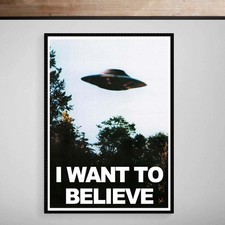
I Want To Believe UFO Poster Giclée Fine Art Heavyweight Print



Current eBay listing
VINTAGE UFO FLYING SAUCERS COMIC ADVERTISING A2 POSTER PRINT
Endnotes
1.
Source: plato.stanford.edu
Title: Encyclopedia of Philosophy Karl Popper
Link:https://plato.stanford.edu/entries/popper/
Source snippet
Stanford Encyclopedia of PhilosophyKarl Popper - Stanford Encyclopedia of Philosophyby S Thornton · 1997 · Cited by 448 — In later years...
2.
Source: pnas.org
Link:https://www.pnas.org/doi/10.1073/pnas.1708274114
Source snippet
The preregistration revolutionby BA Nosek · 2018 · Cited by 2727 — Preregistration is a solution that helps researchers maintain clar...
3.
Source: metaculus.com
Link:https://www.metaculus.com/question-writing/
Source snippet
Question writing and submission guidelinesWhen submitting a question, you are asked to specify the closing date (when the questi...
4.
Source: plato.stanford.edu
Title: Encyclopedia of Philosophy Scientific Method
Link:https://plato.stanford.edu/entries/scientific-method/
Source snippet
Science was science because its method involved...
5.
Source: metaculus.com
Title: forecasting our world in data the next 100 years
Link:https://www.metaculus.com/notebooks/14965/forecasting-our-world-in-data-the-next-100-years/
Source snippet
Forecasting Our World in Data: The Next 100 Years1 Feb 2023 — A key component of a well-written forecasting question is its reso...
6.
Source: onlinelibrary.wiley.com
Title: Online Library Debunking “When Prophecy Fails”
Link:https://onlinelibrary.wiley.com/doi/10.1002/jhbs.70043
7.
Source: help.osf.io
Title: 330 welcome to registrations
Link:https://help.osf.io/article/330-welcome-to-registrations
8.
Source: help.archive.org
Link:https://help.archive.org/help/using-the-wayback-machine/
9.
Source: wayback.archive.org
Link:https://wayback.archive.org/
10.
Source: supreme.justia.com
Link:https://supreme.justia.com/cases/federal/us/509/579/
11.
Source: metaculus.com
Title: seeing the future through fiction how to harness your creativity for forecasting
Link:https://www.metaculus.com/notebooks/17507/seeing-the-future-through-fiction-how-to-harness-your-creativity-for-forecasting/
12.
Source: metaculus.com
Title: how metaculus leverages crowd forecasting
Link:https://www.metaculus.com/notebooks/40619/how-metaculus-leverages-crowd-forecasting/
13.
Source: metaculus.com
Link:https://www.metaculus.com/questions/41806/
14.
Source: metaculus.com
Title: question writing checklist obsolete
Link:https://www.metaculus.com/notebooks/3418/question-writing-checklist-obsolete/
15.
Source: metaculus.com
Link:https://www.metaculus.com/faq/
16.
Source: metaculus.com
Title: what are other bots doing
Link:https://www.metaculus.com/notebooks/43497/what-are-other-bots-doing/
17.
Source: metaculus.com
Title: five years after agi focus week
Link:https://www.metaculus.com/notebooks/26515/five-years-after-agi-focus-week/
18.
Source: metaculus.com
Link:https://www.metaculus.com/questions/21144/tesla-model-2-delivery-date/
19.
Source: blog.archive.org
Title: wayback machine playback now with timestamps
Link:https://blog.archive.org/2017/10/05/wayback-machine-playback-now-with-timestamps/
20.
Source: help.osf.io
Title: 603 benefits of registration
Link:https://help.osf.io/article/603-benefits-of-registration
21.
Source: osf.io
Link:https://osf.io/preprints/osf/2dxu5_v1
22.
Source: help.osf.io
Title: 626 simplifying the preregistration process
Link:https://help.osf.io/article/626-simplifying-the-preregistration-process
23.
Source: osf.io
Link:https://osf.io/registries
24.
Source: osf.io
Title: 9j7qc v2
Link:https://osf.io/preprints/socarxiv/9j7qc_v2
25.
Source: plato.stanford.edu
Title: pseudo science
Link:https://plato.stanford.edu/entries/pseudo-science/
26.
Source: philosophy.institute
Title: popper falsification scientific progress
Link:https://philosophy.institute/logic/popper-falsification-scientific-progress/
27.
Source: iep.utm.edu
Link:https://iep.utm.edu/pop-sci/
Source snippet
Internet Encyclopedia of PhilosophyKarl Popper: Philosophy of SciencePopper's falsificationist methodology holds that scientific theories...
28.
Source: gjopen.com
Link:https://www.gjopen.com/faq
Source snippet
Good Judgment OpenFrequently Asked Questions (FAQ)The official closing date of the question will be listed in question description with t...
29.
Source: religiondispatches.org
Link:https://religiondispatches.org/2008/10/14/aliens-arrive-alabama-today
30.
Source: pubmed.ncbi.nlm.nih.gov
Link:https://pubmed.ncbi.nlm.nih.gov/41186060/
31.
Source: cos.io
Link:https://www.cos.io/initiatives/prereg
32.
Source: pmc.ncbi.nlm.nih.gov
Title: Pub Med Central (PMC)A scientist’s take on scientific evidence in the courtroom
Link:https://pmc.ncbi.nlm.nih.gov/articles/PMC10576137/
33.
Source: pmc.ncbi.nlm.nih.gov
Link:https://pmc.ncbi.nlm.nih.gov/articles/PMC9630412/
34.
Source: pmc.ncbi.nlm.nih.gov
Link:https://pmc.ncbi.nlm.nih.gov/articles/PMC10189590/
35.
Source: Wikipedia
Link:https://en.wikipedia.org/wiki/Falsifiability
36.
Source: goodjudgment.com
Link:https://goodjudgment.com/services/good-judgment-open/
37.
Source: youtube.com
Link:https://www.youtube.com/watch?v=f7VNRX879Ns
38.
Source: gjopen.com
Link:https://www.gjopen.com/
Additional References
39.
Source: youtube.com
Title: Ancient Aliens – Falsifiability in Hypothesis Testing (8-1)
Link:https://www.youtube.com/watch?v=YynQ37yXUPU
Source snippet
This video is relevant because Karl Popper's philosophy of falsifiability directly addresses how testable criteria distinguish genuine sc...
40.
Source: researchgate.net
Link:https://www.researchgate.net/publication/339791892_An_Analysis_of_the_Falsification_Criterion_of_Karl_Popper_A_Critical_Review
41.
Source: academia.edu
Link:https://www.academia.edu/39723236/The_distinction_between_falsification_and_refutation_in_the_demarcation_problem_of_Karl_Popper
42.
Source: harvardlawreview.org
Link:https://harvardlawreview.org/wp-content/uploads/2010/06/vol123_admitting_doubt.pdf
43.
Source: blossomgoodchild.com
Link:https://www.blossomgoodchild.com/eyes-to-the-skies/
44.
Source: gwern.net
Link:https://gwern.net/doc/psychology/cognitive-bias/2025-kelly.pdf
45.
Source: wired.com
Link:https://www.wired.com/2017/04/dont-despair-big-ideas-can-still-change-world
46.
Source: ebsco.com
Link:https://www.ebsco.com/research-starters/religion-and-philosophy/falsifiability-rule
47.
Source: philarchive.org
Link:https://philarchive.org/archive/SFEFAR
48.
Source: reddit.com
Link:https://www.reddit.com/r/askphilosophy/comments/18pcjt4/is_it_true_that_karl_poppers_falsificationism_is/