Within Comet UFOs
Why Hale Bopp's Mystery Object Looked Like Saturn
Shramek's strange-looking point of light can be explained by saturation, tracking, optics and image processing rather than a ringed spacecraft.
On this page
- What appeared in Chuck Shramek's CCD frame
- How stars acquire spikes, elongation and bleeding
- Why compressed images invite false spacecraft interpretations
Page outline Jump by section
Introduction
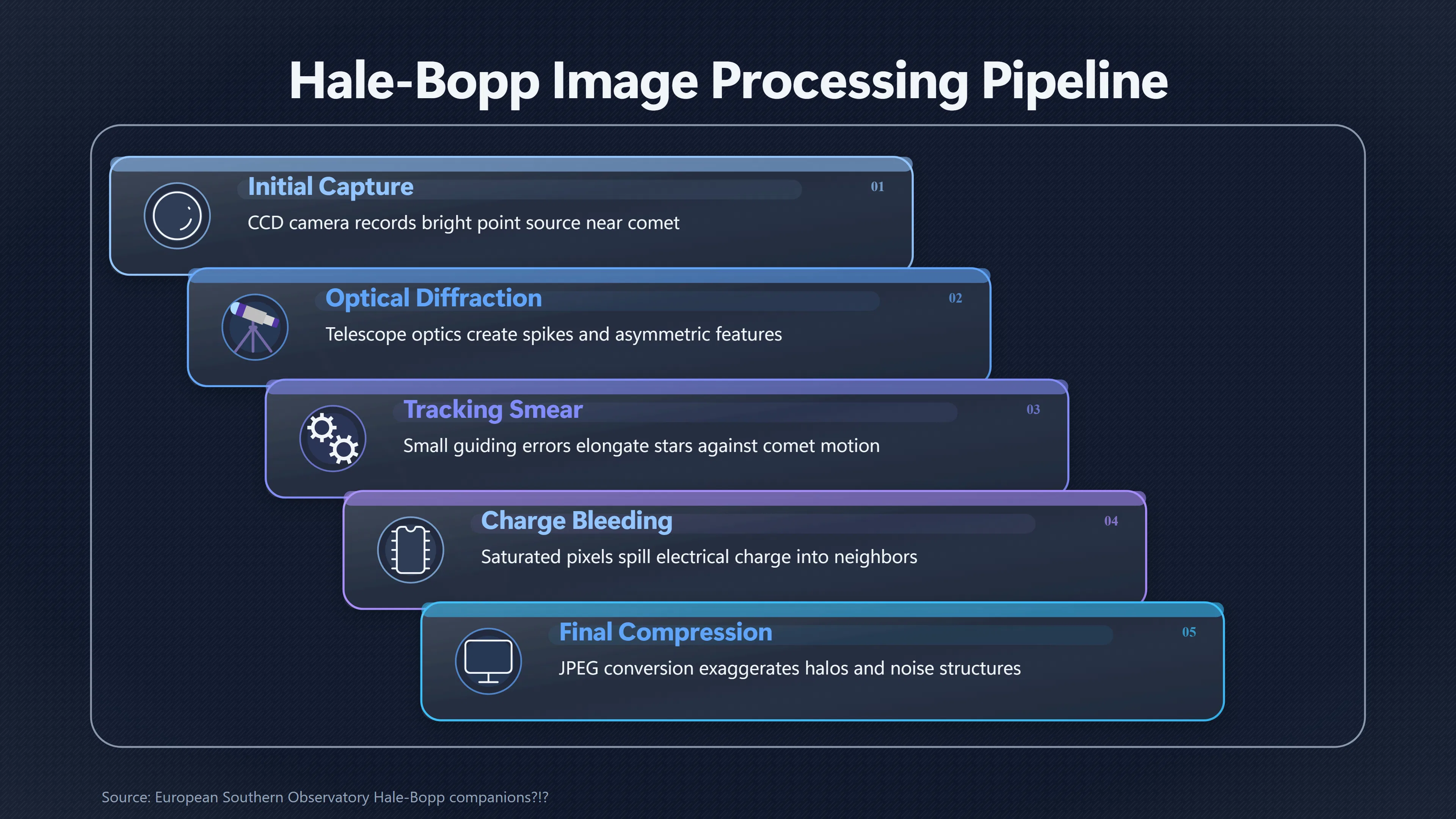
The so-called “Saturn-like object” in Chuck Shramek’s November 1996 image of Comet Hale-Bopp became the visual centrepiece of claims that an enormous alien spacecraft was accompanying the comet. However, the unusual appearance of the object does not require an extraordinary explanation. Astronomers who examined the image concluded that the effect was consistent with a normal background star recorded under ordinary limitations of CCD imaging, telescope optics, tracking and subsequent image processing. The object’s distinctive “ringed” appearance resulted from the way a bright point source was recorded and displayed, not from the shape of a physical object in space.[European Southern Observatory]eso.orgEuropean Southern Observatory Hale-Bopp companions?!?European Southern Observatory Hale-Bopp companions?!?

Understanding why the image looked artificial is important because the spacecraft interpretation depended almost entirely on visual appearance rather than on independent astronomical measurements. Once the imaging mechanisms are understood, the apparent resemblance to Saturn becomes far less mysterious.
What appeared in Chuck Shramek’s CCD frame
Shramek photographed Hale-Bopp using a CCD (charge-coupled device) camera on 14 November 1996. Near the comet was a bright point of light that appeared elongated, with lateral extensions that some viewers likened to Saturn’s rings. On paranormal broadcasts, this appearance was presented as evidence that the object possessed a structured, manufactured form rather than the appearance expected from an ordinary star.[European Southern Observatory]eso.orgEuropean Southern Observatory Hale-Bopp companions?!?European Southern Observatory Hale-Bopp companions?!?
Subsequent comparisons with archival sky surveys showed that the object occupied the position of the catalogue star SAO 141894. The star had been photographed long before Hale-Bopp entered that region of the sky, demonstrating that it was a fixed background star rather than a companion travelling with the comet. The remaining question therefore became not what the object was, but why it looked so unusual in that particular image.[European Southern Observatory]eso.orgEuropean Southern Observatory Hale-Bopp companions?!?European Southern Observatory Hale-Bopp companions?!?
How stars acquire spikes, elongation and bleeding
Astronomical images are not literal photographs of celestial objects. Every recorded point of light is modified by the telescope, detector and image-processing pipeline. Several ordinary effects can combine to make a star appear distinctly non-stellar.
Diffraction and optical effects
Light passing through or around parts of a telescope’s optical system produces diffraction patterns. Depending on the telescope design, bright stars can acquire spikes, short protrusions or asymmetric features that have nothing to do with the object’s physical shape. Reflecting telescopes are especially well known for producing diffraction spikes, but other optical imperfections and scattering effects can also distort stellar images.[Wikipedia]WikipediaDiffraction spikeDiffraction spike
In the Hale-Bopp investigations, astronomers examining the original image specifically attributed the “Saturn-like” appearance to a bright catalogue star affected by diffraction effects rather than to any extended object.[European Southern Observatory]eso.orgEuropean Southern Observatory Hale-Bopp companions?!?European Southern Observatory Hale-Bopp companions?!?
Tracking and slight image smearing
Comets move against the background stars. During an exposure, astronomers often choose whether to track the comet or the stars. If the telescope follows the comet precisely, background stars can appear slightly elongated. Even very small tracking differences or guiding errors can stretch a point source enough to create an unusual-looking profile, especially after contrast enhancement.[European Southern Observatory]eso.orgEuropean Southern Observatory Hale-Bopp companions?!?European Southern Observatory Hale-Bopp companions?!?
Because the eye naturally searches for familiar shapes, a mildly elongated star with side projections can be interpreted as something structured rather than as an imaging artefact.

CCD saturation and charge bleeding
CCD detectors have finite capacity. Very bright sources can saturate individual pixels, causing excess electrical charge to spill into neighbouring pixels, an effect known as blooming or charge bleeding. This frequently produces narrow streaks or extensions aligned with the detector’s pixel columns rather than with any physical orientation in the sky.[Wikipedia]WikipediaDiffraction spikeDiffraction spike
The European Southern Observatory’s catalogue of Hale-Bopp “companion” images notes several examples where bright stars showed hints of charge bleeding, diffraction spikes or threshold effects that changed their apparent shape. These detector artefacts varied from image to image, reinforcing the conclusion that they originated in the imaging system rather than in astronomical objects themselves.[European Southern Observatory]eso.orgEuropean Southern Observatory Hale-Bopp companions?!?European Southern Observatory Hale-Bopp companions?!?
Why compressed images invite false spacecraft interpretations
The version of Shramek’s image that spread across television programmes and early websites was not the original scientific data. Most viewers encountered compressed JPEG reproductions with limited dynamic range.
When astronomical images are compressed or contrast-stretched, faint halos, diffraction features and saturated pixels become exaggerated. At the same time, subtle gradients and noise can merge into apparently coherent structures. A bright star that originally consisted of only a few saturated pixels can therefore acquire a much more dramatic outline when displayed with aggressive brightness thresholds or repeatedly copied between formats.[European Southern Observatory]eso.orgEuropean Southern ObservatoryThe Enormous Size of Comet Hale-Bopp | ESOAugust 30, 1995…
This effect is particularly misleading because astronomical images often require digital enhancement to reveal faint objects. Enhancements that make a comet’s coma visible also amplify detector artefacts surrounding bright stars. Without access to the original data or knowledge of the processing steps, viewers can mistake display artefacts for physical structure.
Why the Saturn resemblance was persuasive
The visual comparison with Saturn gave the rumour unusual persuasive power. Human perception readily matches ambiguous shapes to familiar objects, a cognitive tendency known as pareidolia. Once commentators described the object as “Saturn-like”, later viewers often reported seeing the same resemblance immediately.
That resemblance was reinforced by selective presentation. Cropped enlargements removed surrounding stars that would have provided context, while repeated reproductions encouraged the impression that the object’s unusual appearance represented a stable physical form rather than a transient imaging effect. Astronomers, by contrast, compared the image with star catalogues, earlier sky surveys and additional observations rather than relying on appearance alone. Those comparisons consistently identified the object as SAO 141894, with the unusual morphology arising from ordinary optical and detector effects.[European Southern Observatory]eso.orgEuropean Southern Observatory Hale-Bopp companions?!?European Southern Observatory Hale-Bopp companions?!?
What this reveals about the Hale-Bopp spacecraft claim
The “Saturn-like object” illustrates how astronomical imaging artefacts can become the foundation for extraordinary claims when visual appearance is separated from observational context. No independent observation confirmed a ringed object accompanying Hale-Bopp, and no subsequent imaging showed a giant spacecraft emerging from behind the comet.
Instead, the strongest evidence points to a combination of familiar mechanisms: a known background star, diffraction within the optical system, slight tracking-related elongation, CCD saturation and image-processing choices that together produced an eye-catching but entirely ordinary astronomical artefact. Once those mechanisms are recognised, the apparent artificial structure no longer requires an artificial object.[European Southern Observatory]eso.orgEuropean Southern Observatory Hale-Bopp companions?!?European Southern Observatory Hale-Bopp companions?!?
Amazon book picks
Further Reading
Books and field guides related to Why Hale Bopp's Mystery Object Looked Like Saturn. Use these as the next step if you want deeper reading beyond the article.
Bad Astronomy
A clever, thought-provoking guide that attacks common astronomical misconceptions What is Bad Astronomy? Anything that accidentally or in...
Comet
WHAT ARE THESE GRACEFUL VISITORS TO OUR SKIES? WE NOW KNOW THAT THEY BRING BOTH LIFE AND DEATH AND TEACH US ABOUT OUR ORIGINS. Comet begi...
The Demon-Haunted World
NEW YORK TIMES BESTSELLER • From the renowned astronomer and author of Cosmos comes a “powerful [and] stirring defense of informed ration...
Turn Left at Orion
With over 100,000 copies sold since first publication, this is one of the most popular astronomy books of all time. It is a unique guideb...
eBay marketplace picks
Marketplace Samples
Live-tested eBay searches with available results related to this page.
Selected fromHale-Bopp poster oneBay.co.uk.
Endnotes
1.
Source: eso.org
Title: European Southern Observatory Hale-Bopp companions?!?
Link:https://www.eso.org/~ohainaut/Hale_Bopp/hb_ufo.html
2.
Source: eso.org
Title: European Southern Observatory Hale-Bopp companions?!?
Link:https://www.eso.org/~ohainaut/Hale_Bopp/hb_ufo_list.html
3.
Source: Wikipedia
Title: Diffraction spike
Link:https://en.wikipedia.org/wiki/Diffraction_spike
4.
Source: eso.org
Link:https://www.eso.org/public/news/eso9521/
Source snippet
European Southern ObservatoryThe Enormous Size of Comet Hale-Bopp | ESOAugust 30, 1995...
Published: August 30, 1995
5.
Source: eso.org
Title: Comet Hale-Bopp
Link:https://eso.org/public/news/eso9933/
Source snippet
ESOJune 29, 1999 — PRESS RELEASE COMET HALE-BOPP - STILL ENORMOUS! NEW IMAGES FROM THE NEW TECHNOLOGY TELESCOPE AT LA SILLA 29 June 199...
Published: June 29, 1999
6.
Source: pages.jh.edu
Link:https://pages.jh.edu/gazette/aprjun97/apr0797/comet.html
7.
Source: eso.org
Title: Hale-Bopp companions?!?
Link:https://www.eso.org/~ohainaut/Hale_Bopp/hb_ufo_tholen.html
8.
Source: eso.org
Link:https://www.eso.org/public/images/eso9643b/
9.
Source: eso.org
Title: CC D artifacts
Link:https://www.eso.org/~ohainaut/ccd/CCD_artifacts.html
10.
Source: eso.org
Link:https://www.eso.org/public/images/eso9624a/
11.
Source: hq.eso.org
Link:https://www.hq.eso.org/public/news/eso9624/
12.
Source: eso.org
Link:https://www.eso.org/public/images/eso9609a/
13.
Source: eso.org
Link:https://eso.org/public/news/eso9524/
14.
Source: eso.org
Link:https://www.eso.org/public/images/eso9523a/
15.
Source: eso.org
Link:https://eso.org/public/news/eso9523/
Additional References
16.
Source: jpl.nasa.gov
Title: pia01291 hubble sees material ejected from comet hale bopp
Link:https://www.jpl.nasa.gov/images/pia01291-hubble-sees-material-ejected-from-comet-hale-bopp/
Source snippet
3, 1998 These NASA Hubble Space Telescope pictures of comet Hale-Bopp show a remarkable "pinwheel" pattern and a blob of free-flying debr...
17.
Source: astronomy.com
Title: What causes spikes around stars in pictures, and how can I prevent them?
Link:https://www.astronomy.com/observing/what-causes-spikes-around-stars-in-pictures-and-how-can-i-prevent-them/
Source snippet
21, 2011 — From the February 2011 issue WHAT CAUSES SPIKES AROUND STARS IN PICTURES, AND HOW CAN I PREVENT THEM?...
Published: February 21, 2011
18.
Source: support.itelescope.net
Title: 143095 why are some of my star images showing as big lines or spikes
Link:https://support.itelescope.net/support/solutions/articles/143095-why-are-some-of-my-star-images-showing-as-big-lines-or-spikes-
Source snippet
August 31, 2018 — WHY ARE SOME OF MY STAR IMAGES SHOWING AS BIG LINES OR SPIKES? PRINT Modified on: Fri, 31 Aug, 2018 at 2:43 PM A...
Published: August 31, 2018
19.
Source: youtube.com
Link:https://www.youtube.com/watch?v=nKCOqcL-nUw
Source snippet
This list features public YouTube video watch links covering the astronomical context, history, and claims surrounding Comet Hale-Bopp an...
20.
Source: youtube.com
Title: True Crime: Heaven’s Gate: The Cult Of All Cults Like You Have Never Seen Before
Link:https://www.youtube.com/watch?v=Cv1yRd2lg14
Source snippet
USA - Brightest comet visible to naked eye...
21.
Source: irsa.ipac.caltech.edu
Title: sec4 4g
Link:https://irsa.ipac.caltech.edu/data/WISE/docs/release/All-Sky/expsup/sec4_4g.html
Source snippet
WISE DATA PROCESSING 4. PIPELINE SCIENCE MODULES G. ARTIFACT IDENTIFICATION AND FLAGGING (ARTID) * * * CONTENTS i. Diffraction Spikes ii...
22.
Source: youtube.com
Title: Optical Astronomy by Perry Vlahos
Link:https://www.youtube.com/watch?v=C9I2INT3wSs
Source snippet
True Crime: Heaven's Gate: The Cult Of All Cults Like You Have Never Seen Before...
23.
Source: sacred-texts.com
Link:https://sacred-texts.com/ufo/halbopp2.htm
24.
Source: dlab.epfl.ch
Link:https://dlab.epfl.ch/wikispeedia/wpcd/wp/c/Comet_Hale-Bopp.htm
25.
Source: archive.seattletimes.com
Link:https://archive.seattletimes.com/archive/19970327/2530904/internet-rife-with-chatter-of-comets-companion—-debate-raged-on-whether-saturn-like-object-is-a-star-or-ufo