Within Dorothy Martin
Did the Seekers Really Start Proselytizing Afterward?
The famous claim that the group became more evangelical after failure is now contested by archival evidence and earlier publicity activity.
On this page
- Publicity before the failed deadline
- The behavior reported by Festinger's team
- What later archival research disputes
Page outline Jump by section
Introduction
One of the most influential claims to emerge from Dorothy Martin’s failed 1954 UFO flood prophecy is that her followers responded to disconfirmation by becoming more eager to recruit new believers. In When Prophecy Fails (1956), Leon Festinger, Henry Riecken and Stanley Schachter presented this apparent surge in publicity as a central demonstration of what later became cognitive dissonance theory: rather than abandoning a deeply held belief after it failed, committed believers supposedly sought social validation by spreading it more widely.
That interpretation has become a standard textbook example. However, recent archival research has reopened the historical record and argues that the publicity narrative itself is inaccurate. Newly examined documents suggest that the Seekers had already been seeking publicity before the predicted deadline, while the movement actually fragmented and declined after the prophecy failed rather than launching a sustained campaign of evangelism.[Wiley Online Library]onlinelibrary.wiley.comOnline Library Debunking “When Prophecy Fails”Wiley Online LibraryDebunking “When Prophecy Fails” - Kelly - 2026 - Journal of the History of the Behavioral Sciences - Wiley Online Lib…
Publicity before the failed deadline
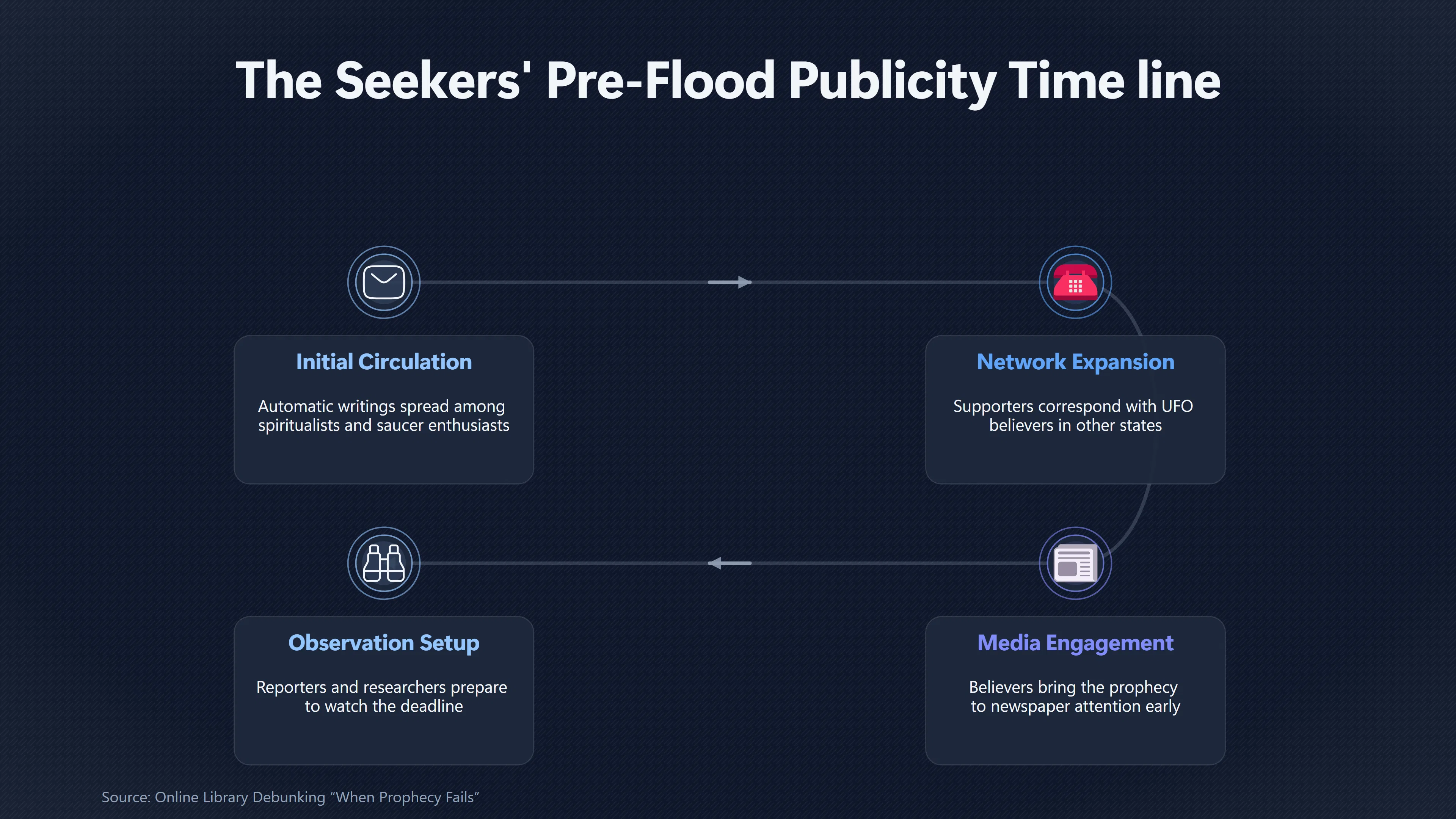
The classic story implies that the group’s missionary activity was a direct response to the failed prophecy. Yet contemporary evidence shows that the movement was already attracting and encouraging public attention before 21 December 1954.
Dorothy Martin’s messages circulated among a network of flying-saucer enthusiasts, spiritualists and contactee believers. Supporters shared her automatic writings, corresponded with UFO enthusiasts in other states and helped bring the prophecy to newspaper attention. Public interest was already sufficiently high that reporters, curious visitors and Festinger’s research team all knew where and when to observe the expected rescue.
This earlier publicity matters because it weakens the idea that proselytising represented a novel psychological response to disconfirmation. If the group had already been publicising its beliefs before the predicted flood, then increased visibility after the deadline cannot automatically be treated as evidence of a new coping mechanism.[Wiley Online Library]onlinelibrary.wiley.comOnline Library Debunking “When Prophecy Fails”Wiley Online LibraryDebunking “When Prophecy Fails” - Kelly - 2026 - Journal of the History of the Behavioral Sciences - Wiley Online Lib…
What When Prophecy Fails reported
Festinger and his colleagues acknowledged that the group had received some earlier publicity, but they argued that a qualitative change occurred after the prophecy failed.
According to their account, the believers interpreted the absence of catastrophe as proof that their faith had persuaded higher powers to spare humanity. This reinterpretation supposedly resolved the psychological tension created by the failed prediction. Having transformed failure into confirmation, members reportedly became much more willing to contact newspapers, welcome interviews and persuade outsiders.
Within the logic of cognitive dissonance theory, this behavioural shift was crucial rather than incidental. Festinger proposed that committed believers whose expectations are publicly disproved can reduce psychological discomfort by convincing additional people that their beliefs remain true. Increased recruitment therefore became one of the defining observable predictions of the theory, and the Seekers were presented as a field demonstration of that process.
Because the case appeared unusually dramatic and well documented, later psychology textbooks frequently cited the group’s alleged burst of publicity as classic evidence for how disconfirmed prophecy can strengthen commitment instead of destroying it.
What later archival research disputes
Recent historical work based on archival materials challenges each step of that narrative.
According to Thomas Kelly’s 2025–26 reassessment, previously unavailable correspondence, field notes and institutional archives indicate that the researchers overstated both the amount and the significance of post-failure publicity. Instead of discovering a movement that suddenly became evangelical after disconfirmation, the archival record suggests that:
- public outreach had already been occurring before the failed prediction;
- the group’s leader soon abandoned the prophecy rather than developing a durable theological justification;
- the movement rapidly dissolved instead of expanding through successful recruitment; and
- sustained organised proselytising after the failed deadline is not supported by the surviving documentary evidence.[Wiley Online Library]onlinelibrary.wiley.comOnline Library Debunking “When Prophecy Fails”Wiley Online LibraryDebunking “When Prophecy Fails” - Kelly - 2026 - Journal of the History of the Behavioral Sciences - Wiley Online Lib…
Kelly therefore argues that one of the most famous observations in When Prophecy Fails rests on an inaccurate reconstruction of events rather than on the complete historical record. His article also contends that some archival documents indicate researcher intervention in the group, raising further questions about interpreting observed behaviour. These broader methodological criticisms remain subjects of scholarly debate, but they reinforce the need to distinguish between the original field report and later archival evidence.[Wiley Online Library]onlinelibrary.wiley.comOnline Library Debunking “When Prophecy Fails”Wiley Online LibraryDebunking “When Prophecy Fails” - Kelly - 2026 - Journal of the History of the Behavioral Sciences - Wiley Online Lib…
Why the dispute matters
The disagreement is important because the publicity claim was not a minor detail. It was one of the strongest behavioural examples supporting Festinger’s broader theory.
If the Seekers genuinely intensified recruitment after the prophecy failed, the episode provides a vivid historical illustration of believers seeking social support in the face of disconfirming evidence. If, instead, the movement had already been publicising itself beforehand and quickly disintegrated afterwards, then the famous case no longer demonstrates that sequence of events.
This does not mean that cognitive dissonance theory itself has been disproved. The theory has since been supported by decades of laboratory experiments and studies in many other settings. Rather, the historical dispute concerns whether Dorothy Martin’s group was ever the clear-cut real-world example that generations of textbooks portrayed it to be.[Wiley Online Library]onlinelibrary.wiley.comOnline Library Debunking “When Prophecy Fails”Wiley Online LibraryDebunking “When Prophecy Fails” - Kelly - 2026 - Journal of the History of the Behavioral Sciences - Wiley Online Lib…
The current historical assessment
The best-supported conclusion today is more qualified than the traditional story.
There is little dispute that the prophecy failed on schedule or that some believers attempted to reinterpret the disappointment. The disputed question is whether this reinterpretation produced a significant, sustained increase in public evangelism.
The traditional interpretation, based largely on When Prophecy Fails, says yes: publicity increased after disconfirmation and became key evidence for cognitive dissonance. More recent archival research argues that this sequence is historically inaccurate, because publicity efforts predated the failed prophecy and the group’s organisational life ended relatively quickly instead of developing into an energetic missionary movement. The result is not a rejection of cognitive dissonance theory itself, but a reassessment of one of its most famous historical case studies.[Wiley Online Library]onlinelibrary.wiley.comOnline Library Debunking “When Prophecy Fails”Wiley Online LibraryDebunking “When Prophecy Fails” - Kelly - 2026 - Journal of the History of the Behavioral Sciences - Wiley Online Lib…
Amazon book picks
Further Reading
Books and field guides related to Did the Seekers Really Start Proselytizing Afterward?. Use these as the next step if you want deeper reading beyond the article.
When Prophecy Fails
The study reported in this volume grew out of some theoretical work, one phase of which bore specifically on the behavior of individuals...
A Theory of Cognitive Dissonance
Originally published: Evanston, Ill.: Row, Peterson, c1957.
Mistakes Were Made (but Not by Me)
Why is it so hard to say "I made a mistake"-and really believe it? When we make mistakes, cling to outdated attitudes, or mistreat other...
The Social Animal
Newly revised and up-to-date, this edition of The Social Animal is a brief, compelling introduction to modern social psychology. Through...
eBay marketplace picks
Marketplace Samples
Live-tested eBay searches with available results related to this page.
Selected fromvintage UFO poster oneBay.co.uk.

Current eBay listing
VINTAGE UFO FLYING SAUCERS COMIC ADVERTISING A4 POSTER PRINT
Current eBay listing
VINTAGE UFO FLYING SAUCERS COMIC ADVERTISING A2 POSTER PRINT
Endnotes
1.
Source: onlinelibrary.wiley.com
Title: Online Library Debunking “When Prophecy Fails”
Link:https://onlinelibrary.wiley.com/doi/10.1002/jhbs.70043
Source snippet
Wiley Online LibraryDebunking “When Prophecy Fails” - Kelly - 2026 - Journal of the History of the Behavioral Sciences - Wiley Online Lib...
2.
Source: onlinelibrary.wiley.com
Link:https://onlinelibrary.wiley.com/doi/abs/10.1002/jhbs.70043
Source snippet
“When Prophecy Fails” - Kelly - 2026 - Journal of the History of the Behavioral Sciences - Wiley Online LibraryNovember 4, 2025 — ORIGINA...
Published: November 4, 2025
3.
Source: onlinelibrary.wiley.com
Link:https://onlinelibrary.wiley.com/doi/full/10.1002/jhbs.70043
Source snippet
“When Prophecy Fails” - Kelly - 2026 - Journal of the History of the Behavioral Sciences - Wiley Online LibraryNovember 4, 2025 — Volume...
Published: November 4, 2025
4.
Source: onlinelibrary.wiley.com
Link:https://onlinelibrary.wiley.com/doi/abs/10.1002/jhbs.70043?campaign=woletoc
Source snippet
“When Prophecy Fails” - Kelly - 2026 - Journal of the History of the Behavioral Sciences - Wiley Online LibraryNovember 4, 2025 — Volume...
Published: November 4, 2025
5.
Source: onlinelibrary.wiley.com
Link:https://onlinelibrary.wiley.com/page/journal/15206696/homepage/productinformation.html
6.
Source: doi.org
Title: Debunking “When Prophecy Fails”
Link:https://doi.org/10.1002%2Fjhbs.70043
Source snippet
Kelly - 2026 - Journal of the History of the Behavioral Sciences - Wiley Online LibraryNovember 4, 2025 — DEBUNKING “WHEN PROPHECY FAILS”...
Published: November 4, 2025
Additional References
7.
Source: newyorker.com
Title: Is Cognitive Dissonance Actually a Thing?
Link:https://www.newyorker.com/culture/the-lede/is-cognitive-dissonance-actually-a-thing
Source snippet
The New YorkerDecember 17, 2025 — IS COGNITIVE DISSONANCE ACTUALLY A THING? A foundational 1956 study of the concept, focussed on a U.F...
Published: December 17, 2025
8.
Source: lifescience.net
Title: Debunking “When Prophecy Fails”
Link:https://www.lifescience.net/publications/1531892/debunking-when-prophecy-fails/
Source snippet
Created on 04 Nov 2025 * Publication details * Citations AUTHORS Thomas Kelly PUBLISHED IN Journal of the history of the behavioral scien...
9.
Source: youtube.com
Link:https://www.youtube.com/watch?v=6d6SJd5sxnM
Source snippet
This selection directly addresses how Leon Festinger's thesis on post-disconfirmation proselytizing and publicity seeking among "The Seek...
10.
Source: youtube.com
Title: End of Days Cults, the Day After | Cognitive Dissonance (Video Essay)
Link:https://www.youtube.com/watch?v=5yVuauQjkDc
Source snippet
When Prophecies Fail - Leon Festinger COGNITIVE DISSONANCE "The Seekers" Sect...
11.
Source: pubmed.ncbi.nlm.nih.gov
Title: Pub Med Debunking “When Prophecy Fails”
Link:https://pubmed.ncbi.nlm.nih.gov/41186060/
Source snippet
Debunking "When Prophecy Fails" - PubMed...
12.
Source: youtube.com
Title: When Prophecy Fails — Why Failed Beliefs Get Stronger
Link:https://www.youtube.com/watch?v=3sOV0HENbkE
Source snippet
End of Days Cults, the Day After | Cognitive Dissonance (Video Essay)...
13.
Source: eurekamag.com
Link:https://eurekamag.com/research/099/774/099774291.php
14.
Source: youtube.com
Title: The UFO Cult That Inspired Cognitive Dissonance | Dorothy Martin & The Seekers
Link:https://www.youtube.com/watch?v=vvFV1v8l-PI
Source snippet
When “When Prophecy Fails” Fails (E350)...
15.
Source: youtube.com
Title: When Prophecies Fail
Link:https://www.youtube.com/watch?v=S6euVitYtqM
Source snippet
InPresence 0211: When Prophecy Fails...
16.
Source: youtube.com
Title: When “When Prophecy Fails” Fails (E350)
Link:https://www.youtube.com/watch?v=IhblbZDXfZU
Source snippet
When Prophecy Fails — Why Failed Beliefs Get Stronger...