Within Press Attention
Can Mocking Coverage Make a Prophecy Stronger?
Even mocking or doubtful coverage can make a landing prediction feel important by giving it visibility, urgency and apparent social proof.
On this page
- How newsworthiness creates apparent importance
- Why skeptical attention still expands the audience
- When ridicule hardens the believer outsider divide
Page outline Jump by section
Introduction
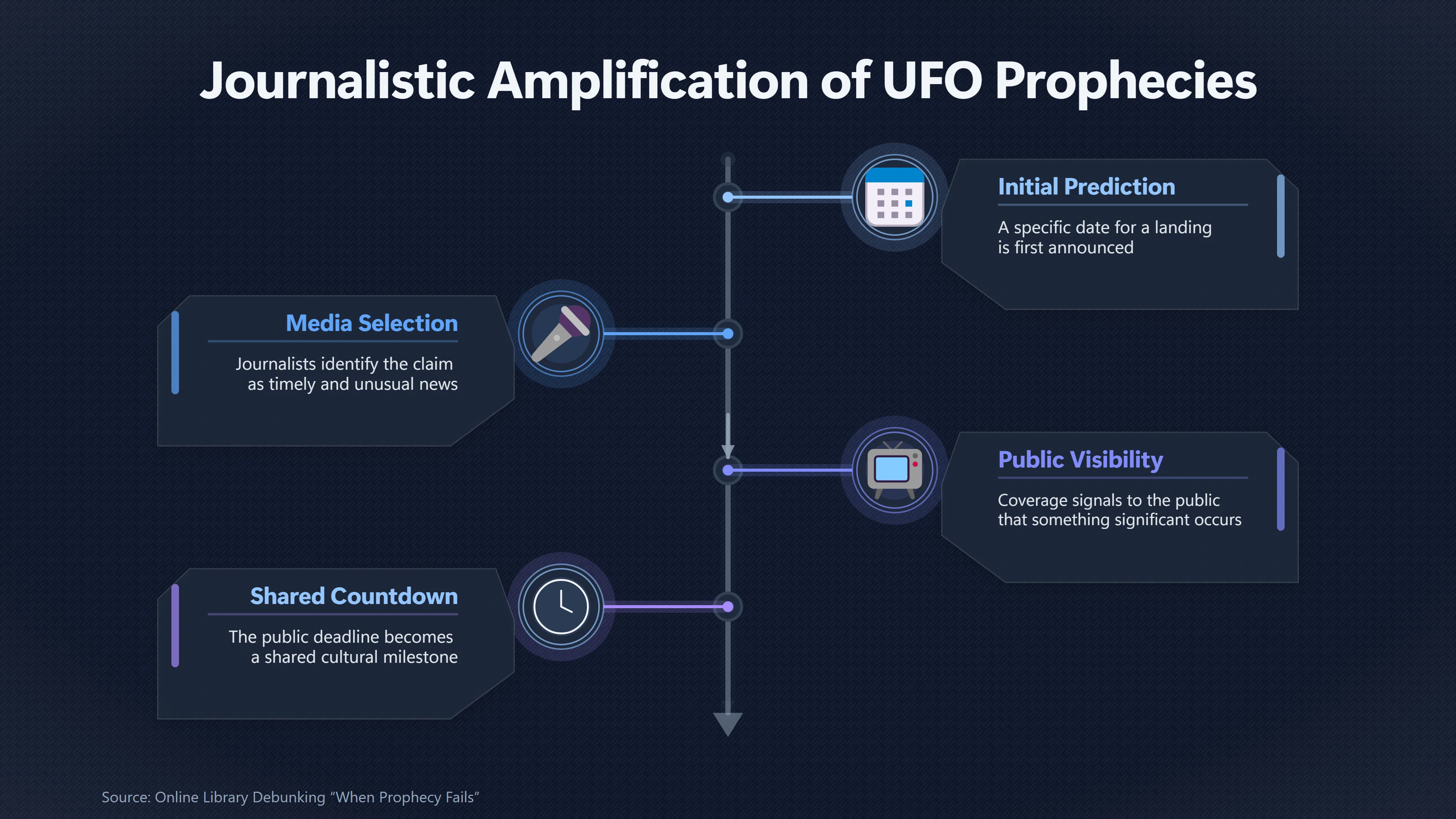
Can mocking coverage make a UFO prophecy stronger? In some circumstances, yes. Sceptical reporting rarely persuades readers that a predicted UFO landing is true, but it can still increase the prophecy’s social importance. By deciding that a prediction deserves coverage, journalists signal that it is a public event worth watching. That visibility can attract curious onlookers, encourage media countdowns to a specific date, and convince believers that the wider world is finally paying attention. When the prediction later fails, the same publicity also ensures that the failure is witnessed publicly.
Within the history of failed UFO landing predictions, the key mechanism is not that scepticism converts non-believers into believers. Rather, sceptical attention expands the audience, raises the perceived stakes, and can deepen believers’ commitment by framing the prophecy as important enough to provoke ridicule or opposition. These effects arise from well-understood dynamics of newsworthiness, social attention and group identity rather than from the truth of the underlying claim.[Wiley Online Library]onlinelibrary.wiley.comOnline Library Debunking “When Prophecy Fails”Wiley Online LibraryDebunking “When Prophecy Fails” - Kelly - 2026 - Journal of the History of the Behavioral Sciences - Wiley Online Lib…
How newsworthiness creates apparent importance
Journalists choose stories because they are timely, unusual and likely to interest audiences. A UFO prophecy with a precise landing date satisfies all three conditions. The decision to report it is therefore often driven by journalistic values rather than belief in extraterrestrial visitors.
For many readers, however, the distinction between being reported and being endorsed is less psychologically important than it appears. Coverage itself signals that something significant is expected to happen. A prophecy that previously circulated only within a small community suddenly acquires a public deadline, identifiable witnesses and the possibility of verification.
This creates several reinforcing effects:
- The prediction appears more consequential simply because established media consider it newsworthy.
- More people become aware of the claimed landing date, increasing anticipation.
- Supporters gain evidence that their beliefs are influencing the outside world, even if the attention is hostile.
- The event becomes easier to organise around because everyone knows when and where the supposed landing will occur.
In this way, sceptical reporting can unintentionally increase the perceived importance of a prophecy without increasing its credibility.
Why sceptical attention still expands the audience
Ridicule and disbelief do not prevent information from spreading. On the contrary, controversy often increases public curiosity.
Many people first encounter extraordinary claims not through believers but through journalists, commentators or critics. Even articles designed to debunk a prediction introduce new audiences to its central message: a specific UFO landing is expected on a particular date.
This wider circulation matters because failed prophecies often depend on visibility. A prediction witnessed by only a handful of followers has limited social impact. One discussed across newspapers, television or online platforms becomes a shared cultural event regardless of whether most observers expect failure.
Modern research on rumours and misinformation likewise shows that unverified claims frequently spread because people discuss, question and share them while uncertainty remains. Attention is not the same as acceptance, but increased attention enlarges the pool of people exposed to the original claim before it is resolved.[arXiv]arxiv.orgAnalysing How People Orient to and Spread Rumours in Social Media by Looking at Conversational ThreadsNovember 23, 2015…
The same dynamic explains why debunking campaigns sometimes struggle. Refuting a claim necessarily repeats it, making audiences who had never encountered it aware that it exists.
When ridicule strengthens the believer–outsider divide
Mocking coverage can also change how committed believers interpret criticism.
Rather than treating hostile reporting as evidence against the prophecy, some followers interpret ridicule as confirmation that outsiders are spiritually blind, closed-minded or threatened by the truth. This reframes scepticism from a challenge into part of the expected narrative.
Several mechanisms contribute to this process:
- Persecution narratives. Mockery becomes evidence that believers are misunderstood rather than mistaken.
- Identity reinforcement. Shared criticism encourages members to distinguish themselves more sharply from outsiders.
- Commitment signalling. Remaining loyal despite public ridicule becomes proof of personal conviction.
- Selective interpretation. Believers may remember that the media “paid attention” more vividly than they remember that the coverage rejected the claims.
None of these mechanisms requires the prophecy itself to become more plausible. Instead, criticism alters the social meaning of commitment within the group.
Dorothy Martin illustrates both the power and limits of publicity
The 1954 Dorothy Martin case demonstrates how media attention can transform a local prophecy into a widely observed event. Newspapers, telephone calls, curious visitors and pranksters all became part of the unfolding story after the prediction entered public view. Publicity altered the group’s environment rather than merely documenting it.[Wiley Online Library]onlinelibrary.wiley.comOnline Library Debunking “When Prophecy Fails”Wiley Online LibraryDebunking “When Prophecy Fails” - Kelly - 2026 - Journal of the History of the Behavioral Sciences - Wiley Online Lib…
For decades, this episode was interpreted largely through When Prophecy Fails, which argued that public disconfirmation prompted stronger commitment and increased proselytising. However, recent archival research challenges that influential interpretation. Thomas Kelly argues that Martin’s followers had already engaged in publicity before the prophecy failed, that the researchers themselves influenced events, and that the movement ultimately dissolved rather than becoming stronger after failure.[Wiley Online Library]onlinelibrary.wiley.comOnline Library Debunking “When Prophecy Fails”Wiley Online LibraryDebunking “When Prophecy Fails” - Kelly - 2026 - Journal of the History of the Behavioral Sciences - Wiley Online Lib…
This revision is important for understanding sceptical coverage. It suggests that publicity can strengthen a prophecy before its test by increasing visibility and social significance, while not necessarily preserving the movement after the prediction fails. Greater attention may intensify anticipation without guaranteeing long-term resilience.
Why journalists still cover predictions they doubt
From a newsroom perspective, a predicted UFO landing offers an unusually clear reporting structure:
- a precise date;
- a dramatic claim;
- identifiable advocates;
- obvious public interest;
- a definite outcome that can be checked.
These characteristics make the story attractive regardless of whether reporters believe the prediction. Journalists can cover the anticipation, attend the scheduled event and report either an extraordinary occurrence or an uneventful conclusion.
This differs from endorsement. News organisations often emphasise uncertainty, include expert scepticism and prepare audiences for the likelihood that nothing unusual will happen. Yet the act of coverage still places the prophecy within the public conversation, giving it visibility that would otherwise have been unavailable.
Media scholars have identified similar “amplification” effects in other fringe movements: reporting intended to expose or ridicule claims can nevertheless increase their reach by making previously obscure ideas more visible and socially salient.[WIRED]wired.comWhitney Phillips' report "The Oxygen of Amplification" from Data & Society's Media Manipulation Initiative highlights the paradox of repo…

The key lesson
Sceptical coverage strengthens a UFO prophecy through attention rather than persuasion. It makes the prediction appear socially significant, expands the audience beyond committed believers, creates a shared public countdown and may reinforce group identity in the face of ridicule. These mechanisms explain why even openly doubtful reporting can increase the prominence of a predicted UFO landing before the promised date arrives.
At the same time, increased visibility does not guarantee lasting success. Public attention also creates a larger audience for the eventual outcome. When the predicted landing fails to occur, the same publicity that elevated the prophecy makes its failure more visible, more easily documented and more difficult to ignore.[Wiley Online Library]onlinelibrary.wiley.comOnline Library Debunking “When Prophecy Fails”Wiley Online LibraryDebunking “When Prophecy Fails” - Kelly - 2026 - Journal of the History of the Behavioral Sciences - Wiley Online Lib…
Amazon book picks
Further Reading
Books and field guides related to Can Mocking Coverage Make a Prophecy Stronger?. Use these as the next step if you want deeper reading beyond the article.
When Prophecy Fails
The study reported in this volume grew out of some theoretical work, one phase of which bore specifically on the behavior of individuals...
The Demon-Haunted World
NEW YORK TIMES BESTSELLER • From the renowned astronomer and author of Cosmos comes a “powerful [and] stirring defense of informed ration...
American Cosmic
More than half of American adults and more than seventy-five percent of young Americans believe in intelligent extraterrestrial life. Thi...
eBay marketplace picks
Marketplace Samples
Live-tested eBay searches with available results related to this page.
Selected fromUFO poster oneBay.co.uk.


Current eBay listing
VINTAGE UFO FLYING SAUCERS COMIC ADVERTISING A2 POSTER PRINT

Current eBay listing
I Want To Believe UFO Poster Giclée Fine Art Heavyweight Print

Endnotes
1.
Source: onlinelibrary.wiley.com
Title: Online Library Debunking “When Prophecy Fails”
Link:https://onlinelibrary.wiley.com/doi/full/10.1002/jhbs.70043
Source snippet
Wiley Online LibraryDebunking “When Prophecy Fails” - Kelly - 2026 - Journal of the History of the Behavioral Sciences - Wiley Online Lib...
2.
Source: wired.com
Link:https://www.wired.com/story/study-media-and-extremism
Source snippet
Whitney Phillips' report "The Oxygen of Amplification" from Data & Society's Media Manipulation Initiative highlights the paradox of repo...
3.
Source: arxiv.org
Link:https://arxiv.org/abs/1511.07487
Source snippet
Analysing How People Orient to and Spread Rumours in Social Media by Looking at Conversational ThreadsNovember 23, 2015...
Published: November 23, 2015
4.
Source: arxiv.org
Title: arXiv False News On Social Media: A Data-Driven Survey
Link:https://arxiv.org/abs/1902.07539
5.
Source: arxiv.org
Title: arXiv False Information on Web and Social Media: A Survey
Link:https://arxiv.org/abs/1804.08559
6.
Source: onlinelibrary.wiley.com
Link:https://onlinelibrary.wiley.com/doi/10.1002/jhbs.70043
7.
Source: onlinelibrary.wiley.com
Link:https://onlinelibrary.wiley.com/doi/abs/10.1002/jhbs.70043
8.
Source: onlinelibrary.wiley.com
Link:https://onlinelibrary.wiley.com/doi/abs/10.1002/jhbs.70043?campaign=woletoc
9.
Source: onlinelibrary.wiley.com
Link:https://onlinelibrary.wiley.com/doi/abs/10.1111/socf.13006
10.
Source: Wikipedia
Title: When Prophecy Fails
Link:https://en.wikipedia.org/wiki/When_Prophecy_Fails
11.
Source: doi.org
Title: Debunking “When Prophecy Fails”
Link:https://doi.org/10.1002%2Fjhbs.70043
Additional References
12.
Source: skepticalinquirer.org
Title: Yes, Cognitive [Dissonance]({{ ‘dissonance/’ | relative_url }}) Is Still Actually a Thing | Skeptical Inquirer
Link:https://skepticalinquirer.org/exclusive/yes-cognitive-dissonance-is-still-actually-a-thing/
Source snippet
March 4, 2026 — ANOTHER REPLICATION FAILURE The first of these attacks was of a familiar form: modern researchers using updated methods a...
Published: March 4, 2026
13.
Source: washingtonpost.com
Title: ufo files nod growing belief aliens mistrust institutions
Link:https://www.washingtonpost.com/opinions/2026/05/15/ufo-files-nod-growing-belief-aliens-mistrust-institutions/
Source snippet
Opinion | UFO files nod to growing belief in aliens and mistrust in institutions - The Washington PostMay 15, 2026 — THE UFO FILES REVEAL...
Published: May 15, 2026
14.
Source: newyorker.com
Title: Is Cognitive Dissonance Actually a Thing?
Link:https://www.newyorker.com/culture/the-lede/is-cognitive-dissonance-actually-a-thing
Source snippet
The New YorkerDecember 17, 2025 — IS COGNITIVE DISSONANCE ACTUALLY A THING? A foundational 1956 study of the concept, focussed on a U.F...
Published: December 17, 2025
15.
Source: youtube.com
Title: End of Days Cults, the Day After | Cognitive Dissonance (Video Essay)
Link:https://www.youtube.com/watch?v=5yVuauQjkDc
Source snippet
Cognitive Dissonance: The Real Reason They Won't Say Yes (And How To Win Them Over)...
16.
Source: youtube.com
Title: When Prophecy Fails Cognitive Dissonance Prevails
Link:https://www.youtube.com/watch?v=2OCaigGnKow
Source snippet
When Prophecy Fails — Why Failed Beliefs Get Stronger...
17.
Source: youtube.com
Title: When Prophecy Fails — Why Failed Beliefs Get Stronger
Link:https://www.youtube.com/watch?v=3sOV0HENbkE
Source snippet
End of Days Cults, the Day After | Cognitive Dissonance (Video Essay)...
18.
Source: youtube.com
Title: When “When Prophecy Fails” Fails (E350)
Link:https://www.youtube.com/watch?v=IhblbZDXfZU
Source snippet
When Prophecy Fails Cognitive Dissonance Prevails - Dr. Kipp Davis...
19.
Source: sciencedirect.com
Link:https://www.sciencedirect.com/science/article/abs/pii/S0747563216307129
20.
Source: cambridge.org
Link:https://www.cambridge.org/core/journals/british-journal-of-political-science/article/media-platforming-and-the-normalisation-of-extreme-right-views/747E769DA6CE4365E0151B55FDF4DEFA
21.
Source: sciencedirect.com
Link:https://www.sciencedirect.com/science/article/abs/pii/S0378216621004045