Within False Corroboration
Where Did the UFO Prediction Really Begin?
A crowded trail of posts can often be reduced to one first claim by checking dates, wording, links and who actually added new evidence.
On this page
- Finding the earliest dated version
- Separating copies from independent origins
- Building a reliable source trail
Page outline Jump by section
Introduction
When a failed UFO prediction spreads online, the number of posts discussing it can create the impression that multiple independent sources support the claim. In practice, many widely shared predictions can be traced back to a single unsupported statement that has been copied, summarised, translated or reacted to thousands of times. The key question is therefore not, “How many people repeated this?” but, “Where did the prediction first appear, and did later sources contribute any new evidence?”
Tracing a UFO prediction to its original source is a practical research process rather than a matter of belief. By identifying the earliest available version, separating copies from genuine independent reporting, and documenting how the claim changed as it spread, it becomes much easier to judge whether an apparent consensus is real or simply an information cascade. This is particularly important when assessing failed predictions, where later retellings often obscure what was originally promised. Official analyses of UFO-related claims have also warned that circular reporting can cause repeated assertions to appear independently verified when they are not.[U.S. Department of War]leadstories.comMay 14, 2026 — FACT CHECK: MEMO ABOUT 'UNIDENTIFIED HUMANOID' IS NOT REAL DEPARTMENT OF WAR DOCUMENT RELEASED IN OFFICIAL UFO FILES FACT…(https://www.defense.gov/News/Transcripts/Transcript/Article/3702219/media-engagement-with-acting-aaro-director-tim-phillips-on-the-historical-recor/)
Finding the Earliest Dated Version
The first goal is to locate the earliest verifiable publication of the prediction rather than the earliest copy that appears in a search engine.
A useful workflow is:
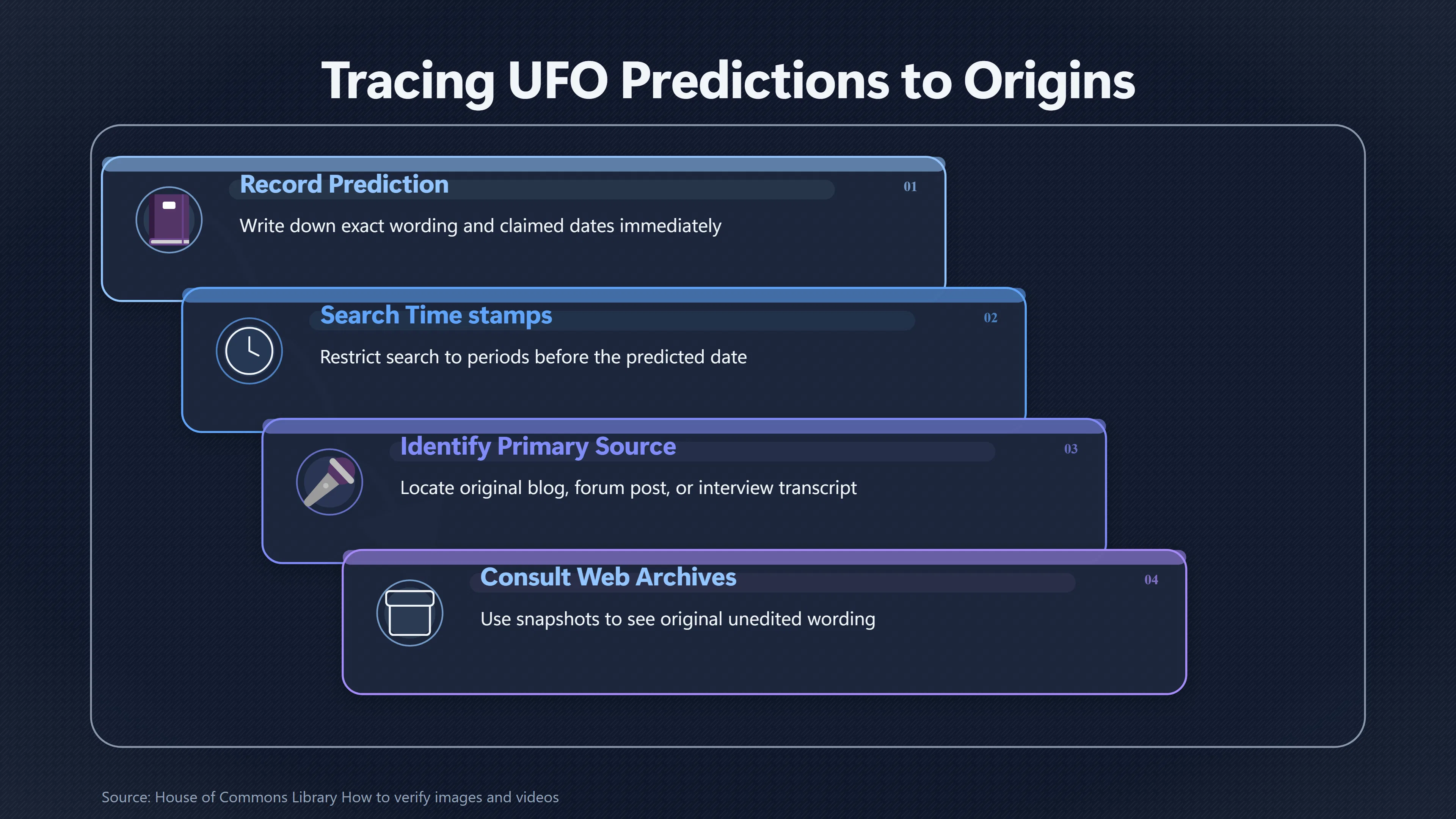
- Write down the exact prediction. Record the claimed event, date, location and any distinctive phrases before searching. Slight wording differences can reveal whether later accounts copied one another.
- Search for the oldest timestamp. Restrict searches to the period before the predicted event. A prediction supposedly made “years in advance” should be discoverable in material that predates the event itself.
- Look for the primary publication. This might be:
a personal website; a blog; a newsletter; a forum post; an interview transcript; a podcast or video upload with a publication date.
- Use web archives. Archived snapshots often preserve pages that have since been edited or removed. They also help establish whether wording changed after the prediction failed. The Internet Archive and other web archives are valuable precisely because they preserve historical versions rather than current edits, while the Library of Congress provides guidance on navigating archived captures and timelines. The Library of Congress
The earliest surviving copy is not automatically the original source, but it establishes a starting point from which earlier references can be investigated.
Separating Copies from Independent Origins
Once several versions have been collected, the next task is determining whether they represent independent reporting or simple duplication.
Several indicators suggest copying rather than independent confirmation:
- identical unusual wording;
- identical spelling mistakes;
- identical quoted passages;
- matching formatting or headings;
- the same supporting images;
- references to another article instead of firsthand evidence.
Independent sources usually contribute something genuinely new, such as:
- an original interview;
- newly obtained documents;
- firsthand witness testimony;
- independently verified dates or records;
- additional evidence collected separately.
By contrast, articles that merely state “reports online claim…” or “multiple websites say…” frequently trace back through several intermediate summaries to one original post.
This distinction matters because repetition measures attention, not evidential strength. The U.S. Department of Defense’s All-domain Anomaly Resolution Office (AARO) has explicitly identified circular reporting as a recurring mechanism by which unsupported UFO claims acquire apparent credibility through repeated retelling. U.S. Department of War(https://www.defense.gov/News/Transcripts/Transcript/Article/3702219/media-engagement-with-acting-aaro-director-tim-phillips-on-the-historical-recor/)
Following the Citation Chain Instead of the Headline
Many articles cite another publication rather than the original claim.
Rather than accepting a citation at face value, follow each reference backwards:
- Which source is actually being cited?
- Does that source contain original evidence?
- Does it merely quote another article?
- Does the chain eventually stop at one individual making the prediction?
Sometimes a chain that appears to involve dozens of publications ultimately converges on:
- one interview;
- one claimed channelling session;
- one social media account;
- one personal website.
When that happens, every later publication should be understood as part of the prediction’s distribution rather than independent corroboration.
Comparing What Changed Along the Way
Predictions often become stronger or vaguer as they spread.
Create a simple comparison of successive versions:
VersionWhat it actually predictsOriginalExact wording published by the claimantEarly repostMinor paraphrasingLater articlesAdded certainty or additional detailsSocial media summariesOften simplified or exaggerated
Pay particular attention to additions such as:
- precise locations never mentioned originally;
- extra dates;
- references to government involvement;
- claims that “scientists agree”;
- statements that “multiple psychics predicted the same thing.”
These additions may originate entirely with later commentators rather than the original claimant.
Conversely, failed predictions are often softened after the fact. Absolute statements become symbolic ones, or precise dates become approximate windows. Archived versions help reveal these retrospective revisions. Guidance on verifying original online material similarly recommends checking the earliest available version because later reposts frequently omit important context or alter the original claim. House of Commons Library
Building a Reliable Source Trail
A useful source trail records every step between the original prediction and later repetition.
An effective trail includes:
- Original source – earliest verifiable publication.
- Archive capture – archived version if available.
- First reposts – earliest known copies.
- Media coverage – news articles discussing the prediction.
- Reaction content – videos, podcasts and forum discussions.
- Post-event revisions – statements made after the prediction failed.
Recording the chain makes it much easier to distinguish:
- original evidence;
- secondary reporting;
- commentary;
- speculation;
- retrospective reinterpretation.
This documentation also prevents later sources from being mistakenly counted as independent witnesses.
A Practical Example of Source Tracing
The widely discussed prediction of a visible spacecraft on 14 October 2008 illustrates the value of source tracing.
Searching backwards through later media coverage eventually leads to the original publication on Blossom Goodchild’s own website, where the prediction was presented as a message attributed to the Federation of Light. Subsequent blogs, forums, videos and news reports largely discussed or reproduced that original announcement rather than supplying new evidence for it.
Although hundreds of webpages eventually referred to the prediction, the source trail demonstrates that the apparent volume of reporting did not represent hundreds of independent predictions. Instead, it documented the spread of one claim through multiple online communities before and after the predicted date.
Common Mistakes That Inflate Apparent Corroboration
Several research errors make unsupported predictions appear stronger than they are:
- Counting reposts as separate sources.
- Treating reactions as confirmation.
- Assuming media coverage validates the underlying claim.
- Ignoring edits made after the prediction failed.
- Searching only current webpages instead of archived versions.
- Stopping at the first article rather than tracing citations backwards.
Each of these mistakes increases the apparent number of “sources” without increasing the amount of original evidence.
What Source Tracing Can—and Cannot—Establish
Tracing a UFO prediction to its origin does not determine whether the prediction was true or false. Instead, it establishes a more limited but crucial fact: how many independent evidential origins actually exist.
Sometimes the investigation reveals several genuinely separate predictions made independently. More often, especially with failed UFO predictions that spread rapidly online, it reveals a single unsupported claim replicated across numerous platforms. Recognising that distinction helps prevent online repetition from being mistaken for corroboration and keeps attention focused on the quality of evidence rather than the quantity of discussion.
Amazon book picks
Further Reading
Books and field guides related to Where Did the UFO Prediction Really Begin?. Use these as the next step if you want deeper reading beyond the article.
Verified: How to Think Straight, Get Duped Less, and Make Bet...
An indispensable guide for telling fact from fiction on the internet—often in less than 30 seconds. The internet brings information to ou...
The Fact-Checker's Bible: A Guide to Getting It Right
These days fact-checking can seem like a lost art. The Fact Checker's Bible arrives not a moment too soon: it is the first—and essential—...
Calling Bullshit: The Art of Skepticism in a Data-Driven World
Bullshit isn’t what it used to be. Now, two science professors give us the tools to dismantle misinformation and think clearly in a world...

The Craft of Research
Rating: 4.3/5 from 6 Google Books ratings
Since 1995, students, researchers, and professionals have turned to The Craft of Research for clear and helpful guidance on how to conduc...
eBay marketplace picks
Marketplace Samples
Live-tested eBay searches with available results related to this page.
Selected fromUFO memorabilia oneBay.co.uk.


Endnotes
1.
Source: defense.gov
Link:https://www.defense.gov/News/Transcripts/Transcript/Article/3702219/media-engagement-with-acting-aaro-director-tim-phillips-on-the-historical-recor/
3.
Source: commonslibrary.parliament.uk
Title: House of Commons Library How to verify images and videos
Link:https://commonslibrary.parliament.uk/research-briefings/cbp-10816/
Source snippet
House of Commons LibraryHow to verify images and videos - House of Commons LibraryMay 5, 2026...
Published: May 5, 2026
Additional References
4.
Source: leadstories.com
Link:https://leadstories.com/hoax-alert/2026/05/fact-check-memo-about-unidentified-humanoid-is-not-real-department-of-war-document-released-in-official-ufo-files.html
Source snippet
May 14, 2026 — FACT CHECK: MEMO ABOUT 'UNIDENTIFIED HUMANOID' IS NOT REAL DEPARTMENT OF WAR DOCUMENT RELEASED IN OFFICIAL UFO FILES FACT...
Published: May 14, 2026
5.
Source: leadstories.com
Link:https://leadstories.com/hoax-alert/2026/05/fact-check-video-of-flying-egg-shaped-object-does-not-come-from-pentagon-ufo-files.html
Source snippet
May 15, 2026 — FACT CHECK: VIDEO OF FLYING EGG-SHAPED OBJECT DOES NOT COME FROM FIRST PENTAGON RELEASE OF UFO FILES FACT CHECK * May 15...
Published: May 15, 2026
6.
Source: dailyarchive.net
Title: How to Find the Original Source of a Viral Claim
Link:https://dailyarchive.net/how-to-find-the-original-source-of-a-viral-news-claim
Source snippet
June 8, 2026 — Image: How to Find the Original Source of a Viral News Claim verification fact checking sources viral claims research HOW...
Published: June 8, 2026
7.
Source: ipwhois.net
Title: how to trace website owner osint guide 2026
Link:https://www.ipwhois.net/blog/how-to-trace-website-owner-osint-guide-2026
Source snippet
How to Trace Who's Behind Any Website (The Complete 2026 OSINT Guide) | IPWhois BlogJune 5, 2026 — Home/ Blog/ Tools & Guides/ How to Tra...
Published: June 5, 2026
9.
Source: datafield.dev
Link:https://datafield.dev/misinformation-media-literacy-critical-thinking/part-04/chapter-20/
10.
Source: leadstories.com
Link:https://leadstories.com/hoax-alert/2026/05/fact-check-video-helicopter-flying-suspicious-orb-not-released-department-war-ufo-footage.html
11.
Source: independent.co.uk
Link:https://www.independent.co.uk/news/ap-pentagon-washington-ufo-congress-b2509641.html
12.
Source: leadstories.com
Link:https://leadstories.com/hoax-alert/2026/05/fact-check-fake-declassified-ufo-footage-shows-octopus-like-creature-with-10-tentacles-bouncing-on-the-sea-flying-off-at-great-speed.html
13.
Source: open.ocolearnok.org
Link:https://open.ocolearnok.org/infoskillsforcommunitycollegeresearchers/chapter/7-2-find-better-coverage-and-trace-claims-back-to-the-original-source/