Within False Corroboration
Why Repeated UFO Claims Start Feeling True
Repeated exposure can make an unsupported UFO forecast easier to process and therefore seem more plausible, even when no evidence has changed.
On this page
- How familiarity affects truth judgments
- Why one repetition can change sharing behavior
- Limits of the illusory truth effect
Page outline Jump by section
Introduction
Repeated UFO predictions can begin to feel more credible even when no new evidence has appeared. This is not because the prediction has become more accurate, but because repeated exposure changes how people judge information. Psychologists call this the illusory truth effect: statements encountered before are processed more fluently, and that feeling of familiarity is often misinterpreted as a sign of truth. The mechanism helps explain why failed UFO forecasts may continue attracting belief long after they have been disproved. Within online communities, repeated reposts, reaction videos, summaries and debates can create the impression that a prediction has gained support, when in reality only its visibility has increased.[ScienceDirect]sciencedirect.comThe illusory truth effect: A review of how repetition increases belief in misinformation - ScienceDirect…
How familiarity affects truth judgments
The illusory truth effect is one of the most consistently replicated findings in cognitive psychology. Rather than carefully evaluating every claim from scratch, people often use mental shortcuts. One of those shortcuts is processing fluency—the ease with which information is understood. Familiar statements require less mental effort to process, and that ease can be unconsciously interpreted as evidence that the statement is probably true.[PubMed Central (PMC)]pmc.ncbi.nlm.nih.govPubMed Central (PMC)The effects of repetition frequency on the illusory truth effect - PMCMay 13, 2021…
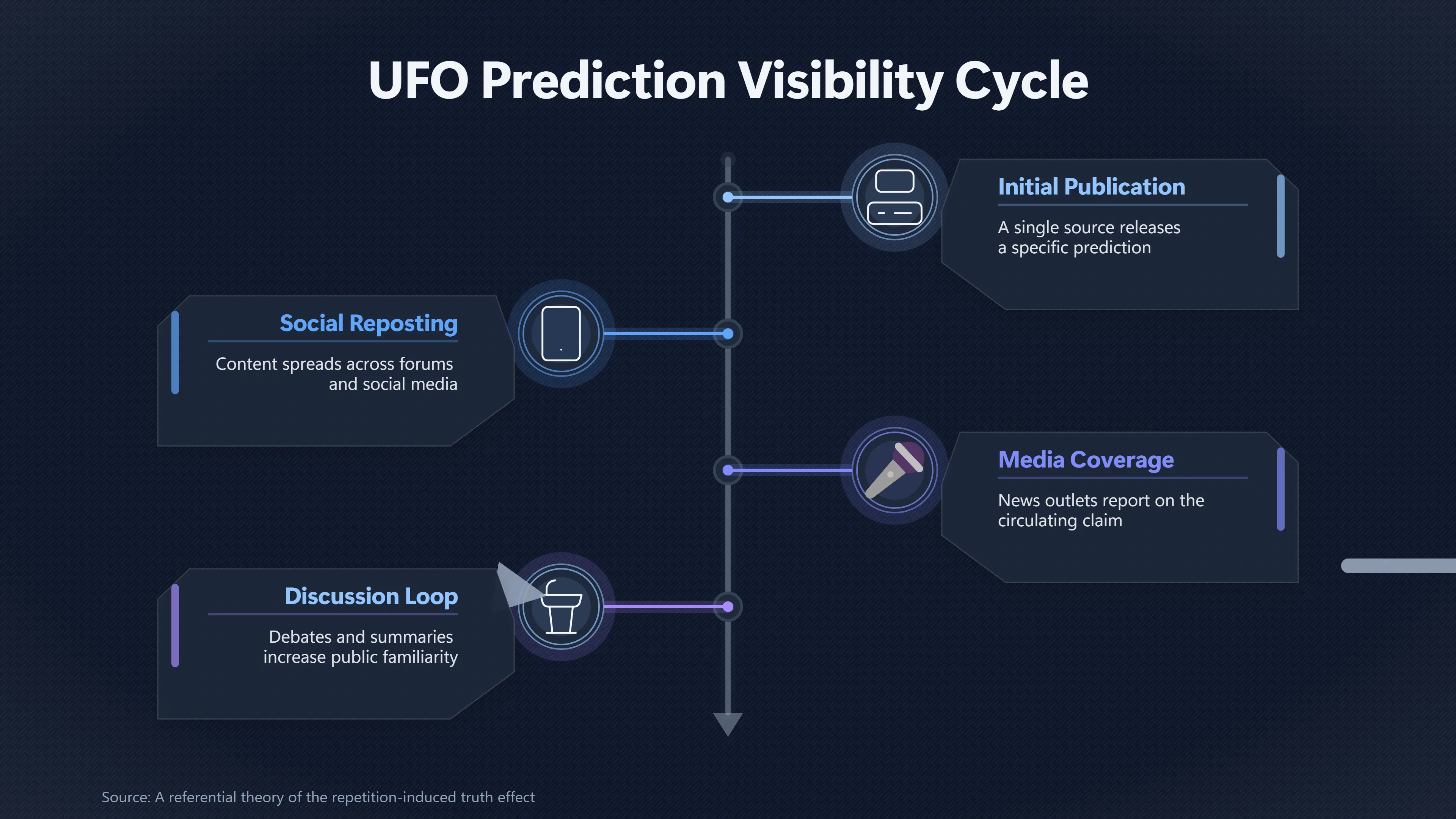
For failed UFO predictions, this distinction matters because repetition usually changes recognition, not evidence. Consider the typical online cycle:
- A prediction is published by a single source.
- It is reposted across forums and social media.
- Videos discuss the prediction.
- News articles report that the prediction is circulating.
- Later discussions cite the widespread attention as if it reflects growing support.
At every stage, the prediction becomes more familiar, but its factual basis may remain identical to the original unsupported claim. Familiarity can therefore substitute for genuine corroboration in people’s intuitive judgments.[ScienceDirect]sciencedirect.comThe illusory truth effect: A review of how repetition increases belief in misinformation - ScienceDirect…
Importantly, this mechanism does not require gullibility or poor reasoning. The effect has been observed even when participants know that repeated information may be unreliable and even when they possess relevant background knowledge. Repetition alters the subjective experience of evaluating a statement before conscious reasoning begins.[ScienceDirect]sciencedirect.comThe illusory truth effect: A review of how repetition increases belief in misinformation - ScienceDirect…
Why one repetition can change sharing behaviour
Repetition influences more than belief—it can also influence whether people choose to pass information on.
Experimental research has shown that even a single previous exposure to misinformation makes people more likely to judge it as accurate and, in turn, more likely to share it on social media. Researchers found that increased perceived accuracy mediated the increase in sharing intentions. In other words, people were not simply sharing familiar claims because they recognised them; familiarity subtly made the claims appear more credible.[PubMed Central (PMC)]pmc.ncbi.nlm.nih.govPubMed Central (PMC)The illusory truth effect leads to the spread of misinformation - PMC…
This finding helps explain why unsuccessful UFO predictions can continue circulating after their predicted dates have passed.
A common sequence is:
- A prediction receives extensive attention before the promised event.
- The prediction fails.
- Discussions continue explaining, reinterpreting or debating the failure.
- New audiences encounter the original prediction through these later conversations.
- The claim becomes increasingly familiar despite its failed outcome.
The repetition itself can therefore sustain visibility independently of evidential strength. The online discussion may become larger precisely because the prediction failed dramatically, exposing still more people to the original claim.

Why failed predictions can remain persuasive
Failed predictions do not always disappear because memory is selective. Many readers remember encountering the prediction but only vaguely remember whether it succeeded, failed or remained unresolved. When the claim later reappears, the familiarity is immediate while the detailed context is often weaker.
For UFO predictions, repeated exposure can produce several misleading impressions:
- “I’ve heard this before.” Familiarity is mistaken for reliability.
- “Lots of people were talking about it.” Widespread discussion is confused with widespread evidence.
- “There must be something behind it.” Repetition is interpreted as independent confirmation rather than repeated reporting of the same original claim.
These impressions arise without requiring deliberate deception. Much of the repetition comes from sincere discussion, speculation, criticism or entertainment. The psychological effect depends on repeated exposure, not on whether each repetition endorses the claim.[ScienceDirect]sciencedirect.comThe illusory truth effect: A review of how repetition increases belief in misinformation - ScienceDirect…
Limits of the illusory truth effect
The illusory truth effect is influential, but it is not irresistible.
People do not automatically believe every repeated claim. Several factors can reduce or override the effect:
- Strong contradictory knowledge. Well-established facts make repetition less persuasive, although studies show repetition can still exert some influence even when claims contradict existing knowledge.
- Active verification. Checking original sources, dates and outcomes shifts attention from familiarity to evidence.
- Independent corroboration. Multiple genuinely independent observations carry far greater evidential value than repeated references to the same prediction.
- Clear memory of failure. When audiences explicitly recall that a predicted UFO event did not occur, familiarity alone is less likely to restore credibility.[ScienceDirect]sciencedirect.comThe illusory truth effect: A review of how repetition increases belief in misinformation - ScienceDirect…
Research also suggests diminishing returns. Additional repetitions continue increasing perceived truth, but the largest jump occurs early. One experimental programme found that the greatest increase in perceived truth came when participants encountered a statement for the second time, with later repetitions producing progressively smaller gains. This helps explain why a prediction can acquire an initial aura of plausibility surprisingly quickly.[PubMed Central (PMC)]pmc.ncbi.nlm.nih.govPubMed Central (PMC)The effects of repetition frequency on the illusory truth effect - PMCMay 13, 2021…

Why repetition should not be mistaken for evidence
Within discussions of failed UFO predictions, the key lesson is that visibility and evidential support are different things. A prediction repeated across hundreds of posts is still supported only by whatever evidence existed before the first repost.
The illusory truth effect explains why repeated exposure can make unsupported forecasts feel increasingly plausible without changing their factual status. Understanding this mechanism helps distinguish two very different questions:
- How many times has this prediction been repeated?
- What new independent evidence has actually emerged since it was first made?
Only the second question addresses whether the prediction has gained factual support. The first primarily measures familiarity, and familiarity alone is not evidence.[sciencedirect.com]sciencedirect.comThe illusory truth effect: A review of how repetition increases belief in misinformation - ScienceDirect…
Amazon book picks
Further Reading
Books and field guides related to Why Repeated UFO Claims Start Feeling True. Use these as the next step if you want deeper reading beyond the article.
Foolproof: Why Misinformation Infects Our Minds and How to Bu...
One of the world’s top experts on fighting misinformation reveals the psychology behind its power—and how we can protect ourselves. From...
The Misinformation Age: How False Beliefs Spread
"Empowering and thoroughly researched, this book offers useful contemporary analysis and possible solutions to one of the greatest threat...
The Believing Brain: From Ghosts and Gods to Politics and Con...
Synthesizing thirty years of research, psychologist and science historian, Michael Shermer upends the traditional thinking about how huma...
eBay marketplace picks
Marketplace Samples
Live-tested eBay searches with available results related to this page.
Selected fromUFO poster oneBay.co.uk.


Current eBay listing
I Want To Believe UFO Poster Giclée Fine Art Heavyweight Print


Current eBay listing
VINTAGE UFO FLYING SAUCERS COMIC ADVERTISING A2 POSTER PRINT
Endnotes
1.
Source: sciencedirect.com
Link:https://www.sciencedirect.com/science/article/abs/pii/S2352250X23001811
Source snippet
The illusory truth effect: A review of how repetition increases belief in misinformation - ScienceDirect...
2.
Source: sciencedirect.com
Title: A referential theory of the repetition-induced truth effect
Link:https://www.sciencedirect.com/science/article/pii/S0010027716303110
3.
Source: pmc.ncbi.nlm.nih.gov
Link:https://pmc.ncbi.nlm.nih.gov/articles/PMC13066098/
Source snippet
review and meta-analysis of the evidence for an illusory truth effect and its determinants - PMCFebruary 27, 2026 — In light of a growing...
Published: February 27, 2026
4.
Source: pmc.ncbi.nlm.nih.gov
Link:https://pmc.ncbi.nlm.nih.gov/articles/PMC8116821/
Source snippet
PubMed Central (PMC)The effects of repetition frequency on the illusory truth effect - PMCMay 13, 2021...
Published: May 13, 2021
5.
Source: pmc.ncbi.nlm.nih.gov
Link:https://pmc.ncbi.nlm.nih.gov/articles/PMC10636596/
Source snippet
PubMed Central (PMC)The illusory truth effect leads to the spread of misinformation - PMC...
6.
Source: pubmed.ncbi.nlm.nih.gov
Title: Pub Med The effects of repetition frequency on the illusory truth effect
Link:https://pubmed.ncbi.nlm.nih.gov/33983553/
Source snippet
The effects of repetition frequency on the illusory truth effect - PubMed...
7.
Source: pubmed.ncbi.nlm.nih.gov
Link:https://pubmed.ncbi.nlm.nih.gov/41501536/
Source snippet
A registered replication report - PubMedJanuary 7, 2026 —. 2026 Jan 7;33(1):39. doi: 10.3758/s13423-025-02836-w. DOES REPETITION INCREAS...
Published: January 7, 2026
8.
Source: pubmed.ncbi.nlm.nih.gov
Link:https://pubmed.ncbi.nlm.nih.gov/35533415/
9.
Source: pubmed.ncbi.nlm.nih.gov
Link:https://pubmed.ncbi.nlm.nih.gov/35144111/
10.
Source: pubmed.ncbi.nlm.nih.gov
Link:https://pubmed.ncbi.nlm.nih.gov/28088712/
Additional References
11.
Source: nature.com
Link:https://www.nature.com/articles/s41467-026-70041-x
Source snippet
February 27, 2026 — Save article View saved research * 10k Accesses * 3 Citations * 64 Altmetric * Metrics details ABSTRACT Over the last...
Published: February 27, 2026
12.
Source: discovery.ucl.ac.uk
Title: UCL Discovery The illusory truth effect leads to the spread of misinformation
Link:https://discovery.ucl.ac.uk/id/eprint/10167185/
Source snippet
UCL DiscoveryThe illusory truth effect leads to the spread of misinformation - UCL Discovery...
13.
Source: youtube.com
Title: Why We Never Think We Are Wrong (Confirmation Bias)
Link:https://www.youtube.com/watch?v=uS0apt9NXGw
Source snippet
Illusory truth effect repetition UFO claims debunking science Why Your Brain Believes Lies (The Illusory Truth Effect)...
14.
Source: youtube.com
Title: Psychology Researcher Explains How Trump Used the Illusory Truth Effect
Link:https://www.youtube.com/watch?v=RYPy2vShW1U
Source snippet
Why We Never Think We Are Wrong (Confirmation Bias)...
15.
Source: youtube.com
Title: What Is The Illusory Truth Effect? ☕ Why We Believe Lies
Link:https://www.youtube.com/watch?v=PCbMEHOsx9g
Source snippet
Psychology Researcher Explains How Trump Used the Illusory Truth Effect...
16.
Source: youtube.com
Title: Why you think you’re right – even if you’re wrong | Julia Galef
Link:https://www.youtube.com/watch?v=w4RLfVxTGH4
Source snippet
What Is The Illusory Truth Effect? ☕ Why We Believe Lies...
17.
Source: defense.gov
Link:https://www.defense.gov/News/News-Stories/Article/Article/3701297/dod-report-discounts-sightings-of-extraterrestrial-technology/
18.
Source: defense.gov
Link:https://www.defense.gov/News/Transcripts/Transcript/Article/3702219/media-engagement-with-acting-aaro-director-tim-phillips-on-the-historical-recor/
19.
Source: defense.gov
Link:https://www.defense.gov/News/Releases/Release/Article/3513171/the-department-of-defense-launches-the-all-domain-anomaly-resolution-office-web/
20.
Source: aaro.mil
Link:https://www.aaro.mil/FAQ/