Within Vague Forecasts
How Long Can 'Soon' Keep a UFO Prediction Alive?
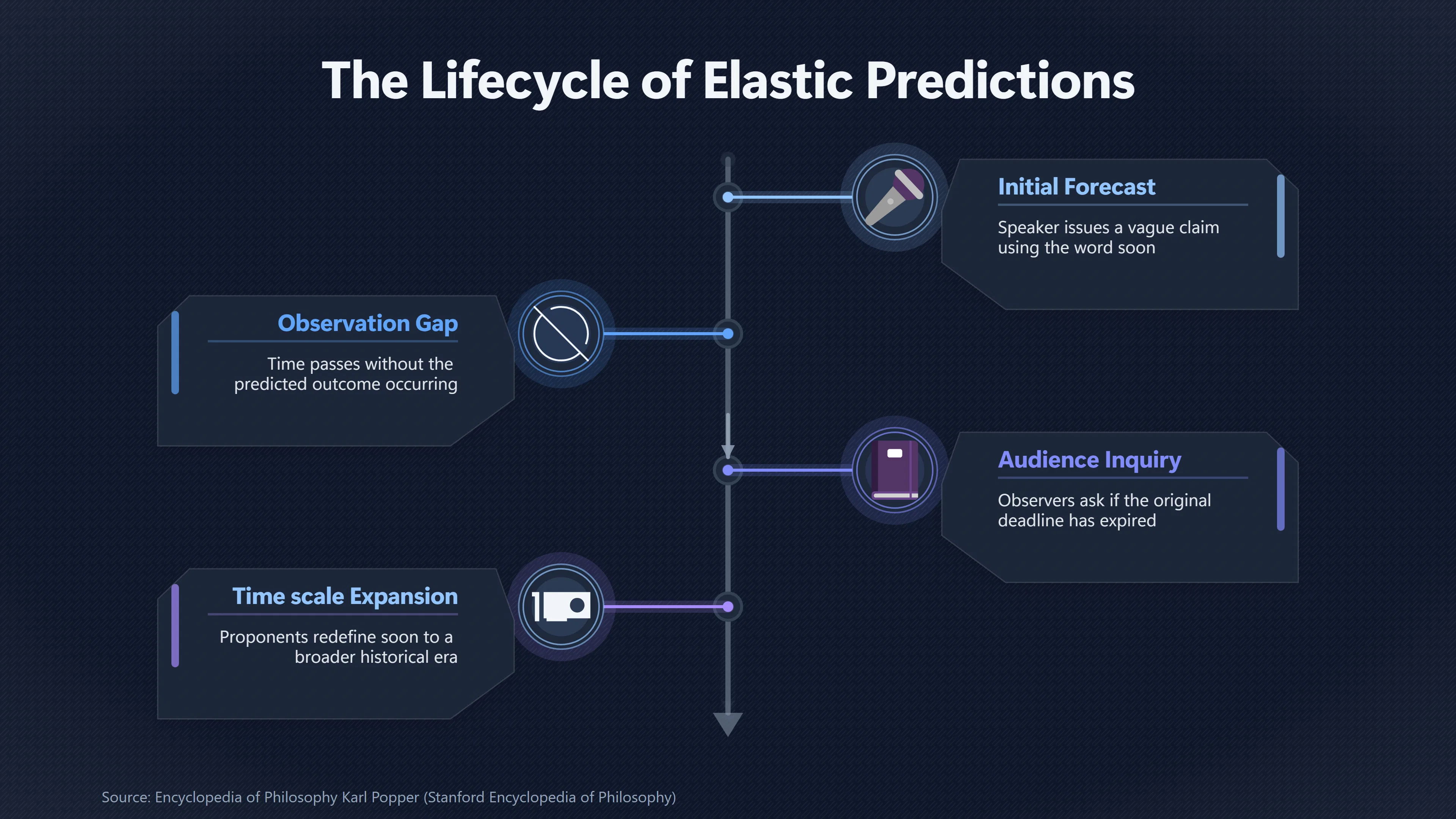
The word 'soon' can stretch from months to decades because no fixed deadline forces the forecast to succeed or fail.
On this page
- Why 'soon' has no fixed boundary
- How timescales shift after delays
- Turning vague timing into a testable claim
Page outline Jump by section
Introduction
Within failed UFO predictions, the word “soon” is one of the most effective ways for a forecast to avoid ever reaching a clear point of failure. Unlike a specific date or measurable deadline, “soon” has no fixed temporal boundary. It can initially suggest days or months to an audience, yet later be reinterpreted as years, decades or even an entire historical era. Because the original claim never established when it would become false, disappointment does not automatically invalidate it.
This elasticity matters because predictions can only be evaluated if they define both what is expected to happen and when it should happen. A statement such as “open contact will occur soon” leaves both the timing and, often, the nature of the event open to later reinterpretation. Rather than producing a failed prediction, delays become opportunities to redefine what “soon” meant all along. This mechanism helps explain why many long-running UFO forecasts appear to survive repeated non-fulfilment without requiring explicit retractions.[Stanford Encyclopedia of Philosophy]plato.stanford.eduEncyclopedia of Philosophy Karl Popper (Stanford Encyclopedia of PhilosophyStanford Encyclopedia of PhilosophyKarl Popper (Stanford Encyclopedia of Philosophy)September 12, 2022…
Why “soon” has no fixed boundary
In everyday English, “soon” is intentionally vague. Linguistic research has shown that temporal expressions such as soon, recently and just do not specify a precise interval. Instead, listeners infer their meaning from context, expectations and the type of event being discussed. A person saying “I’ll reply soon” may be understood differently from someone saying “the next solar eclipse is soon.”[OUP Academic]academic.oup.comOUP AcademicIMPLICIT QUANTIFICATION OF TEMPORAL ADVERBIALS | Journal of Semantics | Oxford Academic…
This flexibility becomes especially useful in predictions about extraordinary events such as extraterrestrial contact because there is no accepted reference timescale.
Several features make the word unusually resistant to failure:
- It contains no calendar deadline.
- It has no agreed maximum duration.
- It allows audiences to supply their own expectations.
- It can later be interpreted relative to a different timescale than the one listeners originally assumed.
In UFO discourse, a speaker may never need to announce a postponement. Instead, they can simply explain that observers misunderstood the intended meaning of “soon”.
How timescales shift after delays
The meaning of “soon” often changes after the predicted event fails to appear. This shift is rarely presented as a correction. Instead, the timeframe itself is quietly expanded.
Common patterns include:
- Human timescale to historical timescale. What first sounded like months becomes “within this generation” or “during humanity’s transition”.
- Historical to cosmic timescale. Delays are justified by claiming extraterrestrial civilisations operate according to centuries rather than human calendars.
- External to spiritual timescale. Rather than expecting visible spacecraft, believers are told that preparation, consciousness or disclosure is already progressing invisibly.
Each reinterpretation preserves the original wording while changing the reference frame against which it is judged.
This is particularly effective because most listeners initially imagine ordinary human timescales unless explicitly told otherwise. Only after expectations are disappointed does the broader interpretation emerge.
Why delayed predictions rarely receive a clear verdict
A prediction normally fails when its stated deadline passes without the predicted outcome occurring. With “soon”, there is no comparable checkpoint.
Instead of producing a binary result, the forecast enters an indefinite waiting period:
- The prediction is made.
- Nothing decisive happens.
- The audience asks whether it has failed.
- The timeframe is expanded.
- Waiting continues.
Because no objective expiry date exists, disagreement shifts away from evidence and towards interpretation. One person may conclude that “soon” has obviously expired, while another argues that the process is still unfolding exactly as expected.
This differs fundamentally from a dated prediction such as “a spacecraft will land before the end of 2028”. Once that date passes, the prediction can be assessed directly.
The psychological advantage of elastic timing
Elastic timing also affects memory. Many people remember the emotional impression that an event was expected “fairly soon” without remembering whether any precise limit was ever stated. As time passes, recollections of the original expectation may themselves become less precise, making later reinterpretations appear more reasonable than they would have seemed at the moment the prediction was made.
The absence of a clear deadline also reduces pressure for accountability. Rather than admitting that a forecast failed, proponents can argue that critics imposed an artificial timetable that never existed in the original wording.
This mechanism does not require deliberate deception in every case. Some speakers may genuinely interpret “soon” differently over time as circumstances change. The important point is that the wording itself makes these reinterpretations possible.
Turning vague timing into a testable claim
The simplest way to prevent indefinite postponement is to replace elastic language with measurable commitments.
Instead of saying:
“Disclosure will happen soon.”
A testable prediction would specify:
- a calendar deadline;
- a clearly defined event;
- observable evidence that would count as success; and
- acknowledgement that failure to meet those conditions counts against the prediction.
For example:
“Before 31 December 2030, an internationally recognised scientific body will publicly authenticate physical evidence demonstrating extraterrestrial technology.”
Whether such a prediction succeeds is a separate question. The important distinction is that it creates a genuine opportunity for both confirmation and failure. This aligns with the broader principle that informative predictions expose themselves to possible refutation rather than remaining compatible with every future outcome.[Stanford Encyclopedia of Philosophy]plato.stanford.eduEncyclopedia of Philosophy Karl Popper (Stanford Encyclopedia of PhilosophyStanford Encyclopedia of PhilosophyKarl Popper (Stanford Encyclopedia of Philosophy)September 12, 2022…

Why this mechanism matters for failed UFO predictions
The resilience of “soon” does not depend on evidence for or against extraterrestrial life. Instead, it reflects the structure of the prediction itself.
When timing remains undefined, the forecast can survive repeated periods of non-occurrence simply by stretching its implied horizon. Every additional delay becomes another opportunity to reinterpret the original wording rather than another failed prediction.
That makes “soon” one of the clearest linguistic mechanisms through which vague UFO forecasts avoid decisive testing. Rather than crossing a visible finish line where they can be judged correct or incorrect, they remain suspended in an indefinitely extendable future, allowing the prediction to stay alive long after most readers initially expected it to be resolved.[Stanford Encyclopedia of Philosophy]plato.stanford.eduEncyclopedia of Philosophy Karl Popper (Stanford Encyclopedia of PhilosophyStanford Encyclopedia of PhilosophyKarl Popper (Stanford Encyclopedia of Philosophy)September 12, 2022…
Amazon book picks
Further Reading
Books and field guides related to How Long Can 'Soon' Keep a UFO Prediction Alive?. Use these as the next step if you want deeper reading beyond the article.
Why People Believe Weird Things
Rating: 4.0/5 from 7 Google Books ratings
Revised and Expanded Edition. In this age of supposed scientific enlightenment, many people still believe in mind reading, past-life regr...
Superforecasting
NEW YORK TIMES BESTSELLER WINNER OF THE CMI MANAGEMENT FUTURES BOOK OF THE YEAR AWARD What if we could improve our ability to predict the...
The Signal and the Noise
This work explores the history, art and science of prediction.
The Logic of Scientific Discovery
When first published in 1959, this book revolutionized contemporary thinking about science and knowledge. It remains one of the most wide...
eBay marketplace picks
Marketplace Samples
Live-tested eBay searches with available results related to this page.
Selected fromUFO poster oneBay.co.uk.
Current eBay listing
I Want To Believe UFO Poster Giclée Fine Art Heavyweight Print


Current eBay listing
VINTAGE UFO FLYING SAUCERS COMIC ADVERTISING A2 POSTER PRINT
Endnotes
1.
Source: plato.stanford.edu
Title: Encyclopedia of Philosophy Karl Popper (Stanford Encyclopedia of Philosophy)
Link:https://plato.stanford.edu/entries/popper/
Source snippet
Stanford Encyclopedia of PhilosophyKarl Popper (Stanford Encyclopedia of Philosophy)September 12, 2022...
Published: September 12, 2022
2.
Source: academic.oup.com
Link:https://academic.oup.com/jos/article-pdf/4/4/327/9835715/327.pdf
Source snippet
OUP AcademicIMPLICIT QUANTIFICATION OF TEMPORAL ADVERBIALS | Journal of Semantics | Oxford Academic...
3.
Source: academic.oup.com
Link:https://academic.oup.com/jos/article/39/1/39/6472306
4.
Source: encyclopedia.com
Title: [Falsifiability]({{ ‘falsifiability/’ | relative_url }}) | Encyclopedia.com
Link:https://www.encyclopedia.com/science-and-technology/physics/science-general/falsifiability
5.
Source: plato.stanford.edu
Link:https://plato.stanford.edu/archives/spr1999/entries/popper/
6.
Source: fiveable.me
Title: Temporal Expressions | Intro to Semantics and Pragmatics | Fiveable
Link:https://fiveable.me/introduction-semantics-pragmatics/key-terms/temporal-expressions
Source snippet
Temporal Expressions | Intro to Semantics and Pragmatics | Fiveable...
7.
Source: plato.sydney.edu.au
Title: He rejected verifiability
Link:https://plato.sydney.edu.au/entries/pseudo-science/
Source snippet
and Pseudo-Science (Stanford Encyclopedia of Philosophy)July 28, 2025 — 4.3 POPPER’S FALSIFICATIONISM Karl Popper described the demarcati...
Published: July 28, 2025
8.
Source: plato.sydney.edu.au
Link:https://plato.sydney.edu.au/entries/prediction-accommodation/index.html
Additional References
9.
Source: doi.org
Link:https://doi.org/10.1086/721797
Source snippet
FALSIFICATIONISM This section outlines relevant aspects of falsificationism. First, we present Popper’s initial ideas. Then we discuss th...
10.
Source: cambridge.org
Title: Going forward as an adverb | English Language & Linguistics | Cambridge Core
Link:https://www.cambridge.org/core/journals/english-language-and-linguistics/article/going-forward-as-an-adverb/8030D2A7617E75E5F6C58EB4719DB867
Source snippet
EXPRESSING THE FUTURE IN ENGLISH Future time reference has been studied extensively in English and beyond. Quite understandably, however...
11.
Source: seop.illc.uva.nl
Title: nl Theory and Observation in Science (Stanford Encyclopedia of Philosophy)
Link:https://seop.illc.uva.nl/entries/science-theory-observation/
Source snippet
and Observation in Science (Stanford Encyclopedia of Philosophy)January 12, 2026 — Hypothetico-Deductive (HD) confirmation theorists prop...
Published: January 12, 2026
12.
Source: cambridge.org
Title: To what extent do children’s expressions of time actually refer to time?
Link:https://www.cambridge.org/core/product/identifier/S0305000924000114/type/journal_article
Source snippet
An investigation into the temporal and discursive usages of temporal adverbs in family interaction | Journal of Child Language | Cambridg...
13.
Source: youtube.com
Link:https://www.youtube.com/watch?v=rvaIBNsY35A
Source snippet
These videos directly analyze how open-ended UFO predictions and ambiguous timescales allow forecasts to repeatedly shift deadlines and a...
14.
Source: youtube.com
Title: The UFO Cult That Inspired Cognitive [Dissonance]({{ ‘dissonance/’ | relative_url }}) | [Dorothy Martin]({{ ‘dorothy-martin/’ | relative_url }}) & The Seekers
Link:https://www.youtube.com/watch?v=vvFV1v8l-PI
Source snippet
10 Doomsday Cults That Got It Wrong | When Prophecy Fails...
15.
Source: youtube.com
Link:https://www.youtube.com/watch?v=6d6SJd5sxnM
Source snippet
UFO Disclosure 2026: What's Inside the Latest Pentagon UAP Files? | NewsX...
16.
Source: sciencedirect.com
Link:https://www.sciencedirect.com/science/article/abs/pii/S0378216617303430
17.
Source: cambridge.org
Link:https://www.cambridge.org/core/journals/philosophy/article/abs/poppers-falsifiability-and-darwins-natural-selection/6CD1B12E7A451C65FE0F5E250E82EC8A
18.
Source: researchgate.net
Title: (PDF) Aspect and the semantics-pragmatics interface: The case of already
Link:https://www.researchgate.net/publication/248458145_Aspect_and_the_semantics-pragmatics_interface_The_case_of_already