Within Dissonance
Why Public UFO Warnings Are So Hard to Retract
People who publicly promoted an alien rescue or disaster may reinterpret failure to defend their judgement, status and identity.
On this page
- How public claims create reputational pressure
- Why retraction threatens identity and status
- When embarrassment leads to exit instead
Page outline Jump by section
Introduction
When people publicly promote a UFO warning or prophecy—whether predicting an alien rescue, mass landing or global catastrophe—they do more than make a factual claim. They tie their reputation, judgement and often their social identity to a specific outcome. Once the predicted event fails to occur, withdrawing the claim can become psychologically and socially more costly than defending or reinterpreting it. This helps explain why some public UFO predictions persist long after their stated deadlines have passed, even when the original prediction is plainly contradicted by events. Research on failed prophecy suggests that public commitment can increase resistance to admitting error, but the pattern is neither universal nor inevitable. Recent historical reassessments also caution against treating any single famous case as a definitive model for every failed UFO prediction.[OUP Academic]academic.oup.comOUP AcademicHow Prophecy Never Fails | When Prophecy Never Fails: Myth and Reality in a Flying-Saucer Group | Oxford AcademicJuly 1, 2005…
How public claims create reputational pressure
Making a prediction in private and making it before an audience are fundamentally different experiences. A public warning creates witnesses who can later evaluate whether the prediction succeeded or failed. Every interview, lecture, website, social media post or television appearance becomes part of a visible record.
For UFO contactees, self-described experiencers and movement leaders, this creates several overlapping pressures:
- Credibility: Admitting a failed prediction may damage future claims about alien contact or privileged knowledge.
- Leadership: Followers often expect certainty from someone presented as having special access to extraterrestrial messages.
- Community standing: Other believers may interpret a retraction as abandoning the wider cause rather than simply correcting one mistaken prediction.
- Personal history: Years of public advocacy become harder to reconcile with acknowledging that a central prediction was wrong.
These pressures are especially strong where the prediction became central to the person’s public identity rather than simply one opinion among many.
Festinger’s original discussion of disconfirmed prophecy highlighted public commitment as one condition that could make belief more resistant after failure, although he argued that several demanding conditions had to operate together rather than automatically producing renewed conviction.[OUP Academic]academic.oup.comOUP AcademicHow Prophecy Never Fails | When Prophecy Never Fails: Myth and Reality in a Flying-Saucer Group | Oxford AcademicJuly 1, 2005…
Why retraction threatens identity and status
For highly committed advocates, retracting a UFO warning is rarely just about correcting a date on a calendar. It may require revising an entire self-understanding.
Someone who has spent years presenting themselves as a trusted interpreter of alien communications has often built relationships, authority and meaning around that role. A public admission of error may therefore threaten several aspects of identity simultaneously:
- Competence: “I misunderstood the messages.”
- Judgement: “I persuaded others to trust a prediction that failed.”
- Purpose: “The mission I devoted myself to may have been mistaken.”
- Social belonging: “My place within this community could disappear.”
Social psychology has long recognised that people often defend identities into which they have invested significant effort. In UFO movements, the public nature of many predictions means identity defence and belief defence frequently become intertwined.[OUP Academic]academic.oup.comOUP AcademicHow Prophecy Never Fails | When Prophecy Never Fails: Myth and Reality in a Flying-Saucer Group | Oxford AcademicJuly 1, 2005…
Reinterpretation often protects the broader worldview
Public retractions are uncommon not necessarily because every believer thinks observable reality has changed, but because many reinterpret only the specific prediction while preserving the larger belief system.
Common reinterpretations include:
- the extraterrestrials delayed their intervention;
- humanity failed a spiritual test;
- the message was misunderstood rather than false;
- unseen events occurred on a spiritual or invisible level;
- the prediction itself altered the future and prevented the disaster.
Such explanations allow believers to preserve confidence in alien intelligences or contact experiences without accepting that the entire worldview has collapsed.
Research on movements with repeated prophetic disappointments argues that these reinterpretations often arise from the broader symbolic system surrounding the prophecy rather than from cognitive dissonance alone. Charismatic communities frequently possess established interpretive traditions that make failed predictions easier to absorb into an ongoing narrative.[OUP Academic]academic.oup.comOUP AcademicHow Prophecy Endures | When Prophecy Never Fails: Myth and Reality in a Flying-Saucer Group | Oxford AcademicJuly 1, 2005…
Public commitment can lock leaders into escalating explanations
The strongest reputational pressures usually affect movement leaders rather than casual followers.
A person who repeatedly announced precise UFO dates may face growing expectations after each missed prediction. Instead of issuing a straightforward correction, successive explanations may become increasingly elaborate because each new interpretation must also explain why previous interpretations failed.
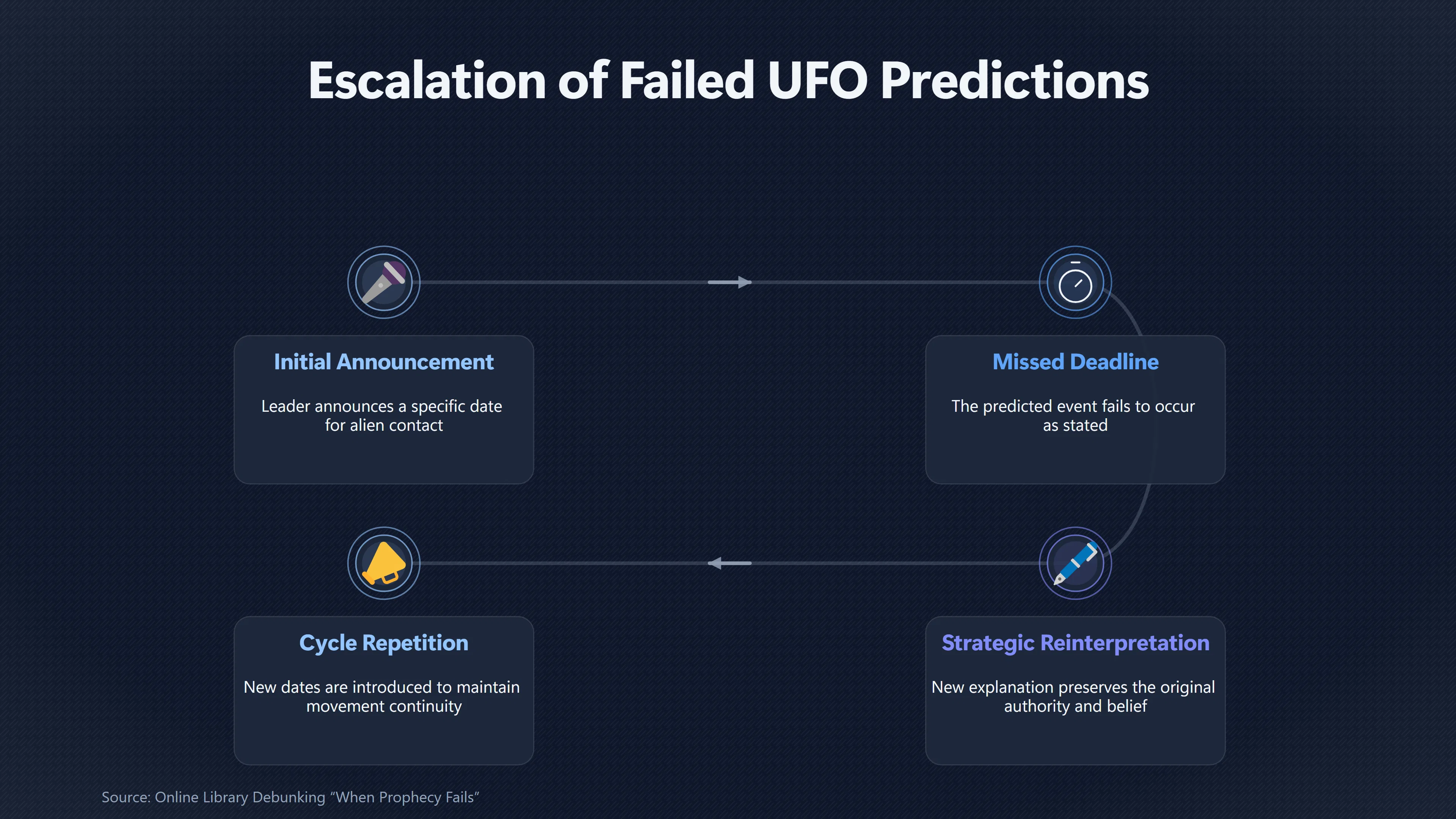
This process can produce a sequence such as:
- the predicted landing does not occur;
- the date is reinterpreted;
- a new explanation preserves the original authority;
- another date or condition is introduced;
- the cycle repeats.
Not every movement follows this path, but historical examples show that preserving leadership credibility can become an important influence on how failed predictions are explained.
Embarrassment sometimes leads to withdrawal instead
It would be misleading to assume that public commitment always produces stronger belief.
Recent historical research has challenged the traditional interpretation of the famous 1954 Dorothy Martin (“Seekers”) case described in When Prophecy Fails. Newly examined archival material argues that Martin herself recanted after the prophecy failed, her group rapidly dissolved and organised recruitment did not expand afterwards as the classic account claimed. If these findings are accepted, they demonstrate that public embarrassment can sometimes lead to withdrawal rather than renewed evangelism.[Wiley Online Library]onlinelibrary.wiley.comOnline Library Debunking “When Prophecy Fails”Wiley Online LibraryDebunking “When Prophecy Fails” - Kelly - 2026 - Journal of the History of the Behavioral Sciences - Wiley Online Lib…
More broadly, studies of prophetic movements show several possible outcomes after failure:
- leaders publicly retract the prediction;
- movements quietly fragment;
- members drift away individually;
- only a committed core remains;
- beliefs continue but are substantially reinterpreted.
The diversity of these outcomes suggests that public commitment increases the social cost of admitting error, but it does not determine how every leader or group will respond.
Why casual supporters often leave more easily
Public commitment is unevenly distributed within UFO movements.
Someone who merely shared an article or attended one meeting usually has little reputation to defend. Leaving requires relatively little explanation.
By contrast, individuals who have:
- organised public events,
- published books,
- appeared in the media,
- recruited followers, or
- repeatedly defended specific predictions
have accumulated much greater reputational investment.
This difference helps explain why visible advocates sometimes appear more resistant than ordinary followers. The social cost of changing course is simply much higher for those whose public identity became associated with the prophecy.
The broader lesson for failed UFO predictions
Public UFO warnings become difficult to retract because they are rarely just predictions. They are often public demonstrations of trust, expertise and identity. Once those elements become intertwined, admitting error may threaten relationships, status and years of personal commitment as much as the factual claim itself.
Historical research supports the idea that public commitment can make failed prophecies harder to abandon, but it also shows that responses vary considerably. Some leaders reinterpret events to preserve continuity, while others recant, withdraw from public life or see their movements dissolve. Rather than a single predictable pattern, failed UFO prophecies reveal how reputational pressure, identity and community dynamics interact differently across individuals and groups.[OUP Academic]academic.oup.comOUP AcademicHow Prophecy Never Fails | When Prophecy Never Fails: Myth and Reality in a Flying-Saucer Group | Oxford AcademicJuly 1, 2005…
Amazon book picks
Further Reading
Books and field guides related to Why Public UFO Warnings Are So Hard to Retract. Use these as the next step if you want deeper reading beyond the article.
Mistakes Were Made (but Not by Me)
Why is it so hard to say "I made a mistake"-and really believe it? When we make mistakes, cling to outdated attitudes, or mistreat other...
When Prophecy Fails
The study reported in this volume grew out of some theoretical work, one phase of which bore specifically on the behavior of individuals...
Influence
Rating: 3.9/5 from 68 Google Books ratings
This is a Summary of the original book, Influence: The Psychology of Persuasion by Robert Cialdini.The book is an authoritative work on t...
The Righteous Mind
'A landmark contribution to humanity's understanding of itself' The New York Times Why can it sometimes feel as though half the populatio...
eBay marketplace picks
Marketplace Samples
Live-tested eBay searches with available results related to this page.
Selected fromalien collectible oneBay.co.uk.




Endnotes
1.
Source: academic.oup.com
Link:https://academic.oup.com/book/7811/chapter/152989636
Source snippet
OUP AcademicHow Prophecy Never Fails | When Prophecy Never Fails: Myth and Reality in a Flying-Saucer Group | Oxford AcademicJuly 1, 2005...
Published: July 1, 2005
2.
Source: onlinelibrary.wiley.com
Title: Online Library Debunking “When Prophecy Fails”
Link:https://onlinelibrary.wiley.com/doi/full/10.1002/jhbs.70043
Source snippet
Wiley Online LibraryDebunking “When Prophecy Fails” - Kelly - 2026 - Journal of the History of the Behavioral Sciences - Wiley Online Lib...
3.
Source: academic.oup.com
Link:https://academic.oup.com/book/7811/chapter/152994882
Source snippet
OUP AcademicHow Prophecy Endures | When Prophecy Never Fails: Myth and Reality in a Flying-Saucer Group | Oxford AcademicJuly 1, 2005...
Published: July 1, 2005
4.
Source: academic.oup.com
Link:https://academic.oup.com/book/7811/chapter-abstract/152989636
Source snippet
OUP AcademicHow Prophecy Never Fails | When Prophecy Never Fails: Myth and Reality in a Flying-Saucer Group | Oxford Academic...
5.
Source: onlinelibrary.wiley.com
Title: Online Library Debunking “When Prophecy Fails”
Link:https://onlinelibrary.wiley.com/doi/10.1002/jhbs.70043
Source snippet
“When Prophecy Fails” - Kelly - 2026 - Journal of the History of the Behavioral Sciences - Wiley Online LibraryNovember 4, 2025 — Volume...
Published: November 4, 2025
6.
Source: onlinelibrary.wiley.com
Link:https://onlinelibrary.wiley.com/doi/abs/10.1002/jhbs.70043
Source snippet
“When Prophecy Fails” - Kelly - 2026 - Journal of the History of the Behavioral Sciences - Wiley Online LibraryNovember 4, 2025 — ORIGINA...
Published: November 4, 2025
7.
Source: onlinelibrary.wiley.com
Link:https://onlinelibrary.wiley.com/doi/abs/10.1002/jhbs.70043?campaign=woletoc
8.
Source: academic.oup.com
Link:https://academic.oup.com/nyu-press-scholarship-online/book/15294/chapter-abstract/169826317
9.
Source: onlinelibrary.wiley.com
Title: j.1083 6101.1997.tb00077.x
Link:https://onlinelibrary.wiley.com/doi/full/10.1111/j.1083-6101.1997.tb00077.x
10.
Source: academic.oup.com
Link:https://academic.oup.com/book/7811/chapter-abstract/152994882
11.
Source: doi.org
Title: Debunking “When Prophecy Fails”
Link:https://doi.org/10.1002%2Fjhbs.70043
12.
Source: books.google.com
Title: When Prophecy Fails
Link:https://books.google.com/books/about/When_Prophecy_Fails.html?id=GRVRvgAACAAJ
13.
Source: doi.org
Link:https://doi.org/10.1111/j.1083-6101.1997.tb00077.x
Additional References
14.
Source: newyorker.com
Link:https://www.newyorker.com/culture/the-lede/is-cognitive-dissonance-actually-a-thing
Source snippet
The theory posits that people experience psychological discomfort when confronted with contradictions between their beliefs and behaviors...
15.
Source: thedebrief.org
Link:https://thedebrief.org/alarm-bells-went-off-new-research-takes-a-critical-look-at-the-landmark-ufo-cult-study-when-prophecy-fails/
Source snippet
The DebriefNovember 13, 2025 — “ALARM BELLS WENT OFF”: NEW RESEARCH TAKES A CRITICAL LOOK AT THE LANDMARK UFO CULT STUDY ‘WHEN PROPHECY F...
Published: November 13, 2025
16.
Source: youtube.com
Title: End of Days Cults, the Day After | Cognitive Dissonance (Video Essay)
Link:https://www.youtube.com/watch?v=5yVuauQjkDc
Source snippet
The UFO Cult That Inspired Cognitive Dissonance | Dorothy Martin & The Seekers...
17.
Source: youtube.com
Title: 10 Doomsday Cults That Got It Wrong | When Prophecy Fails
Link:https://www.youtube.com/watch?v=5V6FmVS_Gr0
Source snippet
End of Days Cults, the Day After | Cognitive Dissonance (Video Essay)...
18.
Source: youtube.com
Title: When “When Prophecy Fails” Fails (E350)
Link:https://www.youtube.com/watch?v=IhblbZDXfZU
Source snippet
10 Doomsday Cults That Got It Wrong | When Prophecy Fails...
19.
Source: sfgate.com
Title: Cult Leader Was a Flop 20 Years Ago / Promised UFO failed to show
Link:https://www.sfgate.com/news/article/Cult-Leader-Was-a-Flop-20-Years-Ago-Promised-2847176.php
20.
Source: youtube.com
Title: The UFO Cult That Inspired Cognitive Dissonance | Dorothy Martin & The Seekers
Link:https://www.youtube.com/watch?v=vvFV1v8l-PI
21.
Source: youtube.com
Title: 235-Leon Festinger and the Alien Apocalypse
Link:https://www.youtube.com/watch?v=fy06VDrnh7A
Source snippet
When “When Prophecy Fails” Fails (E350)...
22.
Source: online.ucpress.edu
Title: Prophecy and Dissonance A Reassessment of Research
Link:https://online.ucpress.edu/nr/article-abstract/12/4/72/70185/Prophecy-and-Dissonance-A-Reassessment-of-Research?redirectedFrom=fulltext
23.
Source: sciencedirect.com
Title: When Festinger Fails: Prophecy and the Watch Tower
Link:https://www.sciencedirect.com/science/article/pii/S0048721X84710256