Within Telescope Test
Could That Telescope Really Settle the Hale Bopp Claim?
Without agreed targets, settings and detection limits, the observation could not function as a decisive test of the companion claim.
On this page
- What an optical detection would require
- Unknown viewing conditions and equipment settings
- Why casual observation differs from a controlled test
Page outline Jump by section
Introduction
The reported telescope observation associated with the Hale–Bopp companion claim is often described as though it should have settled the question. In reality, it could only have answered a much narrower one: whether a particular observer, using a particular telescope under unknown conditions, could see an obvious object near the comet. It could not conclusively prove that no companion existed, nor could its failure to reveal one confirm that a companion was present but hidden.
This distinction matters because the episode is frequently cited in discussions of failed UFO predictions. A telescope can decisively test a claim only when the object being sought, the observing conditions, the equipment, and the required detection threshold are all defined in advance. None of those elements were publicly documented in this case, making the reported observation far less conclusive than later retellings sometimes suggest.[European Southern Observatory]eso.orgEuropean Southern Observatory Hale-Bopp companions?!?European Southern Observatory Hale-Bopp companions?!?
What an optical detection would require
Astronomers routinely evaluate whether an observation is capable of detecting a proposed object. That assessment depends on several measurable factors rather than simply whether someone looked through a telescope.
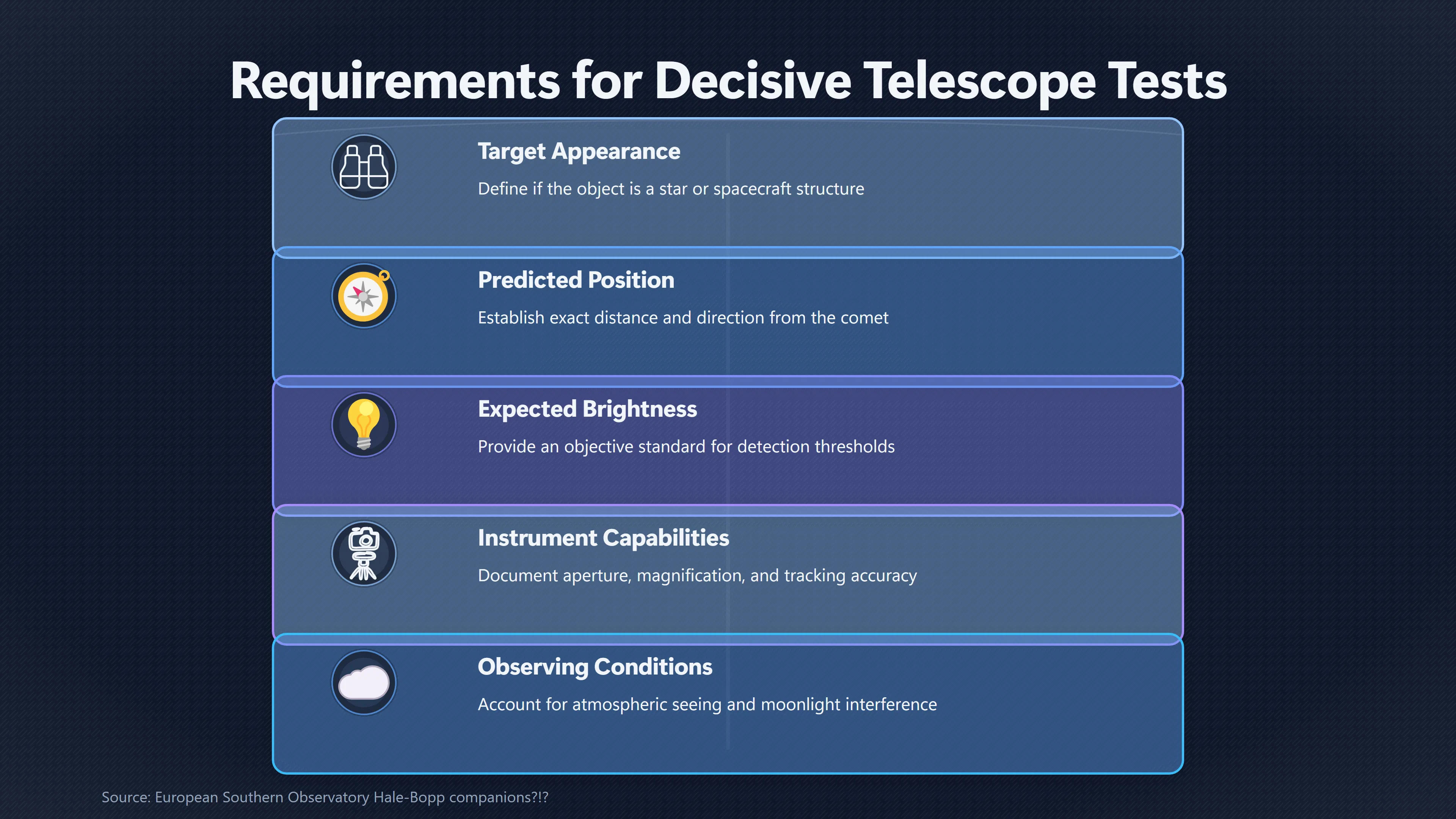
For a telescope observation to serve as a decisive test, investigators would normally need to know:
- The expected appearance of the target. Was the alleged companion supposed to resemble a bright star, a faint diffuse object, or an extended spacecraft-like structure?
- Its predicted position. How far from Hale–Bopp was it expected to appear, and in what direction?
- Its expected brightness. Without a predicted brightness, there is no objective standard for determining whether the telescope should have been able to detect it.
- The instrument’s capabilities. Aperture, magnification, eyepieces, tracking accuracy and optical quality all influence what can be seen.
- Observing conditions. Atmospheric seeing, transparency, moonlight, light pollution and the comet’s altitude above the horizon affect visibility.
Professional astronomical observations routinely document these variables because a non-detection is only meaningful when the observation’s sensitivity is known. A statement that “nothing was seen” has limited scientific value without knowing what the equipment was actually capable of detecting under the conditions at the time.[Cambridge University Press]cambridge.orgCambridge University PressThe Modern Role of Visual Observations of Comets | International Astronomical Union Colloquium | Cambridge Core…
Unknown viewing conditions and equipment settings
The commonly repeated account of the Heaven’s Gate telescope purchase does not include the kind of technical documentation that would allow later observers to evaluate the result scientifically.
Public accounts do not provide:
- an observing log recording date, time and location;
- sky conditions during the observation;
- the eyepiece or magnification used;
- whether the telescope had been properly aligned or focused;
- how long the observers searched;
- whether experienced astronomers independently verified the observation.
These omissions do not mean the observation was inaccurate. They simply mean that its sensitivity cannot now be reconstructed. Without that information, it is impossible to determine whether the observation would have detected a hypothetical object of any particular size or brightness.
This contrasts with normal astronomical practice, where observations intended to establish or rule out an object are accompanied by enough technical information for others to evaluate or repeat the result.[Cambridge University Press]cambridge.orgCambridge University PressThe Modern Role of Visual Observations of Comets | International Astronomical Union Colloquium | Cambridge Core…

Why casual observation differs from a controlled test
A casual telescope viewing session and a controlled astronomical observation answer different questions.
A controlled test begins with a precise prediction. Observers specify where an object should appear, what its expected characteristics are, and what detection limit the equipment can achieve. If the object is absent above that threshold, the non-detection meaningfully constrains the claim.
The reported Hale–Bopp observation lacked those features. Instead, it appears to have been an attempt to look for an alleged companion without an agreed specification of what qualified as success or failure.
This distinction is especially important because comets themselves are visually challenging objects. Their bright, diffuse comae, changing brightness and extended tails can make nearby faint objects difficult to distinguish visually. Experienced comet observers emphasise that visual appearance depends strongly on telescope aperture, magnification, sky quality and the observer’s technique.[British Astronomical Association]britastro.orgOpen source on britastro.org.
What the observation could reasonably test
Despite its limitations, the reported telescope check was not meaningless.
If the alleged companion had been an extremely bright, nearby object of the kind promoted in some public claims, a competent observation with a suitable telescope would be expected to reveal something unusual. Failure to see such an obvious object would count against that specific version of the claim.
However, the observation could not eliminate every possible reformulation. If believers asserted that the object was:
- too faint to detect,
- hidden by unknown technology,
- visible only under special conditions, or
- intentionally undetectable,
then the observation no longer functioned as a decisive empirical test. The claim had effectively been altered so that ordinary optical observation could neither confirm nor falsify it.
This illustrates a broader feature of failed UFO predictions: observational tests are only decisive when both supporters and critics agree beforehand on what outcome would count as confirmation or refutation.

The broader lesson for evaluating failed UFO claims
The Hale–Bopp telescope episode demonstrates that an observation’s evidential value depends as much on its design as on its outcome.
The reported telescope check provided anecdotal evidence that no obvious companion was seen under the circumstances of that viewing. What it did not provide was a documented scientific observation with defined detection limits, independent verification or a reproducible observing record. Consequently, it could neither conclusively disprove every version of the companion claim nor compel believers to abandon it.
That limited evidential power helps explain why the reported failure did not end the Hale–Bopp belief. The telescope observation addressed only whether one particular search located an optically visible companion. It did not establish the broader proposition that every conceivable companion claim had been tested, and once the alleged spacecraft was reframed as something not necessarily detectable by ordinary optical means, the observation ceased to function as a decisive test of the belief itself.[eso.org]eso.orgEuropean Southern Observatory Hale-Bopp companions?!?European Southern Observatory Hale-Bopp companions?!?
Amazon book picks
Further Reading
Books and field guides related to Could That Telescope Really Settle the Hale Bopp Claim?. Use these as the next step if you want deeper reading beyond the article.
The Demon-Haunted World: Science as a Candle in the Dark
Rating: 4.5/5 from 43 Google Books ratings
NEW YORK TIMES BESTSELLER • From the renowned astronomer and author of Cosmos comes a “powerful [and] stirring defense of informed ration...
Bad Astronomy
A clever, thought-provoking guide that attacks common astronomical misconceptions What is Bad Astronomy? Anything that accidentally or in...
The Demon-Haunted World
Rating: 4.5/5 from 43 Google Books ratings
NEW YORK TIMES BESTSELLER • From the renowned astronomer and author of Cosmos comes a “powerful [and] stirring defense of informed ration...
The UFO Experience: A Scientific Inquiry
Cited by the New York Review of Books as "the best brief for visitation," this classic study presents an analysis of UFO reports and conc...
eBay marketplace picks
Marketplace Samples
Live-tested eBay searches with available results related to this page.
Selected fromtelescope eyepiece oneBay.co.uk.
Endnotes
1.
Source: eso.org
Title: European Southern Observatory Hale-Bopp companions?!?
Link:https://www.eso.org/~ohainaut/Hale_Bopp/hb_ufo.html
2.
Source: britastro.org
Link:https://britastro.org/2022/estimating-the-coma-size-and-brightness-of-comets
3.
Source: cambridge.org
Link:https://www.cambridge.org/core/journals/international-astronomical-union-colloquium/article/modern-role-of-visual-observations-of-comets/41CFF640A94C9EE72A7FC7C376D00DD4
Source snippet
Cambridge University PressThe Modern Role of Visual Observations of Comets | International Astronomical Union Colloquium | Cambridge Core...
4.
Source: britastro.org
Title: The visual observation of comets – British Astronomical Association
Link:https://britastro.org/2018/the-visual-observation-of-comets
Source snippet
June 16, 2018 — 2018 June 16 THE VISUAL OBSERVATION OF COMETS Jonathan Shanklin Electronic imaging is now the mainstream of amateur obser...
Published: June 16, 2018
5.
Source: eso.org
Link:https://eso.org/public/news/eso0108/
6.
Source: eso.org
Title: Comet Hale-Bopp
Link:https://eso.org/public/news/eso9933/
7.
Source: eso.org
Title: Hale-Bopp companions?!?
Link:https://www.eso.org/~ohainaut/Hale_Bopp/hb_ufo_tholen.html
8.
Source: eso.org
Title: Hale-Bopp companions?!?
Link:https://www.eso.org/~ohainaut/Hale_Bopp/hb_ufo_list.html
9.
Source: hq.eso.org
Link:https://www.hq.eso.org/public/news/eso9627/
10.
Source: eso.org
Title: First NTT Image of Comet Hale-Bopp after Solar Conjunction | ESO Polska
Link:https://www.eso.org/public/poland/news/eso9609/
11.
Source: eso.org
Link:https://eso.org/public/news/eso9524/
12.
Source: eso.org
Link:https://eso.org/public/news/eso9523/
13.
Source: eso.org
Link:https://eso.org/public/news/eso9520/
14.
Source: imo.net
Link:https://www.imo.net/observations/methods/visual-observation/major/observation/
Additional References
15.
Source: academic.oup.com
Title: We used the standard procedure to derive detection limits outside th
Link:https://academic.oup.com/mnras/article/513/4/5588/6583003
Source snippet
from The COPAINS Pilot Survey: four new BDs and a high companion detection rate for accelerating stars | Monthly Notices of the Royal Ast...
16.
Source: academic.oup.com
Link:https://academic.oup.com/mnras/advance-article/doi/10.1093/mnras/stac3527/6880175
Source snippet
Starting with the direct images, we mask detected companions (where relevant) place as many non...
17.
Source: academic.oup.com
Title: By injecting the companions into the raw frames we
Link:https://academic.oup.com/mnras/article/455/2/2178/1114392
Source snippet
Reduction and Analysis Pipeline for High-contrast Imaging of planetary Companions | Monthly Notices of the Royal Astronomical Society | O...
18.
Source: youtube.com
Link:https://www.youtube.com/watch?v=qnL2EvRqYzk
Source snippet
The Comet Cult: The Strange Story of Heaven’s Gate and the Hale-Bopp Tragedy...
19.
Source: youtube.com
Title: Hale-Bopp: The Comet That Captivated a Generation
Link:https://www.youtube.com/watch?v=PFLhy4dUzdc
Source snippet
Comet Hale Bopp UFO companion Art Bell Hale-Bopp Anomaly Saga 1996-1997: Art Bell Interviews Dr Courtney Brown, Farsight Institute...
20.
Source: youtube.com
Title: The Comet Cult: The Strange Story of Heaven’s Gate and the Hale-Bopp Tragedy
Link:https://www.youtube.com/watch?v=wgzEa9HH9aU
Source snippet
How 39 People Believed a Comet Would Save Them...
21.
Source: space.com
Title: 19931 hale bopp
Link:https://www.space.com/19931-hale-bopp.html
Source snippet
Hale-Bopp: The Bright and Tragic Comet of the 1990s | SpaceFebruary 9, 2022 — COMET HALE-BOPP: FACTS ABOUT THE BRIGHT AND TRAGIC COMET Re...
Published: February 9, 2022
22.
Source: youtube.com
Title: How 39 People Believed a Comet Would Save Them
Link:https://www.youtube.com/watch?v=EqdGT3qBrmE
Source snippet
What Really Happened in the Heaven's Gate Cult? (REUPLOAD)...
23.
Source: researchgate.net
Link:https://www.researchgate.net/publication/14139766_Optical_Observations_of_Comet_Hale-Bopp_C1995_O1_at_Large_Heliocentric_Distances_Before_Perihelion
24.
Source: researchgate.net
Link:https://www.researchgate.net/publication/234315797_Adaptive_optics_observations_of_the_innermost_coma_of_C1995_O1_Are_there_a_Hale%27%27_and_aBopp%27%27_in_comet_Hale-Bopp