Within Irreversible Risk
How Small Sacrifices Build Toward an Irreversible Choice
Earlier losses of relationships, possessions and identity can make rejecting a final prophecy feel more costly than continuing toward it.
On this page
- The step by step pattern of escalating commitment
- Why previous sacrifices can trap people psychologically
- How to distinguish devotion from dangerous finality
Page outline Jump by section
Introduction
One reason failed prophetic movements can become increasingly dangerous is that members may feel they have already sacrificed too much to turn back. Within the specific context of unfalsifiable UFO beliefs, the danger is not simply commitment to an extraordinary claim. It is the gradual accumulation of personal losses—relationships, careers, possessions, identity and previous public commitments—that can make abandoning the belief feel more psychologically painful than continuing. Research in psychology describes this pattern as escalation of commitment: people often continue investing in a failing course of action because of what they have already invested, even when new evidence points the other way.[psychologicalscience.org]psychologicalscience.orgPsychological Science AssociationWhen Action-Inaction Framing Leads to Higher Escalation of Commitment: A New Inaction-Effect Perspective…
Heaven’s Gate illustrates this mechanism with unusual clarity. By the time the group’s final teachings connected Comet Hale–Bopp with departure to the “Next Level”, many members had spent years reorganising their entire lives around the movement. Those earlier sacrifices did not cause the group’s fatal ending by themselves, but they made the psychological cost of leaving far higher than it would have been for a newcomer.[OUP Academic]academic.oup.comOUP AcademicScience and the End of Heaven’s Gate | Prophets and Protons: New Religious Movements and Science in Late Twentieth-Century Am…
The Step-by-Step Pattern of Escalating Commitment
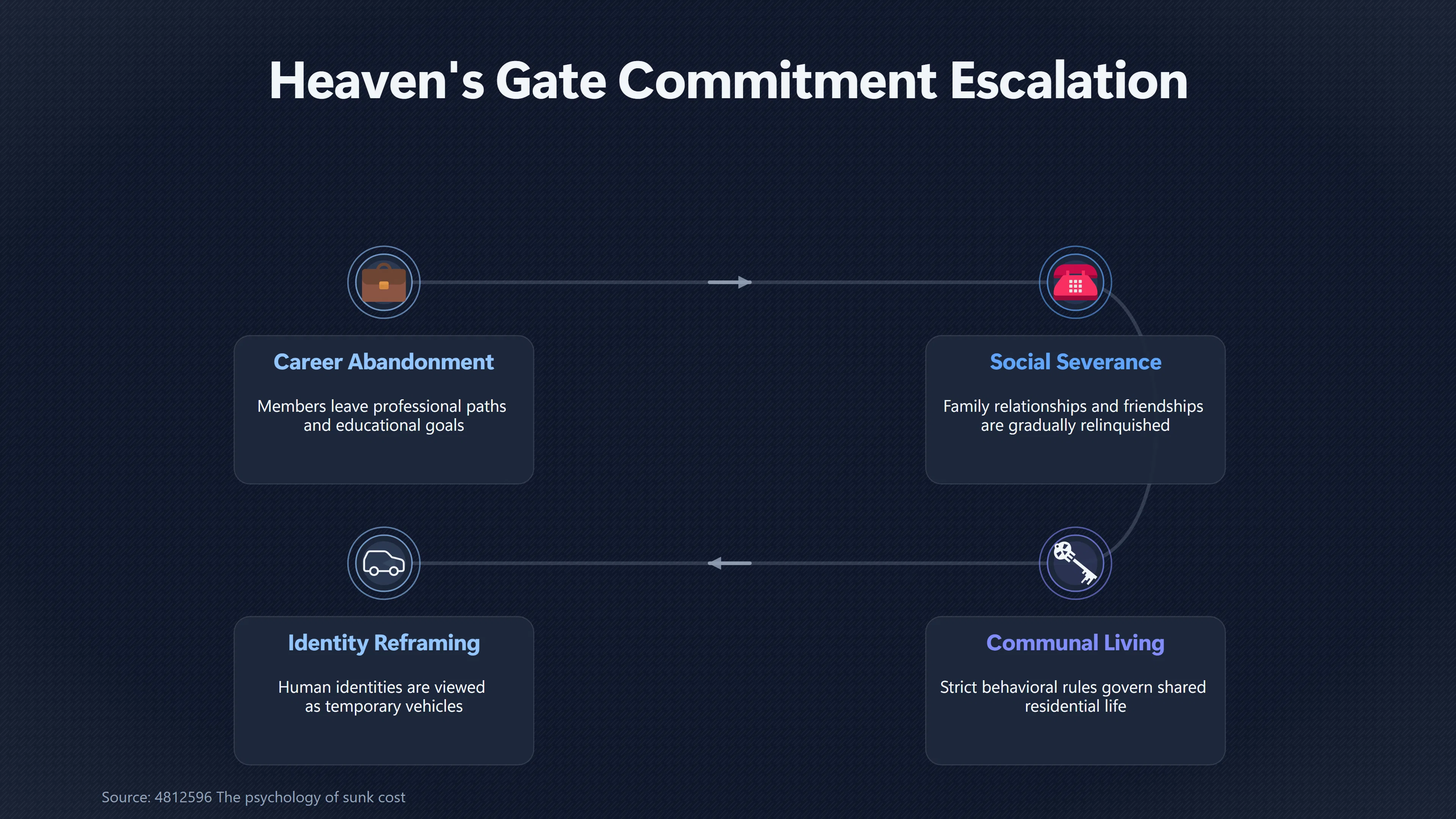
High-control movements rarely begin by asking for irreversible acts. Instead, commitments tend to increase gradually, with each step making the next seem more reasonable.
In Heaven’s Gate, members progressively accepted demands that separated them from ordinary social life. These included:
- Leaving careers or educational paths.
- Giving up many family relationships and friendships.
- Living communally under strict behavioural rules.
- Accepting celibacy as part of becoming “Next Level” beings.
- Reframing their previous identities as temporary human “vehicles” rather than their true selves.[OUP Academic]academic.oup.comOUP AcademicScience and the End of Heaven’s Gate | Prophets and Protons: New Religious Movements and Science in Late Twentieth-Century Am…
None of these individual decisions necessarily predetermined the group’s final actions. Many people make major life changes without coming to harm. The critical feature was that each sacrifice increased dependence upon the belief system that justified it.
Behavioural research shows that people frequently continue investing after negative evidence appears because abandoning the project would force them to admit that previous investments of time, effort and identity cannot be recovered. This is the classic sunk-cost effect and one of the best-studied forms of escalation of commitment.[researchgate.net]researchgate.netResearchGate(PDF) A conceptualisation of task dimensions affecting escalation of commitmentNovember 1, 2005…
Why Previous Sacrifices Can Become Psychological Traps
The pressure created by earlier sacrifices is not mainly financial. It is often emotional and social.
For someone who has reorganised an entire life around a movement, leaving may require acknowledging losses such as:
- Years devoted to a prediction that failed.
- Estrangement from family members.
- Abandoned careers or education.
- Public declarations that now appear mistaken.
- A social identity built almost entirely inside the group.
At that stage, the question is no longer simply, “Is the prediction true?” It also becomes, “If I leave now, what was the point of everything I have already sacrificed?”
Psychological studies show that people frequently respond to this discomfort through self-justification rather than re-evaluation. Earlier commitments become reasons to make still larger commitments, producing a cycle in which each sacrifice increases the perceived need to validate previous ones.[columbia.edu]business.columbia.eduColumbia Business SchoolVicarious entrapment: Your sunk costs, my escalation of commitment | Columbia Business School…
This mechanism helps explain why failed predictions do not always weaken commitment. For some followers, failure can actually increase the need to believe that previous sacrifices were meaningful.
Heaven’s Gate as a Concrete Example
Heaven’s Gate demonstrates how accumulated commitments can narrow perceived alternatives without making departure literally impossible.
Members had already accepted years of demanding lifestyle changes before the group’s final teachings. They had embraced celibacy, adopted communal discipline, and often distanced themselves from former identities and relationships. These earlier decisions created a life increasingly centred on the group’s interpretation of reality.[OUP Academic]academic.oup.comOUP AcademicScience and the End of Heaven’s Gate | Prophets and Protons: New Religious Movements and Science in Late Twentieth-Century Am…
The death of co-founder Bonnie Nettles in 1985 also forced a major reinterpretation of earlier expectations. Rather than abandoning the movement after an apparent contradiction, the group’s theology shifted so that physical death itself became compatible with reaching the “Next Level”. That doctrinal adjustment allowed previous sacrifices to retain their meaning instead of becoming evidence that the original expectations had failed.[OUP Academic]academic.oup.comOUP AcademicScience and the End of Heaven’s Gate | Prophets and Protons: New Religious Movements and Science in Late Twentieth-Century Am…
By the time Hale–Bopp became the final prophetic marker, members were not deciding in isolation whether one prediction was convincing. Many had invested years constructing an entirely new identity around the movement, making withdrawal psychologically far more costly than it would have appeared from the outside.
Distinguishing Devotion from Dangerous Finality
Personal sacrifice is not, by itself, evidence that a belief system is dangerous. People willingly make significant sacrifices for military service, humanitarian work, religious vocations, scientific research and family responsibilities.
The warning signs emerge when sacrifices become mechanisms that discourage independent reassessment.
Important distinctions include:
- Healthy commitment allows members to question teachings without losing their entire identity or social world.
- Healthy communities permit people to leave without treating departure as moral failure or betrayal.
- Evidence-based commitments can be revised when predictions fail.
- Dangerous systems reinterpret every contradiction so that greater sacrifice becomes the prescribed response rather than renewed evaluation.
When previous losses become arguments for making even larger sacrifices, the belief system is no longer simply asking for dedication. It is using past commitment to make future withdrawal increasingly difficult.
Why This Mechanism Matters for Failed UFO Predictions
Within movements built around failed UFO prophecies, escalating commitment helps explain why disconfirmed predictions do not always lead to collapse. If believers have invested little, a failed prediction may simply be disappointing. If they have surrendered relationships, careers, possessions and personal identity, abandoning the belief may feel like accepting that those sacrifices were unnecessary.
That does not mean every disappointed believer responds by deepening commitment. Many people leave after failed prophecies. However, behavioural research suggests that substantial sunk costs can make persistence psychologically attractive, especially when leaders reinterpret failures instead of acknowledging them.[researchgate.net]researchgate.netResearchGate(PDF) A conceptualisation of task dimensions affecting escalation of commitmentNovember 1, 2005…
Heaven’s Gate shows the extreme end of this process. The group’s history illustrates how years of incremental sacrifices, combined with doctrines that absorbed every apparent contradiction, reduced the psychological appeal of leaving precisely when independent evaluation was most needed. The resulting danger lay not in belief about UFOs alone, but in a structure where accumulated personal costs made continued commitment feel easier than reversing course, even as the final demands became irreversible.
Amazon book picks
Further Reading
Books and field guides related to How Small Sacrifices Build Toward an Irreversible Choice. Use these as the next step if you want deeper reading beyond the article.
Mistakes Were Made (but Not by Me)
Why is it so hard to say "I made a mistake"-and really believe it? When we make mistakes, cling to outdated attitudes, or mistreat other...
Influence
Rating: 3.9/5 from 68 Google Books ratings
This is a Summary of the original book, Influence: The Psychology of Persuasion by Robert Cialdini.The book is an authoritative work on t...
The Believing Brain
Synthesizing thirty years of research, psychologist and science historian, Michael Shermer upends the traditional thinking about how huma...
eBay marketplace picks
Marketplace Samples
Live-tested eBay searches with available results related to this page.
Selected fromUFO poster oneBay.co.uk.

Current eBay listing
VINTAGE UFO FLYING SAUCERS COMIC ADVERTISING A2 POSTER PRINT



Current eBay listing
I Want To Believe UFO Poster Giclée Fine Art Heavyweight Print
Endnotes
1.
Source: business.columbia.edu
Link:https://business.columbia.edu/faculty/research/vicarious-entrapment-your-sunk-costs-my-escalation-commitment
Source snippet
Columbia Business SchoolVicarious entrapment: Your sunk costs, my escalation of commitment | Columbia Business School...
2.
Source: academic.oup.com
Link:https://academic.oup.com/nyu-press-scholarship-online/book/15294/chapter-abstract/169826666
Source snippet
OUP AcademicScience and the End of Heaven’s Gate | Prophets and Protons: New Religious Movements and Science in Late Twentieth-Century Am...
3.
Source: researchgate.net
Link:https://www.researchgate.net/publication/247497592_A_conceptualisation_of_task_dimensions_affecting_escalation_of_commitment
Source snippet
ResearchGate(PDF) A conceptualisation of task dimensions affecting escalation of commitmentNovember 1, 2005...
Published: November 1, 2005
4.
Source: academic.oup.com
Link:https://academic.oup.com/dsh/article-abstract/37/1/137/6291823
Source snippet
of the writing of ‘suicide cult’ members | Digital Scholarship in the Humanities | Oxford AcademicJune 3, 2021 —...
Published: June 3, 2021
5.
Source: academic.oup.com
Link:https://academic.oup.com/book/34788/chapter-abstract/297612444
Source snippet
Martyrdom and Religious Suicide: The Branch Davidians and Heaven’s Gate | Martyrdom, Self-Sacrifice, and Self-Immolation: Religious Persp...
6.
Source: researchgate.net
Link:https://www.researchgate.net/publication/232551826_Throwing_Good_Money_After_Bad_The_Effect_of_Sunk_Costs_on_the_Decision_to_Escalate_Commitment_to_an_Ongoing_Project
7.
Source: researchgate.net
Title: 4812596 The psychology of sunk cost
Link:https://www.researchgate.net/publication/4812596_The_psychology_of_sunk_cost
8.
Source: researchgate.net
Link:https://www.researchgate.net/publication/232483675_De-Escalation_of_Commitment_in_Oil_Exploration_When_Sunk_Costs_and_Negative_Feedback_Coincide
9.
Source: researchgate.net
Link:https://www.researchgate.net/publication/368713983_Costly_Commitments_Under_His_Eye_Reconceptualizing_the_Costly_Signaling_Theory_of_Religion
10.
Source: researchgate.net
Link:https://www.researchgate.net/publication/249981944_Scaling_Heaven%27s_Gate_Individualism_and_Salvation_in_a_New_Religious_Movement
11.
Source: researchgate.net
Link:https://www.researchgate.net/publication/248594786_Reconceptualising_the_human_body_Heaven%27s_Gate_and_the_quest_for_divine_transformation
12.
Source: psychologicalscience.org
Link:https://www.psychologicalscience.org/journals/psychological-science/0956797617739368/
Source snippet
Psychological Science AssociationWhen Action-Inaction Framing Leads to Higher Escalation of Commitment: A New Inaction-Effect Perspective...
13.
Source: pubmed.ncbi.nlm.nih.gov
Link:https://pubmed.ncbi.nlm.nih.gov/11302222/
14.
Source: pubmed.ncbi.nlm.nih.gov
Link:https://pubmed.ncbi.nlm.nih.gov/29401001/
15.
Source: pubmed.ncbi.nlm.nih.gov
Link:https://pubmed.ncbi.nlm.nih.gov/21106888/
16.
Source: pubmed.ncbi.nlm.nih.gov
Link:https://pubmed.ncbi.nlm.nih.gov/41261385/
17.
Source: pubmed.ncbi.nlm.nih.gov
Link:https://pubmed.ncbi.nlm.nih.gov/15779532/
Additional References
18.
Source: pmc.ncbi.nlm.nih.gov
Link:https://pmc.ncbi.nlm.nih.gov/articles/PMC5904751/
Source snippet
2018 Feb 5;29(4):537–548. doi: 10.1177/0956797617739368 WHEN ACTION-INACTION FRAMING LEADS TO HIGHER ESCALATION OF COMMITMENT: A NEW INAC...
19.
Source: youtube.com
Title: Sunk Cost Fallacy Explained: Why You Should QUIT and Cut Your Losses
Link:https://www.youtube.com/watch?v=Pd8Z_NzTDM0
Source snippet
Videos inside Heaven's Gate house reveal those lured into cult...
20.
Source: tandfonline.com
Link:https://www.tandfonline.com/doi/abs/10.1080/09541440540000004
21.
Source: sciencedirect.com
Link:https://www.sciencedirect.com/science/article/abs/pii/S0749597885710291
22.
Source: sciencedirect.com
Link:https://www.sciencedirect.com/science/article/abs/pii/0140175085900351
23.
Source: youtube.com
Title: Why Smart People Still Fall For Cults
Link:https://www.youtube.com/watch?v=qd-zX09iJQs
Source snippet
Sunk Cost Fallacy Explained: Why You Should QUIT and Cut Your Losses...
24.
Source: sciencedirect.com
Link:https://www.sciencedirect.com/science/article/abs/pii/S0048721X0500028X
25.
Source: sciencedirect.com
Link:https://www.sciencedirect.com/science/article/pii/S0048721X0500028X
26.
Source: doi.org
Link:https://doi.org/10.1111/j.1083-6101.1997.tb00077.x
27.
Source: onlinelibrary.wiley.com
Link:https://onlinelibrary.wiley.com/doi/10.1111/sltb.70059
Source snippet
Before their deaths, many members left videotaped final messages (“exit statements”), recording a functional eq...