Within Disaster Averted
What Would Count as Proof of Prevention?
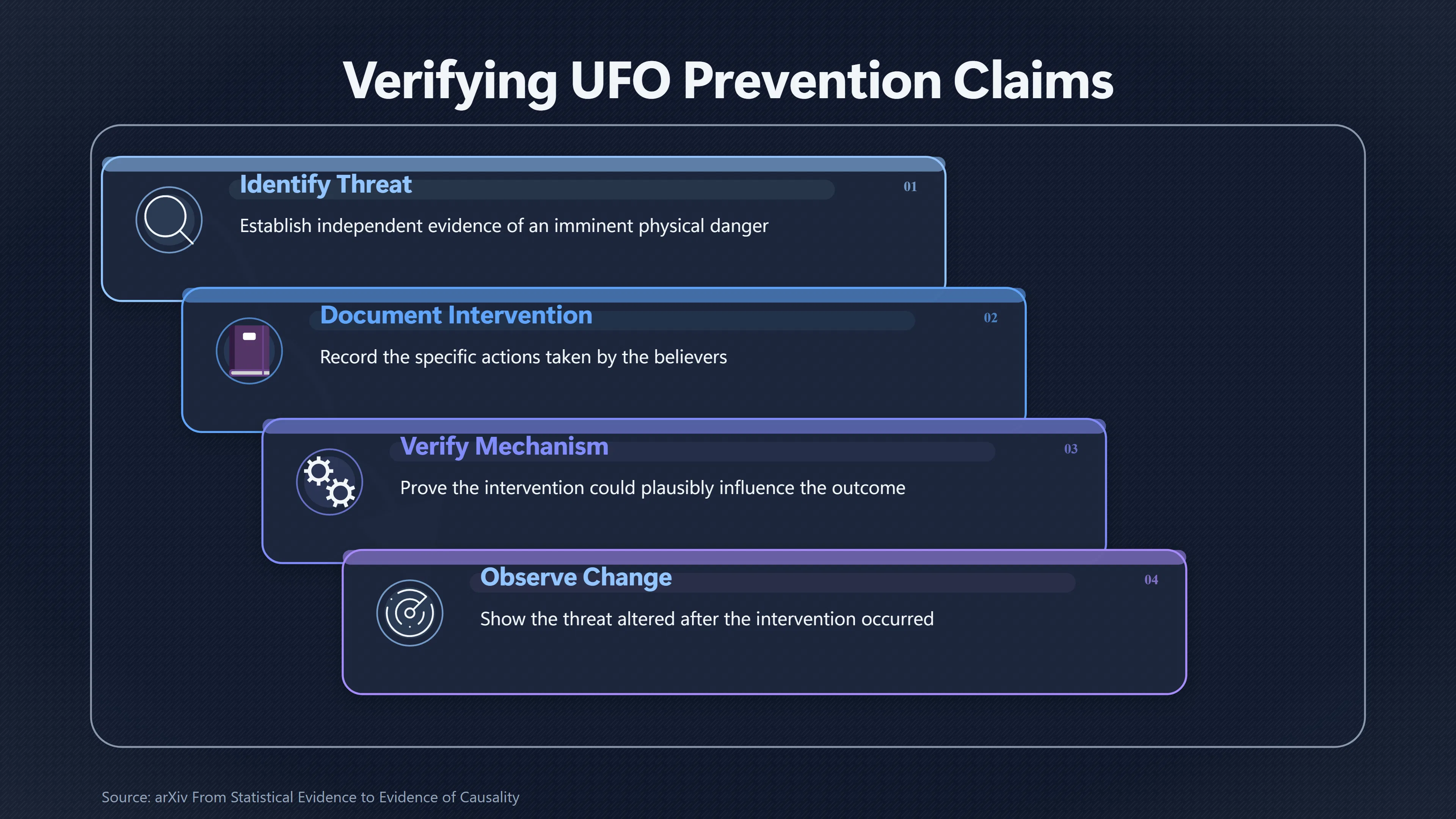
A credible prevention claim needs independent evidence of the threat, intervention, mechanism and likely outcome without intervention.
On this page
- Evidence that the danger was real
- Evidence that the intervention changed the outcome
- Why independent verification matters
Page outline Jump by section
Introduction
Claims that a predicted UFO-related catastrophe was prevented by prayer, faith, meditation or collective spiritual action face a fundamental evidential problem: the predicted disaster never occurred. By itself, that non-occurrence does not show whether a genuine threat was averted or whether no such threat existed in the first place. To establish that a disaster was actually prevented, a claimant would need evidence for four separate propositions: that a real danger existed, that a specific intervention took place, that the intervention could plausibly affect the danger, and that the outcome would probably have been worse without it. Without this chain of evidence, the claim remains an unverified counterfactual—a statement about an alternative history that cannot simply be inferred from the absence of the predicted event.
Within the history of failed UFO prophecies, this distinction is crucial. A prediction that fails does not become successful merely because believers later argue that their actions changed the future. Instead, the burden shifts to demonstrating that prevention, rather than prediction failure, best explains the outcome.
How a Prevention Claim Could Be Tested
Unlike a simple prediction (“a catastrophe will occur”), a prevention claim is a causal claim. It argues that one event changed another. Demonstrating causation requires substantially more evidence than demonstrating coincidence.
A credible prevention claim would need to satisfy four linked questions:
- Was the danger independently real?
- Did the claimed intervention actually occur?
- Is there evidence that the intervention could influence the outcome?
- Is there good reason to think the disaster would otherwise have happened?
Failure at any one stage leaves the prevention claim unsupported.
Evidence That the Danger Was Real
The first requirement is independent confirmation that the threatened catastrophe genuinely existed before believers intervened.
This evidence cannot consist solely of the original prophecy, channelling, automatic writing or messages allegedly received from extraterrestrials. Those are the claims under examination, not independent confirmation.
Examples of stronger evidence would include:
- independently observed physical phenomena indicating imminent danger;
- measurements from multiple unrelated investigators;
- documented natural processes already underway;
- evidence available before the prediction deadline rather than reconstructed afterwards.
This mirrors how genuine disaster prevention is evaluated in ordinary contexts. When a dam is evacuated before failure, engineers can inspect structural damage. When a hurricane warning prompts evacuation, meteorological observations document the approaching storm. The hazard exists independently of the warning itself.
By contrast, most UFO-related catastrophe predictions rely entirely on the authority of the person making the prediction. If no objective evidence of the impending disaster can be found, it becomes impossible to distinguish “a disaster was prevented” from “there never was a disaster.”
Evidence That the Intervention Changed the Outcome
Even if an independently verified danger existed, the next question would be whether the claimed intervention altered events.
In principle, this would require evidence such as:
- a clearly documented intervention occurring before the outcome;
- an observable change following that intervention;
- exclusion of more ordinary explanations;
- a plausible causal pathway connecting the intervention to the outcome.
This is considerably more demanding than simply noting that believers prayed, meditated or gathered together.
For example, if an asteroid genuinely altered course after a measurable physical interaction, astronomers could calculate the change in its trajectory. Likewise, if engineers repaired a failing bridge before collapse, inspection records could show which repairs removed the danger.
Belief-based prevention claims generally lack this intermediate evidence. The intervention is assumed to have worked because the predicted catastrophe did not happen, rather than demonstrated through independently measurable changes.
Why the Counterfactual Is So Difficult
The greatest obstacle is that prevention claims depend on a counterfactual: what would have happened had believers done nothing.
Modern causal inference attempts to estimate such alternative outcomes using comparison groups, natural experiments and statistical modelling, but even sophisticated methods depend upon measurable interventions and observable variables. They cannot directly establish claims involving unobservable spiritual forces or extraterrestrial intentions.[arXiv]arxiv.orgAn Exact and Robust Conformal Inference Method for Counterfactual and Synthetic ControlsDecember 25, 2017…
This is why statements such as:
- “The world would have been destroyed.”
- “The aliens cancelled the catastrophe.”
- “Our collective consciousness saved humanity.”
cannot be verified simply because history followed the safer outcome.
The missing timeline—the one in which believers supposedly failed to intervene—cannot be observed directly.
Why Independent Verification Matters
Independent evidence serves two important purposes.
First, it prevents circular reasoning.
A circular argument looks like this:
- The prediction was true because the disaster was prevented.
- We know the disaster was prevented because the prediction was true.
No outside evidence enters the reasoning.
Independent verification instead requires information that does not originate with the prediction itself or its supporters.
Second, independence reduces confirmation bias. People naturally interpret ambiguous outcomes in ways that preserve important beliefs. For controversial claims—especially extraordinary ones—science and historical investigation therefore rely on evidence from multiple unrelated sources rather than repeated assertions from a single community.[arXiv]arxiv.orgarXiv Fact or Fiction: Verifying Scientific ClaimsFact or Fiction: Verifying Scientific ClaimsApril 30, 2020…
Applying These Standards to UFO Prophecy Claims
The classic UFO prophecy associated with Dorothy Martin illustrates the evidential challenge.
Following the failure of the predicted flood and extraterrestrial rescue in December 1954, the movement became associated with the idea that the group’s spiritual devotion had saved the Earth. Regardless of continuing historical debate over exactly how the episode unfolded and later reinterpretations of the original study, the prevention claim itself lacks the evidential chain required to establish that a catastrophe was actually averted.[Wiley Online Library]onlinelibrary.wiley.comOnline Library Debunking “When Prophecy Fails”Wiley Online LibraryDebunking “When Prophecy Fails” - Kelly - 2026 - Journal of the History of the Behavioral Sciences - Wiley Online Lib…
Specifically, there is no independently verified evidence that:
- an Earth-destroying flood was imminent;
- extraterrestrial beings had advance knowledge of such an event;
- collective spiritual activity measurably altered any physical process;
- the catastrophe would otherwise have occurred.
The absence of these elements means the non-occurrence of the predicted disaster is more simply explained as a failed prediction than as a demonstrated successful intervention.

What Would Convincingly Demonstrate Prevention?
A genuinely persuasive prevention claim would require all of the following:
- Independent evidence of an actual impending threat, documented before the prediction deadline.
- Clear documentation of the alleged intervention, including when and how it occurred.
- A credible mechanism explaining how the intervention could influence the threat.
- Independent observations showing the threat changed after the intervention.
- Strong evidence that, without the intervention, the harmful outcome was likely.
This is a demanding standard, but it is the same standard applied whenever people claim to have prevented disasters through engineering, medicine, emergency management or other interventions. The stronger the causal claim, the stronger the required evidence.
Why Non-Occurrence Alone Is Not Enough
The fact that a predicted UFO-related catastrophe never happened cannot by itself establish that believers prevented it. The same observation is compatible with several competing explanations:
- the original prediction was mistaken;
- the predicted threat never existed;
- the prediction was based on faulty information;
- the prediction was intentionally fabricated;
- the claimed intervention prevented the disaster.
Because all of these explanations fit the single observed outcome—that no catastrophe occurred—the outcome alone cannot distinguish between them. Only independent evidence supporting the entire causal chain from threat to intervention to changed outcome could demonstrate that a disaster was genuinely averted. Without that evidence, prevention claims remain assertions rather than verified explanations.
Amazon book picks
Further Reading
Books and field guides related to What Would Count as Proof of Prevention?. Use these as the next step if you want deeper reading beyond the article.
The Book of Why
The hugely influential book on how the understanding of causality revolutionized science and the world, by the pioneer of artificial inte...
The Art of Statistics
'A statistical national treasure' Jeremy Vine, BBC Radio 2 'Required reading for all politicians, journalists, medics and anyone who trie...
Bad Science
Ben Goldacre takes us on a journey through the bad science we are fed daily by hacks and quacks.
Why People Believe Weird Things
Rating: 4.0/5 from 7 Google Books ratings
Revised and Expanded Edition. In this age of supposed scientific enlightenment, many people still believe in mind reading, past-life regr...
eBay marketplace picks
Marketplace Samples
Live-tested eBay searches with available results related to this page.
Selected fromUFO poster oneBay.co.uk.
Current eBay listing
I Want To Believe UFO Poster Giclée Fine Art Heavyweight Print


Current eBay listing
VINTAGE UFO FLYING SAUCERS COMIC ADVERTISING A2 POSTER PRINT
Endnotes
1.
Source: arxiv.org
Link:https://arxiv.org/abs/1712.09089
Source snippet
An Exact and Robust Conformal Inference Method for Counterfactual and Synthetic ControlsDecember 25, 2017...
Published: December 25, 2017
2.
Source: arxiv.org
Title: arXiv From Statistical Evidence to Evidence of Causality
Link:https://arxiv.org/abs/1311.7513
3.
Source: arxiv.org
Title: arXiv Fact or Fiction: Verifying Scientific Claims
Link:https://arxiv.org/abs/2004.14974
Source snippet
Fact or Fiction: Verifying Scientific ClaimsApril 30, 2020...
Published: April 30, 2020
4.
Source: onlinelibrary.wiley.com
Title: Online Library Debunking “When Prophecy Fails”
Link:https://onlinelibrary.wiley.com/doi/full/10.1002/jhbs.70043
Source snippet
Wiley Online LibraryDebunking “When Prophecy Fails” - Kelly - 2026 - Journal of the History of the Behavioral Sciences - Wiley Online Lib...
5.
Source: onlinelibrary.wiley.com
Link:https://onlinelibrary.wiley.com/doi/10.1002/jhbs.70043
Source snippet
“When Prophecy Fails” - Kelly - 2026 - Journal of the History of the Behavioral Sciences - Wiley Online LibraryNovember 4, 2025 — Volume...
Published: November 4, 2025
6.
Source: onlinelibrary.wiley.com
Link:https://onlinelibrary.wiley.com/doi/abs/10.1002/jhbs.70043
7.
Source: onlinelibrary.wiley.com
Link:https://onlinelibrary.wiley.com/doi/abs/10.1002/jhbs.70043?campaign=woletoc
8.
Source: doi.org
Title: Debunking “When Prophecy Fails”
Link:https://doi.org/10.1002%2Fjhbs.70043
Additional References
9.
Source: sciencedirect.com
Link:https://www.sciencedirect.com/org/science/article/pii/S0965356225000321
Source snippet
December 14, 2026 — DISASTER PREVENTION AND MANAGEMENT: AN INTERNATIONAL JOURNAL Volume 35, Issue 6, 14 December 2026, Pages...
Published: December 14, 2026
10.
Source: youtube.com
Title: End of Days Cults, the Day After | Cognitive [Dissonance]({{ ‘dissonance/’ | relative_url }}) (Video Essay)
Link:https://www.youtube.com/watch?v=5yVuauQjkDc
Source snippet
Festinger's When Prophecy Fails: What Happens After the World Doesn't End...
11.
Source: youtube.com
Title: Festinger’s When Prophecy Fails: What Happens After the World Doesn’t End
Link:https://www.youtube.com/watch?v=bkRjQ5juZXk
Source snippet
10 Doomsday Cults That Got It Wrong | When Prophecy Fails...
12.
Source: youtube.com
Link:https://www.youtube.com/watch?v=6d6SJd5sxnM
Source snippet
When Prophecy Fails Leon Festinger UFO cult End of Days Cults, the Day After | Cognitive Dissonance (Video Essay)...
13.
Source: pubmed.ncbi.nlm.nih.gov
Title: Pub Med Debunking “When Prophecy Fails”
Link:https://pubmed.ncbi.nlm.nih.gov/41186060/
Source snippet
Debunking "When Prophecy Fails" - PubMed...
14.
Source: youtube.com
Title: 10 Doomsday Cults That Got It Wrong | When Prophecy Fails
Link:https://www.youtube.com/watch?v=5V6FmVS_Gr0
Source snippet
When Prophecy Fails Cognitive Dissonance Prevails - Dr. Kipp Davis...
15.
Source: psychologytoday.com
Link:https://www.psychologytoday.com/us/blog/about-thinking/202606/critical-thinking-tips-for-close-encounters-with-ufo-claims
Source snippet
Critical Thinking Tips for Close Encounters With UFO Claims | Psychology TodayJune 18, 2026 — CRITICAL THINKING TIPS FOR CLOSE ENCOUNTERS...
Published: June 18, 2026
16.
Source: GOV.UK
Title: It beg
Link:https://www.gov.uk/government/publications/employment-data-lab-information-and-guidance/literature-review-and-methodological-background-to-the-employment-data-lab
Source snippet
review and methodological background to the Employment Data Lab - GOV.UKJuly 9, 2026 — 2 OVERVIEW OF APPROACHES TO COUNTERFACTUAL IMPACT...
Published: July 9, 2026
17.
Source: frontiersin.org
Link:https://www.frontiersin.org/journals/earth-science/articles/10.3389/feart.2022.847196/full
18.
Source: independent.co.uk
Link:https://www.independent.co.uk/news/ap-pentagon-washington-ufo-congress-b2509641.html