Within Observer Effects
What Happened to the Believers Who Went Quiet?
Researchers and reporters may have overrepresented outspoken believers while quieter members withdrew beyond the surviving record.
On this page
- Why accessible members dominate field notes
- Withdrawal as an overlooked response to failure
- How selective survival distorts group portraits
Page outline Jump by section
Introduction
One of the least discussed problems in accounts of failed UFO prophecies is not what committed believers said after disappointment, but who stopped speaking altogether. Small flying-saucer groups were often documented through the people who remained available to researchers, journalists and later historians. Members who quietly drifted away, refused interviews or severed contact typically left few records. As a result, surviving narratives can overstate the importance of outspoken believers while understating how many participants simply disengaged after a failed prediction.
This matters because the historical record of unsuccessful UFO prophecies is not a complete census of everyone who believed. It is a record shaped by access. Researchers could only interview people who stayed, spoke and accepted observation. Those who withdrew often disappeared from the evidence, creating a subtle but important form of selection bias that complicates conclusions about how believers respond when predictions fail.[Wiley Online Library]onlinelibrary.wiley.comOnline Library Debunking “When Prophecy Fails”Wiley Online LibraryDebunking “When Prophecy Fails” - Kelly - 2026 - Journal of the History of the Behavioral Sciences - Wiley Online Lib…
Why Accessible Members Dominate Field Notes
Participant observation depends on continued access. In small UFO groups, that access was usually concentrated among a handful of committed individuals willing to host meetings, answer questions and speak with outsiders. These people naturally generated most of the written record.
The opposite is also true. Someone disappointed by an unfulfilled prophecy might simply stop attending meetings, avoid further discussion and return to ordinary life. Such a person rarely becomes part of the archive because researchers cannot interview someone who is no longer present. Their absence is therefore easily mistaken for insignificance rather than recognised as a possible outcome of prophetic failure.
The classic example is the group surrounding Dorothy Martin (also known under the pseudonym Marian Keech). When Prophecy Fails became influential largely because it documented the reactions of members who remained visible during and immediately after the failed prediction. More recent archival work argues that the published account did not adequately represent the rapid dissolution of the wider movement, meaning the surviving voices may not have reflected the experiences of everyone who had briefly participated.[Wiley Online Library]onlinelibrary.wiley.comOnline Library Debunking “When Prophecy Fails”Wiley Online LibraryDebunking “When Prophecy Fails” - Kelly - 2026 - Journal of the History of the Behavioral Sciences - Wiley Online Lib…
This does not imply deliberate distortion by every observer. Rather, it illustrates a common problem in qualitative research: people who continue participating are easier to study than those who quietly leave.
Withdrawal as an Overlooked Response to Failure
A failed UFO prediction does not force every believer into the same psychological response. Some reinterpret events, some strengthen their commitment, some fragment into smaller circles, and others simply abandon the movement.
The final category often receives the least attention because withdrawal produces little documentary evidence. A person who concludes that a prophecy was mistaken may:
- stop attending meetings without public disagreement;
- avoid former associates;
- lose interest in discussing UFO claims;
- refuse later interviews;
- destroy personal correspondence or memorabilia.
None of these actions creates an extensive historical record. Consequently, later researchers examining surviving documents encounter a disproportionate number of highly committed participants while encountering relatively few examples of ordinary disengagement.
Recent reassessments of the Dorothy Martin case argue that the group’s overall trajectory more closely resembled disintegration than long-term expansion. If accurate, this substantially changes the interpretation of who remained available for observation after the prediction failed.[Wiley Online Library]onlinelibrary.wiley.comOnline Library Debunking “When Prophecy Fails”Wiley Online LibraryDebunking “When Prophecy Fails” - Kelly - 2026 - Journal of the History of the Behavioral Sciences - Wiley Online Lib…
Silence Is Not Evidence of Continued Belief
An important methodological mistake is treating silence as neutral.
When former members disappear from the historical record, it is tempting to assume they remained believers whose later views are simply unknown. Yet silence may equally represent complete abandonment of the movement. Without independent evidence, neither interpretation can be assumed.
For historians of UFO movements, missing testimony therefore creates uncertainty rather than support for either persistence or scepticism.

How Selective Survival Distorts Group Portraits
The historical portrait of a small movement is often built from the people whose papers survive, whose interviews were recorded or whose names continued appearing in correspondence. This is sometimes called a survivorship problem: the visible cases are not necessarily representative of the original population.
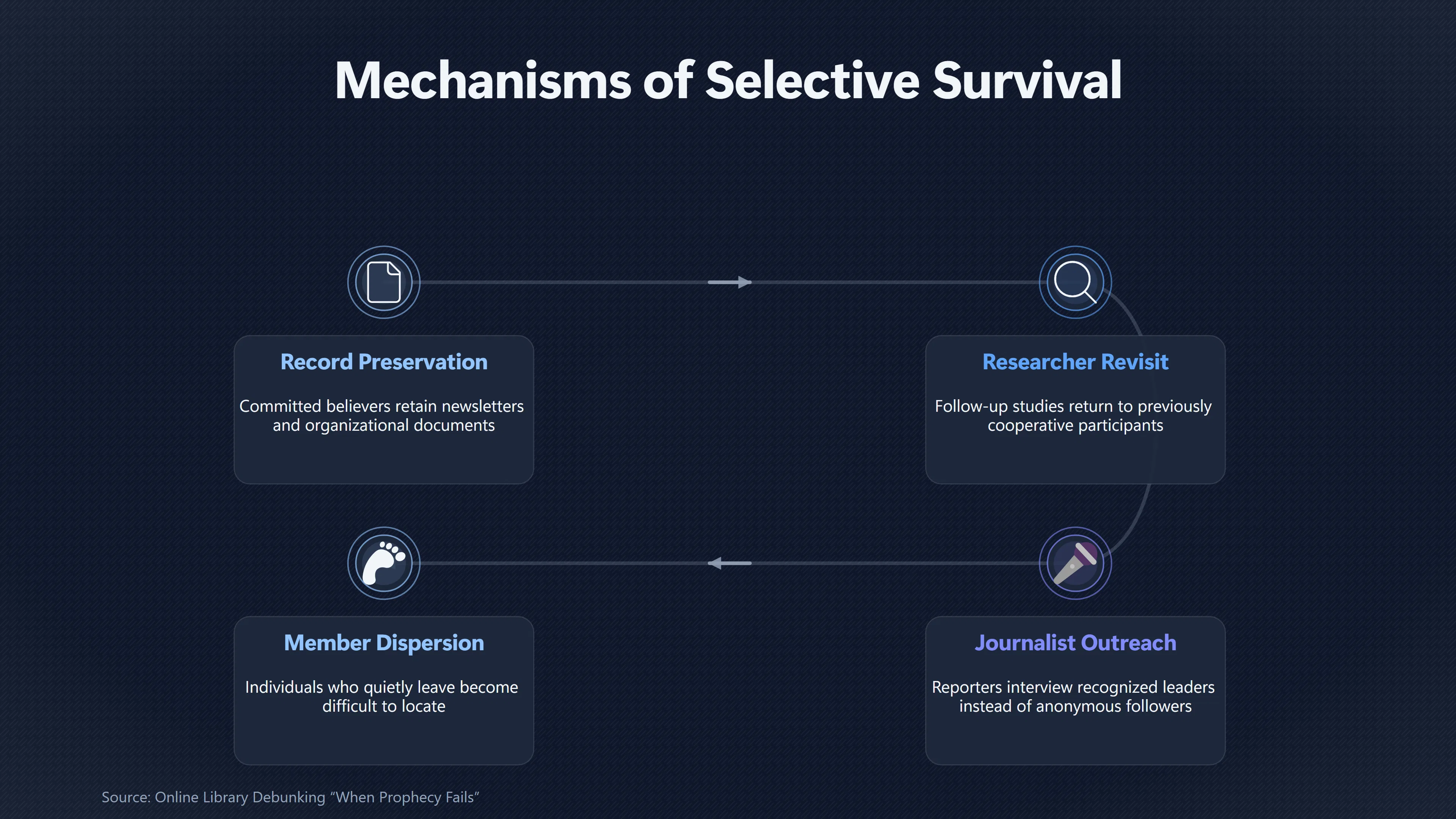
Several mechanisms reinforce this effect.
- Committed members preserve records. People who continue believing are more likely to retain newsletters, letters and organisational documents.
- Researchers revisit familiar contacts. Follow-up studies naturally return to participants who previously cooperated.
- Journalists seek spokespersons. Reporters interview recognised leaders rather than anonymous former followers.
- Former members disperse. Individuals who quietly leave become increasingly difficult to locate over time.
These processes gradually amplify the voices of persistent believers while reducing the visibility of those whose main response was ordinary disengagement.
The result is not necessarily a false history, but a narrowed one. Readers may come away with the impression that reinterpretation was the dominant reaction simply because reinterpretation produced the richest documentation.

The Dorothy Martin Case as a Cautionary Example
The debate surrounding When Prophecy Fails illustrates why missing members matter.
The original study became famous for suggesting that failed prophecy could increase proselytising under certain conditions. More recent archival research argues that the broader movement dissolved far more rapidly than the published narrative suggested and that several researchers had unusually close involvement with the group itself. These reassessments do not merely question particular factual claims; they also highlight how concentrating on accessible participants can produce an incomplete picture of the group’s overall fate.[Wiley Online Library]onlinelibrary.wiley.comOnline Library Debunking “When Prophecy Fails”Wiley Online LibraryDebunking “When Prophecy Fails” - Kelly - 2026 - Journal of the History of the Behavioral Sciences - Wiley Online Lib…
Even scholars who continue to regard cognitive dissonance as a valuable psychological theory generally acknowledge that observational case studies provide weaker evidence than controlled experiments because many influences cannot be separated. The Martin episode therefore serves less as a definitive template for every failed prophecy than as a reminder that observer access and participant attrition both shape what later generations believe happened.[The New Yorker]newyorker.comThe theory posits that people experience psychological discomfort when confronted with contradictions between their beliefs and behaviors…
What This Means for Interpreting Failed UFO Predictions
Selective access does not prove that believers usually abandoned UFO movements after failed predictions, nor does it prove that they generally became more committed. Instead, it identifies a limitation in the surviving evidence.
When evaluating reports about small UFO groups, readers should ask:
- Who was still available to be interviewed?
- How many original participants had already left?
- Were quiet departures systematically recorded?
- Does the evidence describe the whole membership or only the most visible survivors?
These questions encourage a more balanced interpretation of failed prophecy. In many small UFO groups, the loudest remaining believers are not necessarily the most representative witnesses. Those who disappeared from view may have constituted a substantial, but largely undocumented, share of the original movement, leaving historians with an archive that naturally favours persistence over quiet withdrawal.
Amazon book picks
Further Reading
Books and field guides related to What Happened to the Believers Who Went Quiet?. Use these as the next step if you want deeper reading beyond the article.
When Prophecy Fails
The study reported in this volume grew out of some theoretical work, one phase of which bore specifically on the behavior of individuals...
Ethnography: Principles in Practice
Now in its third edition, this leading introduction to ethnography has been thoroughly updated and substantially rewritten. It offers a s...

The Craft of Research
Rating: 4.3/5 from 6 Google Books ratings
Since 1995, students, researchers, and professionals have turned to The Craft of Research for clear and helpful guidance on how to conduc...
Doing Qualitative Research
"As a novice researcher and doctoral student myself, I found this text basic, resourceful, and encouraging. I now feel that my research j...
eBay marketplace picks
Marketplace Samples
Live-tested eBay searches with available results related to this page.
Selected fromalien history poster oneBay.co.uk.


Endnotes
1.
Source: onlinelibrary.wiley.com
Title: Online Library Debunking “When Prophecy Fails”
Link:https://onlinelibrary.wiley.com/doi/10.1002/jhbs.70043
Source snippet
Wiley Online LibraryDebunking “When Prophecy Fails” - Kelly - 2026 - Journal of the History of the Behavioral Sciences - Wiley Online Lib...
2.
Source: onlinelibrary.wiley.com
Title: Online Library Debunking “When Prophecy Fails”
Link:https://onlinelibrary.wiley.com/doi/full/10.1002/jhbs.70043
Source snippet
“When Prophecy Fails” - Kelly - 2026 - Journal of the History of the Behavioral Sciences - Wiley Online LibraryNovember 4, 2025 — Volume...
Published: November 4, 2025
3.
Source: onlinelibrary.wiley.com
Link:https://onlinelibrary.wiley.com/doi/10.1002/evan.70020
Source snippet
Rituals Fail: Rationalization, Bayesianism, and Predictive Processing - Hong - 2025 - Evolutionary Anthropology: Issues, News, and Review...
4.
Source: onlinelibrary.wiley.com
Link:https://onlinelibrary.wiley.com/doi/abs/10.1002/jhbs.70043
Source snippet
“When Prophecy Fails” - Kelly - 2026 - Journal of the History of the Behavioral Sciences - Wiley Online LibraryNovember 4, 2025 — ORIGINA...
Published: November 4, 2025
5.
Source: onlinelibrary.wiley.com
Link:https://onlinelibrary.wiley.com/doi/abs/10.1002/jhbs.70043?campaign=woletoc
6.
Source: newyorker.com
Link:https://www.newyorker.com/culture/the-lede/is-cognitive-dissonance-actually-a-thing
Source snippet
The theory posits that people experience psychological discomfort when confronted with contradictions between their beliefs and behaviors...
7.
Source: doi.org
Title: Debunking “When Prophecy Fails”
Link:https://doi.org/10.1002%2Fjhbs.70043
Source snippet
Kelly - 2026 - Journal of the History of the Behavioral Sciences - Wiley Online LibraryNovember 4, 2025 — DEBUNKING “WHEN PROPHECY FAILS”...
Published: November 4, 2025
8.
Source: doi.org
Link:https://doi.org/10.1558%2Fijsnr.33085
Additional References
9.
Source: academic.oup.com
Link:https://academic.oup.com/book/7811/chapter/152989636
Source snippet
OUP AcademicHow Prophecy Never Fails | When Prophecy Never Fails: Myth and Reality in a Flying-Saucer Group | Oxford Academic...
10.
Source: pubmed.ncbi.nlm.nih.gov
Title: Pub Med Debunking “When Prophecy Fails”
Link:https://pubmed.ncbi.nlm.nih.gov/41186060/
Source snippet
Debunking "When Prophecy Fails" - PubMed...
11.
Source: youtube.com
Title: 235-Leon Festinger and the Alien Apocalypse
Link:https://www.youtube.com/watch?v=fy06VDrnh7A
Source snippet
End of Days Cults, the Day After | Cognitive Dissonance (Video Essay)...
12.
Source: openlibrary.org
Link:https://openlibrary.org/books/OL24462152M/When_prophecy_fails
13.
Source: openlibrary.org
Link:https://openlibrary.org/works/OL4788695W/When_prophecy_fails
14.
Source: youtube.com
Title: When “When Prophecy Fails” Fails
Link:https://www.youtube.com/watch?v=IhblbZDXfZU
Source snippet
10 Doomsday Cults That Got It Wrong | When Prophecy Fails...
15.
Source: researchgate.net
Title: (PDF) Messianic Movements and Failed Prophecies in Israel: Five Case Studies
Link:https://www.researchgate.net/publication/249981966_Messianic_Movements_and_Failed_Prophecies_in_Israel_Five_Case_Studies
16.
Source: youtube.com
Link:https://www.youtube.com/watch?v=6d6SJd5sxnM
Source snippet
235-Leon Festinger and the Alien Apocalypse...
17.
Source: youtube.com
Title: 10 Doomsday Cults That Got It Wrong | When Prophecy Fails
Link:https://www.youtube.com/watch?v=5V6FmVS_Gr0
Source snippet
InPresence 0211: When Prophecy Fails...
18.
Source: youtube.com
Title: End of Days Cults, the Day After | Cognitive Dissonance (Video Essay)
Link:https://www.youtube.com/watch?v=5yVuauQjkDc