Within Comet UFOs
How a Missing Star Became a Spacecraft
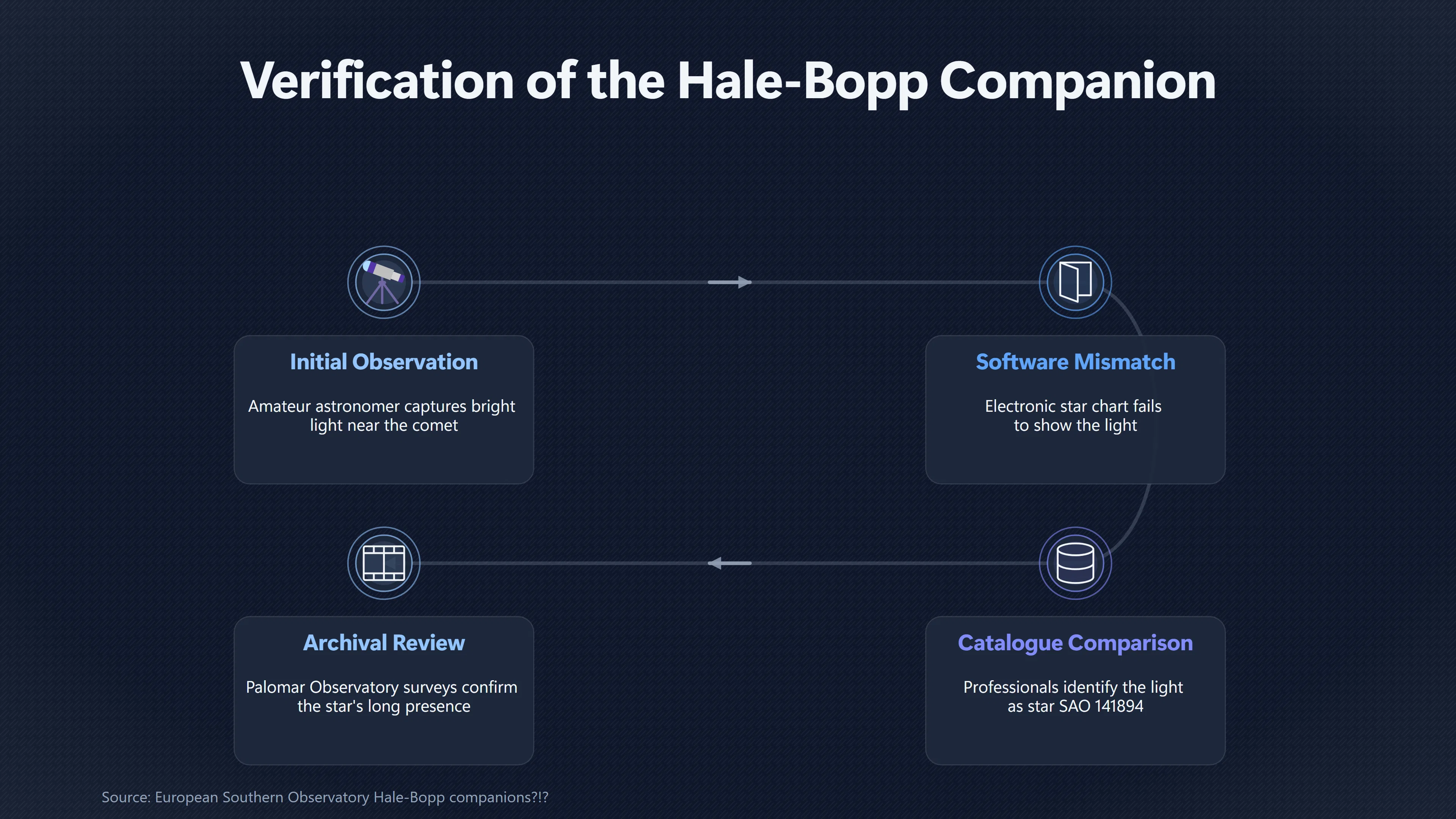
The supposed companion seemed new partly because the observer's software did not display the catalogued star already occupying that position.
On this page
- Why SAO 141894 was absent from the display
- How catalogue limits shape amateur observations
- The checks that separate software omissions from discoveries
Page outline Jump by section
Introduction
One of the most influential details behind the 1996 Hale–Bopp “spacecraft” rumour was not a mysterious object in the sky but a missing entry on an electronic star chart. The supposed companion appeared extraordinary because amateur astronomer Chuck Shramek’s CCD image showed a bright point of light near the comet while his astronomy software apparently showed nothing at the same position. That mismatch was quickly interpreted by some as evidence that the object was not an ordinary star. Subsequent investigation showed that the light was the catalogued background star SAO 141894 and that the apparent discrepancy arose from software and catalogue-display issues rather than the discovery of a new celestial object. This episode remains a useful example of how incomplete or misconfigured astronomical datasets can generate convincing but false UFO claims.
Why SAO 141894 was absent from the display
The central misunderstanding was straightforward: observers compared a photographic image against a digital sky chart and assumed that every visible object should appear in both. When one bright object appeared in the image but not on the chart, the absence itself became part of the evidence for an extraordinary interpretation.
Professional astronomers rapidly compared the CCD image with established star catalogues and archival sky surveys, identifying the object as SAO 141894, a known background star already present in photographs taken decades before Comet Hale–Bopp entered that region of the sky. Because the star had been recorded long before the comet’s arrival, it could not have been travelling alongside the comet as a concealed spacecraft.[European Southern Observatory]Check archival sky surveys.Open source on eso.org.
The remaining question therefore became not “What is the object?” but “Why didn’t the software display it?”
One widely cited technical explanation concerns the way astronomical software handled entries from the Hubble Guide Star Catalog (GSC). Although SAO 141894 is an ordinary star, the Guide Star Catalog classified it as a “nonstar” for operational reasons related to selecting reliable guide objects for the Hubble Space Telescope. Software such as MegaStar allowed users to hide this category from view. If that option was enabled, the chart could omit SAO 141894 even though the CCD camera recorded it normally. Contemporary developers of MegaStar stressed that the star was present in the underlying database and argued that the most likely explanation was a display configuration rather than a missing catalogue entry.[MIRA]mira.orgMega Star ReviewMegaStar Review - MIRA Quarterly Newsletter - Summer 97…
How catalogue limits shape amateur observations
The Hale–Bopp episode illustrates a broader point about electronic sky charts: they are filtered representations of much larger astronomical databases rather than literal maps of everything visible in an image.
Several factors can produce apparent mismatches between an image and a chart:
- catalogue filters that suppress certain object classes;
- user-selected magnitude limits that hide fainter objects;
- different catalogues containing different object types;
- display settings intended to reduce clutter rather than maximise completeness;
- image-processing effects that make some stars appear brighter or more unusual than expected.
These limitations are usually harmless during routine observing because astronomers understand that software provides a selected view of the sky. Problems arise when a chart omission is interpreted as positive evidence that an object is unknown instead of prompting a check against additional catalogues.
In discussions following the Hale–Bopp controversy, some commentators suggested alternative explanations for the omission, including magnitude-display settings or other software configuration choices. Although the precise settings used during the original observation have remained a subject of debate, the important point is that several ordinary software behaviours can explain why a known star failed to appear on one display. None require the existence of a previously undiscovered object.[MIRA]mira.orgMega Star ReviewMegaStar Review - MIRA Quarterly Newsletter - Summer 97…

The checks that separate software omissions from discoveries
Professional astronomical practice treats a discrepancy between an image and a chart as the beginning of an investigation rather than its conclusion.
In the Hale–Bopp case, astronomers applied several straightforward verification steps:
- Compare multiple star catalogues. A genuine discovery should not disappear simply because a different catalogue is consulted.
-
Check archival sky surveys. The Palomar Observatory Sky Survey already showed the same star at the same position years before Hale–Bopp arrived. European Southern Observatory
- Confirm relative motion. A background star remains fixed relative to other stars while a comet moves noticeably from night to night.
- Review the original image. Diffraction spikes, saturation and CCD artefacts can change the apparent shape of stellar images, making ordinary stars appear elongated or “Saturn-like.” European Southern Observatory
Each of these checks pointed towards the same conclusion: the object behaved exactly like a normal background star.
Why the missing chart entry became persuasive
The chart omission carried psychological weight because it appeared to provide independent confirmation of an extraordinary claim. Instead of relying solely on the unusual appearance of one CCD image, proponents could argue that computer software had also “failed” to identify the object.
In reality, both observations depended on the same underlying assumption—that the electronic chart was complete. Once that assumption proved incorrect, the apparent corroboration disappeared. The image still contained a real object, but it was a previously catalogued star whose absence from one software display reflected data filtering or configuration rather than a hidden spacecraft.
This distinction matters when assessing failed UFO predictions. The Hale–Bopp rumour gained credibility not because new astronomical evidence accumulated but because an ordinary software limitation was interpreted as evidence of concealment or discovery. When independent catalogues, archival photographs and positional measurements were consulted, the extraordinary interpretation collapsed, leaving a well-documented example of how missing star-chart data can transform a routine observational mismatch into a widely repeated UFO claim.
Amazon book picks
Further Reading
Books and field guides related to How a Missing Star Became a Spacecraft. Use these as the next step if you want deeper reading beyond the article.
Turn Left at Orion
With over 100,000 copies sold since first publication, this is one of the most popular astronomy books of all time. It is a unique guideb...
Bad Astronomy
A clever, thought-provoking guide that attacks common astronomical misconceptions What is Bad Astronomy? Anything that accidentally or in...
The Demon-Haunted World
NEW YORK TIMES BESTSELLER • From the renowned astronomer and author of Cosmos comes a “powerful [and] stirring defense of informed ration...
eBay marketplace picks
Marketplace Samples
Example marketplace items related to this page. Use the search link to explore similar finds on eBay.
Selected fromstar chart poster oneBay.co.uk.

Endnotes
3.
Source: mira.org
Title: Mega Star Review
Link:https://www.mira.org/newsletr/nlfall97/megastar.htm
Source snippet
MegaStar Review - MIRA Quarterly Newsletter - Summer 97...
4.
Source: eso.org
Link:https://eso.org/public/news/eso0108/
5.
Source: eso.org
Link:https://www.eso.org/public/images/eso9849b/
6.
Source: eso.org
Link:https://www.eso.org/public/images/eso9849a/
7.
Source: eso.org
Link:https://eso.org/public/news/eso9520/
8.
Source: hq.eso.org
Link:https://www.hq.eso.org/public/news/eso8703/
9.
Source: skycharts.net
Link:https://www.skycharts.net/?page_id=2121
Additional References
10.
Source: carinasoft.com
Title: See the Voyager 4.5 downloads page for details (scroll
Link:https://www.carinasoft.com/FAQ/faq2.html
Source snippet
Carina SoftwareFebruary 1, 2011 — You can also import asteroid/comet/spacecraft data files manually if for some reason Voyager's automati...
Published: February 1, 2011
11.
Source: fight.fudgie.org
Title: 20150301 episode 127 the saga of comet 092f4d41
Link:https://fight.fudgie.org/search/show/ep/episode/20150301_episode-127-the-saga-of-comet-_092f4d41
Source snippet
PseudoAstronomy - Episode 127 - The Saga of Comet Hale-Bopp and its Fugacious Companion, Part 1 - TranscriptMarch 1, 2015 — Exposing Pseu...
Published: March 1, 2015
12.
Source: bisque.com
Title: 1242 panoramic horizon photo isnt displayed
Link:https://www.bisque.com/forums/topic/1242-panoramic-horizon-photo-isnt-displayed/
Source snippet
1242 – PANORAMIC HORIZON PHOTO ISN’T DISPLAYED – Bisque.com 2026July 9, 2017 — * * # Software Bisque Knowledge Base Article – 1242 PANORA...
Published: July 9, 2017
13.
Source: youtube.com
Title: Heaven’s Gate Cult Initiation Tape Part 1
Link:https://www.youtube.com/watch?v=AqSZhwu1Rwo
Source snippet
Hale-Bopp Anomaly Saga 1996-1997 Art Bell Hale-Bopp Anomaly Saga 1996-1997: Art Bell Interviews Dr Courtney Brown, Farsight Institute Rob...
14.
Source: cloudynights.com
Title: “The Sky” software
Link:https://www.cloudynights.com/forums/topic/90448-the-sky-software/
Source snippet
Equipment (No astrophotography) - Cloudy NightsJanuary 2, 2007 — TOM T Posted January 3, 2007 * ### Tom T * A Father, A Teacher, A Pionee...
Published: January 2, 2007
15.
Source: youtube.com
Link:https://www.youtube.com/watch?v=qnL2EvRqYzk
Source snippet
What Really Happened in the Heaven's Gate Cult?...
16.
Source: youtube.com
Title: Videos inside Heaven’s Gate house reveal those lured into cult: 20/20 Preview
Link:https://www.youtube.com/watch?v=Dju4F0twu0A
Source snippet
The Sky at Night - Hale Bopp - The Great Comet of '97...
17.
Source: youtube.com
Title: What Really Happened in the Heaven’s Gate Cult?
Link:https://www.youtube.com/watch?v=npfSb3Ax1IU
Source snippet
Videos inside Heaven's Gate house reveal those lured into cult: 20/20 Preview...
18.
Source: skepsis.no
Title: » Kometen Hale-Bopps følgesvenn
Link:https://www.skepsis.no/kometen-hale-bopps-f%C3%B8lgesvenn/
Source snippet
Skepsis » Kometen Hale-Bopps følgesvenn...
19.
Source: astrodrive.com
Link:https://www.astrodrive.com/bitwise/copy/reviews/software/astronomy/skymappro11_thesky6.html