Within Dorothy Martin
Did the Researchers Change the Prophecy Group?
Festinger's investigators posed as believers inside a tiny movement, raising questions about whether observation itself shaped the reported outcome.
On this page
- How investigators entered the circle
- Why researcher numbers mattered
- Journalists, surveillance and altered behavior
Page outline Jump by section
Introduction
One of the enduring controversies surrounding Dorothy Martin’s failed 1954 UFO flood prophecy is not simply how believers reacted when the prediction failed, but whether the observers themselves helped shape that reaction. Leon Festinger, Henry Riecken and Stanley Schachter’s classic study When Prophecy Fails became a foundation of cognitive dissonance theory because it appeared to document believers strengthening their commitment after an obvious failure. However, both contemporary methodological criticism and newly released archival material have raised a more specific question: did covert participant observation alter the behaviour it was intended to measure? Rather than treating the researchers as invisible recorders, many historians now argue that they became active participants within an unusually small, emotionally charged group.[Wiley Online Library]onlinelibrary.wiley.comOnline Library Debunking “When Prophecy Fails”Wiley Online LibraryDebunking “When Prophecy Fails” - Kelly - 2026 - Journal of the History of the Behavioral Sciences - Wiley Online Lib…
How investigators entered the circle
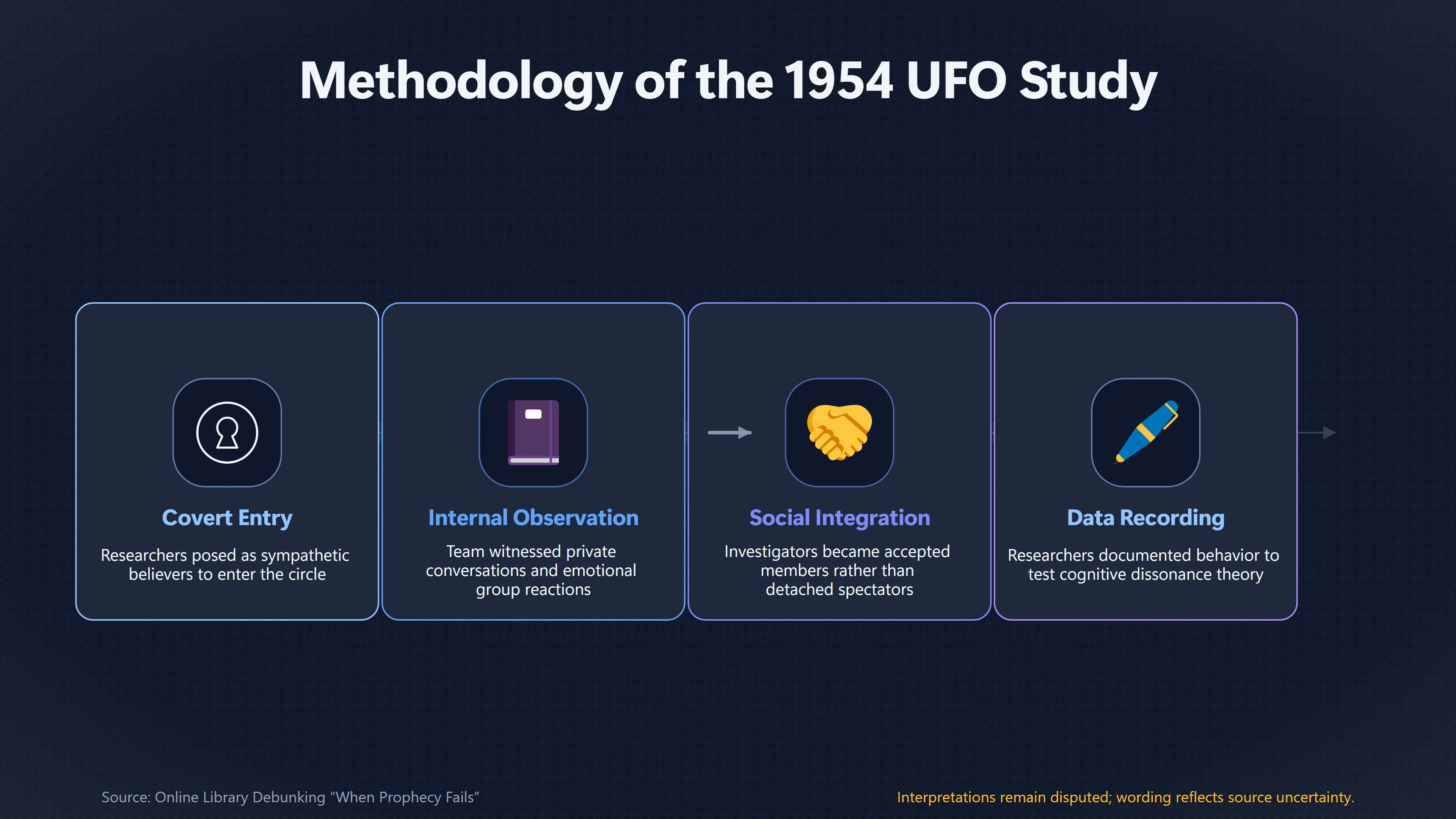
Festinger’s team did not openly identify themselves as psychologists. Instead, they entered Martin’s circle by posing as sympathetic believers in order to observe events from inside the movement. At the time, covert participant observation was regarded by some social scientists as the only practical way to study private groups that would probably reject outside scrutiny.
The approach offered obvious advantages. Researchers could witness conversations, emotional reactions and group dynamics that would likely disappear if participants knew they were being studied. This method became one of the best-known examples of participant observation in twentieth-century social psychology.
The same method also created an unavoidable tension. Because the researchers were expected to behave like genuine believers, they were not merely watching interactions—they were contributing to them. Every conversation, expression of confidence or apparent agreement could potentially reinforce the social environment surrounding Martin’s followers. Even Festinger’s original account recognised that the investigators became accepted members of the group rather than detached spectators.[Wikipedia]WikipediaWhen Prophecy FailsWhen Prophecy Fails
Why researcher numbers mattered
The observer-effect debate has intensified because later archival work suggests the research presence was larger than many readers of When Prophecy Fails realised.
According to archival material analysed by political scientist Thomas Kelly, the project involved not only the three principal investigators but also several paid assistants operating undercover. At some meetings, infiltrators may have constituted a remarkably large share of those present, with estimates suggesting that roughly half the people attending certain gatherings were connected to the research project. In such a small movement, this was not a trivial background presence but a substantial part of the social setting itself.[Wiley Online Library]onlinelibrary.wiley.comOnline Library Debunking “When Prophecy Fails”Wiley Online LibraryDebunking “When Prophecy Fails” - Kelly - 2026 - Journal of the History of the Behavioral Sciences - Wiley Online Lib…
This matters because Festinger’s theory depended partly on social reinforcement. One of the theory’s conditions was that believers surrounded by supportive companions would find it easier to maintain commitment after disconfirmation. If a significant proportion of those apparently providing support were actually undercover researchers, separating naturally occurring group dynamics from researcher-created social reinforcement becomes much more difficult.
The issue is therefore methodological rather than merely ethical. The question is not simply whether deception was acceptable, but whether the very act of embedding numerous covert participants altered the phenomenon under investigation.
Did researchers encourage commitment?
The strongest criticisms go beyond simple participation and argue that some researchers actively influenced events.
Kelly’s examination of previously sealed archival documents alleges that one research assistant claimed to receive psychic impressions or dreams consistent with the group’s expectations, while Henry Riecken adopted the role of a respected spiritual authority within Martin’s circle. Kelly also highlights archival statements in which Riecken later suggested that he had “precipitated” key events during the study. If interpreted literally, such remarks imply more than passive observation.[Wiley Online Library]onlinelibrary.wiley.comOnline Library Debunking “When Prophecy Fails”Wiley Online LibraryDebunking “When Prophecy Fails” - Kelly - 2026 - Journal of the History of the Behavioral Sciences - Wiley Online Lib…
These claims remain controversial. Kelly argues they demonstrate investigator interference that compromised the study’s central conclusions. Supporters of the original research generally acknowledge that participant observation inevitably involved interaction but dispute whether the available evidence overturns the broader psychological insights derived from the case. Many psychologists continue to regard cognitive dissonance as supported by decades of laboratory and field research independent of the Martin episode, even if the famous case study itself deserves re-evaluation.[The New Yorker]newyorker.comThe theory posits that people experience psychological discomfort when confronted with contradictions between their beliefs and behaviors…

Journalists, surveillance and altered behaviour
The researchers were not the only outsiders influencing events. Martin’s prophecy had already attracted newspaper attention before the predicted date arrived, bringing journalists, photographers and curious visitors to what had previously been a relatively obscure gathering.
This combination of media attention and covert observation likely changed the social environment in several ways:
- Increased public scrutiny may have encouraged believers to defend their commitment more forcefully.
- A larger audience created opportunities for dramatic public statements that might not have occurred within a private circle.
- Difficulty distinguishing insiders from outsiders may have changed patterns of trust and discussion.
- Multiple simultaneous observers—reporters, police, neighbours and undercover researchers—created an unusually artificial setting for studying spontaneous religious behaviour.
Because these influences occurred together, historians caution against attributing every post-prophecy action solely to cognitive dissonance. Public performance, embarrassment, interpersonal pressure and reactions to intense scrutiny may all have contributed alongside genuine belief.[Wikipedia]WikipediaWhen Prophecy FailsWhen Prophecy Fails
How later archival evidence changed the debate
For decades, When Prophecy Fails was largely accepted at face value because researchers had limited access to the underlying field materials. The release of additional archival documents has shifted discussion from whether Martin’s prophecy failed—which is undisputed—to whether the published account accurately represented what happened afterward.
Kelly argues that the archives show Martin soon recanted, the movement rapidly fragmented and sustained post-failure evangelism was far less significant than the book suggested. He also contends that some episodes presented as spontaneous evidence of increased commitment were influenced by the researchers’ own participation. These conclusions challenge the traditional interpretation but have not ended scholarly debate; instead, they have prompted renewed examination of one of psychology’s most influential field studies.[Wiley Online Library]onlinelibrary.wiley.comOnline Library Debunking “When Prophecy Fails”Wiley Online LibraryDebunking “When Prophecy Fails” - Kelly - 2026 - Journal of the History of the Behavioral Sciences - Wiley Online Lib…
What the observer-effect debate means
The observer-effect question is ultimately about the limits of field research rather than the truth or falsity of UFO prophecies. Nearly everyone agrees that Martin’s flood prediction failed. The unresolved issue is whether the reactions recorded in When Prophecy Fails were entirely the group’s own, or whether they were partly shaped by an unusually large contingent of covert investigators operating inside a tiny religious movement.
As a result, modern discussions increasingly distinguish between two separate claims. One concerns the historical event itself—the failed UFO rescue prophecy. The other concerns the methodological reliability of the famous study built around that event. The latter remains an active subject of historical and methodological debate, illustrating how the presence of observers can become part of the story they seek to document.[Wiley Online Library]onlinelibrary.wiley.comOnline Library Debunking “When Prophecy Fails”Wiley Online LibraryDebunking “When Prophecy Fails” - Kelly - 2026 - Journal of the History of the Behavioral Sciences - Wiley Online Lib…
Amazon book picks
Further Reading
Books and field guides related to Did the Researchers Change the Prophecy Group?. Use these as the next step if you want deeper reading beyond the article.
When Prophecy Fails
The study reported in this volume grew out of some theoretical work, one phase of which bore specifically on the behavior of individuals...
Participant Observation
Spradley should be read by anyone who wants to gain a true understanding of the process of participant observation. This text is a follow...

The Craft of Research
Rating: 4.3/5 from 6 Google Books ratings
Since 1995, students, researchers, and professionals have turned to The Craft of Research for clear and helpful guidance on how to conduc...
Doing Ethnography
With regular exercises, lists of key terms and points and self-evaluation checklists, Doing Ethnography systematically describes the vari...
eBay marketplace picks
Marketplace Samples
Live-tested eBay searches with available results related to this page.
Selected fromUFO patch oneBay.co.uk.


Endnotes
1.
Source: onlinelibrary.wiley.com
Title: Online Library Debunking “When Prophecy Fails”
Link:https://onlinelibrary.wiley.com/doi/full/10.1002/jhbs.70043
Source snippet
Wiley Online LibraryDebunking “When Prophecy Fails” - Kelly - 2026 - Journal of the History of the Behavioral Sciences - Wiley Online Lib...
2.
Source: Wikipedia
Title: When Prophecy Fails
Link:https://en.wikipedia.org/wiki/When_Prophecy_Fails
3.
Source: onlinelibrary.wiley.com
Link:https://onlinelibrary.wiley.com/doi/10.1002/jhbs.70043
Source snippet
“When Prophecy Fails” - Kelly - 2026 - Journal of the History of the Behavioral Sciences - Wiley Online LibraryNovember 4, 2025 — Volume...
Published: November 4, 2025
4.
Source: onlinelibrary.wiley.com
Link:https://onlinelibrary.wiley.com/doi/abs/10.1002/jhbs.70043
Source snippet
“When Prophecy Fails” - Kelly - 2026 - Journal of the History of the Behavioral Sciences - Wiley Online LibraryNovember 4, 2025 — ORIGINA...
Published: November 4, 2025
5.
Source: onlinelibrary.wiley.com
Link:https://onlinelibrary.wiley.com/doi/abs/10.1002/jhbs.70043?campaign=woletoc
Source snippet
“When Prophecy Fails” - Kelly - 2026 - Journal of the History of the Behavioral Sciences - Wiley Online LibraryNovember 4, 2025 — Volume...
Published: November 4, 2025
6.
Source: newyorker.com
Link:https://www.newyorker.com/culture/the-lede/is-cognitive-dissonance-actually-a-thing
Source snippet
The theory posits that people experience psychological discomfort when confronted with contradictions between their beliefs and behaviors...
7.
Source: doi.org
Title: Debunking “When Prophecy Fails”
Link:https://doi.org/10.1002%2Fjhbs.70043
8.
Source: books.google.com
Title: When Prophecy Fails
Link:https://books.google.com/books/about/When_Prophecy_Fails.html?id=GRVRvgAACAAJ
Additional References
9.
Source: greaterwrong.com
Title: Debunking “When Prophecy Fails”
Link:https://www.greaterwrong.com/posts/qth5r82ZhMEXzc25y/debunking-when-prophecy-fails
Source snippet
LessWrong 2.0 viewerNovember 6, 2025 — DEBUNKING “WHEN PROPHECY FAILS” Matrice Jacobine6 Nov 2025 17:26 UTC 52 points 6 comments1 min rea...
Published: November 6, 2025
10.
Source: reddit.com
Link:https://www.reddit.com/r/socialpsychology/comments/1v0m0uf/festinger_etal_when_prophecy_fails_1956_and/
Source snippet
Festinger, et.al: When Prophecy Fails (1956), and Festinger's 1957 Cognitive Dissonance...
11.
Source: youtube.com
Link:https://www.youtube.com/watch?v=41im5nk0g5c
Source snippet
When Prophecies Fail - Leon Festinger COGNITIVE DISSONANCE "The Seekers" Sect...
12.
Source: pubmed.ncbi.nlm.nih.gov
Title: Pub Med Debunking “When Prophecy Fails”
Link:https://pubmed.ncbi.nlm.nih.gov/41186060/
Source snippet
Debunking "When Prophecy Fails" - PubMed...
13.
Source: youtube.com
Link:https://www.youtube.com/watch?v=6d6SJd5sxnM
Source snippet
2015 Marty Center Senior Fellow Symposium with Betty M. Bayer...
14.
Source: youtube.com
Title: When “When Prophecy Fails” Fails (E350)
Link:https://www.youtube.com/watch?v=IhblbZDXfZU
Source snippet
235-Leon Festinger and the Alien Apocalypse...
15.
Source: youtube.com
Title: When Prophecies Fail
Link:https://www.youtube.com/watch?v=S6euVitYtqM
16.
Source: youtube.com
Title: 235-Leon Festinger and the Alien Apocalypse
Link:https://www.youtube.com/watch?v=fy06VDrnh7A
Source snippet
InPresence 0211: When Prophecy Fails...
17.
Source: sciety.org
Title: Debunking “When Prophecy Fails” | Sciety
Link:https://sciety.org/articles/activity/10.31235/osf.io/9j7qc_v1
18.
Source: sciety.org
Title: Debunking “When Prophecy Fails” | Sciety
Link:https://sciety.org/articles/activity/10.31235/osf.io/9j7qc_v2