Within Claim Types
Why Fixed Dates Make UFO Claims Riskier
Predictions tied to a specific date are easier to judge than claims that rely on words such as soon, imminent or when humanity is ready.
On this page
- How time windows determine testability
- The shift from deadlines to readiness conditions
- A practical test for post hoc date changes
Page outline Jump by section
Introduction
Predictions about UFOs are not all equally testable. A claim that “a fleet of spacecraft will appear over major cities on 14 October” can be checked against a clear deadline. By contrast, statements that disclosure is “imminent”, contact will occur “soon”, or extraterrestrials will arrive “when humanity is ready” have no objective endpoint. That difference in wording largely determines whether a failed prediction is acknowledged as a failure or can be indefinitely postponed.
Within the broader history of failed UFO predictions, the distinction between fixed dates and vague timing is one of the most important tools for judging credibility. A prediction tied to a specific date creates a clear pass-or-fail test. Predictions framed around flexible conditions or undefined future periods are much harder to falsify because their timing can be repeatedly reinterpreted without ever reaching a decisive moment.
Why Fixed Dates Make UFO Claims Riskier
Specific dates expose a prediction to immediate public verification. If the promised event does not happen within the announced window, observers do not need specialist knowledge to recognise the failure.
This is particularly true for predictions involving:
- public spacecraft landings;
- worldwide mass sightings;
- official government announcements;[uap-archive.org]uap-archive.orgSource details in endnotes.
- large-scale rescue events visible to many witnesses.
Once the deadline passes without the promised event, the original prediction remains available for comparison with reality. Historical researchers can examine contemporary books, newsletters, interviews or recordings to determine exactly what was promised before the deadline.
Classic examples include Dorothy Martin’s prediction that believers would be rescued by flying saucers before a catastrophic flood in December 1954 and numerous later predictions of scheduled landings or mass appearances that likewise failed to occur on the announced dates. The historical importance of these cases lies less in the particular date than in the fact that the date created an objective test.
Because these deadlines are public and specific, they leave relatively little room to argue that the prediction was fulfilled exactly as originally stated.
How Time Windows Determine Testability
The wording of the time window often matters more than the extraordinary nature of the prediction itself.
A useful comparison illustrates the difference:
Prediction wordingCan it be objectively tested?Typical outcome”A spacecraft will land on 15 July 2027.”Yes.Either the event occurred or it did not.”Disclosure will happen this year.”Mostly yes, although “disclosure” may later be redefined.Arguments often shift to partial disclosures.”Disclosure is imminent.”No clear endpoint.Deadline continually moves forward.”Aliens will appear when humanity is spiritually ready.”No.Timing depends on an undefined condition.
The more precisely the time window is defined, the easier independent observers can determine whether the prediction succeeded.
Conversely, replacing dates with words such as soon, imminent, near future, or at the appropriate time makes independent evaluation progressively more difficult.
Why Many Later Predictions Avoid Exact Dates
Many UFO movements gradually reduced their reliance on precise calendars after highly visible failures.
There are several practical reasons for this shift.
Repeated failures become cumulative. Every missed date remains permanently available for comparison with later claims. Over decades, a series of incorrect deadlines can substantially damage credibility.
Flexible wording survives longer. Predictions without a defined endpoint cannot technically expire. Followers may continue expecting fulfilment years or decades later.
Psychological commitment can be preserved. Instead of admitting that the original prediction failed, believers may conclude that extraterrestrials postponed their plans because humanity changed, governments interfered, or the timing was deliberately altered.
This pattern is not unique to UFO beliefs. Historians of prophecy have observed similar shifts in many millenarian movements after failed predictions, where specific dates gradually give way to less falsifiable expectations.
The Shift from Deadlines to Readiness Conditions
A particularly common transition replaces calendar dates with conditions that cannot be independently measured.
Examples include claims that contact will occur:
- when humanity reaches a higher level of consciousness;
- when enough people awaken spiritually;
- when governments become prepared;
- when humanity no longer reacts with fear;
- when extraterrestrials judge civilisation to be ready.
Unlike a fixed date, these conditions lack objective criteria.
No universally accepted measurement exists for “collective readiness” or “spiritual maturity.” Consequently, observers cannot determine whether the required condition has been satisfied or whether it has merely been postponed.
This transforms the prediction from a statement about a future event into a statement whose timing depends upon an undefined threshold.
How Post-Hoc Date Changes Keep Predictions Alive
One recurring feature of failed UFO predictions is the revision of timing after the original deadline has passed.
Several common patterns appear repeatedly:
- The date was symbolic rather than literal.
- The event occurred on a spiritual rather than physical level.
- Human behaviour altered the timetable.
- Extraterrestrials delayed intervention.
- The prediction was misunderstood by followers.
- The event has begun gradually rather than suddenly.
Each explanation reduces the importance of the original deadline while preserving belief in the broader claim.
From a historical perspective, the important question is not whether revised explanations are sincere, but whether they match what was publicly predicted before the deadline expired.

A Practical Test for Post-Hoc Date Changes
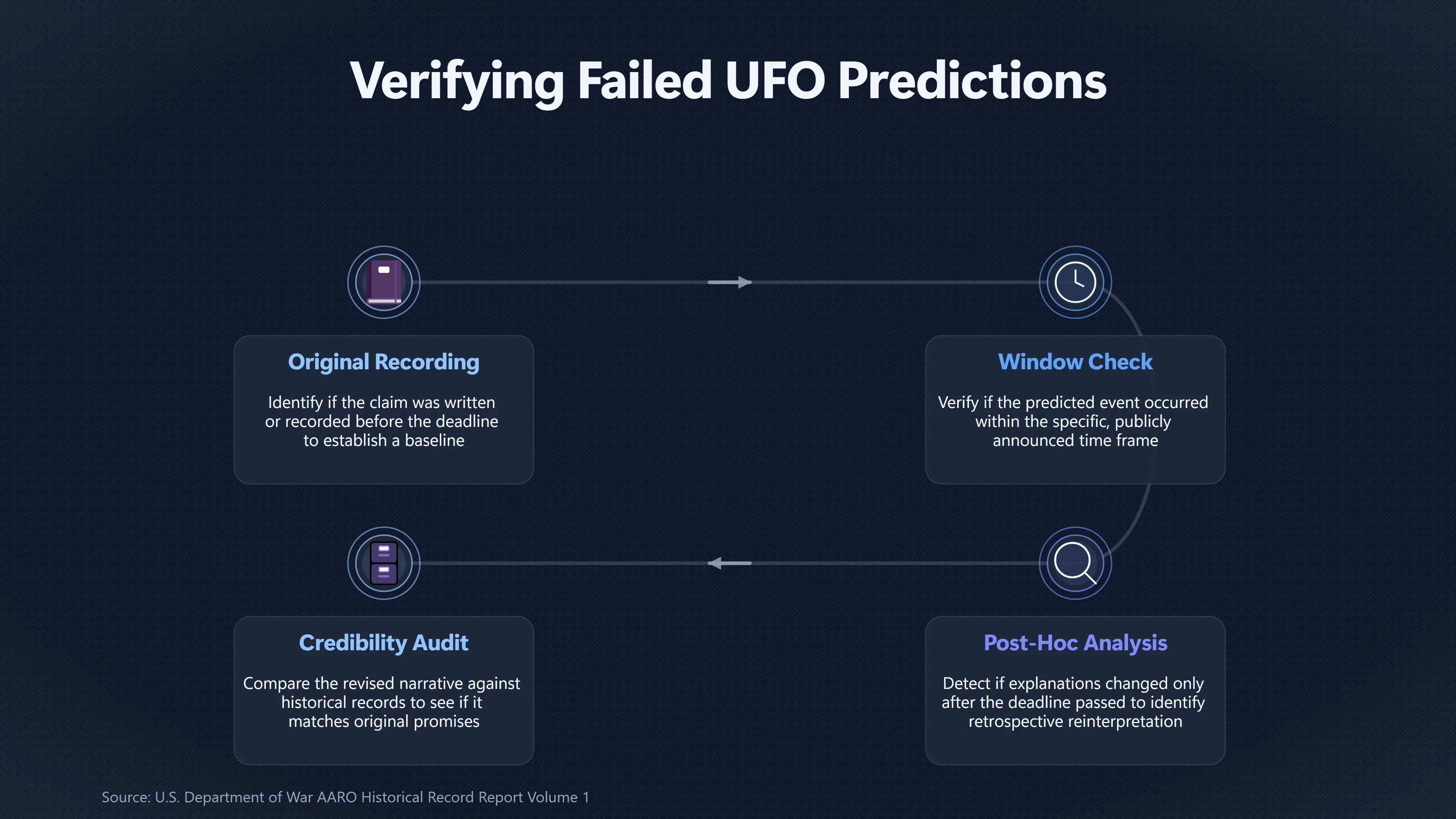
A straightforward method helps distinguish between genuine fulfilment and retrospective reinterpretation.
Ask three questions.
- Was the original prediction written or recorded before the deadline?
- Did the predicted event occur within the stated time window?
- Did explanations change only after the deadline had passed?
If substantial reinterpretation appears only after the expected event failed to occur, the revised explanation should not be treated as evidence that the original prediction succeeded.
This approach avoids judging beliefs themselves while focusing on the historical record of what was actually promised.
Why This Matters When Comparing UFO Prediction Types
Comparisons between rescue claims, landing predictions, sighting forecasts and disclosure announcements become much clearer once timing is considered alongside the event itself.
A dramatic rescue prophecy with a fixed date is generally easier to evaluate than a vague disclosure prediction that can be stretched indefinitely. Likewise, a promised public landing on a named day creates a stronger historical test than a statement that contact is “very near.”
Modern official investigations reinforce the importance of distinguishing clearly testable claims from open-ended expectations. The US Department of Defense’s All-domain Anomaly Resolution Office (AARO) notes that unresolved reports are not evidence of extraterrestrial technology and that decades of official investigations have not verified extraterrestrial craft or confirmed hidden reverse-engineering programmes. An unresolved observation therefore cannot retrospectively validate a missed prediction whose announced deadline has already passed.[U.S. Department of War]media.defense.govU.S. Department of War AARO Historical Record Report Volume 1U.S. Department of War AARO Historical Record Report Volume 1(https://www.defense.gov/News/News-Stories/Article/Article/3701297/dod-report-discounts-sightings-of-extraterrestrial-technology/)
The central lesson is methodological rather than ideological: the precision of a prediction’s timing largely determines whether it can genuinely fail. Fixed dates create objective historical tests. Vague promises of events occurring “soon”, “imminently”, or “when humanity is ready” leave enough flexibility that expectations can continue long after the original anticipation would otherwise have expired.
Amazon book picks
Further Reading
Books and field guides related to Why Fixed Dates Make UFO Claims Riskier. Use these as the next step if you want deeper reading beyond the article.
When Prophecy Fails
The study reported in this volume grew out of some theoretical work, one phase of which bore specifically on the behavior of individuals...
The Believing Brain
Synthesizing thirty years of research, psychologist and science historian, Michael Shermer upends the traditional thinking about how huma...
The Demon-Haunted World
Rating: 4.5/5 from 43 Google Books ratings
NEW YORK TIMES BESTSELLER • From the renowned astronomer and author of Cosmos comes a “powerful [and] stirring defense of informed ration...
Mistakes Were Made (but Not by Me)
Why is it so hard to say "I made a mistake"-and really believe it? When we make mistakes, cling to outdated attitudes, or mistreat other...
eBay marketplace picks
Marketplace Samples
Live-tested eBay searches with available results related to this page.
Selected fromUFO poster oneBay.co.uk.


Current eBay listing
I Want To Believe UFO Poster Giclée Fine Art Heavyweight Print


Current eBay listing
VINTAGE UFO FLYING SAUCERS COMIC ADVERTISING A2 POSTER PRINT
Endnotes
1.
Source: defense.gov
Link:https://www.defense.gov/News/News-Stories/Article/Article/3701297/dod-report-discounts-sightings-of-extraterrestrial-technology/
Source snippet
U.S. Department of WarDOD Report Discounts Sightings of Extraterrestrial Technology > U.S. Department of Defense > Defense Department New...
2.
Source: media.defense.gov
Title: U.S. Department of War AARO Historical Record Report Volume 1
Link:https://media.defense.gov/2024/Mar/08/2003409233/-1/-1/0/AARO_Historical_Record_Report_Vol_1_2024.pdf
3.
Source: defense.gov
Link:https://www.defense.gov/News/Releases/Release/Article/3700894/statement-by-pentagon-press-secretary-maj-gen-pat-ryder-on-the-historical-recor/
Additional References
4.
Source: disclosurearchives.com
Title: Reading AARO: what its words actually mean · Disclosure Archives
Link:https://disclosurearchives.com/briefings/reading-aaro-analytical-guide
Source snippet
May 14, 2026 — READING AARO: AN ANALYTICAL GUIDE TO WHAT THE OFFICE SAYS AND DOESN'T A close textual reading of the AARO Historical Recor...
Published: May 14, 2026
5.
Source: doi.org
Title: Debunking “When Prophecy Fails”
Link:https://doi.org/10.1002%2Fjhbs.70043
Source snippet
Kelly - 2026 - Journal of the History of the Behavioral Sciences - Wiley Online LibraryNovember 4, 2025 — DEBUNKING “WHEN PROPHECY FAILS”...
Published: November 4, 2025
6.
Source: youtube.com
Title: Ancient Aliens – [Falsifiability]({{ ‘falsifiability/’ | relative_url }}) in Hypothesis Testing
Link:https://www.youtube.com/watch?v=YynQ37yXUPU
Source snippet
When Prophecy Fails UFO cult prediction Why Religions Survive When Prophecies Fail...
7.
Source: onlinelibrary.wiley.com
Link:https://onlinelibrary.wiley.com/doi/abs/10.1002/jhbs.70043
Source snippet
“When Prophecy Fails” - Kelly - 2026 - Journal of the History of the Behavioral Sciences - Wiley Online LibraryNovember 4, 2025 — ORIGINA...
Published: November 4, 2025
8.
Source: onlinelibrary.wiley.com
Link:https://onlinelibrary.wiley.com/doi/10.1002/jhbs.70043
Source snippet
“When Prophecy Fails” - Kelly - 2026 - Journal of the History of the Behavioral Sciences - Wiley Online LibraryNovember 4, 2025 — Volume...
Published: November 4, 2025
9.
Source: onlinelibrary.wiley.com
Link:https://onlinelibrary.wiley.com/doi/abs/10.1002/jhbs.70043?campaign=woletoc
Source snippet
“When Prophecy Fails” - Kelly - 2026 - Journal of the History of the Behavioral Sciences - Wiley Online LibraryNovember 4, 2025 — Volume...
Published: November 4, 2025
10.
Source: onlinelibrary.wiley.com
Link:https://onlinelibrary.wiley.com/doi/full/10.1002/jhbs.70043
Source snippet
“When Prophecy Fails” - Kelly - 2026 - Journal of the History of the Behavioral Sciences - Wiley Online LibraryNovember 4, 2025 — Volume...
Published: November 4, 2025
11.
Source: youtube.com
Title: End of Days Cults, the Day After | Cognitive [Dissonance]({{ ‘dissonance/’ | relative_url }})
Link:https://www.youtube.com/watch?v=5yVuauQjkDc
Source snippet
Ancient Aliens – Falsifiability in Hypothesis Testing...
12.
Source: youtube.com
Title: Why Religions Survive When Prophetic Dates Fail
Link:https://www.youtube.com/watch?v=nH-pwULIGzs
Source snippet
1950s False Prophets: UFO Doomsday Contactees Were Always Wrong...
13.
Source: uap-archive.org
Link:https://uap-archive.org/uap/records/aaro-historical-record-report-vol1/