Within Prediction Records
Which Timestamp Should You Trust?
Displayed post dates, archive captures, email routing times and event deadlines must be separated to build a reliable chronology.
On this page
- The three dates every record needs
- Why visible publication dates can mislead
- Resolving conflicts across archives, email and print
Page outline Jump by section
Introduction
When documenting failed UFO predictions, conflicting dates are common rather than exceptional. A single prediction may display one date on a webpage, another in an internet archive, another in an email header, and yet another in a newspaper report. These dates are not necessarily contradictory because they measure different stages in the life of the same claim. The key question is not which date is “correct”, but what each timestamp proves. A reliable chronology distinguishes when a prediction was written, when it became publicly accessible, when independent evidence shows it existed, and when the predicted event was supposed to occur. Keeping these separate prevents both unfair criticism and unjustified rehabilitation of predictions after their deadlines have passed.
Which Timestamp Should You Trust?
The safest approach is to treat each timestamp as evidence for a different historical fact instead of searching for a single authoritative date.
A well-documented UFO prediction should record at least three distinct dates:
Date typeWhat it provesCommon sourceClaim creation dateWhen the author says the prediction was written or sentPage footer, document metadata, email “Date” fieldIndependent existence dateThe earliest externally verifiable evidence that the wording existedWeb archive capture, newspaper publication, mailing-list archive, library copyPrediction deadlineWhen the promised UFO event was expected to occurThe prediction itself
These dates answer different historical questions. An author’s stated publication date may indicate intent, but an independent archive demonstrates that the wording actually existed before the deadline. Likewise, a prediction’s deadline determines whether later revisions should be considered part of the original claim or post-event interpretation.
For documenting failed predictions, the most important relationship is:
Independent evidence must pre-date the prediction deadline.
If the only surviving copy appeared after the event supposedly occurred, it becomes much harder to establish exactly what was originally promised.
The Three Dates Every Record Needs
A complete chronology becomes much easier to interpret when each record separates the following elements.
Visible publication date
This is the date shown to readers on a webpage, blog post, newsletter or printed document.
It is useful but not decisive. Website owners can edit displayed dates, migrate content to new publishing systems or republish older material under newer timestamps. Conversely, some websites deliberately preserve an original publication date even after substantial revisions.
The visible date therefore documents how the publisher presents the material, not necessarily when the specific wording first became public.
Independent capture date
This is often the strongest evidence.
Examples include:
- Internet Archive Wayback Machine captures.[archivesupport.zendesk.com]archivesupport.zendesk.comInternet Archive Help CenterUsing The Wayback Machine – Internet Archive Help CenterJanuary 13, 2021…
- National web archives.
- Archived mailing-list messages.
- Newspaper publication dates.
- Library deposit records.
- Contemporary forum quotations.
An archived capture proves only that the page existed no later than the capture time. It does not prove that the page first appeared on that date. A page could have been online for weeks before anyone archived it. The Internet Archive itself notes that “Save Page Now” creates a one-time archived capture rather than establishing when a page originally went live.[Internet Archive Help Center]archivesupport.zendesk.comInternet Archive Help CenterUsing The Wayback Machine – Internet Archive Help CenterJanuary 13, 2021…
Consequently, the earliest archive capture should be treated as the latest confirmed point by which the wording existed, not necessarily its moment of publication.
Event deadline
This is the promised date for the UFO event itself.
Unlike publication dates, this usually comes directly from the claimant’s wording:
- “Ships will appear on 14 October.”
- “Disclosure will occur before Christmas.”
- “Landings will begin within three days.”
Everything else in the chronology should be interpreted relative to this deadline.
Why Visible Publication Dates Can Mislead
Conflicting dates often arise because modern publishing systems rewrite metadata while leaving the text largely unchanged.
Common causes include:
- website redesigns that assign new publication dates;
- migration between blogging platforms;
- corrected typographical errors;
- updated image galleries;
- new categories or tags;
- automatic CMS (content management system) updates.
A prediction that originally appeared in 2007 may therefore display a 2012 publication date after a site rebuild even though its wording remained largely unchanged.
The reverse problem also occurs.
Some authors edit predictions after a failed deadline but preserve the original publication date. Without archived versions, later readers may wrongly assume the softened wording existed from the beginning.
This is why historical comparison between versions matters more than relying on a single displayed date.
Reading Email Dates Correctly
Email records introduce another layer of timestamps.
Several dates can legitimately appear in one message:
- the author’s “Date” header;[archivesupport.zendesk.com]archivesupport.zendesk.com360004716091 Wayback Machine General Information360004716091 Wayback Machine General Information
- the sequence of “Received” timestamps added by mail servers;
- archive ingestion dates for mailing lists;
- local download dates in recipients’ inboxes.
Under the Internet Message Format standard, the Date header records when the sender completed the message for transmission, while the Received headers record its progress through mail servers. These timestamps answer different questions and should not be treated as interchangeable.[RFC Editor]rfc-editor.orgRFC EditorRFC 5322: Internet Message Format | RFC Editor…
For UFO prediction records, this distinction matters because:
- the author’s Date header indicates when the message was reportedly sent;[archivesupport.zendesk.com]archivesupport.zendesk.com360004716091 Wayback Machine General Information360004716091 Wayback Machine General Information
- server routing records independently demonstrate that the email travelled through mail systems before the prediction deadline.
Multiple recipients with matching copies provide stronger corroboration than a single forwarded message discovered years later.
Resolving Conflicts Across Archives, Email and Print
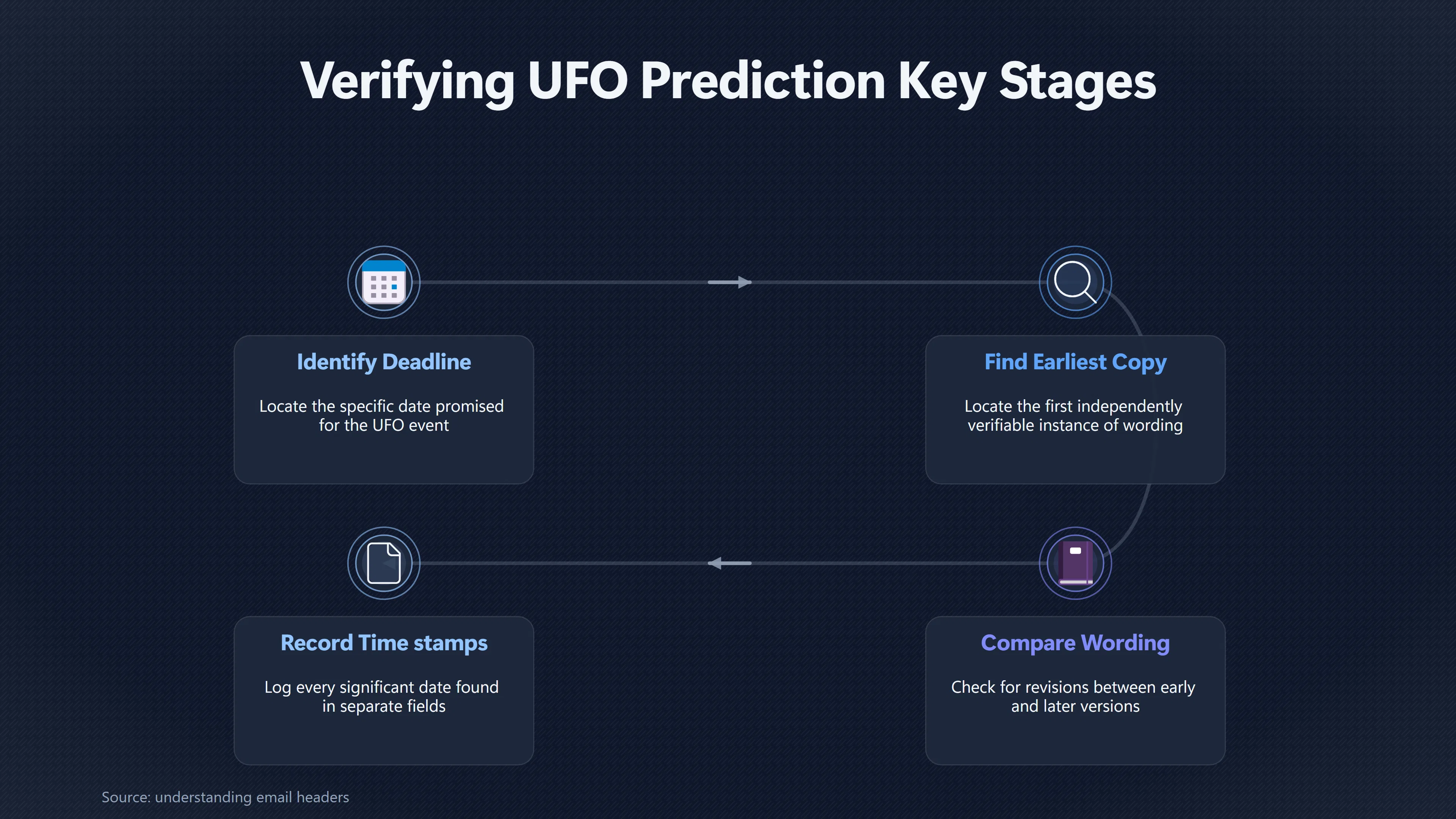
When dates disagree, reconstruct the chronology instead of choosing one source.
A practical order of evaluation is:
- Identify the prediction deadline.
- Locate the earliest independently verifiable copy.
- Compare that wording with later versions.
- Record every significant timestamp separately.
- Explain what each timestamp proves.
Consider a hypothetical example:
- Website displays: 5 March
- Wayback capture: 28 April
- Newspaper quotes prediction: 18 March
- Event deadline: 1 May
This does not mean the website date is false.
Instead, the evidence shows:
- the author claims publication on 5 March;
- independent press coverage confirms the prediction existed by 18 March;
- the archived webpage confirms it certainly existed by 28 April;
- all verified evidence predates the 1 May deadline.
That produces a coherent chronology without requiring every source to match exactly.
When Printed Sources Outweigh Digital Ones
Printed material often resolves online uncertainty.
A dated newspaper, magazine, conference programme or printed leaflet can demonstrate that a prediction circulated publicly before later website edits occurred.
Print evidence is particularly valuable when:
- the original website has disappeared;
- archived captures begin only after revisions;
- domain ownership has changed;
- online timestamps conflict.
Library copies, newspaper databases and scanned periodicals can therefore provide an independent anchor for dating UFO predictions.
Building a Reliable Chronology
The strongest documentation avoids collapsing multiple timestamps into a single “publication date”. Instead, every important record should explicitly distinguish:
- author’s stated publication date;
- earliest independently verified existence;
- prediction deadline;
- later revisions or explanations, each with their own dates.
This approach preserves historical accuracy without assuming that conflicting timestamps indicate deception. In many cases they simply reflect different stages of publication, preservation and circulation. Only by separating these functions can researchers fairly determine whether a UFO prediction genuinely existed before its promised event and whether later alterations changed the claim after the deadline had already passed.
Amazon book picks
Further Reading
Books and field guides related to Which Timestamp Should You Trust?. Use these as the next step if you want deeper reading beyond the article.
Calling Bullshit
Bullshit isn’t what it used to be. Now, two science professors give us the tools to dismantle misinformation and think clearly in a world...
The Demon-Haunted World
Rating: 4.5/5 from 43 Google Books ratings
NEW YORK TIMES BESTSELLER • From the renowned astronomer and author of Cosmos comes a “powerful [and] stirring defense of informed ration...
Bad Science
Ben Goldacre takes us on a journey through the bad science we are fed daily by hacks and quacks.
eBay marketplace picks
Marketplace Samples
Live-tested eBay searches with available results related to this page.
Selected fromUFO poster oneBay.co.uk.


Current eBay listing
I Want To Believe UFO Poster Giclée Fine Art Heavyweight Print


Current eBay listing
VINTAGE UFO FLYING SAUCERS COMIC ADVERTISING A2 POSTER PRINT
Endnotes
1.
Source: rfc-editor.org
Link:https://www.rfc-editor.org/info/rfc5322/
Source snippet
RFC EditorRFC 5322: Internet Message Format | RFC Editor...
2.
Source: mailneo.co
Title: understanding email headers
Link:https://www.mailneo.co/blog/understanding-email-headers
Source snippet
A Technical GuideJanuary 29, 2026 — COMMON HEADERS AND WHAT THEY MEAN Here's a quick reference for the headers you'll see in almost every...
Published: January 29, 2026
3.
Source: rfc-editor.org
Link:https://www.rfc-editor.org/info/rfc1849/
4.
Source: rfc-editor.org
Link:https://www.rfc-editor.org/info/rfc5064/
5.
Source: rfc-editor.org
Link:https://www.rfc-editor.org/rfc/inline-errata/rfc5322.html
6.
Source: archivesupport.zendesk.com
Link:https://archivesupport.zendesk.com/hc/en-us/articles/360004651732-Using-The-Wayback-Machine
Source snippet
Internet Archive Help CenterUsing The Wayback Machine – Internet Archive Help CenterJanuary 13, 2021...
Published: January 13, 2021
7.
Source: datatracker.ietf.org
Link:https://datatracker.ietf.org/doc/html/rfc5322
Source snippet
IETF DatatrackerRFC 5322 - Internet Message Format...
8.
Source: archivesupport.zendesk.com
Title: 360018359991 Search A Basic Guide
Link:https://archivesupport.zendesk.com/hc/en-us/articles/360018359991-Search-A-Basic-Guide
Source snippet
A Basic Guide – Internet Archive Help CenterAugust 30, 2021 — SEARCH - A BASIC GUIDE * August 30, 2021 16:42 * Updated There are several...
Published: August 30, 2021
9.
Source: archivesupport.zendesk.com
Title: 360004716091 Wayback Machine General Information
Link:https://archivesupport.zendesk.com/hc/en-us/articles/360004716091-Wayback-Machine-General-Information
10.
Source: rfcinfo.com
Title: rfc 5322
Link:https://rfcinfo.com/rfc-5322/
11.
Source: mailertogo.com
Link:https://www.mailertogo.com/rfc/5322
Additional References
12.
Source: waybackmachine.works
Link:https://waybackmachine.works/
Source snippet
Wayback Machine: View, Search, and Save Archived Web PagesJuly 1, 2026 — HOW THE WAYBACK MACHINE WORKS The Wayback Machine uses web crawl...
Published: July 1, 2026
13.
Source: smtpedia.com
Title: Each hop in the delivery chain adds one Recei
Link:https://smtpedia.com/received-headers-email-trace-chain/
Source snippet
Received Headers and the Email Trace Chain: A Practical Reading Guide (RFC 5322)July 12, 2026 — WHAT RECEIVED HEADERS ARE A Received head...
Published: July 12, 2026
14.
Source: youtube.com
Title: Leon Festinger and the Alien Apocalypse
Link:https://www.youtube.com/watch?v=fy06VDrnh7A
Source snippet
When Prophecy Fails Analysis This video provides specific historical context on how [Dorothy Martin]({{ 'dorothy-martin/' | relative_url }})'s UFO prediction records and archives...
15.
Source: waybackmachine.bar
Title: It lets you view, search
Link:https://waybackmachine.bar/
Source snippet
Wayback Machine: How to View, Search, and Save Archived Web PagesJuly 1, 2026 — WAYBACK MACHINE: HOW TO VIEW, SEARCH, AND SAVE ARCHIVED W...
Published: July 1, 2026
16.
Source: loc.gov
Link:https://www.loc.gov/programs/web-archiving/for-researchers/searching-the-web-archive/
17.
Source: epo.org
Link:https://www.epo.org/en/legal/guidelines-epc/2025/g_iv_7_5_4.html
18.
Source: os-intelligent.com
Link:https://os-intelligent.com/tools/wayback-machine/
19.
Source: github.com
Link:https://github.com/internetarchive/wayback/blob/master/wayback-cdx-server/README.md
20.
Source: youtube.com
Link:https://www.youtube.com/watch?v=6d6SJd5sxnM
Source snippet
10 Doomsday Cults That Got It Wrong | When Prophecy Fails...
21.
Source: youtube.com
Title: The UFO Cult That Inspired Cognitive [Dissonance]({{ ‘dissonance/’ | relative_url }}) | Dorothy Martin & The Seekers
Link:https://www.youtube.com/watch?v=vvFV1v8l-PI
Source snippet
When “When Prophecy Fails” Fails...